
As a researcher in the field of high-precision gear transmissions, I have long been engaged in developing advanced drive systems for high-end equipment and precision instruments. Open-loop, large-ratio, and high-accuracy gear pairs are crucial for indexing systems, but existing solutions like the involute enveloping toroidal (TI) worm drive face challenges such as partial loading and incomplete tooth flank engagement due to helix angle limitations. These issues compromise indexing accuracy and longevity. To address this, I propose a novel drive form: the elliptical toroidal worm (EI worm) meshing with an involute cylindrical gear. This design aims to achieve full-tooth-flank conjugation, enhancing meshing performance. In this article, I will present my theoretical framework, analysis of meshing parameters, and performance comparisons, emphasizing the role of the cylindrical gear throughout.
My work begins with establishing the spatial relationship between the elliptical toroidal surface and the cylindrical surface of the involute cylindrical gear. The generatrix of the elliptical toroid is derived from the intersection of an oblique plane with the gear’s pitch cylinder. Let the gear’s pitch radius be $$r$$, and the shaft angle between the worm and gear axes be $$\epsilon$$. The generatrix equation is:
$$ \frac{y^2}{r^2} + \frac{x^2}{(r \csc \epsilon)^2} = 1 $$
This elliptical profile, when projected onto the horizontal plane, coincides with the gear’s pitch cylinder, potentially extending the contact line length for smoother transmission. The tooth surface of the EI worm is generated by enveloping the involute cylindrical gear tooth surface. For the left flank of a standard involute cylindrical gear, the surface equation in coordinate system $$\sigma_1$$ is:
$$ \begin{aligned}
\mathbf{r}_{1L} &= x_{1L} \mathbf{i}_1 + y_{1L} \mathbf{j}_1 + z_{1L} \mathbf{k}_1 \\
x_{1L} &= r_b \cos \tau + r_b u \sin \tau \\
y_{1L} &= r_b \sin \tau – r_b u \cos \tau \\
z_{1L} &= \alpha_1 \rho \lambda + \alpha_2 h_L \\
\tau &= \sigma_0 – \alpha_1 \lambda – \alpha_2 u
\end{aligned} $$
Here, $$r_b$$ is the base radius, $$u$$ is the rolling angle, $$\sigma_0$$ is half the base circle angle corresponding to the gear tooth thickness, $$h_L$$ is the axial parameter, $$\rho$$ is the spiral parameter, $$\lambda$$ is the rotation angle from helical motion, and $$\alpha_1, \alpha_2$$ are parameters (0 or 1) defining spur ($$\alpha_1=0, \alpha_2=1$$) or helical ($$\alpha_1=1, \alpha_2=1$$) gears. The meshing condition requires the relative velocity $$\mathbf{v}_{12}$$ and the unit normal vector $$\mathbf{n}$$ at the contact point to be perpendicular:
$$ \Phi = \mathbf{v}_{12} \cdot \mathbf{n} = 0 $$
Through coordinate transformations and solving the meshing function, I derive the EI worm tooth surface equation. For the left flank, in coordinate system $$\sigma_2$$ attached to the worm:
$$ \begin{aligned}
\mathbf{r}_{2L} &= x_{2L} \mathbf{i}_1 + y_{2L} \mathbf{j}_1 + z_{2L} \mathbf{k}_1 \\
x_{2L} &= (x_{1L} \cos \phi_1 – y_{1L} \sin \phi_1 – a) \cos \phi_2 + (x_{1L} \sin \phi_1 + y_{1L} \cos \phi_1) \cos \epsilon \sin \phi_2 + z_{1L} \sin \epsilon \sin \phi_2 \\
y_{2L} &= -(x_{1L} \cos \phi_1 – y_{1L} \sin \phi_1 – a) \sin \phi_2 + (x_{1L} \sin \phi_1 + y_{1L} \cos \phi_1) \cos \epsilon \cos \phi_2 + z_{1L} \sin \epsilon \cos \phi_2 \\
z_{2L} &= -(x_{1L} \sin \phi_1 + y_{1L} \cos \phi_1) \sin \epsilon + z_{1L} \cos \epsilon
\end{aligned} $$
with the meshing function $$\Phi$$ providing a relation between $$\phi_1$$ and $$u$$. This formulation allows numerical modeling of the EI worm surfaces.
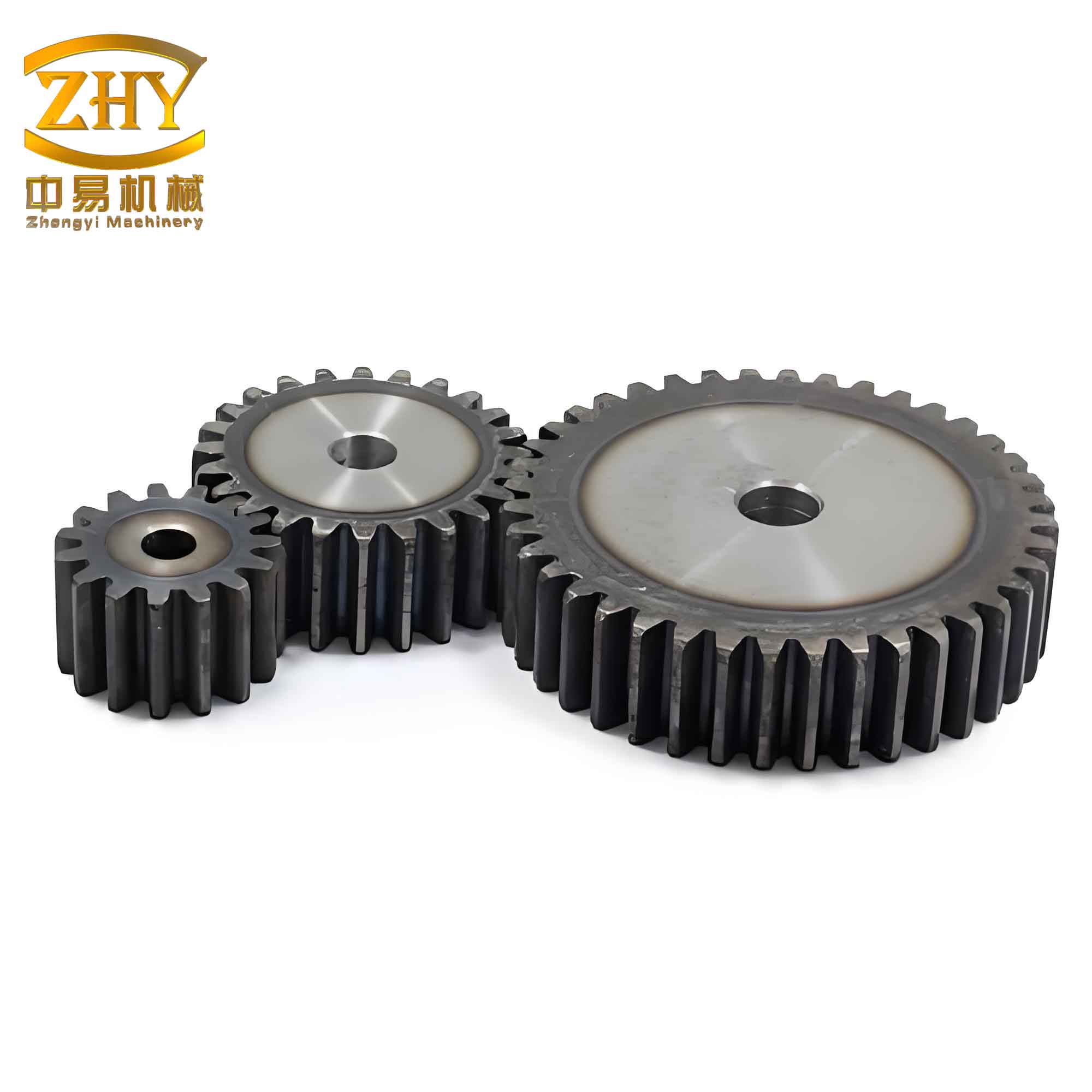
The cylindrical gear is central to this drive, and its involute profile ensures high manufacturability and precision. By adjusting parameters, I optimize the meshing behavior. The instantaneous contact lines on the cylindrical gear tooth flank are determined by solving $$\Phi=0$$ for various $$\phi_1$$. Their distribution reveals the engagement area. To avoid non-meshing zones, I analyze the limit line of meshing. For a spur cylindrical gear ($$\alpha_1=0, \alpha_2=1$$), the condition for no limit line (full flank engagement) is:
$$ \epsilon > \arccos \left( \frac{r_b}{i_{21} r_b – a} \right) $$
where $$i_{21}$$ is the gear ratio. Proper selection of $$\epsilon$$ ensures the entire cylindrical gear tooth flank participates in meshing.
I also investigate the root cut limit line on the EI worm tooth surface to prevent interference. The first-order limit function $$\psi(u, h, t)=0$$ is derived from:
$$ \psi = \mathbf{N} \cdot \mathbf{v}_{12} + \Phi_t = 0 $$
where $$\mathbf{N}$$ involves partial derivatives of $$\Phi$$. Avoiding this curve on the worm tooth ensures smooth conjugation.
To quantitatively assess performance, I define key meshing parameters: induced normal curvature, lubrication angle, and relative entrainment speed. For line contact surfaces, the induced normal curvature $$k_\sigma$$ indicates conformity and contact strength:
$$ k_\sigma = \frac{\psi^2}{\mathbf{N}^2} $$
A smaller absolute value denotes better conformity. The lubrication angle $$\theta_v$$, between the contact line direction and relative velocity, affects oil film formation:
$$ \theta_v = \arcsin \left( \frac{|\mathbf{N} \cdot \mathbf{v}_{12}|}{|\mathbf{N}| |\mathbf{v}_{12}|} \right) $$
Values near 90° promote lubrication. The relative entrainment speed $$v_{jx}$$ influences hydrodynamic film thickness:
$$ v_{jx} = \frac{(\mathbf{w}_1 \times \mathbf{r}_1 + \mathbf{w}_2 \times \mathbf{r}_2) \cdot \mathbf{N}}{2 |\mathbf{N}|} $$
Higher speeds enhance lubrication.
I now analyze how design parameters impact the meshing of the cylindrical gear with the EI worm. Using a base case: module $$m=2 \text{ mm}$$, gear teeth $$Z_2=120$$, worm threads $$Z_1=1$$, pressure angle $$\alpha=20^\circ$$, center distance $$a=135 \text{ mm}$$, and meshing teeth number 12. The effects are summarized in tables and formulas below.
| Parameter Range | Contact Line Distribution | Induced Normal Curvature $$|k_\sigma|$$ | Lubrication Angle $$\theta_v$$ | Relative Entrainment Speed $$v_{jx}$$ |
|---|---|---|---|---|
| $$\epsilon < 95^\circ$$ | Limited, possible crossing | Increases with $$\epsilon$$ | Decreases with $$\epsilon$$ | Decreases with $$\epsilon$$ |
| $$\epsilon \approx 95^\circ$$ | Full flank, uniform | High | Moderate | Moderate |
| $$\epsilon > 95^\circ$$ | Full flank but ratio declines | Higher | Lower | Lower |
The shaft angle critically controls the engagement of the cylindrical gear. For full flank meshing, $$\epsilon$$ must exceed a threshold, eliminating limit lines.
| Module $$m$$ (mm) | Cylindrical Gear Tooth Width | Contact Line Distribution | $$|k_\sigma|$$ Trend | $$\theta_v$$ Trend | $$v_{jx}$$ Trend |
|---|---|---|---|---|---|
| 1-2 | Increases | Becomes uniform | Decreases rapidly | Increases | Increases |
| >2 | Larger | Full flank | Decreases slowly | Increases | Increases |
Smaller modules allow more teeth for error averaging, but must ensure tooth strength. The cylindrical gear’s design balances these factors.
| Gear Ratio $$i$$ | Cylindrical Gear Size | Contact Line Distribution | $$|k_\sigma|$$ Trend | $$\theta_v$$ Trend | $$v_{jx}$$ Trend |
|---|---|---|---|---|---|
| Increasing | Increases | Full flank achievable | Decreases | Decreases | Increases |
Higher ratios expand the cylindrical gear, but the meshing area ratio may drop after a point.
To compare with the TI worm drive, I consider identical parameters, with the TI worm having an optimal helix angle. The cylindrical gear meshing area in the EI worm drive is significantly larger. Quantitative comparisons are:
| Performance Metric | EI Worm Drive | TI Worm Drive | Advantage |
|---|---|---|---|
| Meshing Area Ratio on Cylindrical Gear | Full flank (≈91.7% of tooth width) | Partial (≈16.7% of tooth width) | EI is 5.49× larger |
| Induced Normal Curvature $$|k_\sigma|$$ | ≈0.3 to 0.4 (varies with point) | ≈0.4 | Similar, EI slightly lower |
| Lubrication Angle $$\theta_v$$ | ≈70° to 75° | ≈65.8° | EI higher |
| Relative Entrainment Speed $$v_{jx}$$ | ≈200 to 300 mm/s | ≈150 mm/s | EI higher |
The formulas for parameter trends in the EI worm drive are summarized as follows. For a given meshing point on the cylindrical gear, the induced normal curvature decreases with increasing module and gear ratio, but increases with shaft angle:
$$ |k_\sigma| \propto \frac{1}{m^a}, \quad |k_\sigma| \propto \frac{1}{i^b}, \quad |k_\sigma| \propto \epsilon^c $$
where $$a, b, c$$ are positive exponents. The lubrication angle increases with module but decreases with shaft angle and gear ratio:
$$ \theta_v \propto m^d, \quad \theta_v \propto \frac{1}{\epsilon^e}, \quad \theta_v \propto \frac{1}{i^f} $$
The relative entrainment speed increases with module and gear ratio, but decreases with shaft angle:
$$ v_{jx} \propto m^g, \quad v_{jx} \propto i^h, \quad v_{jx} \propto \frac{1}{\epsilon^j} $$
These proportionalities guide optimization. For instance, to maximize the cylindrical gear’s engagement and lubrication, I select a shaft angle around 95°, a module of 2 mm, and a gear ratio of 120.
In conclusion, my proposed EI worm drive with an involute cylindrical gear achieves full-tooth-flank conjugation, addressing the limitations of TI worm drives. The elliptical toroidal surface extends contact lines, ensuring uniform load distribution and wear across the cylindrical gear tooth flank. Through theoretical derivation and parameter analysis, I demonstrate that the EI worm drive offers superior meshing area, comparable contact strength, and better lubrication potential. This work provides a foundation for designing high-performance worm gear drives, emphasizing the synergy between the elliptical worm and the cylindrical gear. Future work will involve experimental validation and application in precision indexing systems.
To further illustrate, the cylindrical gear’s involute profile is key to this design. Its mathematical representation allows precise generation of the worm surface. The engagement condition ensures that every point on the cylindrical gear tooth can potentially contact the worm, minimizing localized wear. This is crucial for maintaining accuracy over time. The tables and formulas presented here offer a concise summary for engineers to tailor designs based on specific requirements, always keeping the cylindrical gear at the core of the system.