
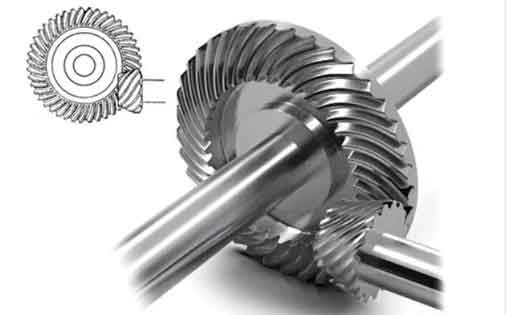
In modern industrial applications, spiral bevel gears are critical components due to their smooth transmission, high load capacity, and low noise characteristics. They are widely used in aerospace, marine, automotive, and machine tool industries. However, the manufacturing of spiral bevel gears poses significant challenges, particularly in terms of efficiency and precision. Traditional methods, such as the five-cut process, require multiple machine setups, leading to increased equipment demand, floor space, and labor intensity. To address these issues, I propose a novel machining method using a double-spindle cutter head machine. This approach aims to enhance the machining efficiency of spiral bevel gears by reducing installation times and enabling single-setup processing for both tooth flanks. In this article, I will delve into the development of the double-spindle machine model, analysis of NC machining motions, solution of machine motion coordinates, tooth flank error modification, and experimental validation. Throughout this discussion, the focus will remain on optimizing the production of spiral bevel gears, with repeated emphasis on key aspects to highlight their importance in advanced manufacturing.
The double-spindle cutter head machine represents a significant advancement in gear machining technology. It integrates two cutter heads on a single machine, allowing for simultaneous or sequential processing of both convex and concave flanks of spiral bevel gears. This design not only streamlines the workflow but also improves economic benefits in mass production. The machine structure consists of four main components: the cutter box, workpiece box, machine column, and machine base. Each cutter head is mounted on a separate spindle within a drum, which is fixed during operation but adjustable for positioning. The cutter box moves horizontally along the X-axis, the workpiece box moves vertically along the Y-axis, and the machine column rotates to set the workpiece installation angle. Additionally, a Z-axis slide controls the cutting depth. This configuration enables precise control over the relative motion between the tool and workpiece, essential for achieving high-quality gear teeth. The machining process involves positioning the cutter heads, performing generating motions through coordinated movements of the X, Y, and C-axes, and executing indexing for multiple teeth. However, it is important to note that this machine model is currently suited for processing pinions with root angles greater than 25° to avoid potential collisions between the cutter head and workpiece fixture.
To mathematically model the double-spindle machine, I establish a coordinate system that captures the spatial relationships during machining. Let \( S_m (X_m, Y_m, Z_m) \) be the fixed machine coordinate system, located on the plane of the cutter tip. For each cutter head, I define a cutter coordinate system \( S_{ci} (X_{ci}, Y_{ci}, Z_{ci}) \), where \( i = 1, 2 \) corresponds to the left and right cutter heads, respectively, with a cutter rotation angle \( \theta \). The workpiece coordinate system \( S_w (X_w, Y_w, Z_w) \) is attached to the gear blank and rotates clockwise around the C-axis during generation, with an angle \( \phi_w \). Auxiliary coordinate systems \( S_{b1}, S_{b2}, S_a, \) and \( S_n \) facilitate transformations. The workpiece installation angle is denoted as \( \delta_M \), and the positions of the cutter centers in the machine coordinates are represented by \( X_i \) (with sign conventions: negative for \( i=1 \), positive for \( i=2 \)), \( Y \), and \( Z \). The machine column rotation center is point C, and the design crossing point is \( O_1 \), with a distance \( L \) from C to \( O_1 \) and a horizontal correction \( \Delta x \). The tooth flank equation is derived as:
$$
\mathbf{r}_w = \mathbf{M}_{wa} \mathbf{M}_{an} \mathbf{M}_{nm} \mathbf{M}_{mb} \mathbf{M}_{bc} \mathbf{r}_{ci}
$$
Here, the transformation matrices are defined as follows. For the workpiece motion:
$$
\mathbf{M}_{wa} = \begin{bmatrix} 1 & 0 & 0 & 0 \\ 0 & \cos \phi_w & \sin \phi_w & 0 \\ 0 & -\sin \phi_w & \cos \phi_w & 0 \\ 0 & 0 & 0 & 1 \end{bmatrix}
$$
For the installation adjustment:
$$
\mathbf{M}_{an} = \begin{bmatrix} \cos \delta_M & 0 & \sin \delta_M & -\Delta x \\ 0 & 1 & 0 & 0 \\ -\sin \delta_M & 0 & \cos \delta_M & 0 \\ 0 & 0 & 0 & 1 \end{bmatrix}
$$
For the Z-axis movement:
$$
\mathbf{M}_{nm} = \begin{bmatrix} 1 & 0 & 0 & 0 \\ 0 & 1 & 0 & 0 \\ 0 & 0 & 1 & -Z \\ 0 & 0 & 0 & 1 \end{bmatrix}
$$
For the X and Y movements:
$$
\mathbf{M}_{mb} = \begin{bmatrix} 1 & 0 & 0 & \pm X_i \\ 0 & 1 & 0 & Y \\ 0 & 0 & 1 & 0 \\ 0 & 0 & 0 & 1 \end{bmatrix}
$$
For the cutter rotation:
$$
\mathbf{M}_{bc} = \begin{bmatrix} \cos \theta & -\sin \theta & 0 & 0 \\ \sin \theta & \cos \theta & 0 & 0 \\ 0 & 0 & 1 & 0 \\ 0 & 0 & 0 & 1 \end{bmatrix}
$$
This comprehensive model allows for precise simulation and control of the machining process for spiral bevel gears.
In parallel, I consider the basic generating machining model, which traditionally involves a cradle-type machine. In this model, a coordinate system \( S_p (X_p, Y_p, Z_p) \) is fixed to the cradle, rotating with an angle \( \phi_g \). The radial distance is \( S_r \), the angular position is \( q \), the vertical offset is \( E_m \), and the bed correction is \( \Delta b \). The total transformation matrix for this model is:
$$
\mathbf{M}_{cw}^{(G)} = \mathbf{M}_{wa} \mathbf{M}_{an} \mathbf{M}_{nm} \mathbf{M}_{mp} \mathbf{M}_{pb} \mathbf{M}_{bc}
$$
where additional matrices account for cradle rotation and tool positioning. Specifically:
$$
\mathbf{M}_{mp} = \begin{bmatrix} 1 & 0 & 0 & 0 \\ 0 & 1 & 0 & E_m \\ 0 & 0 & 1 & -\Delta b \\ 0 & 0 & 0 & 1 \end{bmatrix}, \quad \mathbf{M}_{pb} = \begin{bmatrix} \cos \phi_g & -\sin \phi_g & 0 & 0 \\ \sin \phi_g & \cos \phi_g & 0 & 0 \\ 0 & 0 & 1 & 0 \\ 0 & 0 & 0 & 1 \end{bmatrix} \begin{bmatrix} 1 & 0 & 0 & S_r \cos q \\ 0 & 1 & 0 & S_r \sin q \\ 0 & 0 & 1 & 0 \\ 0 & 0 & 0 & 1 \end{bmatrix}
$$
To ensure equivalence between the double-spindle machine and the basic generating model, I set \( \mathbf{M}_{cw}^{(C)} = \mathbf{M}_{cw}^{(G)} \), leading to the derivation of motion coordinates for the NC axes. By solving this equation, I obtain the following expressions for the machine axes:
$$
X_i = \pm (\Delta x \cos \delta_M + A_1 \cos \delta_M – A_3 \sin \delta_M)
$$
$$
Y = A_2
$$
$$
Z = -\Delta x \sin \delta_M – A_1 \sin \delta_M – A_3 \cos \delta_M
$$
$$
C = R_a \phi_g
$$
where \( R_a \) is the generating ratio, and the coefficients \( A_1, A_2, A_3 \) are given by:
$$
A_1 = 0.5 S_r \cos(q – \delta_M + \phi_g) + 0.5 S_r \cos(q + \delta_M + \phi_g) – \Delta b \sin \delta_M – \Delta x
$$
$$
A_2 = E_m + S_r \sin(q + \phi_g)
$$
$$
A_3 = -0.5 S_r \sin(q + \delta_M + \phi_g) + 0.5 S_r \sin(q – \delta_M + \phi_g) – \Delta b \cos \delta_M
$$
These coordinates are then transformed into absolute positions in the machine coordinate system. Let \( (X_c, Y_c) \) be the absolute coordinates of the cutter center, with reference point \( O_0 \) at \( (X_0, Y_0) \). The transformations are:
$$
X_c = X_0 – [(L + \Delta x) \cos \delta_M – X_i]
$$
$$
Y_c = Y_0 – Y
$$
In practice, these equations are implemented in NC systems, such as Siemens 828D, using G-code instructions to control the machine axes. For machining spiral bevel gears, separate sets of cutting data are used for the convex and concave flanks, corresponding to the left and right cutter heads, respectively. This ensures accurate tooth geometry and enhances the efficiency of producing spiral bevel gears.
To achieve high precision in spiral bevel gears, tooth flank error modification is essential. Due to errors from tools, fixtures, and machine inaccuracies, manufactured tooth surfaces may deviate from theoretical designs, affecting meshing performance. Traditional methods rely on manual contact pattern adjustment, which is time-consuming and subjective. Instead, I employ a digital detection and modification approach. This involves measuring the gear on a gear measuring center, such as the JD45, to obtain surface errors, and then iteratively adjusting machining parameters to compensate. The modification model is based on minimizing the deviation between the theoretical and actual tooth surfaces. Let \( \mathbf{r}^{(T)}(u_i, \theta_i) \) represent the measured tooth surface as discrete points, and \( \mathbf{r}(u_{ti}, \theta_{ti}; \Delta \phi^{(k)}) \) be the theoretical surface equation with parameters \( u_{ti}, \theta_{ti} \) and machining parameter corrections \( \Delta \phi^{(k)} \), where \( k \) is the number of corrected parameters. The objective function is:
$$
f(u_{ti}, \theta_{ti}; \Delta \phi^{(k)}) = \min \sum_{i=1}^{m \times n} \delta(u_{ti}, \theta_{ti}; \Delta \phi^{(k)})^2 = \min \sum_{i=1}^{m \times n} \left( \mathbf{r}^{(T)}(u_i, \theta_i) – \mathbf{r}(u_{ti}, \theta_{ti}; \Delta \phi^{(k)}) \right) \cdot \mathbf{n}(u_{ti}, \theta_{ti}; \Delta \phi^{(k)})^2
$$
Here, \( m \times n \) denotes the grid of measurement points on the tooth surface, and \( \mathbf{n} \) is the unit normal vector. The Powell optimization algorithm is used to solve for \( \Delta \phi^{(k)} \), enabling automatic correction. For the double-spindle machine, this process is applied separately to the convex and concave flanks, with corrected parameters stored in two sets of R-parameters in the NC system. This facilitates easy re-machining to achieve theoretical accuracy, ensuring optimal performance of spiral bevel gears.
I conducted experimental validation on a pair of spiral bevel gears, specifically a 17/28 gear set from a Steyr transmission. The gear blank parameters are summarized in Table 1, and the machining parameters for the pinion are listed in Table 2. The experiments were performed on a self-developed double-spindle NC gear milling machine. After machining, the tooth flanks were measured on a JD45 gear measuring center to evaluate errors. Initial measurements revealed diagonal errors, with maximum deviations of -125 μm on the concave flank and 184.5 μm on the convex flank. These errors were corrected using the modification process, resulting in adjusted machining parameters as shown in Table 3. After re-machining, the errors were reduced to within -20 μm to 12 μm, demonstrating the effectiveness of the double-spindle machining method for spiral bevel gears.
| Parameter | Gear (28 teeth) | Pinion (17 teeth) |
|---|---|---|
| Number of Teeth | 28 | 17 |
| Module (mm) | 10.3572 | 10.3572 |
| Hand of Spiral | Right | Left |
| Mean Pressure Angle (°) | 22.5 | |
| Midpoint Spiral Angle (°) | 35 | |
| Face Width (mm) | 50 | |
| Outer Pitch Diameter (mm) | 290 | 176.07 |
| Whole Depth (mm) | 19.55 | |
| Mounting Distance (mm) | 113 | 162 |
| Pitch Cone Angle (°) | 58.7363 | 31.2637 |
| Face Cone Angle (°) | 61.5047 | 35.7463 |
| Root Cone Angle (°) | 54.2537 | 28.4953 |
| Parameter | Concave Flank | Convex Flank |
|---|---|---|
| Cutter Radius (mm) | 145.53 | 158.7 |
| Cutter Blade Angle (°) | -20.5 | 24.5 |
| Workpiece Installation Angle (°) | 27.6374 | |
| Radial Distance (mm) | 132.8 | 141.2788 |
| Angular Position (°) | -66.7854 | -63.3574 |
| Horizontal Offset (mm) | -4.853 | 5.0204 |
| Vertical Offset (mm) | 1.94 | -2.197 |
| Bed Correction (mm) | 2.251 | -2.329 |
| Generating Ratio | 1.88132 | 1.96623 |
| Pinion Flank | Radial Distance (mm) | Angular Position (°) | Vertical Offset (mm) | Bed Correction (mm) | Horizontal Offset (mm) | Generating Ratio |
|---|---|---|---|---|---|---|
| Concave | 1.03514 | -0.1174 | 0.9664 | -0.7025 | 1.4714 | 0.0161 |
| Convex | -0.4071 | 0.6374 | 0.9291 | 0.3808 | -0.7177 | -0.0138 |
The success of these experiments underscores the viability of the double-spindle machine for producing high-quality spiral bevel gears. The machine’s ability to process both flanks in a single setup reduces cycle times and minimizes human error. Moreover, the integration of digital modification ensures that tooth surfaces meet stringent tolerances, enhancing the meshing performance and longevity of spiral bevel gears in demanding applications. Future work will focus on extending this technology to gears with smaller root angles by modifying the machine structure, such as elongating the left cutter head spindle and increasing the height difference between the two spindles to prevent interference.
In conclusion, the double-spindle cutter head machine offers a transformative approach to manufacturing spiral bevel gears. By combining advanced kinematic modeling, precise NC control, and automated error correction, it addresses key inefficiencies in traditional methods. The experimental results validate its effectiveness, with tooth flank errors significantly reduced after modification. As industries continue to demand higher performance and efficiency, this technology will play a crucial role in advancing gear manufacturing. Further refinements in machine design and algorithm optimization will expand its applicability, making it a cornerstone for the production of spiral bevel gears in various sectors. Ultimately, this research contributes to the ongoing evolution of precision engineering, ensuring that spiral bevel gears remain reliable components in modern machinery.