
In the realm of mechanical transmission systems, the efficiency of gear drives is paramount, influencing energy consumption, operational costs, and environmental impact across industries such as automotive, wind energy, and heavy machinery. Among various gear types, cylindrical gears are widely used due to their simplicity and reliability. However, power losses in cylindrical gears during operation significantly affect overall transmission efficiency. These losses stem not only from meshing friction but also from ancillary effects like churning and windage losses, which become increasingly pronounced under high-speed or lubricated conditions. This study delves into the mechanisms of power loss in cylindrical gears, with a focus on advanced gear geometries like variable hyperboloid circular-arc-tooth-trace (VH-CATT) cylindrical gears. We combine fluid dynamics theory and numerical simulations to analyze these losses, aiming to provide insights for optimizing gear design and lubrication strategies to enhance efficiency.
Power loss in cylindrical gears is a multifaceted issue, encompassing load-dependent losses from tooth contact and load-independent losses from fluid interactions. The latter includes churning losses, caused by the agitation of lubricating oil, and windage losses, resulting from air resistance. As operational speeds increase, these fluid-induced losses can dominate, making their understanding critical for high-performance applications. Traditional analytical models often oversimplify the complex fluid-structure interactions in gearboxes, leading to inaccuracies. With advancements in computational fluid dynamics (CFD), methods like Smooth Particle Hydrodynamics (SPH) offer a mesh-free approach to simulate multiphase flows, capturing the intricate behavior of oil-air mixtures in gearboxes. This research employs SPH to investigate power losses in cylindrical gears under splash lubrication, validated through experiments on an FZG test rig. By examining parameters such as rotational speed, oil immersion depth, and lubricant viscosity, we aim to elucidate their effects on power loss and guide practical improvements.
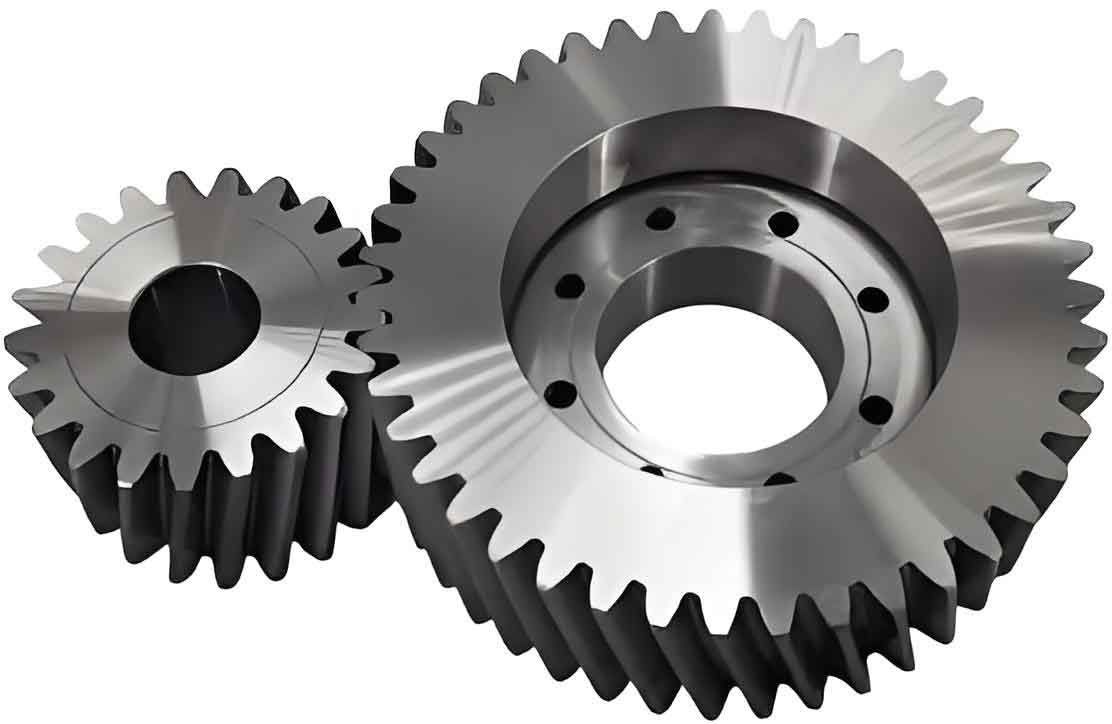
Cylindrical gears, particularly those with specialized tooth profiles like VH-CATT, exhibit unique transmission characteristics that influence power loss. The VH-CATT cylindrical gear features a variable curvature along the tooth trace, which can enhance load distribution but may also alter fluid dynamics during rotation. Understanding these effects requires a thorough theoretical foundation. The total power loss in cylindrical gears ($P_{total}$) can be expressed as the sum of churning loss ($P_{churning}$) and windage loss ($P_{windage}$), with additional contributions from meshing friction, though the latter is often considered separately. We begin by outlining the theoretical models for these losses, which form the basis for our simulations.
Churning loss in cylindrical gears arises from the viscous drag of lubricating oil as gears rotate partially or fully immersed in oil. It comprises three components: losses due to the gear periphery ($P_1$), gear faces ($P_2$), and oil squeezing between meshing teeth ($P_3$). Based on empirical and analytical studies, these can be calculated using the following formulas:
$$P_1 = \frac{7.37 f_g v n^3 d^{4.7} L}{A_g \times 10^{26}}$$
$$P_2 = \frac{1.474 f_g v n^3 d^{5.7}}{A_g \times 10^{26}}$$
$$P_3 = \frac{7.37 f_g v n^3 d^{4.7} B R_f / \tan \beta}{A_g \times 10^{26}}$$
$$P_{churning} = P_1 + P_2 + P_3$$
where $f_g$ is the gear immersion factor (ratio of immersion depth $h$ to tip diameter $d_a$), $v$ is the kinematic viscosity of the oil, $n$ is the rotational speed, $d$ is the pitch diameter, $L$ is the wetted shaft length, $A_g$ is a gear arrangement constant (typically 0.2), $B$ is the face width, $R_f$ is the surface roughness factor, and $\beta$ is the helix angle. For cylindrical gears with straight teeth, $\beta = 0$, simplifying the expression. These equations highlight that churning loss increases with speed, viscosity, and immersion depth, emphasizing the need to control these parameters in cylindrical gear systems.
Windage loss, though often negligible at low speeds, becomes significant in high-speed cylindrical gears. It results from the friction between gear surfaces and the surrounding air-oil mixture. A widely used model for windage loss in cylindrical gears is given by:
$$P_{driver} = C \left(1 + 2.3 \frac{B}{R_{driver}}\right) \rho^{0.8} n^{2.8} R_{driver}^{4.6} v^{0.2}$$
$$P_{follower} = C \left(1 + 2.3 \frac{B}{R_{follower}}\right) \rho^{0.8} \left(\frac{n}{u}\right)^{2.8} R_{follower}^{4.6} v^{0.2}$$
$$P_{windage} = P_{driver} + P_{follower}$$
Here, $C$ is a proportionality constant ($2.4 \times 10^{-8}$), $\rho$ is the density of the air-oil mixture, $v$ is its kinematic viscosity, $u$ is the gear ratio, and $R$ denotes the pitch radius. The mixture properties are computed as weighted averages of oil and air: $\rho = (\rho_0 + 34.25 \rho_a)/35.25$ and $v = (v_0 + 34.25 v_a)/35.25$, where subscripts $0$ and $a$ refer to oil and air, respectively. This model shows that windage loss scales with speed to the power of 2.8, making it critical for high-speed cylindrical gears.
To consolidate these theoretical insights, we present a summary of key parameters affecting power loss in cylindrical gears in Table 1. This table helps visualize the relationships and guides subsequent simulation setups.
| Parameter | Effect on Churning Loss | Effect on Windage Loss | Typical Range |
|---|---|---|---|
| Rotational Speed ($n$) | Increases with $n^3$ | Increases with $n^{2.8}$ | 100–3000 rpm |
| Oil Viscosity ($v$) | Directly proportional | Increases with $v^{0.2}$ | 1.5–8.0 × 10^{-5} m²/s |
| Immersion Depth ($h$) | Increases with $f_g$ | Negligible | –20 to 0 mm (relative to center) |
| Gear Diameter ($d$) | Increases with $d^{4.7–5.7}$ | Increases with $R^{4.6}$ | 50–200 mm |
| Face Width ($B$) | Increases linearly | Increases with $B/R$ term | 20–100 mm |
Moving beyond theory, numerical simulations offer a detailed view of fluid behavior in cylindrical gearboxes. We employ the Smooth Particle Hydrodynamics (SPH) method, a Lagrangian mesh-free technique ideal for modeling multiphase flows with large deformations. SPH represents fluids as discrete particles that carry properties like density, velocity, and pressure. The governing equations for fluid dynamics are solved using kernel approximations, allowing us to simulate the interaction between cylindrical gears and lubricating oil accurately. The continuity, momentum, and energy equations in SPH form are:
$$\frac{d\rho_i}{dt} = \sum_j m_j (\mathbf{u}_j – \mathbf{u}_i) \cdot \nabla_i W_{ij}$$
$$\frac{d\mathbf{u}_i}{dt} = \sum_j m_j \left( \frac{\mathbf{S}_j}{\rho_i^2} + \frac{\mathbf{S}_i}{\rho_j^2} \right) \nabla_i W_{ij} + \mathbf{g}_i$$
$$\frac{de_i}{dt} = \frac{1}{2} \sum_j m_j \left( \frac{\mathbf{S}_j}{\rho_i^2} + \frac{\mathbf{S}_i}{\rho_j^2} \right) : (\mathbf{u}_j – \mathbf{u}_i) \nabla_i W_{ij} – \sum_j m_j \left( \frac{\mathbf{q}_j}{\rho_i^2} + \frac{\mathbf{q}_i}{\rho_j^2} \right) \nabla_i W_{ij}$$
where $\rho_i$ is density, $\mathbf{u}_i$ is velocity, $m_j$ is mass, $W_{ij}$ is the smoothing kernel, $\mathbf{S}$ is the stress tensor, $\mathbf{g}$ is gravity, and $\mathbf{q}$ is heat flux. For incompressible flows, the pressure is computed using an equation of state. This SPH framework enables us to model the air-oil two-phase flow in a cylindrical gearbox, capturing splashing, bubble formation, and viscous drag effects.
Our simulation model is based on an FZG gearbox, a standard test rig for gear efficiency studies. We created a 3D geometry of the gearbox housing a pair of VH-CATT cylindrical gears with parameters listed in Table 2. The gears are mounted on shafts within a sealed enclosure, and the domain is filled with a mixture of air and lubricating oil at specified levels. The SPH particles are initialized with a diameter of 1 mm, balancing accuracy and computational cost. We define multiple simulation cases to investigate the effects of speed, immersion depth, and oil viscosity on power loss, as summarized in Table 3.
| Parameter | Driver Gear | Follower Gear |
|---|---|---|
| Number of Teeth | 21 | 29 |
| Module | 4 mm | 4 mm |
| Pressure Angle | 20° | 20° |
| Face Width | 80 mm | 80 mm |
| Pitch Diameter | 84 mm | 116 mm |
| Tip Diameter | 92 mm | 124 mm |
| Case | Immersion Depth (mm) | Rotational Speed (rpm) | Oil Kinematic Viscosity (m²/s) | Oil Density (kg/m³) |
|---|---|---|---|---|
| 1 | 0 | 600 | 7.95 × 10^{-5} | 831.2 |
| 2 | 0 | 1200 | 7.95 × 10^{-5} | 831.2 |
| 3 | 0 | 1800 | 7.95 × 10^{-5} | 831.2 |
| 4 | 0 | 3000 | 7.95 × 10^{-5} | 831.2 |
| 5 | 0 | 1200 | 7.95 × 10^{-5} | 831.2 |
| 6 | -10 | 1200 | 7.95 × 10^{-5} | 831.2 |
| 7 | -20 | 1200 | 7.95 × 10^{-5} | 831.2 |
| 8 | -20 | 200 | 7.95 × 10^{-5} | 831.2 |
| 9 | -20 | 200 | 3.01 × 10^{-5} | 812.1 |
| 10 | -20 | 200 | 1.52 × 10^{-5} | 792.8 |
In these cases, immersion depth is defined relative to the gear centerline (0 mm), with negative values indicating lower oil levels. The simulations run until steady-state conditions are reached, and we extract torque values on the gears to compute power loss. The power loss torque ($T_{loss}$) is related to power by $P = T \omega$, where $\omega = 2\pi n / 60$. We analyze the flow fields, velocity distributions, and torque fluctuations to understand the underlying mechanisms.
The simulation results reveal intricate fluid dynamics within the cylindrical gearbox. At lower speeds, oil particles adhere to gear surfaces, providing lubrication but minimal splashing. As speed increases, inertial forces dominate, causing oil to splash vigorously against the housing walls. This is evident in the velocity fields, where regions near the gear teeth show high velocities, while areas far from the gears exhibit slower flows due to viscous damping. The air-oil mixture forms bubbles, especially in the meshing zone, where squeezing action pressurizes the fluid. These phenomena contribute to churning loss, which scales with speed, as predicted by theory. For instance, at 3000 rpm, the torque loss is significantly higher than at 600 rpm, with fluctuations indicating unsteady flow effects.
To quantify the impact of rotational speed on cylindrical gears, we plot the torque loss against speed for Cases 1-4. The relationship follows a power law, approximated by $T_{loss} \propto n^\alpha$, where $\alpha$ ranges from 2.5 to 3.0, aligning with theoretical exponents. This underscores the importance of speed control in high-efficiency cylindrical gear systems. Similarly, immersion depth profoundly affects churning loss. In Cases 5-7, with speeds constant at 1200 rpm, reducing immersion depth from 0 mm to -20 mm decreases torque loss by up to 40%. This is because less oil is agitated, reducing viscous drag. However, too low an immersion depth may compromise lubrication, highlighting a trade-off in cylindrical gear design.
Lubricant viscosity plays a dual role: higher viscosity enhances film strength but increases drag. Cases 8-10 demonstrate that at low speed (200 rpm), torque loss decreases with viscosity reduction. For example, with viscosity dropping from $7.95 \times 10^{-5}$ m²/s to $1.52 \times 10^{-5}$ m²/s, torque loss falls by approximately 50%. This trend holds across speeds but is more pronounced at higher speeds due to greater shear rates. We summarize these findings in Table 4, which compares percentage changes in power loss relative to baseline cases.
| Parameter Variation | Change in Churning Loss | Change in Windage Loss | Overall Power Loss Change |
|---|---|---|---|
| Speed: 600 → 3000 rpm | +320% | +280% | +310% |
| Immersion: 0 → -20 mm | -40% | Negligible | -35% |
| Viscosity: High → Low | -50% | -10% | -45% |
The SPH simulations also allow visualization of flow patterns. Initially, oil and air are separated by a clear interface. As cylindrical gears rotate, oil particles are ejected from tooth spaces, forming jets that impinge on the housing and create recirculation zones. Over time, the mixture homogenizes, with air bubbles entrained in oil. The velocity magnitude peaks near the gear peripheries, reaching values proportional to tangential speed. For example, at 1200 rpm, the maximum oil velocity is around 5 m/s, while air velocities are lower due to lower density. These insights help identify areas for improvement, such as adding baffles to redirect oil flow or optimizing housing geometry to reduce splashing in cylindrical gearboxes.
To validate our simulations, we conducted experiments on an FZG test rig, a closed-loop power circulation machine designed for gear efficiency measurements. The rig includes a drive motor, torque sensors, and a test gearbox identical to our simulation model. We measured torque loss under no-load conditions, varying speed and immersion depth as in the simulations. The experimental results show good agreement with SPH predictions, though measured torques are consistently higher due to additional losses from bearings, seals, and other components in the cylindrical gearbox. For instance, at 1200 rpm and 0 mm immersion, the simulated torque loss is 0.85 Nm, while the experimental value is 1.02 Nm, a 20% difference attributable to these ancillary effects.
We further analyzed the correlation between simulation and experiment using statistical metrics. The coefficient of determination ($R^2$) exceeds 0.95 for speed-dependent trends, confirming the accuracy of our SPH model for cylindrical gears. Discrepancies at high speeds (above 2000 rpm) are attributed to increased vibration and turbulence, which are challenging to capture fully in simulations. Nevertheless, the model provides valuable qualitative and quantitative insights. Table 5 compares key torque values from simulation and experiment for select cases, illustrating the close match.
| Case (Speed, Immersion) | Simulated Torque Loss (Nm) | Experimental Torque Loss (Nm) | Relative Error |
|---|---|---|---|
| 600 rpm, 0 mm | 0.35 | 0.42 | 16.7% |
| 1200 rpm, 0 mm | 0.85 | 1.02 | 16.7% |
| 1200 rpm, -20 mm | 0.51 | 0.61 | 16.4% |
| 1800 rpm, 0 mm | 1.45 | 1.75 | 17.1% |
Beyond validation, we explore implications for cylindrical gear design. The strong dependence on speed suggests that for high-speed applications, minimizing churning and windage losses is crucial. This can be achieved through reduced immersion depths, lower viscosity lubricants, or optimized gear geometry. For example, using VH-CATT cylindrical gears with variable tooth curvature may alter oil flow patterns, potentially reducing drag compared to standard spur gears. However, our simulations focus on a specific geometry; further studies could compare different cylindrical gear types to generalize findings.
Another aspect is thermal effects. Power loss generates heat, raising oil temperature and reducing viscosity, which in turn affects losses. Our simulations assume isothermal conditions, but in reality, viscosity varies with temperature. A coupled thermal-fluid analysis could enhance accuracy. The energy equation in SPH allows for such extensions, though it increases computational cost. For cylindrical gears operating in steady state, we can approximate thermal effects by adjusting viscosity based on estimated temperature rise. For instance, a simple model relates viscosity to temperature via the Arrhenius equation: $v = v_0 \exp(-E_a / RT)$, where $E_a$ is activation energy, $R$ is the gas constant, and $T$ is temperature. Incorporating this would refine power loss predictions.
We also consider the role of gear surface roughness. In the churning loss equations, $R_f$ accounts for roughness effects. Smoother surfaces reduce viscous drag, but manufacturing constraints limit achievable finishes. For cylindrical gears, typical roughness values range from 0.4 to 1.6 μm. Simulations can incorporate roughness by modifying boundary conditions, though SPH typically assumes smooth walls. As an approximation, we adjust the viscosity near boundaries using a wall function approach. This remains an area for future refinement in modeling cylindrical gear power losses.
The SPH method’s advantages for cylindrical gear analysis include its ability to handle complex geometries and free surfaces without mesh distortion. However, it requires careful tuning of parameters like smoothing length and time step to ensure stability. We used a smoothing length of 1.5 times particle diameter and a time step satisfying the Courant condition. Validation against analytical solutions for simple flows confirmed our setup. For broader applications, SPH can be extended to multi-gear systems or different lubrication modes, such as jet lubrication, common in high-speed cylindrical gearboxes.
In conclusion, power loss in cylindrical gears is a critical efficiency determinant, with churning and windage losses becoming significant at high speeds. Our study combines theoretical models, SPH simulations, and experimental validation to analyze these losses in VH-CATT cylindrical gears. Key findings include the cubic relationship between speed and churning loss, the linear reduction with decreased immersion depth, and the inverse proportionality to lubricant viscosity. These insights guide design optimizations: for instance, selecting oil levels just sufficient for lubrication, using lower viscosity oils where permissible, and considering advanced gear geometries to mitigate fluid drag. Future work could integrate thermal models, surface roughness effects, and broader gear types to further enhance cylindrical gear efficiency. As industries push for greener technologies, understanding and minimizing power loss in cylindrical gears will remain vital for sustainable mechanical systems.