
This study investigates the effects of forging ratios and normalizing temperatures on the mechanical properties, grain size, and banded structure of 17Cr2Ni2MoVNb steel. The results demonstrate that higher forging ratios (greater deformation) and elevated normalizing temperatures improve banded structure refinement and grain size uniformity. Additionally, the yield ratio shows a downward trend with increased forging ratios, providing critical insights for selecting raw material dimensions in spur gear precision forging.
1. Material Properties and Microstructural Analysis
The chemical composition of 17Cr2Ni2MoVNb steel is shown in Table 1. Mechanical tests and microstructural observations were conducted under varying forging conditions.
| C | Si | Mn | P | S | Cr | Ni | Mo | Nb | Fe |
|---|---|---|---|---|---|---|---|---|---|
| 0.20 | 0.18 | 0.58 | 0.004 | 0.002 | 1.70 | 1.60 | 0.28 | 0.02–0.06 | Bal. |
The relationship between forging parameters and material performance is quantified as:
$$ \sigma = K \cdot \epsilon^n \cdot \exp\left(\frac{Q}{RT}\right) $$
where \( \sigma \) is flow stress, \( \epsilon \) is strain rate, \( Q \) is activation energy, and \( T \) is absolute temperature.
2. Forging Process Optimization
Closed-die forging was adopted for spur gear manufacturing. Key process parameters include:
- Billet size: \( \phi 50 \times 84 \, \text{mm} \)
- Preheating temperature: 200–300°C
- Forging temperature: 1,050°C
- Press velocity: 0.3 m/s
| Forging Ratio | \( R_{p0.2} \) (MPa) | \( R_m \) (MPa) | Elongation (%) | Impact Energy (J) |
|---|---|---|---|---|
| 2 | 903–935 | 1,023–1,076 | 14–16 | 80–106 |
| 3 | 883–960 | 1,018–1,086 | 11.5–16 | 30–98 |
| 4 | 913–963 | 1,049–1,107 | 8–16 | 28–120 |
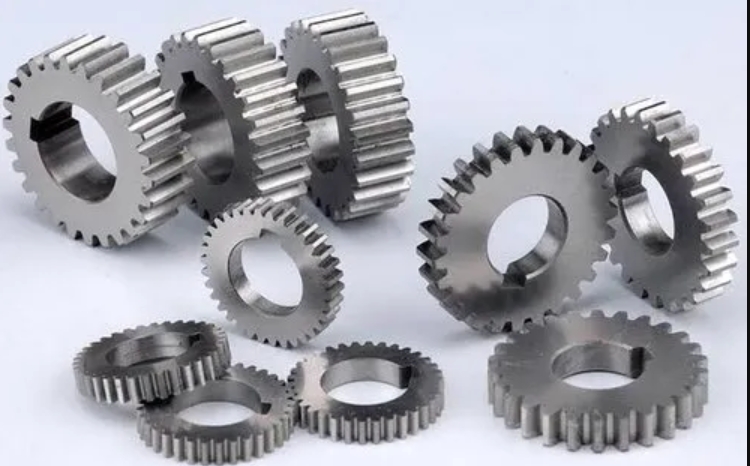
3. Finite Element Analysis of Closed-Die Forging
Numerical simulation using DEFORM-3D software revealed critical deformation characteristics:
$$ \epsilon_{\text{effective}} = \sqrt{\frac{2}{3} \epsilon_{ij} \epsilon_{ij}} $$
Key findings from simulation:
- Complete tooth profile formation at 42.9 mm stroke
- Maximum forming load: 2,150 kN
- Temperature gradient: 150°C between core and surface
4. Tooling Design and Production Validation
The prestressed die assembly with single-layer containment ring demonstrated superior performance:
| Die Type | Average Life (shots) | Failure Mode |
|---|---|---|
| Monolithic H13 | 8,000 | Thermal fatigue |
| Prestressed Assembly | 15,000+ | Wear |
Batch production results confirmed:
- Material utilization: 72% (vs. 40% in machining)
- Tooth profile accuracy: DIN 6 grade
- Continuous grain flow along tooth flank
5. Conclusion
The closed-die forging process enables high-precision manufacturing of spur gears with 17Cr2Ni2MoVNb steel, achieving:
$$ \text{Productivity gain} = \frac{t_{\text{machining}} – t_{\text{forging}}}{t_{\text{machining}}} \times 100\% = 42\% $$
This technology provides technical support for implementing carbon-neutral manufacturing through material savings and extended service life.