
In my extensive experience in the field of mechanical engineering and precision manufacturing, I have consistently observed that cylindrical gears serve as critical transmission components in modern machinery and instruments. Their primary function is to transmit power uniformly and smoothly from one shaft to another. The stability of their accuracy and quality plays a pivotal role in the overall performance of mechanical systems. In the aviation industry, where operational environments are extreme—characterized by high speeds, heavy loads, and demanding fatigue resistance—cylindrical gears are typically designed as spur cylindrical gears. These gears are not only essential for transmission systems but also integral to various complex mechanisms involving power transfer and motion control. As aviation technology advances, the requirements for gear quality become increasingly stringent. Consequently, precision measurement skills have become an indispensable aspect of quality control. This article delves into the precision measurement and quality control of aviation cylindrical gears, focusing on error analysis, practical detection methods, and the implementation of effective quality assurance strategies.
The manufacturing process of aviation cylindrical gears is highly specialized, involving multiple stages such as rough machining (e.g., hobbing or shaping), heat treatment (like carburizing and quenching to achieve a hard surface and soft core for wear resistance, impact resistance, and fatigue resistance), and finish machining (typically grinding to ensure high precision). Post-grinding, the gear accuracy often exceeds Grade 6 according to GB/T 10095.1-2022. For instance, for a gear with a module of 3 mm, the tooth profile error and tooth direction error are controlled within 0.008 mm, the tooth surface runout is between 0.02 to 0.04 mm, the variation in base tangent length is within 0.01 mm, and the surface roughness ranges from Ra 0.4 to Ra 0.8 μm. However, comprehensively evaluating gear quality in a single manufacturing step is challenging due to the complexity of parameters and potential error sources. Therefore, based on theoretical models and testing standards for aviation cylindrical gears, I emphasize the selection of four key factors that significantly affect working performance: single-flank rolling deviation (often related to one-tooth angle accuracy), total cumulative pitch deviation (related to one-rotation angle accuracy), contact accuracy, and tooth thickness error. By controlling measurement errors, we can analyze whether the gear’s dimensional accuracy, motion accuracy, and contact accuracy meet requirements, thereby providing theoretical basis and practical guidance for quality control, reducing trial-and-error costs, improving machining quality, and promoting lean production in factories.
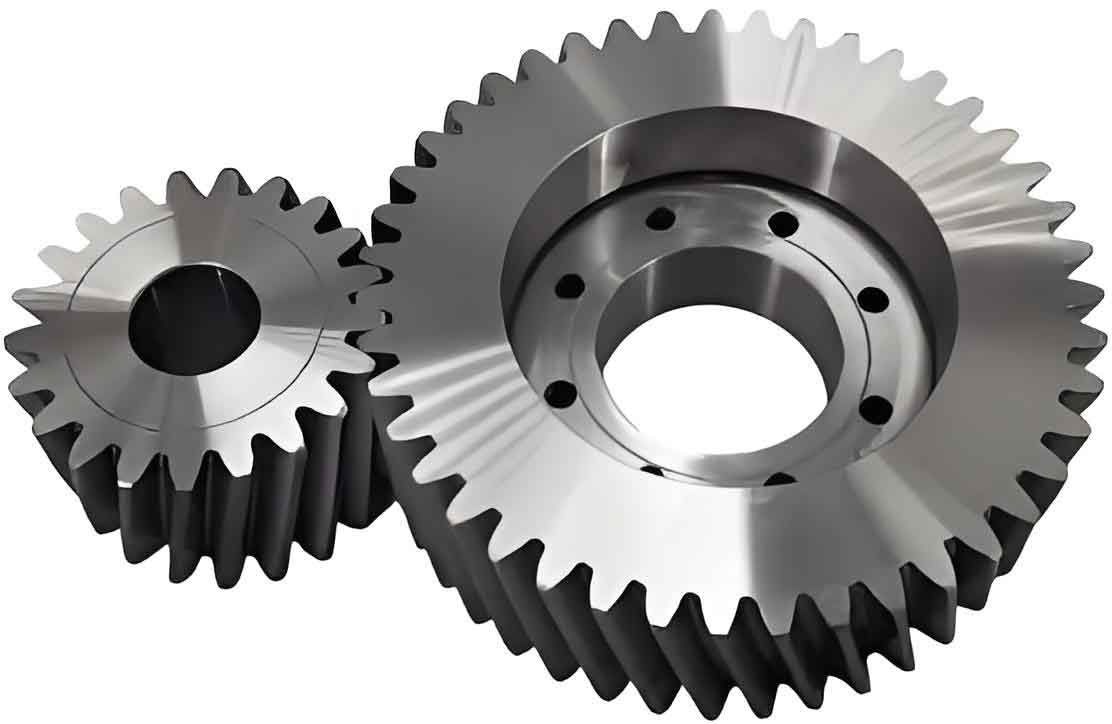
To understand the precision characteristics of aviation cylindrical gears, it is essential to define their accuracy features, which primarily encompass motion accuracy, contact accuracy, and smoothness. These characteristics are interrelated and influenced by various factors including design, manufacturing processes, material properties, and heat treatment. The following table summarizes these precision features:
| Precision Characteristic | Meaning | Specific Role in Aviation Gears |
|---|---|---|
| Motion Accuracy | Refers to the deviation between the actual transmission ratio and the theoretical transmission ratio during gear operation. | In aviation transmission systems, high motion accuracy is crucial for stability and reliability. Deviations can lead to changes in transmission ratio, increased tooth wear, vibration, noise, and potential system performance degradation. |
| Contact Accuracy | Refers to the contact condition between gear tooth surfaces, including contact area, contact pressure, and contact pattern. | Good contact accuracy ensures uniform load distribution and high load-carrying capacity, thereby extending gear service life and preventing premature failure under extreme conditions. |
| Smoothness | Refers to the stability during gear transmission, i.e., the level of impact and vibration during meshing. | Smoothness is affected by factors like pitch deviation, tooth profile error, and base pitch deviation. Improving smoothness reduces vibration, shock, and noise, enhancing system reliability and operational comfort. |
In practical detection processes, the evaluation of aviation cylindrical gears focuses on four main aspects: one-tooth angle accuracy (related to single-flank rolling deviation), one-rotation angle accuracy (related to cumulative pitch deviation), contact accuracy, and tooth thickness error. These evaluations are critical for assessing gear performance. The table below details these evaluation items:
| Evaluation Item | Main Aspects Reflected | Primary Influences | Control Measures | On-Site Measurement Methods |
|---|---|---|---|---|
| One-Tooth Angle Accuracy | Tooth profile deviation and adjacent pitch deviation. | Smoothness of gear transmission. | Control tooth profile error and adjacent pitch difference. | Tooth profile error measured with instruments; adjacent pitch difference indirectly measured via base pitch deviation using a base pitch gauge. |
| One-Rotation Angle Accuracy | Pitch spacing and deviation of teeth relative to the rotational reference. | Smoothness and motion accuracy. | Control tooth surface radial runout and indexing error. | Tooth surface radial runout and variation in base tangent length measured with dial indicators and micrometers. |
| Contact Accuracy | Tooth surface contact condition during meshing. | Gear strength and lifespan. | Control tooth direction and profile deviations, surface roughness. | Tooth direction and profile deviations measured with specialized instruments. |
| Tooth Thickness Error | Meshing clearance of gear pairs. | Meshing clearance and backlash. | Control base tangent length or measurement over pins. | Variation in base tangent length measured with a gear tooth micrometer or caliper. |
The meshing of cylindrical gears involves point contact along the tooth height, evaluated via tooth profile error, and line contact along the tooth length, evaluated via tooth direction error. Evaluating one-tooth angle accuracy primarily assesses the smoothness during instantaneous contact of gear pairs, which often have significant backlash leading to floating contact. Key measurements include tooth profile error and adjacent pitch difference. If these errors are excessive, fluctuating contact stresses can cause impact during meshing. On-site, tooth profile error is measured using profile testers, while adjacent pitch difference is indirectly evaluated through base pitch deviation. The base pitch, a fundamental parameter in gear meshing, can be calculated using the formula:
$$P_b = \pi M \times \cos \alpha$$
where \( P_b \) is the base pitch, \( M \) is the module, and \( \alpha \) is the pressure angle. This formula shows that for gears with the same module, the base pitch depends solely on the pressure angle. Thus, pressure angle errors directly affect the base pitch value. Measuring base pitch with a base pitch gauge is convenient and effective for assessing adjacent pitch differences in cylindrical gears.
Evaluating one-rotation angle accuracy involves checking deviations during gear rotation, ensuring tooth surface radial runout and indexing errors are within limits. Contact accuracy evaluation focuses on tooth surface contact during meshing. For spur cylindrical gears, tooth direction deviation is critical as it affects line contact along the tooth length. Controlling tooth direction deviation adequately meets contact accuracy requirements. Tooth thickness evaluation is typically done by measuring the base tangent length or measurement over pins to ensure proper meshing clearance. This clearance depends on fixed center distance, tooth thickness, and tooth surface runout. During machining, pitch deviations also influence the variation in base tangent length, which can be used to assess one-rotation angle accuracy.
Error analysis in precision measurement of aviation cylindrical gears is vital for reliable quality control. The manufacturing process is unique, combining mechanical cold working with special processes like heat treatment and surface treatment. Thus, gear machining is often treated as a specialized production activity. In final inspection, to avoid damage, gear tooth parameters are not checked, necessitating 100% inspection during grinding. Inspectors must evaluate various single items and provide comprehensive feedback. Common on-site measurements include tooth profile and direction errors using testers, surface roughness with conventional methods, tooth surface radial runout with two-center clamping, base pitch variation with base pitch gauges, and base tangent length variation with gear tooth micrometers. The table below summarizes error sources and solutions for key detection items:
| Detection Item | Main Influencing Factors | Conventional Solutions |
|---|---|---|
| Tooth Profile and Direction Errors | Periodic speed variations from transmission system errors in machining equipment; excessive axial play of machine tool spindle; large radial runout of spindle and tool axis; poor tool grinding and installation accuracy. | Improve rigidity and installation accuracy of grinding wheels; enhance rotational accuracy of indexing motion; eliminate axial play of spindle and eccentric errors in worktable indexing. |
| Tooth Surface Roughness | Poor rigidity of mechanical components or external vibrations; non-uniform material of gear blanks; dull grinding wheels or improper cutting speeds causing built-up edges; sudden changes in relative position between wheel and blank during cutting; unstable workshop environment during finishing. | Reduce vibration sources; improve wheel quality and rigidity of tool and workpiece spindles; enhance clamping stability; ensure cooling and lubrication; select appropriate heat treatments; control cutting parameters; monitor wheel wear; maintain constant temperature (20°C ±5°C) and humidity (70%-80%). |
| Tooth Surface Radial Runout | Improper workpiece clamping; misalignment after clamping; contamination of fixtures or machine centers. | Inspectors remind operators to ensure proper clamping and fixture installation; conduct thorough pre-checks to prevent human errors. |
| Base Pitch Deviation | Reduced machine tool accuracy; untimely wheel dressing and balancing; large difference in tooth number between standard and workpieces. | Compare base pitch values with previous parts; control machine stability and operator wheel dressing frequency; use standard pieces with tooth counts close to workpieces for comparative measurement. |
| Base Tangent Length Variation | Indexing errors from machine tools; untimely wheel dressing and balancing. | If variation exceeds 0.03 mm, indicate machine instability; halt processing and notify maintenance to check indexing discs, spindle, etc. |
In practical on-site detection of cylindrical gears, several critical points require attention to ensure accuracy. During rough machining before heat treatment (e.g., hobbing or shaping), accuracy is largely ensured by the machine and tools, with limited adjustment scope. Thus, first-article inspection is crucial, focusing on fixture and tool stability and control of feed rates. However, in grinding operations (whether form grinding or worm grinding), the wheel profile is dressed by operators using diamond tools, making wheel dressing quality, machine stability, workshop environment, and workpiece clamping directly influential. Inspectors must monitor these aspects and prompt adjustments if anomalies occur. Specific detection considerations include:
1. First-Article Processing: During machining, observe tooth surface roughness in real-time; texture should be uniform and clear. Post-grinding, conduct precision error detection, low-temperature tempering, and burn checks. If deviations are found, analyze issues from tooth profile charts, tooth direction charts, tooth thickness errors, and base pitch errors to implement corrections.
2. Base Pitch Inspection: Always use standard pieces with similar tooth counts for comparative measurement to minimize error from differing measurement points. Check each tooth; if base pitch deviation exceeds 0.005 mm between consecutive gears, it indicates machine issues or excessive wheel wear, requiring immediate stoppage and troubleshooting.
3. Tooth Thickness Control: Typically measured via base tangent length. For batch production, dedicated gauges can reduce inspector workload, but measurement should cover at least four points. Monitor gauge tightness; anomalies necessitate operator checks on machining conditions.
4. Tooth Profile and Direction Error Checks: Perform both simultaneously. Workpiece misalignment may minimally affect tooth profile but significantly impact tooth direction. According to GB/T 10095.1-2022, tooth profile error definitions may not fully account for position and shape effects. In practice, smaller error values sometimes lead to poorer smoothness than larger ones due to installation distance errors. Therefore, portions of tooth tip and root should have negative deviations to avoid tip contact and mid-concavity during meshing.
Based on my research and experience in precision measurement and quality control of aviation cylindrical gears, I summarize the following insights for reference in gear manufacturing and quality assurance:
1. Rational Selection of Measurement Techniques and Methods: Different measurement techniques have varying scopes and accuracy requirements. In practice, ensure measurement result accuracy and reliability by selecting appropriate methods for cylindrical gears. Define each single inspection item according to technical requirements and develop standards-compliant detection schemes.
2. Enhanced Error Analysis and Control: During gear measurement, identify primary error sources and strengthen analysis and control to ensure result accuracy. For instance, excessive errors in tooth profile, tooth direction, surface roughness, waviness, base tangent length variation, or tooth surface radial runout can interact and affect overall quality. Therefore, gear quality assessment must be comprehensive, identifying dominant errors for improvement.
3. Improvement of Inspector Competence: Inspector competence significantly impacts measurement accuracy and reliability. Thus, invest in training and education to enhance professional skills and knowledge, ensuring precise and dependable gear measurements.
In conclusion, precision measurement and quality control of aviation cylindrical gears revolve around identifying error sources and maintaining errors within acceptable limits. By improving inspector expertise, enabling comprehensive analysis, and targeting major errors for refinement, we can ensure gear accuracy and quality meet design specifications. This approach enhances product quality, reduces production costs, and achieves lean manufacturing objectives. The continuous advancement in measurement technologies and deeper understanding of gear dynamics will further drive the evolution of quality control practices for cylindrical gears in the aviation sector and beyond.
To further elaborate on the theoretical foundations, the evaluation of cylindrical gears often involves statistical methods and tolerance analysis. For example, the total cumulative pitch deviation \( F_p \) can be expressed as a function of individual pitch deviations \( f_{pt} \):
$$F_p = \sqrt{\sum_{i=1}^{z} (f_{pt,i})^2}$$
where \( z \) is the number of teeth. This highlights the importance of controlling each pitch deviation to minimize overall error. Similarly, tooth profile error \( f_f \) influences meshing smoothness, and its control is critical for high-performance cylindrical gears.
In terms of material science, the choice of carburizing alloy steels for aviation cylindrical gears affects hardness gradients and residual stresses, which in turn impact fatigue life. The relationship between surface hardness \( H \) and core hardness \( H_c \) can be optimized through heat treatment parameters, often modeled empirically:
$$H = H_0 + k \cdot \sqrt{t}$$
where \( H_0 \) is initial hardness, \( k \) is a material constant, and \( t \) is treatment time. Such models aid in setting quality control benchmarks.
Moreover, the integration of digital twin technology in gear manufacturing allows for real-time monitoring and predictive quality control. By simulating gear performance under operational conditions, potential defects in cylindrical gears can be identified early, reducing scrap rates and enhancing reliability.
Another aspect is environmental control in measurement labs. As noted, maintaining standard temperature and humidity is crucial for accurate dimensional measurements of cylindrical gears. The thermal expansion coefficient \( \alpha_T \) of gear materials (e.g., steel has \( \alpha_T \approx 11 \times 10^{-6} \, \text{K}^{-1} \)) means temperature variations can introduce significant errors. Therefore, calibration under controlled conditions is essential.
Finally, the role of standards cannot be overstated. Adherence to international standards like ISO 1328 or GB/T 10095 ensures consistency and interoperability in cylindrical gear production. Regular updates to these standards reflect advancing technologies and materials, guiding quality control practices.
In summary, through meticulous precision measurement, robust error analysis, and continuous improvement in processes and personnel skills, the quality control of aviation cylindrical gears can be effectively managed, contributing to safer and more efficient aviation systems.