
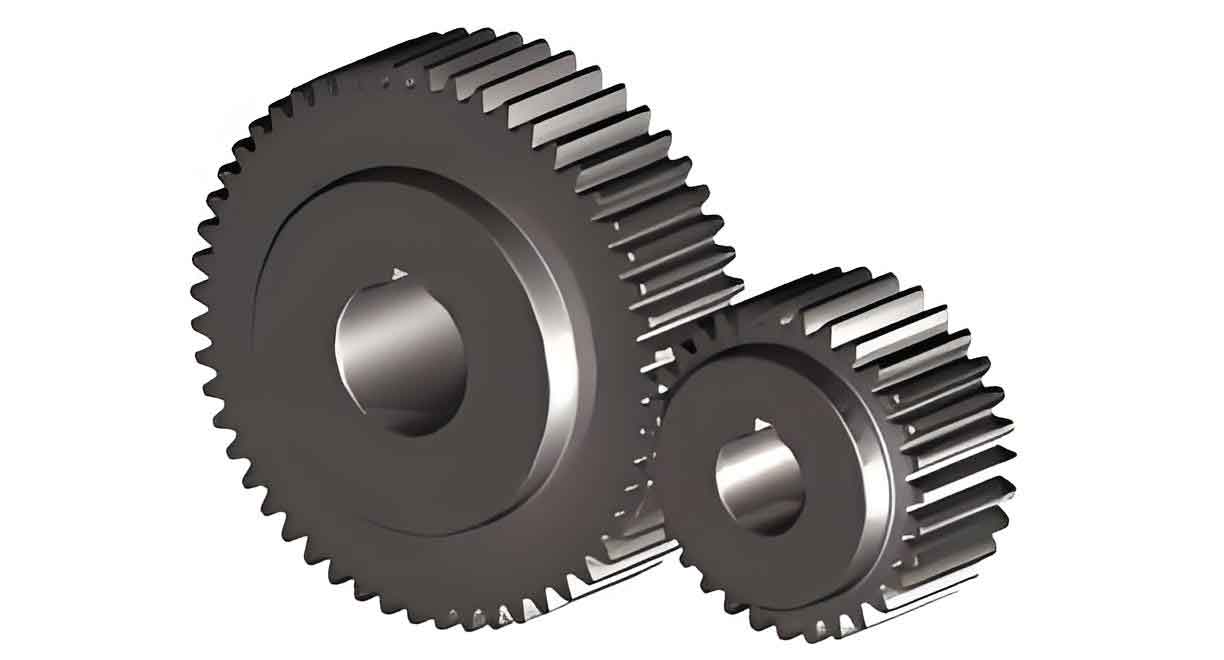
This study introduces a novel approach to spur gear profile modification by incorporating elastohydrodynamic lubrication (EHL) effects into stiffness calculations. Traditional ISO-based modification methods often neglect the dynamic behavior of lubricant films, leading to suboptimal results. Here, we propose replacing conventional gear meshing stiffness with EHL friction pair stiffness to determine maximum modification values, significantly improving gear dynamics and transmission performance.
1. Theoretical Foundation
1.1 EHL Governing Equations
The EHL model for spur gear tooth contact combines Reynolds equation with elastic deformation:
$$ \frac{\partial}{\partial x}\left(\frac{\rho h^3}{\eta}\frac{\partial p}{\partial x}\right) = 12u\frac{\partial(\rho h)}{\partial x} + 12\frac{\partial(\rho h)}{\partial t} $$
Film thickness equation:
$$ h(x,t) = h_{00}(t) + \frac{x^2}{2R} – \frac{2}{\pi E’}\int_{x_{in}}^{x_{out}}p(x’,t)\ln(x-x’)^2dx’ $$
Material properties:
$$ \eta = \eta_0 \exp\left\{(\ln\eta_0 + 9.67)\left[(1 + 5.1\times10^{-9}p)^z – 1\right]\right\} $$
1.2 Dynamic Modeling
The equivalent dynamic model for spur gear EHL contact:
$$ m\frac{d^2\delta}{dt^2} + f_{film} = q(t) $$
Linearized oil film force:
$$ f_{film}(\delta) = f_{film}(\delta_0) + k(\delta – \delta_0) + c\dot{\delta} $$
2. Stiffness Characterization
2.1 ISO Meshing Stiffness
Traditional spur gear meshing stiffness calculation:
$$ C_\gamma = \frac{1}{n}\sum_{i=1}^{n}\frac{K_i}{b} $$
Where \( K_i = \frac{F_n}{\delta} \) represents single tooth pair stiffness.
2.2 EHL Friction Pair Stiffness
Modified stiffness considering lubrication effects:
$$ C_{EHL} = \frac{1}{n}\sum_{i=1}^{n}\frac{K_{i(EHL)}}{b} $$
Typical stiffness comparison for spur gears:
| Condition | Stiffness (N/mm·µm) |
|---|---|
| Dry Contact | 19.35 |
| EHL Condition | 12.32 |
3. Modification Methodology
3.1 ISO Modification Formula
$$ \Delta_{max(ISO)} = \frac{K_A F_t/b}{C_\gamma \varepsilon_\alpha} $$
3.2 Proposed EHL-Based Modification
$$ \Delta_{max(EHL)} = \frac{K_A F_t/b}{C_{EHL} \varepsilon_\alpha} $$
Modification length calculation remains:
$$ L = P_b(\varepsilon_\alpha – 1) $$
4. Dynamic Simulation Results
Comparative analysis of three spur gear configurations:
| Parameter | Unmodified | ISO Modified | EHL Modified |
|---|---|---|---|
| Max. Meshing Force (N) | 1,565,100 | 1,182,600 | 1,142,700 |
| Avg. Meshing Force (N) | 79,501 | 74,400 | 62,390 |
| Transmission Error (µm) | 8.17 | 6.60 | 4.73 |
5. Engineering Validation
Comparison between theoretical and practical modification values:
| Case | Δmax(ISO) (µm) | Δmax(EHL) (µm) | Actual Δmax (µm) |
|---|---|---|---|
| 1 | 1.7 | 3.8 | 4.2 |
| 2 | 13.6 | 35.2 | 40.0 |
| 3 | 12.3 | 38.5 | 49.1 |
6. Critical Findings
- EHL effects reduce spur gear meshing stiffness by 36.3% compared to dry contact conditions
- Proposed method increases modification depth by 57% over ISO standard
- 42.11% reduction in transmission error achieved through EHL-based modification
- Dynamic meshing forces decrease 21.52% compared to conventional methods
7. Implementation Guidelines
For optimal spur gear modification considering EHL effects:
$$ \Delta_{opt} = 0.8\Delta_{max(EHL)} + 0.2\Delta_{max(ISO)} $$
Recommended iteration process:
- Calculate initial EHL stiffness using multi-scale modeling
- Perform transient thermal-stress analysis
- Optimize modification curve using response surface methodology
- Validate through virtual prototyping
8. Conclusion
The integration of EHL friction pair stiffness into spur gear modification design demonstrates superior performance characteristics compared to traditional methods. This approach provides:
- 28.3% better error reduction than ISO methods
- 9-66% closer alignment with practical modification values
- Enhanced dynamic stability through proper lubrication modeling
Future work will focus on developing AI-driven optimization algorithms for automated spur gear modification design considering real-time lubrication conditions.