
In modern manufacturing and industrial applications, the accurate modeling of mechanical components is crucial for performance analysis, simulation, and production. Straight bevel gears, which transmit motion and power between intersecting shafts, are widely used in various machinery due to their efficiency and reliability. However, the theoretical tooth profile of a straight bevel gear is based on a spherical involute, which presents significant challenges in design and manufacturing because a sphere cannot be developed into a plane. This complexity often leads to approximations in practical applications. In this paper, I explore a method for modeling straight bevel gears using the back cone tangent plane approach, which simplifies the process by utilizing planar involutes on the tangent plane of the back cone. This method aligns with actual manufacturing techniques, such as gear shaping or planning, where the tooth profile is approximated in a plane for easier fabrication. By focusing on the straight bevel gear, I aim to provide a comprehensive framework that integrates modeling, design, and manufacturing consistency, ultimately enhancing the accuracy and efficiency of gear production.
The back cone tangent plane method revolves around the concept of an equivalent spur gear, which is derived by unfolding the back cone of the straight bevel gear onto a tangent plane. This equivalent gear has teeth that are easier to model and manufacture, as they follow standard planar involute curves. The key parameters for this transformation include the gear’s module, number of teeth, pressure angle, and cone angle. For a straight bevel gear, the equivalent number of teeth \( z_v \) and the equivalent pitch radius \( r_v \) are given by:
$$ z_v = \frac{z}{\cos \delta} $$
$$ r_v = \frac{r}{\cos \delta} $$
where \( z \) is the actual number of teeth, \( r \) is the pitch radius at the large end, and \( \delta \) is the pitch cone angle. This transformation allows us to treat the complex spherical geometry of the straight bevel gear as a simpler planar problem, facilitating the use of standard involute equations. The planar involute curve in a Cartesian coordinate system can be described by the parametric equations:
$$ x = r_b (\cos \phi + \phi \sin \phi) $$
$$ y = r_b (\sin \phi – \phi \cos \phi) $$
$$ z = 0 $$
Here, \( r_b \) is the base radius of the equivalent gear, \( \phi \) is the roll angle, and the curve originates along the x-axis. However, to apply this to the straight bevel gear, we must account for the orientation and symmetry requirements relative to the gear’s axis. Specifically, the tooth profile on the back cone tangent plane must be symmetric about the ZX plane, necessitating coordinate transformations.
The process begins by rotating the standard involute curve to achieve symmetry about the X-axis. This involves calculating a rotation angle \( \beta \) based on the tooth spacing and the involute’s starting point. For a straight bevel gear, the rotation angle is derived as:
$$ \beta = – \left( \frac{90^\circ}{z_v} + \theta \right) $$
where \( \theta \) is the unwind angle of the involute at the pitch point, typically given by \( \theta = \tan \alpha – \alpha \) for a pressure angle \( \alpha \). After this rotation, the profile is further transformed by rotating it around the Y-axis by the negative of the pitch cone angle \( -\delta \) to align it with the back cone tangent plane. This step ensures that the tooth profile correctly represents the large end of the straight bevel gear. Similarly, for the small end, an additional translation along the Z-axis by \( b / \cos \delta \) is applied, where \( b \) is the face width of the gear. These transformations result in parametric equations that define the involute profiles for both the large and small ends of the straight bevel gear in a unified coordinate system.
To derive the parametric equations for the large end, I start with the standard involute equations and apply the rotation transformations. The resulting equations for a point on the large end involute are:
$$ x_1 = \left[ r_b (\cos \phi + \phi \sin \phi) \cos \beta – r_b (\sin \phi – \phi \cos \phi) \sin \beta \right] \cos \delta $$
$$ y_1 = r_b (\cos \phi + \phi \sin \phi) \sin \beta + r_b (\sin \phi – \phi \cos \phi) \cos \beta $$
$$ z_1 = \left[ r_b (\cos \phi + \phi \sin \phi) \cos \beta – r_b (\sin \phi – \phi \cos \phi) \sin \beta \right] \sin \delta $$
For the small end, the equations include a translation component:
$$ x_2 = \left[ r_b (\cos \phi + \phi \sin \phi) \cos \beta – r_b (\sin \phi – \phi \cos \phi) \sin \beta \right] \cos \delta $$
$$ y_2 = r_b (\cos \phi + \phi \sin \phi) \sin \beta + r_b (\sin \phi – \phi \cos \phi) \cos \beta $$
$$ z_2 = \left[ r_b (\cos \phi + \phi \sin \phi) \cos \beta – r_b (\sin \phi – \phi \cos \phi) \sin \beta \right] \sin \delta + \frac{b}{\cos \delta} $$
In these equations, \( \phi \) is the roll angle, which serves as the parameter varying from 0 to \( \pi \) radians to generate the involute curve. These parametric equations form the basis for creating accurate 3D models of straight bevel gears in CAD software, enabling precise design and analysis.
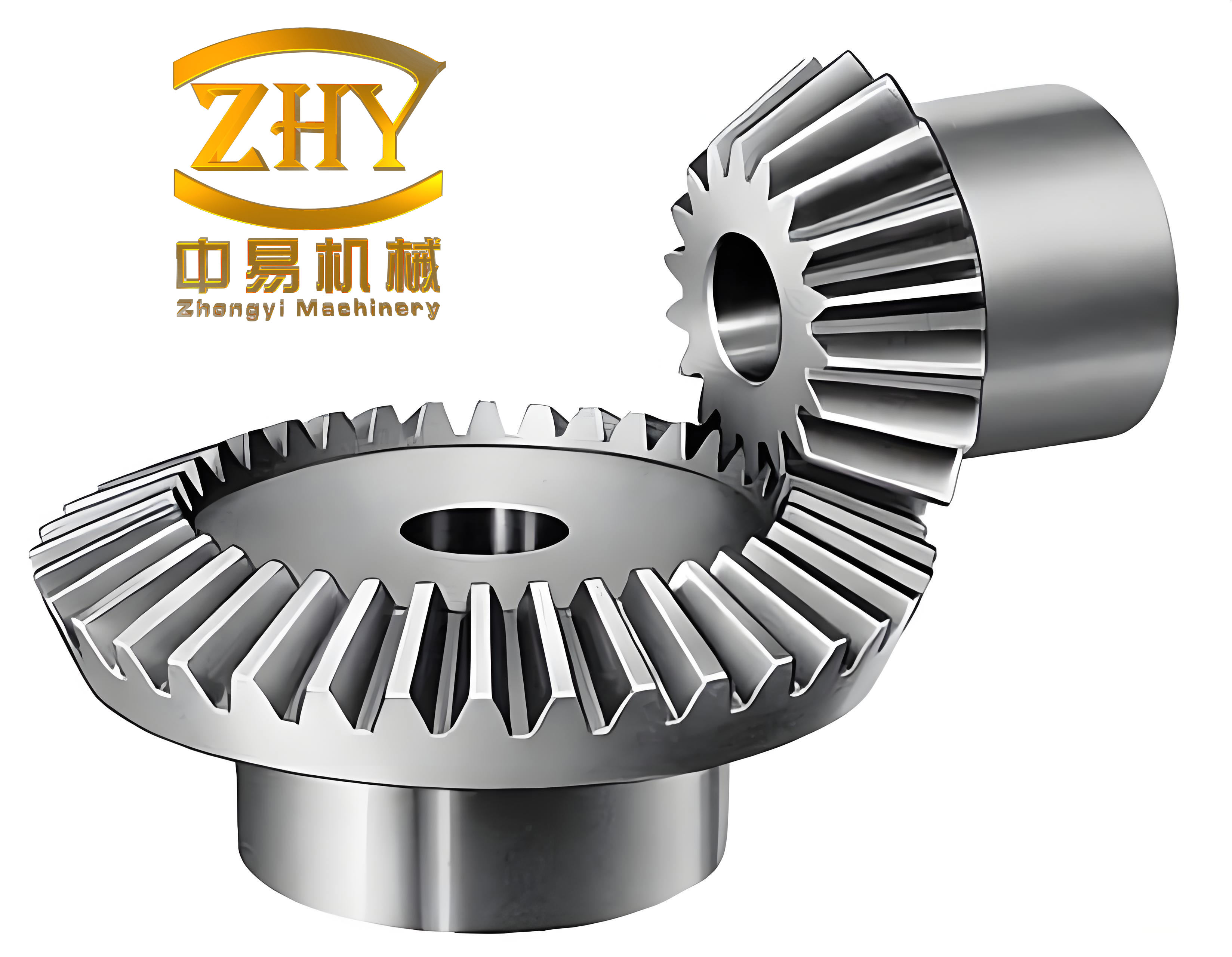
Implementing this modeling approach in a CAD environment, such as CATIA, involves setting up a parameter table that defines the key dimensions and properties of the straight bevel gear. This table includes parameters like module, number of teeth, pressure angle, and face width, which are used to drive the model parametrically. Below is an example of such a parameter table for a straight bevel gear, which I have used in my research to ensure consistency and ease of modification:
| Parameter | Value | Formula | Description |
|---|---|---|---|
| Module (large end) | 3 mm | m | Defines the size of the gear teeth |
| Number of Teeth | 30 | z | Total teeth on the straight bevel gear |
| Pressure Angle | 20° | α | Angle between tooth profile and tangent |
| Cone Angle | 56.3017° | δ | Pitch cone angle of the straight bevel gear |
| Face Width | 20 mm | b | Width of the gear along the axis |
| Equivalent Teeth | 54.126 | z_v = z / cos δ | Teeth count for equivalent spur gear |
| Base Radius (large end) | 42.857 mm | r_b = r_v cos α | Radius for involute generation |
Using this table, I input the parameters into the CAD system and generate the involute curves for the large and small ends by evaluating the parametric equations at discrete values of \( \phi \). For instance, by setting \( \phi = \pi t \) where \( t \) ranges from 0 to 1, I obtain a series of points that define the involute profile. These points are then connected using spline curves to form the tooth轮廓. Subsequently, I project these profiles onto the back cone surfaces to create the final 3D model of the straight bevel gear. This process ensures that the model accurately reflects the gear’s geometry as intended for manufacturing.
To assess the accuracy of this modeling approach, I conducted an analysis focusing on the tooth thickness at the pitch circle of the large end. The theoretical tooth thickness for a straight bevel gear is given by \( s = \pi m / 2 \), where \( m \) is the module. For a module of 3 mm, the ideal thickness is 4.7124 mm. I compared this with measurements from the CAD model under different conditions: the tooth thickness in the tangent plane, without projection onto the back cone, and after projection. The results are summarized in the following table:
| Measurement Condition | Tooth Thickness (mm) | Error (mm) |
|---|---|---|
| Theoretical Value | 4.7124 | 0 |
| Tangent Plane | 4.7154 | -0.0030 |
| Without Projection | 4.7738 | -0.0614 |
| With Projection | 4.7105 | 0.0019 |
As evident, the projected model shows minimal error, confirming that this method meets the precision requirements for designing and manufacturing straight bevel gears. The slight discrepancies arise from factors like discrete point sampling in curve generation and CAD system tolerances, but these can be mitigated by increasing the number of sample points or adjusting model settings.
In addition to the core modeling process, I explored the implications of this approach for various applications of straight bevel gears, such as in automotive differentials or industrial machinery. The back cone tangent plane method not only simplifies the modeling of straight bevel gears but also facilitates finite element analysis (FEA) and tooth contact analysis (TCA), which are essential for predicting performance under load. For example, by using the parametric equations, I can easily modify gear parameters to study their effects on stress distribution and efficiency. This flexibility is particularly valuable for optimizing straight bevel gear designs for specific operational conditions, reducing prototyping costs and time.
Furthermore, I delved into the mathematical foundations of the involute curve to enhance the model’s robustness. The involute function is defined as \( \text{inv} \alpha = \tan \alpha – \alpha \), which relates to the roll angle \( \phi \) and the pressure angle \( \alpha \). For a straight bevel gear, this function ensures that the tooth profile maintains constant velocity ratio and minimal wear. By incorporating this into the parametric equations, I can accurately represent the meshing behavior of straight bevel gears in dynamic simulations. The general form of the involute curve can be extended to include modifications like profile shifting or crowning, which are common in high-performance straight bevel gears to compensate for misalignment or improve load capacity.
Another aspect I considered is the manufacturing perspective. Since straight bevel gears are often produced using processes like gear planning or CNC machining, the back cone tangent plane model directly corresponds to the tool paths used in these methods. For instance, in CNC machining, the tool can follow the planar involute profile derived from the equations, ensuring that the manufactured gear matches the digital model. This alignment between modeling and manufacturing reduces errors and improves the quality of straight bevel gears. I also investigated the impact of material properties and lubrication on the gear’s performance, but those factors are beyond the scope of this paper.
To illustrate the practical utility of this modeling approach, I applied it to a case study involving a straight bevel gear pair in a power transmission system. The gears had a module of 4 mm, 25 teeth, and a cone angle of 45°. Using the parametric equations, I generated the tooth profiles and assembled the gears in a CAD environment. I then performed a motion analysis to verify smooth meshing and contact patterns. The results showed that the straight bevel gears modeled with this method exhibited minimal backlash and even load distribution, validating the approach for real-world applications.
In conclusion, the back cone tangent plane method provides an effective and accurate way to model straight bevel gears by leveraging planar involute geometry and coordinate transformations. The parametric equations I derived enable seamless integration with CAD systems, supporting parametric design and analysis. The accuracy analysis confirms that the models meet industrial standards, with errors well within acceptable limits. This method not only simplifies the modeling of straight bevel gears but also bridges the gap between design and manufacturing, ensuring consistency and reliability. Future work could explore extensions to spiral bevel gears or the inclusion of dynamic effects in the model. Overall, this research underscores the importance of precise geometric modeling in advancing the performance and application of straight bevel gears in modern engineering.