
The successful production of large, high-speed, and heavily loaded gear shafts presents significant challenges in heavy forging. These components are characterized by their substantial cross-sections, stringent non-destructive testing requirements, and the use of advanced alloy steels that are prone to defects like flaking and coarse grain structure. This article details our first-hand experience and methodology in developing a robust forging process for a qualified 17Cr2Ni2Mo carburizing gear shaft. By implementing stringent controls over raw materials, forging deformation parameters, and post-forging heat treatment, we achieved superior internal quality that exceeds standard ultrasonic inspection requirements.
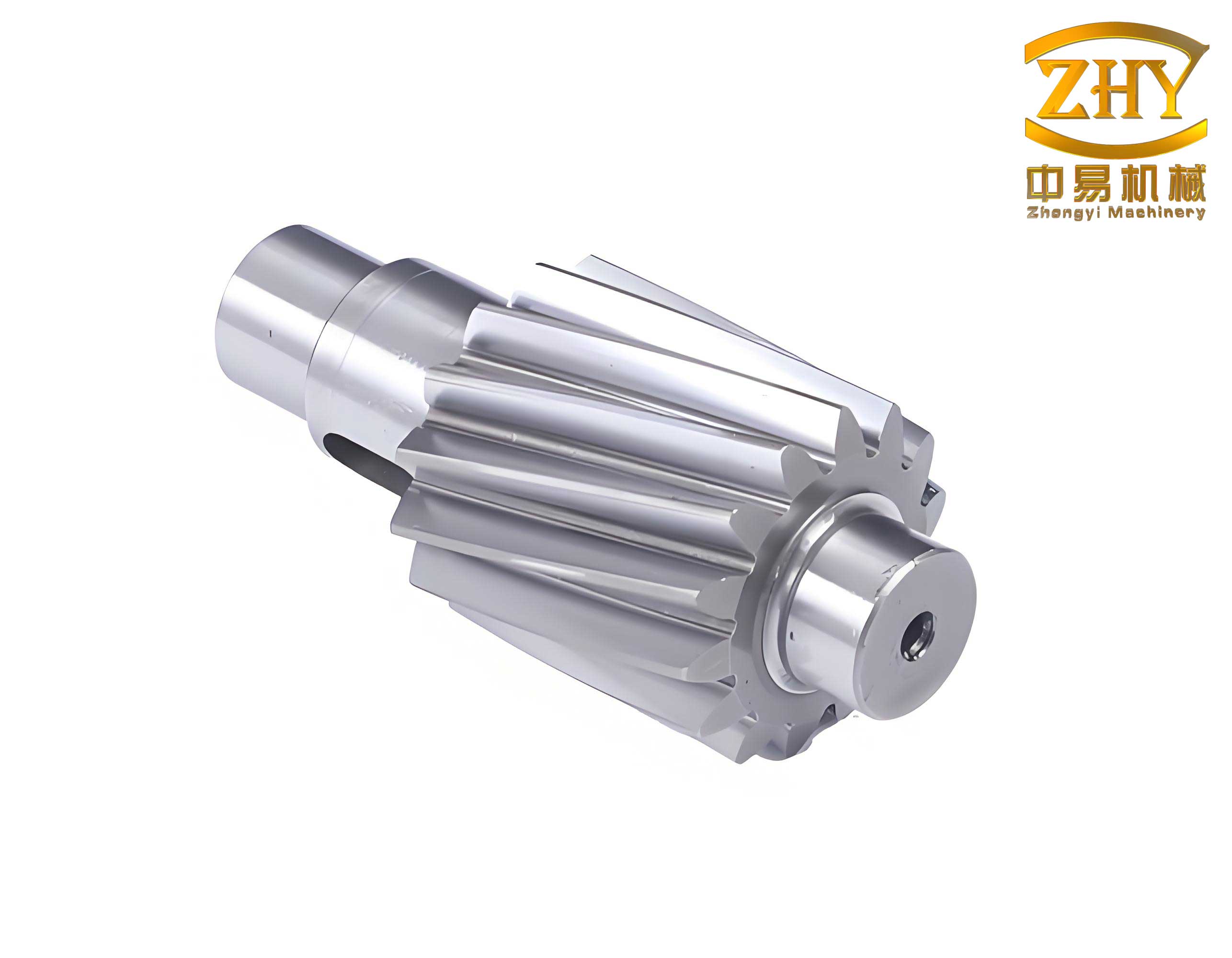
The primary challenge in manufacturing this specific gear shaft was its massive size, with a maximum outer diameter of 910 mm and a final forging weight of nearly 12 tons. Forging such a large cross-section on our 32 MN hydraulic press pushed the equipment’s capabilities to their limit, making it difficult to ensure thorough center compaction and meet the Grade II ultrasonic testing standards per JB/T 5000.15-2007. Furthermore, the selected material, 17Cr2Ni2Mo, is known for its strong susceptibility to flaking (hydrogen-induced cracking) and pronounced structural heredity, which often leads to coarse or mixed grain structures after forging if not meticulously controlled. The multi-stage process required a long manufacturing cycle, where each step had to be optimized to prevent defects and ensure the final performance of this critical drive gear shaft.
1. Raw Material Selection and Control
The foundation for a high-integrity forging is laid at the melting stage. For this demanding gear shaft application, we mandated the use of a vacuum degassed and refined steel ingot. This advanced steelmaking process is crucial for drastically reducing the gas content, particularly hydrogen, and minimizing non-metallic inclusions and segregation within the ingot. Tight internal control limits were imposed on the chemical composition, especially for harmful elements. The sulfur (S) and phosphorus (P) content were controlled to very low levels to enhance toughness and reduce hot shortness, while the hydrogen ([H]) content was mandated to be at or below 2 ppm to eliminate the risk of flaking during cooling. The chemical composition requirements and the actual measured values from the produced ingot are summarized in Table 1.
| Element | Standard Requirement | Internal Control Limit | Measured Value |
|---|---|---|---|
| C | 0.14 – 0.19 | 0.14 – 0.19 | 0.14 |
| Si | 0.17 – 0.35 | 0.17 – 0.35 | 0.24 |
| Mn | 0.40 – 0.60 | 0.40 – 0.60 | 0.49 |
| P | ≤ 0.030 | ≤ 0.015 | 0.012 |
| S | ≤ 0.030 | ≤ 0.010 | 0.008 |
| Cr | 1.50 – 1.80 | 1.60 – 1.80 | 1.65 |
| Ni | 1.40 – 1.70 | 1.50 – 1.70 | 1.57 |
| Mo | 0.25 – 0.35 | 0.25 – 0.35 | 0.28 |
| Cu | ≤ 0.25 | ≤ 0.25 | 0.05 |
A 16.2-ton vacuum refined ingot was selected for the production of this gear shaft. The established forging temperature range was set between 1250°C (start) and 750°C (finish) to ensure adequate plasticity and proper microstructural evolution.
2. Ingot Heating Strategy
The heating process is designed to transform the steel’s microstructure into a homogeneous austenitic state, which maximizes plasticity and minimizes deformation resistance. It also promotes elemental diffusion, reducing chemical segregation. The two critical parameters are heating temperature and soaking time, which were strategically varied for different forging stages.
For the initial heats, particularly the upsetting operation, a high starting temperature is beneficial for center compaction. We selected a starting forging temperature of 1250°C, ensuring it remained below the steel’s incipient melting point to avoid burning. The soaking time at this temperature was extended to 1.0 – 1.5 hours per 100 mm of ingot section thickness. This prolonged soak ensures complete and uniform through-heating of the massive section, creating optimal conditions for breaking down the as-cast structure and healing central discontinuities during subsequent forging.
For the final finishing heat, the approach was different. To obtain a finer final grain size in the finished gear shaft, the heating temperature was lowered to 1150-1180°C. The soaking time was also reduced to 0.7 – 1.0 hours per 100 mm. This lower temperature prevents excessive grain growth while still providing sufficient plasticity to complete the forging operation before the temperature drops to the 750°C lower limit. This controlled heating for the last stage helps secure the required internal quality and mechanical properties.
The heating strategy can be summarized by the following principles governing soaking time ($t_s$) based on section thickness ($D$ in mm):
$$ \text{For initial/heavy deformation heats: } t_s = (1.0 \text{ to } 1.5) \times \frac{D}{100} \quad \text{(hours at ~1250°C)}$$
$$ \text{For final/finishing heats: } t_s = (0.7 \text{ to } 1.0) \times \frac{D}{100} \quad \text{(hours at ~1150-1180°C)}$$
3. Forging Deformation Process: A Multi-Stage Approach
The core of producing a sound large gear shaft lies in the carefully sequenced forging operations designed to achieve a high total forging ratio, effective center work, and uniform deformation. Our process for the 17Cr2Ni2Mo gear shaft consisted of six distinct heats, as outlined in Table 2.
| Heat No. | Temperature Range (°C) | Operation Summary and Key Objectives |
|---|---|---|
| 1 | 1100 – 850 | Prepare the ingot: Press the gripping end (mandrel hold), perform ingot conditioning (break down the coarse as-cast surface layer), and crop the bottom discard. This ensures a centered grip for subsequent handling and removes poor-quality material. |
| 2 | 1250 – 750 | First Upsetting. Upset the ingot to a maximum diameter of 1700 mm. This dramatically increases the cross-sectional area, which is essential for achieving a high forging ratio during subsequent drawing. It begins the process of breaking down the central segregation zone. |
| 3 | 1250 – 750 | Primary Drawing with Wide Anvils. Use 800 mm wide anvils to draw the upset block by the “flat-and-edge” method. This is a critical center-compaction stage. Key parameters like reduction per pass (20%) and anvil width-to-height ratio (0.6-0.8) are strictly controlled to apply high triaxial compressive stresses to the core, effectively welding internal voids. The workpiece is ultimately drawn to a 950 mm square cross-section. |
| 4 | 1250 – 750 | Second Upsetting. Upset the block again to a diameter of 1700 mm. A second upsetting operation is necessary for large sections to further refine the microstructure, homogenize the material, and most importantly, to allow for an additional drawing operation. This is key to achieving the total forging ratio required for the gear shaft’s smallest sections. |
| 5 | 1250 – 750 | Secondary Drawing with Wide Anvils. Repeat the wide-anvil flat-and-edge drawing process (as in Heat 3) to reduce the cross-section back to a 950 mm square. This step continues the internal consolidation and ensures the applied forging work is fully imparted. |
| 6 | 1220 – 750 | Final Forming. Switch to 500 mm anvils for better maneuverability. According to a pre-designed blank distribution plan, draw down and shape the various stepped sections of the final gear shaft. This heat forges the preform to its final dimensions while maintaining sufficient remaining forging ratios in all sections. |
3.1 Key Forging Parameters and Their Rationale
The success of the deformation process hinges on controlling specific mechanical parameters. For the crucial wide-anvil drawing stages (Heats 3 & 5), we focused on:
Reduction per Pass ($\varepsilon$): A high reduction, typically 20%, was applied with full anvil contact. This large strain is necessary to penetrate to the center of the workpiece. It can be expressed as:
$$\varepsilon = \frac{h_0 – h_1}{h_0} \times 100\%$$
where $h_0$ is the height before the press stroke and $h_1$ is the height after.
Anvil Width-to-Height Ratio ($R$): This is a critical parameter for center stress state. We maintained a ratio ($R = W / h_0$) between 0.6 and 0.8. Using anvils that are too narrow relative to the workpiece height leads to a “double-barrel” effect with tensile stresses at the center, which can open defects. The chosen range ensures predominantly compressive stresses throughout the cross-section, promoting internal void closure.
$$ 0.6 \leq R = \frac{W}{h_0} \leq 0.8 $$
Total Forging Ratio ($K_{total}$): For large, high-quality forgings like this gear shaft, a significant total forging ratio is required to ensure thorough work of the material and refine the microstructure. It is the product of the area ratios from all drawing and upsetting operations. For the most demanding section of this gear shaft, we ensured $K_{total} \geq 4$. The forging ratio for a drawing operation is given by:
$$K_{draw} = \frac{A_0}{A_1}$$
where $A_0$ and $A_1$ are the cross-sectional areas before and after drawing, respectively. The use of two upsetting-drawing cycles was essential to achieve this high ratio from the original ingot.
4. Post-Forging Heat Treatment for Microstructure Control
Given the multiple high-temperature forging heats and the inherent structural heredity of 17Cr2Ni2Mo steel, the as-forged state is prone to coarse austenite grains. A specialized post-forging heat treatment (PFHT) cycle is indispensable to refine the grain structure, eliminate the risk of flaking (by diffusing out hydrogen), and prepare the microstructure for final machining and carburizing.
For this large-section gear shaft, we employed a double normalizing and tempering process. The first high-temperature normalizing is designed to completely recrystallize the austenite grain boundaries, breaking the inherited coarse structure and promoting the fragmentation of carbide networks. This is followed by a second, conventional normalizing at a slightly lower temperature to further refine and homogenize the grain size. Finally, tempering is conducted to relieve internal stresses and improve toughness. The specific thermal cycle is illustrated in the curve below.
Post-Forging Heat Treatment Cycle:
1. First Normalize: Heat to 920-940°C, soak sufficiently for through-heating (approx. 2-3 hours), then air cool (AC).
2. Second Normalize: Reheat to 860-880°C, soak, then air cool (AC).
3. Temper: Heat to 620-650°C, hold for an extended period (10-15 hours) to ensure thorough hydrogen removal and stress relief, then furnace cool (FC) to below 300°C before air cooling.
The extended tempering hold is critical for hydrogen effusion, which follows Fick’s law of diffusion. The time required is proportional to the square of the section thickness, justifying the long duration for this massive gear shaft.
$$ t \propto \frac{D^2}{D_{eff}} $$
where $t$ is time, $D$ is section thickness, and $D_{eff}$ is the effective diffusion coefficient for hydrogen in steel at the tempering temperature.
5. Conclusion and Quality Verification
Through the integrated control of high-purity raw materials, a meticulously designed multi-stage forging process emphasizing center compaction, and a tailored double normalizing heat treatment, we successfully produced a large 17Cr2Ni2Mo carburizing gear shaft with excellent internal integrity. The forged gear shaft was subjected to comprehensive ultrasonic testing after rough machining. The inspection results confirmed the absence of any rejectable defect indications. The internal quality was found to be superior to the requirements of the Grade II standard per JB/T 5000.15-2007, validating the effectiveness of the developed forging and heat treatment methodology.
This case study underscores that producing high-performance, large-section gear shafts from challenging alloy steels is not merely a shaping operation but a comprehensive metallurgical process. Each step—from steelmaking and heating through deformation and final heat treatment—must be scientifically designed and rigorously controlled to transform a cast ingot into a reliable, high-strength gear shaft capable of withstanding extreme service conditions in heavy-duty machinery.