
In the realm of mechanical engineering, the machining of gear shafts represents a critical area of focus, particularly when dealing with specialized configurations such as drum-shaped gear shafts. These components, characterized by small modules, few teeth, and large helix angles, pose significant challenges due to their high precision requirements. Unlike standard gear shafts, which are more common in domestic markets, these special drum gear shafts demand meticulous attention to detail in both material processing and machining techniques. From my extensive experience in this field, I have observed that factors like heat treatment conditions and machining positioning methods play pivotal roles in achieving the desired accuracy. This article delves into an in-depth analysis of these influences, presenting improvements in induction quenching and hobbling locating strategies that have yielded superior results in the production of such gear shafts.
The importance of gear shafts in transmission systems cannot be overstated; they serve as essential elements in transferring torque and motion across various industrial applications. Drum gear shafts, in particular, offer enhanced load-bearing capacity and ease of installation adjustment, making them ideal for gear couplings and similar devices. However, their complex geometry—featuring a crowned tooth profile—introduces additional machining complexities. When combined with small modules (e.g., fine pitch), low tooth counts (such as 4 teeth), and substantial helix angles (e.g., 20°), the manufacturing process becomes even more demanding. The precision targets for these gear shafts often exceed those of conventional ones, necessitating innovative approaches to overcome deformation and inconsistency during machining.
To set the context, let me outline the typical specifications for a special drum gear shaft, as derived from practical cases. The following table summarizes key parameters that define such components:
| Parameter | Value | Unit |
|---|---|---|
| Number of Teeth (z) | 4 | – |
| Normal Diametral Pitch (Pn) | 26 | teeth/inch |
| Normal Pressure Angle (αn) | 20 | degrees |
| Helix Angle (β) | 20 (left-hand) | degrees |
| Outer Diameter (Do) | 6.9494 / 6.851 | mm |
| Standard Pitch Diameter (D) | 4.158 | mm |
| Normal Tooth Thickness (sn) | 1.9456 / 1.9253 | mm |
| Root Diameter (Dr) | 2.8448 / 2.7889 | mm |
| Face Width (b) | 12.0 (min) | mm |
| Lead Length (L) | 35.8937 | mm |
| Base Diameter (Db) | 3.079 | mm |
| Span Measurement (with pin diameter φ=3 mm) | 10.1295 / 10.1 | mm |
| Involute Profile Error (Fα) | 0.011 | mm |
| Radial Runout at Pitch Circle (Fr) | 0.028 | mm |
| Tooth Direction Error (Fβ) | 0.013 | mm |
These parameters highlight the tight tolerances involved, especially for gear shafts with minimal tooth counts and large helix angles. The technical requirements often include surface hardness in the range of 550-750 HV, core hardness above 450 HV, a drum-shaped tooth profile with a crown of 0.02-0.04 mm, and a precision grade equivalent to JIS 4. Achieving such specs necessitates a thorough understanding of the machining dynamics, particularly how heat treatment and positioning methods affect the final outcome for these gear shafts.
When machining gear shafts, especially those with complex geometries, one of the primary challenges is controlling deformation during the hobbling process. Gear shafts with small modules and few teeth are prone to significant elastic deformation under cutting forces, which can lead to uneven material removal and compromised accuracy. This issue is exacerbated by the large helix angle, as the helical teeth introduce additional torsional stresses. In my investigations, I have identified that the inherent stiffness of the workpiece plays a crucial role, and this stiffness is influenced by both the material state (via heat treatment) and the support provided during machining (via positioning methods). Therefore, optimizing these factors is essential for producing high-quality gear shafts.
Heat treatment, particularly induction quenching, is a critical step in the manufacturing sequence for gear shafts. It not only enhances surface hardness and wear resistance but also affects the internal stress state of the material, which in turn influences machining deformation. For special drum gear shafts, a two-stage hobbling process—rough hobbling followed by induction quenching and then finish hobbling—is often preferred. This approach leverages the increased rigidity imparted by quenching to improve accuracy during the final cut. However, the conditions of induction quenching, such as the design of the induction coil, can significantly alter the residual stresses and subsequent distortion.
To quantify the impact of heat treatment on gear shafts, I conducted experiments with three different induction coil configurations, each varying in cooler structure. The goal was to minimize internal stresses and reduce post-quenching deformation. The results demonstrated that the coil design profoundly affects parameters like profile error, tooth direction error, cumulative pitch error, and radial runout. For instance, a conventional coil structure led to substantial changes in tooth direction, with nearly 100% increase after quenching, whereas an improved coil design reduced this variation by 30%. This reduction in thermal distortion is vital for maintaining precision in gear shafts during subsequent machining steps.
The relationship between quenching conditions and deformation can be modeled using stress-strain principles. The residual stress (σres) induced by induction quenching can be approximated by:
$$ \sigma_{res} = E \cdot \epsilon_{th} – \sigma_{yield} $$
where \( E \) is Young’s modulus, \( \epsilon_{th} \) is the thermal strain due to rapid heating and cooling, and \( \sigma_{yield} \) is the yield strength of the material. For gear shafts made of typical alloy steels, minimizing \( \epsilon_{th} \) through controlled quenching helps lower \( \sigma_{res} \), thereby reducing machining-induced rebound. The improved coil design enhances cooling uniformity, which can be expressed as a function of heat flux distribution:
$$ q(x) = k \cdot \Delta T(x) $$
where \( q(x) \) is the heat flux at position \( x \), \( k \) is the thermal conductivity, and \( \Delta T(x) \) is the temperature gradient. By optimizing \( \Delta T(x) \) across the gear shaft profile, deformation is mitigated.
The following table compares the percentage reduction in deformation for key gear accuracy parameters under different induction quenching conditions, based on my experimental data:
| Accuracy Parameter | Conventional Coil (% Reduction) | Improved Coil (% Reduction) |
|---|---|---|
| Profile Error (Fα) | 10 | 40 |
| Tooth Direction Error (Fβ) | 0 | 30 |
| Cumulative Pitch Error (Fp) | 30 | 40 |
| Radial Runout (Fr) | 20 | 50 |
As evident, the improved coil structure yields superior results across all metrics, underscoring its importance in the production of precision gear shafts. This enhancement translates to more stable cutting forces, uniform stock allowance during hobbling, and minimized rebound due to residual stresses—all critical for achieving the tight tolerances required for drum gear shafts.
Beyond heat treatment, the machining positioning method is another pivotal factor influencing the accuracy of gear shafts. Traditionally, center-hole locating is used for hobbling, but for slender, long gear shafts with few teeth, this approach may not provide sufficient rigidity. The large helix angle exacerbates twisting moments, leading to increased deformation during cutting. In my practice, I have explored alternative positioning strategies, specifically shifting from center-hole to outer-diameter locating. This change increases the contact area between the workpiece and the fixture, thereby enhancing stiffness and stability during hobbling.
The outer-diameter locating method employs a sleeve fixture that clamps the gear shaft along its cylindrical surface, as opposed to supporting it at the ends. This configuration significantly reduces deflection under cutting forces. The bending moment \( M \) experienced by a gear shaft during hobbling can be expressed as:
$$ M = F_c \cdot L $$
where \( F_c \) is the cutting force and \( L \) is the effective length. By using outer-diameter locating, the effective length \( L \) is reduced due to the distributed support, leading to a lower \( M \) and thus less deformation. For a gear shaft with a helix angle \( \beta \), the torsional component adds complexity, but increased rigidity from better positioning helps counteract it.
To illustrate the benefits, I implemented a sleeve fixture design that incorporates cooling channels for heat dissipation and chip removal, along with a stop block to ensure axial consistency. The fixture’s structure allows for precise alignment, which is crucial for maintaining the drum shape and helix angle of the gear shafts. After adopting this outer-diameter locating method, the measured accuracy parameters showed marked improvement, as summarized below:
| Measured Parameter | Value (μm) | Comments |
|---|---|---|
| Maximum Profile Error (Fα) | 9.4 | Within specified limits |
| Maximum Tooth Direction Error (Fβ) | 7.2 | Drum shape well-formed and symmetric, meeting 0.02-0.04 mm crown requirement |
| Cumulative Pitch Error (Fp) | 3.6 | Exceeds JIS 4 grade standards |
| Radial Runout (Fr) | 3.5 | Fully compliant with drawing specifications |
These results confirm that outer-diameter locating effectively mitigates deformation, enabling the production of gear shafts that meet stringent accuracy demands. The stability afforded by this method ensures consistent gear tooth geometry, even for challenging configurations like small-module, few-teeth drum gear shafts.
In the broader context of gear shaft manufacturing, it is essential to consider the interplay between material properties, heat treatment, and machining processes. The mechanical behavior of gear shafts under load can be described using Hertzian contact theory for tooth engagement, but during machining, the focus is on minimizing deviations. The total error \( E_{total} \) in a gear shaft can be modeled as a superposition of errors from various sources:
$$ E_{total} = E_{ht} + E_{pos} + E_{cut} $$
where \( E_{ht} \) is the error due to heat treatment, \( E_{pos} \) is from positioning inaccuracies, and \( E_{cut} \) is from cutting dynamics. By optimizing heat treatment conditions and positioning methods, as discussed, \( E_{ht} \) and \( E_{pos} \) are reduced, leading to a lower \( E_{total} \). This holistic approach is key to advancing the machining of specialized gear shafts.
To visualize the geometry of such gear shafts, consider the following representation, which highlights the drum-shaped profile and helical teeth. This image provides a clear reference for understanding the complexities involved in machining these components:
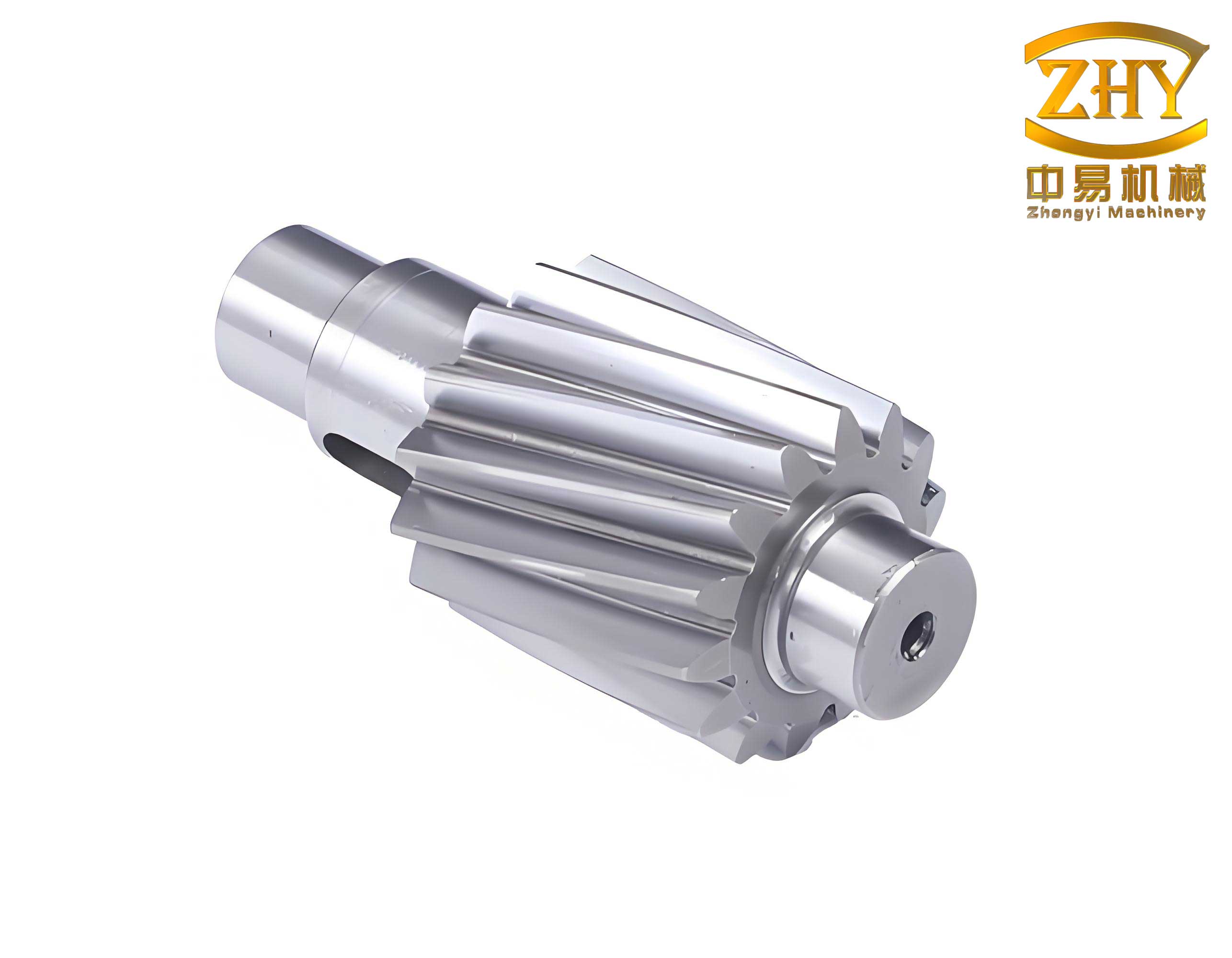
The drum shape, characterized by a crowned tooth flank, requires precise control over tooth direction errors, which is why the improvements in heat treatment and positioning are so impactful. For gear shafts with large helix angles, the lead \( L \) is given by:
$$ L = \frac{\pi \cdot D}{\tan(\beta)} $$
where \( D \) is the pitch diameter and \( \beta \) is the helix angle. In our case, with \( D = 4.158 \) mm and \( \beta = 20^\circ \), \( L \approx 35.8937 \) mm, indicating a significant helical path that must be accurately machined. Any deformation during hobbling can distort this lead, affecting the meshing performance of the gear shafts.
Furthermore, the induction quenching process for gear shafts involves rapid heating to austenitizing temperatures followed by controlled cooling. The depth of hardening \( d_h \) can be estimated using the equation:
$$ d_h = \sqrt{\frac{2 \cdot \alpha \cdot t}{\ln\left(\frac{T_s – T_0}{T_c – T_0}\right)}} $$
where \( \alpha \) is thermal diffusivity, \( t \) is time, \( T_s \) is surface temperature, \( T_c \) is critical temperature, and \( T_0 \) is initial temperature. By adjusting coil design and cooling parameters, \( d_h \) can be optimized to balance hardness and minimal distortion for gear shafts.
In practice, the manufacturing of gear shafts often involves iterative testing. For instance, after implementing the improved induction coil and outer-diameter locating, batch production of drum gear shafts showed consistent accuracy. Statistical analysis of gear parameters revealed that profile and tooth direction errors were uniformly distributed, confirming the stability of the process. This consistency is vital for applications where gear shafts must operate under high torque and冲击 loads, such as in gear couplings or precision drives.
Another aspect worth exploring is the material selection for gear shafts. While this article focuses on processing techniques, the base material—typically alloy steels like AISI 4140 or 4340—also influences machining outcomes. The hardness gradient from surface to core, achieved through induction quenching, must be tailored to withstand operational stresses without compromising machinability. For gear shafts with small modules, the tooth roots are particularly susceptible to stress concentration, so proper heat treatment is essential to prevent cracking or premature failure.
To summarize the key findings, the machining of special drum gear shafts benefits greatly from targeted improvements in both heat treatment and positioning methods. The use of advanced induction coil designs reduces thermal deformation, while outer-diameter locating enhances rigidity during hobbling. These strategies collectively address the challenges posed by small modules, few teeth, and large helix angles, enabling the production of gear shafts that meet high-precision standards.
Looking ahead, further research could delve into digital simulations of the quenching process for gear shafts, using finite element analysis to predict distortion and optimize coil geometries. Additionally, adaptive machining techniques, such as real-time monitoring of cutting forces, could be integrated to dynamically adjust parameters for even greater accuracy. As the demand for high-performance gear shafts grows in industries like aerospace, automotive, and robotics, such advancements will be crucial.
In conclusion, my experience underscores that success in machining specialized gear shafts hinges on a deep understanding of the interplay between material behavior and processing conditions. By refining heat treatment protocols and innovating in fixture design, manufacturers can overcome the inherent difficulties of drum gear shaft production. This not only elevates the quality of gear shafts but also expands their application potential in advanced mechanical systems. The journey toward perfecting these components is ongoing, but with continued focus on precision and innovation, the future for gear shafts looks promising.