
Helical gears are extensively utilized in industrial applications for motion and power transmission, prized for their high load-bearing capacity and smooth operational characteristics. Modifying the tooth profile of gears serves to compensate for meshing interference, thereby reducing impact and transmission error within helical gear systems. Research indicates that the time-varying mesh stiffness (TVMS) and transmission error of a gear pair are primary sources of internal excitation, directly influencing the system’s dynamic performance. Consequently, a thorough investigation into tooth profile modification is essential for enhancing the dynamic behavior of helical gear systems. This paper proposes a novel analytical model for calculating the mesh stiffness of helical gear pairs with modified tooth profiles, based on the slicing principle.
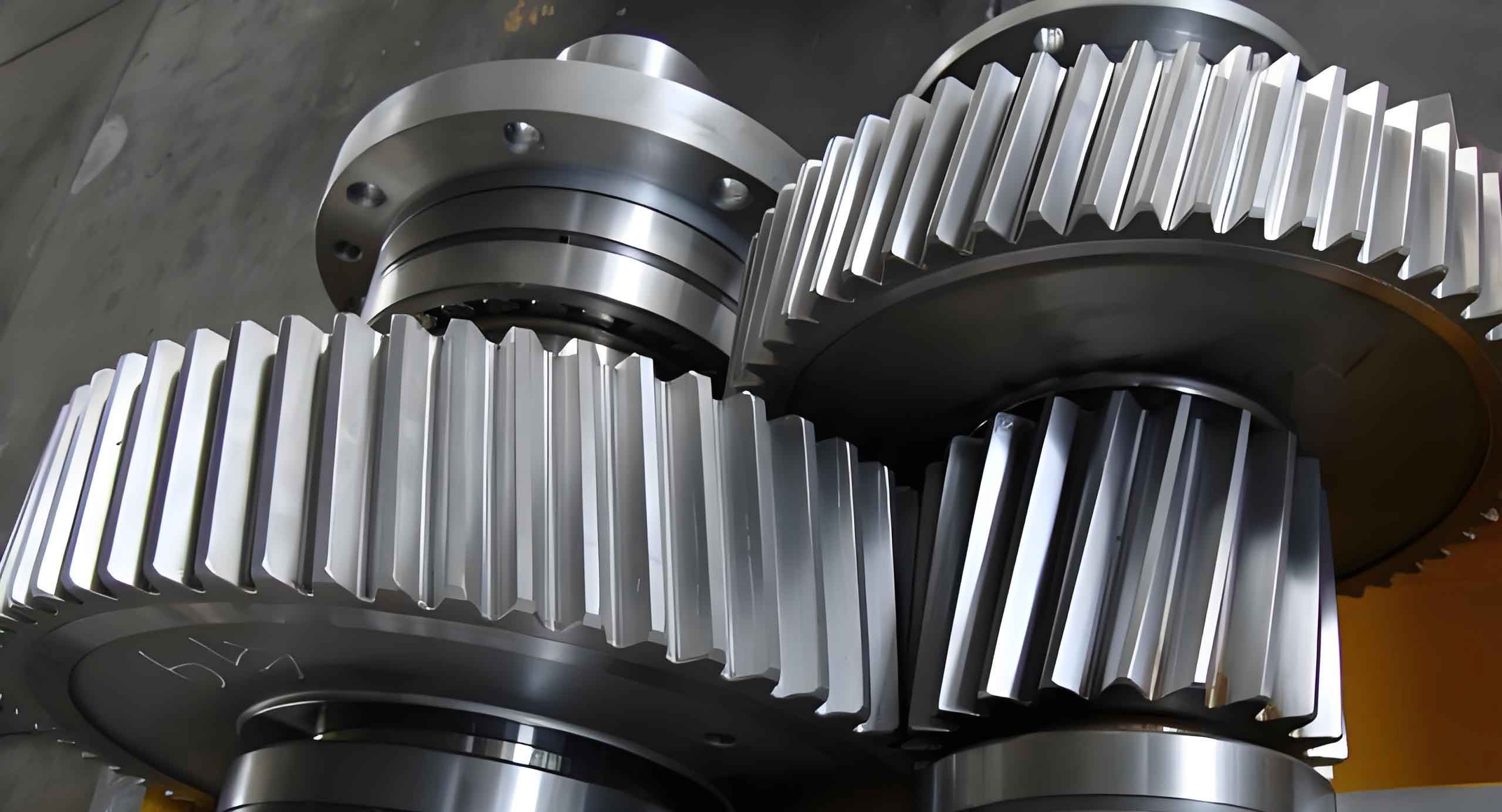
The contact line between the mating surfaces of helical gears is inclined at the helix angle, \(\beta\), relative to the gear axis. This inclination causes the working position of the contact line to shift from one end of the tooth flank to the other during the meshing process. Tooth profile modification typically involves removing a small amount of material from the tip region, deviating from the theoretical involute profile. This adjustment compensates for manufacturing errors and tooth deflections under load, effectively mitigating meshing impacts and reducing transmission error. The modification is defined by the maximum tip relief amount, \(C_a\), the length of the relief region along the path of contact, \(L_a\), and the shape of the relief curve. A linear tip relief profile is commonly adopted, where the modification amount at a distance \(x\) from the start of relief, \(P_s\), is given by:
$$C(x) = C_a \left( \frac{x}{L_a} \right)^s$$
where \(s=1\) for a linear shape.
To model the complex contact in helical gears, the slicing principle is employed. The helical gear is divided into a series of thin slices along its face width. For each infinitesimally thin slice, the helix angle can be neglected, allowing it to be treated as a spur gear. The mesh stiffness of the entire helical gear pair with profile modification, \(k_{hm}\), can be obtained by integrating the mesh stiffness of the modified spur gear slice, \(k_{sm}\), along the instantaneous contact line length, \(L_t\):
$$k_{hm} = \int_{0}^{L_{tmax}} \left( \frac{k_{sm}}{W \cos^2 \beta} \right) dL_t$$
where \(W\) is the gear face width and \(k_{sm}/W\) represents the mesh stiffness per unit width of the modified spur gear pair. The total mesh stiffness of the helical gear pair, \(K_{hm}\), is the sum of the stiffness contributions from all gear pairs in simultaneous contact:
$$K_{hm} = \sum_{j=1}^{N_h} k_{hm_j}$$
Here, \(N_h\) is the maximum number of helical gear pairs in simultaneous contact, determined by the total contact ratio \(\varepsilon_{\gamma} = \varepsilon_{\alpha} + \varepsilon_{\beta}\), where \(\varepsilon_{\alpha}\) is the transverse contact ratio and \(\varepsilon_{\beta}\) is the overlap ratio. The symbol \([\;]\) denotes rounding up to the nearest integer.
The foundation of the model lies in accurately determining the mesh stiffness of a single tooth pair of spur gears with profile modification, \(k_{sm}\). The total mesh stiffness of a modified spur gear pair, \(K_m\), considering the effect of tooth profile errors \(E_{pg}\), is expressed as:
$$K_{m} = \frac{\sum_{i=1}^{N_s} k_i}{1 + \sum_{i=1}^{N_s} k_i E_{pg} / F}$$
where \(F\) is the total meshing force, \(N_s\) is the number of tooth pairs in contact (typically 1 or 2 for spur gears), and \(k_i\) is the mesh stiffness of the \(i\)-th tooth pair with a perfect involute profile. This single-pair stiffness, \(k_i\), combines several elastic components for both the driving and driven gears:
$$k_i = \frac{1}{\frac{1}{k_{b1}} + \frac{1}{k_{s1}} + \frac{1}{k_{a1}} + \frac{1}{k_{f1}} + \frac{1}{k_{b2}} + \frac{1}{k_{s2}} + \frac{1}{k_{a2}} + \frac{1}{k_{f2}} + \frac{1}{k_h}}$$
In this equation, \(k_b\), \(k_s\), \(k_a\), \(k_f\), and \(k_h\) represent the bending, shear, axial compressive, fillet foundation, and Hertzian contact stiffnesses, respectively. These components are calculated using formulas derived from the elastic strain energy of a cantilever beam and Hertzian contact theory. For example, the bending stiffness is given by an integral along the tooth height \(d\):
$$\frac{1}{k_b} = \int_0^d \frac{[(d-x)\cos\alpha – h_g \sin\alpha]^2}{E I_x} dx$$
where \(E\) is Young’s modulus, \(\alpha\) is the pressure angle, \(h_g\) is the half-thickness at the load application point, and \(I_x\) is the area moment of inertia of the cross-section.
The total profile error, \(E_{pg}\), varies with the meshing phase. Considering a double-single-double tooth contact cycle, the error is determined by the relative positions of the mating profiles. For the initial double-tooth contact phase (Phase I), where pair 1 is in the standard profile zone and pair 2 is in the modified zone, the total error is \(E_{pg(12)} = E_2 – E_1\). In the subsequent single-tooth contact phase (Phase II), \(E_{pg} = 0\). In the final double-tooth contact phase (Phase III), where pair 2 exits and pair 3 enters, the total error is \(E_{pg(23)} = E_3 – E_2\). The individual profile errors \(E_1\), \(E_2\), and \(E_3\) are functions of the gear rotation angle \(\theta\) and the modification parameters \(C_a\) and \(L_a\).
Once the total spur gear mesh stiffness \(K_m\) is obtained from the above equations, the mesh stiffness for a single modified spur gear pair, \(k_{sm}\), can be extracted. This is done by subtracting the stiffness of the non-dominant tooth pair during the double-contact phases. Therefore, \(k_{sm}\) is defined piecewise over a meshing cycle:
$$k_{sm} =
\begin{cases}
k_{sm1} = K_m – k_{i-1}, & 0 \le \theta \le \theta_0 \\
k_{sm2} = k_i, & \theta_0 \le \theta \le \theta_2 – \theta_0 \\
k_{sm3} = K_m – k_{i+1}, & \theta_2 – \theta_0 \le \theta \le \theta_2
\end{cases}$$
where \(k_i\) is the stiffness of a perfect involute tooth pair, and \(\theta_0\), \(\theta_2\) are rotation angles corresponding to the modification length and the total double-single-double contact period, respectively.
To apply this to helical gears, the relationship between the contact line length \(L_t\) and the rotation angle \(\theta\) is used: \(dL_t = (W / \cos \beta) / \theta_3 \cdot d\theta\), where \(\theta_3 = 2\pi \varepsilon_{\beta} / N\) is the rotation angle corresponding to the axial contact length. The mesh stiffness for the \(j\)-th single helical gear pair, \(k_{hm_j}\), can then be expressed as an integral over angle:
$$k_{hm_j} = \int_{\theta_{sj}}^{\theta_{ej}} k_{smb} \, d\theta$$
where the integrand \(k_{smb} = k_{sm} (\cos \beta / \theta_3)\), and \(\theta_{sj}\), \(\theta_{ej}\) are the start and end angles of the contact line for the \(j\)-th pair. The integration limits are crucial and depend on the geometric relationship between the axial contact length \(L_{\beta}\), the modification length \(L_a\), and the transverse path of contact length \(L_p\). Based on these relationships, helical gear pairs can be classified into four distinct types, each with a specific set of integration rules for calculating \(k_{hm_j}\).
| Gear Type | Geometric Condition | Angular Condition | Description |
|---|---|---|---|
| Type I | \(L_{\beta} < L_a\) | \(\theta_3 < \theta_0\) | Axial contact length is less than the modification length. |
| Type II | \(L_a < L_{\beta} < L_p – L_a\) | \(\theta_0 < \theta_3 < \theta_2 – \theta_0\) | Axial length is between modification length and the remaining standard profile length. |
| Type III | \(L_p – L_a < L_{\beta} < L_p\) | \(\theta_2 – \theta_0 < \theta_3 < \theta_2\) | Axial length is greater than the remaining standard profile length but less than the full transverse path. |
| Type IV | \(L_{\beta} > L_p\) | \(\theta_3 > \theta_2\) | Axial contact length exceeds the transverse path of contact. |
The piecewise integrals for \(k_{hm_j}\) for each of the four helical gear types are provided in the foundational research. By summing the stiffness contributions \(k_{hm_j}\) for all \(N_h\) pairs in contact according to Equation (3), the total time-varying mesh stiffness \(K_{hm}\) for the modified helical gear pair is obtained. Finally, the loaded static transmission error (LSTE), a key dynamic excitation, can be calculated as:
$$\delta_{LSTE} = \frac{F_N}{K_{hm}} + E_{pg\_min}$$
where \(F_N = T / (r_b \cos \alpha \cos \beta)\) is the normal mesh force (\(T\) is torque, \(r_b\) is base radius), and \(E_{pg\_min}\) is the minimum profile error among the engaging teeth at a given meshing position.
To validate the proposed model, its predictions are compared against established methods for both spur and helical gears. First, the spur gear sub-model is verified. The calculated TVMS for a modified spur gear pair using the proposed method is compared with results obtained from direct application of the total mesh stiffness formula. Two different spur gear models from literature are used for this comparison.
| Parameter | Model I Gear | Model II Gear |
|---|---|---|
| Number of Teeth | 30 | 30 |
| Module (mm) | 2 | 4 |
| Face Width (mm) | 20 | 40 |
| Pressure Angle (°) | 20 | 20 |
| Torque (N·m) | 150 | 98 |
| Contact Ratio \(\varepsilon_{\alpha}\) | 1.65 | 1.61 |
| Relief Amount \(C_a\) (\(\mu m\)) | 32 | 8 |
| Relief Length \(L_a\) (\(\mu m\)) | 960 | 600 |
The results show perfect agreement between the two calculation pathways for the spur gear TVMS, thereby validating the accuracy of the single modified spur gear pair stiffness, \(k_{sm}\), which is the cornerstone of the helical gear model.
Subsequently, the complete helical gear model is validated against published data. The parameters for a low-contact-ratio (LCR) and a high-contact-ratio (HCR) helical gear set are used.
| Parameter | LCR Gears | HCR Gears |
|---|---|---|
| Number of Teeth (Pinion/Gear) | 21 / 49 | 39 / 117 |
| Module (mm) | 5 | 4.5 |
| Face Width (mm) | 16 | 200 |
| Pressure Angle \(\alpha\) (°) | 20 | 20 |
| Helix Angle \(\beta\) (°) | 15 | 13.5 |
| Torque (N·m) | 100 | 600 |
| Total Contact Ratio \(\varepsilon_{\gamma}\) | 1.85 | 4.9 |
| Transverse Ratio \(\varepsilon_{\alpha}\) | 1.58 | 1.71 |
| Overlap Ratio \(\varepsilon_{\beta}\) | 0.27 | 3.19 |
The total mesh stiffness results for the HCR helical gears with various relief lengths \(L_a\) are compared with reference data. The predicted curves align closely with the reference results. A quantitative error analysis on the maximum and average mesh stiffness values confirms the model’s accuracy.
| \(L_a\) (\(\mu m\)) | Max. Stiffness (Proposed) (N/m) | Max. Stiffness (Ref.) (N/m) | Rel. Error (%) | Avg. Stiffness (Proposed) (N/m) | Avg. Stiffness (Ref.) (N/m) | Rel. Error (%) |
|---|---|---|---|---|---|---|
| 932 | 2.21e8 | 2.20e8 | 0.5 | 1.57e8 | 1.61e8 | 2.5 |
| 1600 | 1.89e8 | 1.82e8 | 3.8 | 1.41e8 | 1.44e8 | 2.0 |
| 2200 | 1.37e8 | 1.33e8 | 3.0 | 1.25e8 | 1.29e8 | 3.1 |
| 2800 | 1.27e8 | 1.26e8 | 0.8 | 1.10e8 | 1.23e8 | 2.7 |
The minor discrepancies can be attributed to differences in modeling assumptions, such as the treatment of the instantaneous contact line length under modification and the use of a nonlinear Hertzian contact stiffness in the proposed model versus a potential linear approximation in the reference.
Using the validated model, the influence of tooth profile modification on the TVMS and LSTE of helical gears is investigated. The modification parameters are normalized: \(C_n = C_a / C_{a\_max}\) and \(L_n = L_a / L_{a\_max}\). The analysis focuses on the LCR (\(\varepsilon_{\gamma}=1.85\)) and HCR (\(\varepsilon_{\gamma}=4.9\)) gear sets. The single-pair mesh stiffness for modified spur gears, which forms the basis of the helical gear integral, exhibits distinct characteristics in the double- and single-tooth contact regions, with the transitions smoothed by the modification.
For the LCR helical gears (Type III), a maximum of two pairs are in contact simultaneously. For the HCR helical gears (Type IV), up to five pairs can be in contact. A key observation is that as the total contact ratio increases, the fluctuation of mesh stiffness over a meshing cycle diminishes significantly, leading to inherently smoother operation of high-contact-ratio helical gears.
The effects of varying the normalized relief length \(L_n\) (with \(C_n=1\)) and relief amount \(C_n\) (with \(L_n=0.4\)) are systematically studied. The cases where \(L_n=0\) or \(C_n=0\) represent standard, unmodified gears. The results demonstrate that both the length and amount of profile modification profoundly affect the proportion of single and multi-tooth contact within a cycle, the smoothness of stiffness transitions, and the overall magnitude of stiffness and transmission error.
| Trend | Effect on TVMS | Effect on LSTE |
|---|---|---|
| Increasing \(L_n\) or \(C_n\) | Smoother transitions between contact phases. Reduced average mesh stiffness. Smaller amplitude of stiffness fluctuation. | Reduced amplitude of transmission error fluctuation. |
| Large \(L_n\) & \(C_n\) | Mesh stiffness and LSTE become nearly constant over the cycle. | Very low dynamic excitation, beneficial for noise reduction. |
This presents a design trade-off. While extensive profile modification minimizes mesh stiffness variation and transmission error fluctuation—thereby reducing vibration and noise—it also lowers the average mesh stiffness. A lower average stiffness implies reduced load-sharing capacity and potentially higher overall elastic deflections. Therefore, optimizing the profile modification for helical gears requires a balanced consideration of dynamic performance (minimizing excitation) and static load capacity (maintaining sufficient stiffness).
In conclusion, a novel analytical model for the time-varying mesh stiffness of helical gear pairs with tooth profile modification has been established based on the slicing principle. The model classifies helical gears into four geometric types and provides a convenient integral formula for calculating mesh stiffness, eliminating the need to determine the meshing state and individual stiffness for each sliced spur gear pair. The method has been validated against established models, confirming its accuracy and efficiency. The analysis of helical gears with different contact ratios reveals that profile modification effectively smoothes mesh stiffness transitions and reduces transmission error fluctuation, with the effects becoming more pronounced as the modification extent increases. However, this comes at the cost of a reduced average mesh stiffness, highlighting the essential compromise in the design of modified helical gears for optimal dynamic and static performance.