
The design of bevel gear transmission systems is a fundamental yet complex task in mechanical engineering, involving numerous interdependent parameters and stringent performance constraints. Traditional design methodologies often rely on iterative manual calculations or simplified optimization approaches, which can be time-consuming, inefficient, and may not guarantee a globally optimal solution. The need for lightweight, reliable, and cost-effective mechanical components further intensifies the challenge. This article presents a comprehensive study on an advanced optimization design system developed to address these challenges. The core of the system integrates a Genetic Algorithm (GA) for global optimization, specifically tailored with fuzzy reliability constraints for the bevel gear pair, within a web-based architecture built on the .NET platform. This integration aims to automate and enhance the design process, enabling efficient exploration of the design space to find the optimal bevel gear parameters that minimize volume while ensuring operational reliability under uncertain conditions.
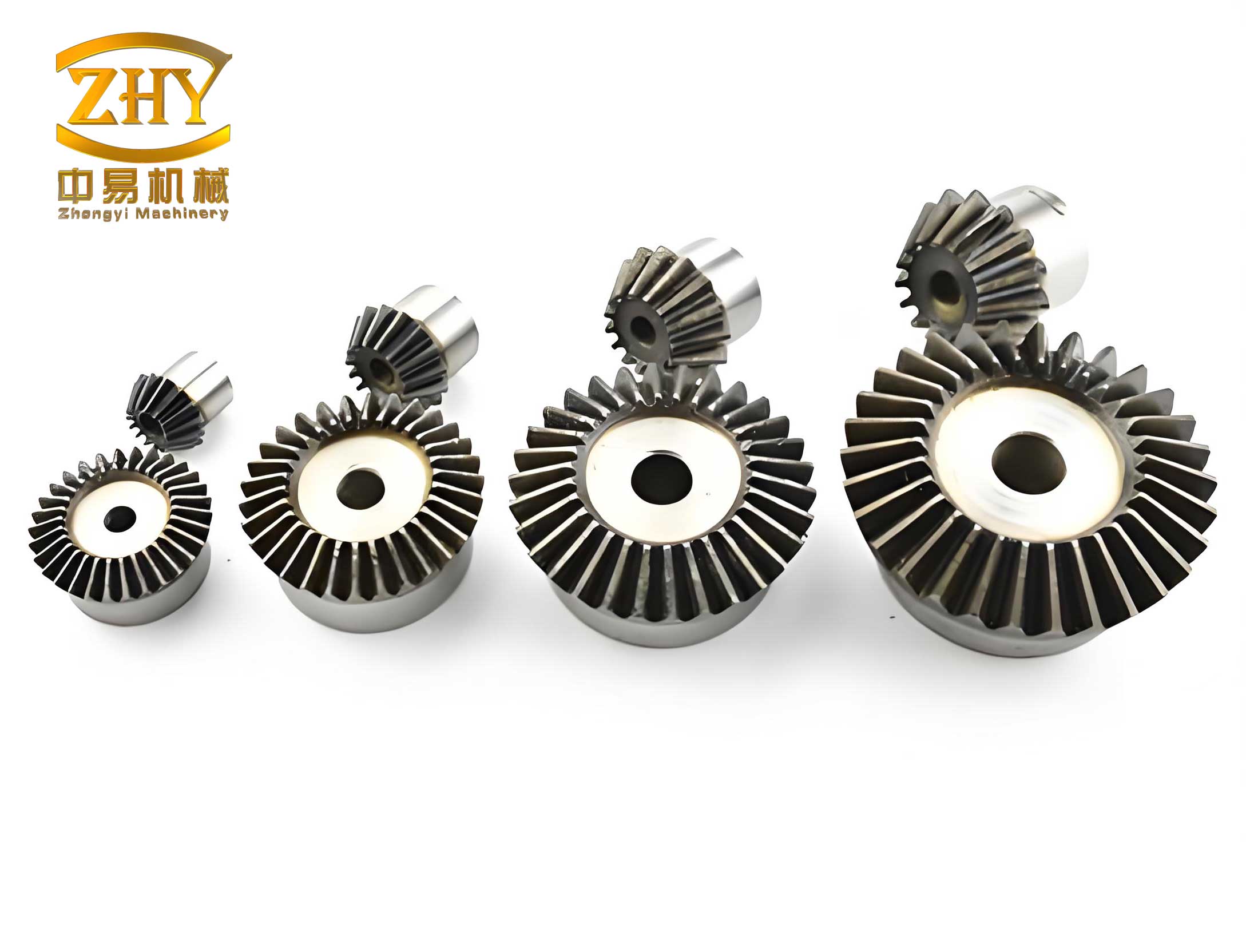
The bevel gear is a crucial component for transmitting power and motion between intersecting shafts, typically at a 90-degree angle. Its design optimization must balance factors such as geometric dimensions, material strength, and load capacity. Conventional optimization techniques can struggle with the nonlinear, multi-modal nature of the bevel gear design problem. Genetic Algorithms, inspired by natural selection, offer a robust alternative for such complex, discontinuous search spaces. When combined with the concept of fuzzy reliability—which accounts for the probabilistic nature of stresses and the fuzziness of strength limits—the optimization model becomes more realistic and robust compared to deterministic safety-factor approaches.
The proposed system is architected using a Browser/Server (B/S) model, which allows for remote access and utilization of the optimization tools via a standard web browser. The front-end, developed with .NET technologies, provides an intuitive interface for parameter input and result visualization. The computationally intensive optimization engine, implemented in MATLAB, is encapsulated and invoked remotely. This hybrid programming approach leverages the strengths of C# for web application development and MATLAB for powerful mathematical modeling and algorithm execution. The communication between the client-side browser and the server-side MATLAB routines is facilitated through specially constructed project files and web services, enabling seamless data transfer and algorithm invocation. This framework not only streamlines the bevel gear design process but also makes advanced optimization techniques accessible in a collaborative, network-based environment.
System Architecture and Key Technologies
The optimization system is built upon a three-tier B/S architecture, which effectively separates concerns and enhances scalability and maintainability. The tiers are: the Presentation Layer, the Business Logic Layer, and the Data Access Layer.
The Presentation Layer is the user interface rendered in the web browser. It is responsible for capturing user inputs, such as the power rating, speed, material properties, and desired reliability level for the bevel gear transmission, and for displaying the final optimization results, including plots of the genetic algorithm’s convergence. Technologies like AJAX (Asynchronous JavaScript and XML) are employed to enable dynamic, partial page updates without requiring a full reload, improving user interactivity. The Document Object Model (DOM) is manipulated to refresh the display with new data received from the server.
The Business Logic Layer, hosted on a web server, acts as the intermediary. It receives requests from the presentation layer, processes them, and coordinates tasks. Its primary role in this system is to handle the request to perform an optimization. It packages the input parameters into a suitable format and calls upon the services provided by the Data Access Layer.
The Data Access Layer is where the core optimization algorithm resides. This layer is responsible for communicating with the MATLAB runtime environment. It passes the design parameters to a pre-compiled MATLAB function (an .m file) that contains the genetic algorithm optimization routine tailored for the bevel gear problem. After the optimization is complete, this layer retrieves the results and passes them back up through the Business Logic Layer to the user’s browser. The key technological enabler here is the creation of a .NET Assembly from the MATLAB code, allowing C# applications to call MATLAB functions as if they were native .NET methods. This involves generating a Dynamic Link Library (DLL) from the MATLAB project and adding references to it within the Visual Studio project, along with the necessary MATLAB .NET utility libraries for data type conversion (e.g., `MWNumericArray`).
Mathematical Model for Bevel Gear Optimization Using Genetic Algorithm
The success of the system hinges on a well-defined mathematical model. The optimization problem is formulated to minimize the total volume of a pair of straight bevel gears—a direct proxy for lightweight design—subject to constraints that ensure safe operation under fuzzy reliability criteria.
Design Variables
The independent variables that define the geometry of the bevel gear pair and are optimized by the genetic algorithm are:
$$ \mathbf{x} = (z_1, m, \psi_R)^T = (x_1, x_2, x_3)^T $$
where:
- $z_1$ is the number of teeth on the pinion (smaller gear).
- $m$ is the module at the large end of the bevel gear.
- $\psi_R$ is the face width factor, where the face width $b = \psi_R \cdot R$ and $R$ is the cone distance.
These variables have practical bounds: $17\cos\delta_1 \leq z_1 \leq z_{1_{max}}$, $2 \leq m \leq m_{max}$, and $0.25 \leq \psi_R \leq 0.30$, where $\delta_1$ is the pitch angle of the pinion.
Objective Function (Fitness Function)
The objective is to minimize the total volume $V_{total}$ of the gear pair. The fitness function for the genetic algorithm is defined as:
$$ \text{fitnessfun} = V_1 + V_2 $$
where the volume of the pinion ($V_1$) and the gear ($V_2$) are approximated by the volume of their frustums:
$$ V_1 = \frac{\pi}{3} b \cos\delta_1 \left[ \left( \frac{m z_1}{2} \right)^2 + \frac{m z_1}{2} \cdot \frac{(R-b)}{R} \cdot \frac{m z_1}{2} + \left( \frac{(R-b)}{R} \cdot \frac{m z_1}{2} \right)^2 \right] $$
$$ V_2 = \frac{\pi}{3} b \cos\delta_2 \left[ \left( \frac{m z_2}{2} \right)^2 + \frac{m z_2}{2} \cdot \frac{(R-b)}{R} \cdot \frac{m z_2}{2} + \left( \frac{(R-b)}{R} \cdot \frac{m z_2}{2} \right)^2 \right] $$
Here, $z_2$ is the number of teeth on the gear, $u = z_2/z_1$ is the gear ratio, $\delta_2$ is the pitch angle of the gear, and the cone distance $R$ is given by $R = \frac{m}{2} \sqrt{z_1^2 + z_2^2}$.
Fuzzy Reliability Constraints
Instead of traditional deterministic safety factors, the model employs fuzzy reliability constraints for contact fatigue strength and bending fatigue strength. This approach recognizes that both the applied stress and the material strength are not fixed values but have probabilistic distributions and fuzzy boundaries.
Let the stress (contact or bending) be a random variable following a normal distribution with probability density function $f(x)$. The fatigue strength limit is treated as a fuzzy variable with a normal membership function $\mu_A(x)$:
$$ f(x) = \frac{1}{\sqrt{2\pi}\sigma_x} \exp\left[ -\frac{(x – \mu_x)^2}{2\sigma_x^2} \right] $$
$$ \mu_A(x) = \exp\left[ -\frac{(x – a)^2}{D} \right] $$
where $a$ and $D$ are parameters determined from the fatigue limit curve (e.g., Gerber equation), and $\mu_x, \sigma_x$ are the mean and standard deviation of the stress.
The fuzzy failure probability $P_x(A)$ for a given stress mode (contact $H$ or bending $F$) is derived by integrating over the fuzzy strength domain:
$$ P_x(A) = \sqrt{\frac{D}{2\sigma_x^2 + D}} \cdot \exp\left[ -\frac{(a – \mu_x)^2}{2\sigma_x^2 + D} \right] \cdot \left[ \Phi(y_1) + \Phi(y_2) \right] $$
where $\Phi(\cdot)$ is the standard normal cumulative distribution function, and
$$ y_i = \left( \frac{2\sigma_x^2 + D}{D \sigma_x^2} \right)^{1/2} \cdot \left( c_i – \frac{2a\sigma_x^2 + D \cdot \mu_x}{2\sigma_x^2 + D} \right), \quad i=1,2 $$
with $[c_1, c_2]$ defining the domain of the membership function $\mu_A(x)$.
If the required system reliability is $R’$, the nonlinear constraint for contact fatigue strength ($Nic_1$) and bending fatigue strength ($Nic_2$) are formulated as:
$$ Nic_1 = 1 – P_H(A) – R’ \geq 0 $$
$$ Nic_2 = 1 – P_F(A) – R’ \geq 0 $$
These constraints are passed to the genetic algorithm, ensuring the optimal bevel gear design meets the specified fuzzy reliability target.
Genetic Algorithm Implementation
The MATLAB `ga` function is used to solve this constrained optimization problem. The function call is structured as:
[x_opt, fval, output] = ga(@fitnessfun, nvars, [], [], [], [], Lb, Ub, @nonlcon, options)
Where `@fitnessfun` is the handle for the volume function, `nvars=3`, `Lb` and `Ub` are the lower and upper bounds of the design variables, and `@nonlcon` is the function that returns the fuzzy reliability constraints $Nic_1$ and $Nic_2$. The algorithm’s parameters (population size, crossover rate, mutation rate, etc.) are configured in the `options` structure to balance exploration and convergence.
System Implementation and Case Study Analysis
The system was developed using MATLAB 2013a for the algorithm, Visual Studio 2012 for the .NET web application, and deployed on a Windows Server platform. The user interface is divided into a navigation area, a help section, and a main parameter input section. For a case study, a closed straight bevel gear drive with a shaft angle $\Sigma = 90^\circ$ was optimized. The goal was to minimize the bevel gear pair volume subject to a fuzzy reliability greater than 0.995.
The user inputs parameters such as transmitted power, pinion speed, gear ratio, material properties (mean and deviation of strength), and the target reliability. Upon submission, the request is processed through the .NET layers, the MATLAB genetic algorithm is executed, and the results are fetched back.
The results interface displays critical information:
- Optimization Progress: A plot showing the best and mean fitness value across generations, demonstrating the convergence of the genetic algorithm for the bevel gear problem.
- Optimal Design Variables: The best-found values for $z_1$, $m$, and $\psi_R$ before and after practical rounding (e.g., rounding tooth count to an integer).
- Optimal Fitness Value: The minimized total volume of the bevel gear pair.
In the presented case, the genetic algorithm converged after approximately 95 generations. The optimal solution before rounding was found near $(z_1, m, \psi_R) \approx (19.77, 2.0, 0.25)$. After practical rounding of the pinion teeth to $z_1 = 20$, the final optimal bevel gear parameters were:
$$ \mathbf{x^*} = (20, 2.0, 0.25)^T $$
with a minimized total volume $f(\mathbf{x^*}) = 58,119.2 \text{ mm}^3$.
Validation and Comparative Analysis
To validate the system’s results, the same fuzzy-reliability-constrained problem was solved directly in MATLAB using a conventional nonlinear constraint solver (`fmincon`). The results were in close agreement, as shown in Table 1. This confirms the correctness of the genetic algorithm implementation within the web system. Notably, the genetic algorithm, while achieving a comparable optimum, offers advantages in global search capability for such non-convex problems.
| Optimization Method | Pinion Teeth ($z_1$) | Module ($m$) | Face Width Factor ($\psi_R$) | Objective Value (mm³) | Computational Load |
|---|---|---|---|---|---|
| fmincon Function (Fuzzy Reliability) | 19.63 (unrounded) | 2.0 | 0.25 | 56,653.1 | Higher |
| fmincon Function (Rounded) | 20 | 2.0 | 0.25 | 58,119.2 | Higher |
| Genetic Algorithm (Proposed System) | 19.77 (unrounded) | 2.0 | 0.25 | 56,615.2 | Moderate/Lower |
| Genetic Algorithm Final (Rounded) | 20 | 2.0 | 0.25 | 58,119.2 | Moderate/Lower |
Furthermore, the superiority of the fuzzy reliability constraint over a traditional deterministic constraint based solely on contact and bending strength formulas was investigated. As illustrated in Table 2, a design optimized with traditional constraints, while meeting basic strength checks, resulted in a significantly lower fuzzy reliability (~0.890). In contrast, the proposed system’s design, optimized explicitly for fuzzy reliability, met all strength criteria and achieved the target reliability >0.995. This demonstrates that a deterministic approach can lead to an under-designed bevel gear from a reliability perspective, while the fuzzy reliability model provides a more robust and safer design optimization framework for the bevel gear transmission.
| Constraint Type in GA | Pinion Teeth ($z_1$) | Module ($m$) | Face Width Factor ($\psi_R$) | Volume (mm³) | Contact Strength | Bending Strength | Fuzzy Reliability |
|---|---|---|---|---|---|---|---|
| Fuzzy Reliability | 20 | 2.0 | 0.25 | 58,119.2 | Pass | Pass | > 0.995 |
| Traditional Deterministic | 19 | 2.0 | 0.25 | 49,830.6 | Pass | Pass | ~0.890 |
Conclusion
This research successfully developed and demonstrated a web-based optimal design system for bevel gear transmission. The system effectively integrates a global search Genetic Algorithm, enhanced with sophisticated fuzzy reliability constraints for the bevel gear pair, into a user-accessible .NET platform using a B/S architecture. The implementation of hybrid C# and MATLAB programming facilitates robust numerical computation and seamless web interaction. The case study confirms that the system can efficiently find optimal bevel gear parameters—minimizing material volume while guaranteeing a specified level of operational reliability under realistic uncertainties. The comparative analysis validates the results and underscores the critical advantage of using fuzzy reliability constraints over traditional methods for designing a reliable bevel gear system. This system offers a significant step forward in making advanced, reliable bevel gear design optimization more efficient, accessible, and controllable within modern, collaborative engineering environments.