
The gear pump stands as a fundamental and widely utilized component in hydraulic systems. Its operation principle relies on the meshing and rotation of a gear pair to transfer fluid from a low-pressure inlet chamber to a high-pressure outlet chamber. Among various hydraulic pump types, the gear pump is favored for its simple and compact structure, small volume, excellent self-priming capability, insensitivity to fluid contamination, reliable operation, ease of maintenance, low cost, and suitability for high-speed rotation. Consequently, it finds extensive application in engineering machinery, agricultural equipment, and numerous industrial fields. However, a significant inherent drawback limits the performance and lifespan of conventional gear pumps: unbalanced radial force. During operation, the outlet pressure acts to push the gears towards the inlet side. This pressure differential across the gear circumference generates a substantial net radial force on the gear shafts. This force leads to shaft deflection, potentially causing a phenomenon known as “scraping” or contact between the gear tips and the pump housing. This increases friction and wear in the moving pairs and imposes a heavy load on the supporting bearings. As the required output pressure increases, this radial imbalance becomes more severe, directly compromising the pump’s performance and service life. Therefore, mitigating or eliminating radial force is a critical challenge in advancing gear pump technology.
The harmonic drive gear pump represents an innovative design that combines the principles of harmonic gear transmission with the functionality of a gear pump. This novel integration effectively addresses the radial force imbalance. In a harmonic drive gear pump, the key components are a rigid circular spline (刚轮), a flexible spline or “flexspline” (柔轮), and a wave generator. The fundamental innovation lies in the symmetrical placement of two identical inlet and two identical outlet ports. By situating the pressure ports diametrically opposite each other, the radial hydraulic forces generated are largely counterbalanced, significantly reducing the net radial load on the bearings and thereby extending the pump’s operational life.
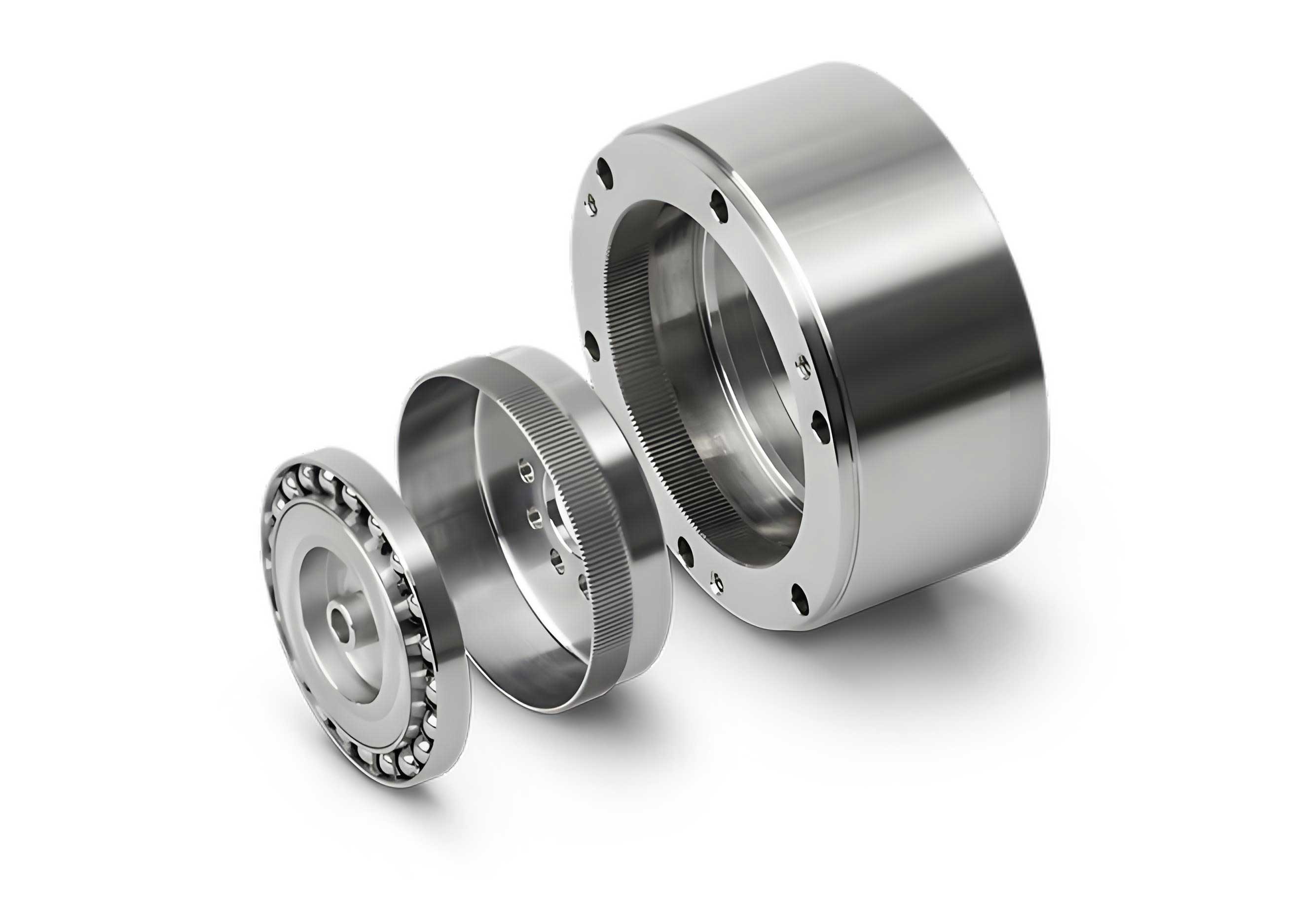
The operating principle of the harmonic drive gear pump can be described as follows. A pair of partition plates is installed between the rigid circular spline and the flexspline to separate the low-pressure and high-pressure chambers. The wave generator is typically held stationary. When the rigid circular spline rotates clockwise, it causes the flexspline to deform and rotate in the same direction due to the wave generator’s action. As the gear teeth disengage near the inlet ports, the sealed volume between teeth increases, creating a vacuum. Hydraulic fluid is then drawn into these expanding tooth spaces from the inlet ports under atmospheric pressure. The fluid-filled tooth spaces are carried by the rotation of the flexspline and rigid spline towards the outlet zone. In the outlet region, the teeth of the flexspline and rigid circular spline gradually re-engage. This re-engagement reduces the volume between the meshing teeth, compressing the trapped fluid and generating high pressure. The pressurized fluid is then forced out through the outlet ports and into the hydraulic system. This process repeats continuously with each revolution, providing a steady flow.
Selection of Tooth Profile Type for Harmonic Drive Gears
The tooth profile geometry of a gear pump has a profound impact on its manufacturability, performance characteristics, noise generation, and efficiency. For the harmonic drive gear pump, the choice of tooth profile is crucial as it must accommodate the elastic deformation of the flexspline while maintaining effective sealing and smooth force transmission. Among known profile types, the involute profile is the most prevalent in general gearing and offers distinct advantages for this application.
The selection of an involute profile for a harmonic drive gear pump is primarily justified by two factors. First, within the context of the harmonic drive gear pump’s operation, the involute profile approximates a straight-sided form over the active meshing region. The slight deviation from a perfect straight line does not fundamentally impair the transmission principle or the pumping action. Second, involute gears benefit from well-established and relatively simple machining processes. Standard gear manufacturing techniques, with minor modifications, can be readily adapted for producing the special gears required for harmonic drives, making the involute profile economically and practically viable.
Involute profiles for harmonic drives are generally categorized into two main types, as summarized in the table below:
| Profile Type | Description | Key Characteristics |
|---|---|---|
| Involute Narrow-Slot Tooth | The tooth space width at the root circle is significantly smaller than the tooth thickness. | Widely adopted due to its manufacturing advantages and sufficient strength. |
| Involute Wide-Slot Tooth | The tooth space width at the root circle is close to or greater than the tooth thickness. It is a modified form of the standard involute. | Involves reducing tooth height (shortening addendum and dedendum) to alleviate stress concentration at the tooth root, a critical concern for the flexspline. |
Regardless of whether a narrow-slot or wide-slot design is used, a standard involute profile in a harmonic drive gear mesh exhibits specific contact characteristics. Under no-load conditions, only a few pairs of teeth are in simultaneous contact. When transmitting torque, the number of teeth in contact increases significantly due to the flexspline’s deformation; however, many of these teeth are in a state of “semi-meshing” or partial contact. This imperfect contact condition is not ideal for the formation of a durable lubricating film between tooth surfaces and can lead to increased wear and reduced efficiency. To optimize the performance and longevity of the harmonic drive gear pump, it is essential to apply a controlled modification, or “profile correction,” to the standard involute. This process, known as tooth flank modification or tip/root relief, involves slightly altering the ideal involute shape near the tips and roots of the teeth. The purpose is to compensate for manufacturing errors, elastic deformations under load (especially of the flexspline), and misalignments, thereby promoting smoother engagement, reducing edge loading, improving the contact pattern, and minimizing noise and vibration. For the harmonic drive gear pump, a properly modified involute profile offers the best compromise between performance, manufacturability, and durability. The modification parameters must be carefully designed considering the unique elastic deformation cycle of the flexspline during operation.
Derivation of Tooth Profile Curve Equations for the Harmonic Drive Gear Pump
To accurately model, analyze, and manufacture the components of a harmonic drive gear pump, precise mathematical descriptions of the tooth profiles for both the rigid circular spline and the flexspline are indispensable. The derivation must account for the kinematic relationship between the parts and the controlled deformation of the flexspline induced by the wave generator.
Fundamental Assumptions
To simplify the complex analysis while retaining essential accuracy for the meshing geometry, the following reasonable assumptions are made:
- Constant Neutral Curve Length: During operation, the length of the neutral curve (or middle layer) of the flexspline wall neither elongates nor contracts. This implies that the strain in the circumferential direction at the neutral layer is zero.
- Rigid Tooth, Deforming Space: The shape of the individual teeth on the flexspline remains unchanged during deformation. The deformation is assumed to occur primarily in the tooth spaces or the body of the flexspline between teeth.
- Planar Deformation: The deformation of the flexspline is confined to the cross-sectional plane. Consequently, the symmetrical longitudinal profile of a tooth remains a plane after deformation.
- Steady Elastic Deformation: The elastic deformation pattern of the flexspline’s neutral curve, imposed by the wave generator, remains constant during steady-state operation. This means the shape of the deformed neutral curve relative to the wave generator is fixed.
These assumptions allow us to treat the flexspline’s motion as the rolling of its undeformed neutral curve along a “base curve” defined by the wave generator’s shape, plus an additional rotational component.
Coordinate System Establishment
We consider the flexspline as the driving member. For kinematic analysis under no-load conditions, the presence of the rigid circular spline does not affect the position and motion of the flexspline tooth profiles. The wave generator’s effect is represented solely by its “base curve” or “cam curve,” denoted as curve \( c \).
Since the motion of every tooth on the flexspline is identical except for a phase difference, analyzing a single representative tooth is sufficient. The following coordinate systems are established, as conceptually illustrated in the accompanying figure (note: the figure link is placed earlier in the article).
- Fixed Coordinate System {xoy}: This system is fixed to the wave generator. The origin \( o \) is at the center of the wave generator. The \( y \)-axis coincides with the major axis of the elliptical wave generator (or the defined major axis for other shapes).
- Moving Coordinate System {x₁o₁y₁}: This system is rigidly attached to the flexspline tooth being analyzed. The origin \( o₁ \) is located on the neutral curve \( c \) of the deformed flexspline. The \( y₁ \)-axis lies along the symmetrical centerline of the flexspline tooth.
- Moving Coordinate System {x₂o₂y₂}: This system is rigidly attached to the corresponding tooth space on the rigid circular spline. The origin \( o₂ \) is at the rotation center of the rigid circular spline. The \( y₂ \)-axis lies along the symmetrical centerline of the rigid spline’s tooth space.
When the flexspline rotates clockwise with an angular velocity \( \omega_1 \), it rolls along the surface of the fixed wave generator. This motion induces the rotation of the rigid circular spline. The motion of a flexspline tooth is thus a composite motion: translation along the base curve \( c \) and an additional rotation about point \( o₁ \).
Let \( (x_1, y_1) \) and \( (x_2, y_2) \) represent the coordinates of a point on the flexspline tooth profile in system {x₁o₁y₁} and on the rigid spline tooth profile in system {x₂o₂y₂}, respectively. Their coordinates in the fixed system {xoy} are found through coordinate transformations.
The transformation from the flexspline tooth system to the fixed system is given by:
$$
\begin{bmatrix} x_{1f} \\ y_{1f} \\ 1 \end{bmatrix} = \mathbf{M_{01}} \begin{bmatrix} x_1 \\ y_1 \\ 1 \end{bmatrix}
$$
where \( (x_{1f}, y_{1f}) \) are the coordinates in {xoy}, and the transformation matrix \( \mathbf{M_{01}} \) is:
$$
\mathbf{M_{01}} = \begin{bmatrix}
\cos\psi & -\sin\psi & \rho_1 \cos\varphi_1 \\
\sin\psi & \cos\psi & \rho_1 \sin\varphi_1 \\
0 & 0 & 1
\end{bmatrix}
$$
Similarly, the transformation from the rigid spline system to the fixed system is:
$$
\begin{bmatrix} x_{2f} \\ y_{2f} \\ 1 \end{bmatrix} = \mathbf{M_{02}} \begin{bmatrix} x_2 \\ y_2 \\ 1 \end{bmatrix}
$$
with the transformation matrix \( \mathbf{M_{02}} \):
$$
\mathbf{M_{02}} = \begin{bmatrix}
\cos\varphi_2 & -\sin\varphi_2 & 0 \\
\sin\varphi_2 & \cos\varphi_2 & 0 \\
0 & 0 & 1
\end{bmatrix}
$$
Geometric and Angular Relationships
The geometry is defined by a wave generator, most commonly elliptical. The parameter equations for an ellipse are:
$$ x = b \sin t, \quad y = a \cos t $$
where \( a \) and \( b \) are the semi-major and semi-minor axes, and \( t \) is an angular parameter. In polar coordinates \( (\rho, \varphi_H) \) relative to the fixed system {xoy}, the ellipse equation is:
$$ \rho = \frac{ab}{\sqrt{a^2 \sin^2 \varphi_H + b^2 \cos^2 \varphi_H}} $$
Here, \( \rho \) is the radial distance from origin \( o \) to a point \( H \) on the cam surface, and \( \varphi_H \) is its polar angle measured from the x-axis.
The following key angles are derived from the geometry of the harmonic drive gear assembly, linking the various coordinate systems:
- Angle \( \psi \): The angle between the fixed system {xoy} and the flexspline tooth system {x₁o₁y₁}. It defines the orientation of the flexspline tooth relative to the fixed axes.
$$ \psi = \arctan\left( \sqrt{\frac{a^2}{b^2}} \tan \varphi_H \right) $$ - Rigid Spline Rotation Angle \( \varphi_2 \): Related to the flexspline rotation angle \( \varphi \) by the gear ratio.
$$ \varphi_2 = \frac{z_1}{z_2} \varphi $$
where \( z_1 \) and \( z_2 \) are the number of teeth on the flexspline and rigid circular spline, respectively. Typically, \( z_2 – z_1 = 2n \), where \( n \) is the wave number (often 2 for an elliptical generator). - Radial Distance \( \rho_1 \): The radial distance from the fixed origin \( o \) to the origin \( o_1 \) on the flexspline’s neutral curve \( c \). If \( e \) is the wall thickness of the flexspline, then:
$$ \rho_1 = \sqrt{e^2 + \rho^2 + 2e\rho \cos\mu} $$ - Angle \( \mu \): The angle between the flexspline tooth centerline (y₁-axis) and the radial line \( \rho \) to the cam contact point \( H \).
$$ \mu = \psi – \varphi_H $$ - Angle \( \mu_1 \): A smaller angle (generally \( \mu_1 \le 2^\circ \)) between the flexspline tooth centerline (y₁-axis) and the radial line \( \rho_1 \) to its own origin \( o_1 \). It can be approximated as:
$$ \mu_1 \approx \arcsin\left( \frac{\rho}{\rho_1} \sin \mu \right) \quad \text{or} \quad \mu_1 \approx \frac{\rho}{\rho_1} \sin \mu $$ - Angle \( \gamma \): The small angle between the two radial lines \( \rho \) and \( \rho_1 \).
$$ \gamma = \mu – \mu_1 $$ - Polar Angle \( \varphi_1 \): The polar angle of point \( o_1 \) on the neutral curve.
$$ \varphi_1 = \varphi_H + \gamma $$
In these definitions, \( \varphi, \varphi_H, \varphi_1, \varphi_2, \gamma \) are directed angles, positive in the direction of \( \omega_1 \). Angles \( \mu \) and \( \mu_1 \) are also directed, typically positive in the clockwise direction.
Derivation of Tooth Profile Equations
The goal is to express the tooth profiles in their respective body-attached coordinate systems {x₁o₁y₁} and {x₂o₂y₂}. We start with the standard parametric equation for an involute curve. For simplicity, a local coordinate system {x₀o₀y₀} is first defined with its origin at the gear’s center and its y₀-axis passing through the midpoint of the tooth (or tooth space). The parametric equations for the left-side flank of an involute tooth in this local system are:
$$
\begin{aligned}
x_0 &= r_b (\sin u – u \cos \alpha_0 \cos(u + \alpha_0)) \\
y_0 &= r_b (\cos u + u \cos \alpha_0 \sin(u + \alpha_0))
\end{aligned}
$$
where:
- \( r_b = r \cos \alpha_0 \) is the base circle radius, with \( r = m z / 2 \) being the standard pitch radius (for a non-standard or profile-shifted gear, \( r \) is the operating pitch radius or a reference radius).
- \( \alpha_0 \) is the standard pressure angle (e.g., 20°).
- \( u \) is the involute roll angle parameter, related to the pressure angle \( \alpha_k \) at any point on the involute by \( u = \tan \alpha_k – \tan \alpha_0 \).
To position this involute correctly on the gear, a rotation by an angle \( \theta \) is applied to align the tooth’s symmetry axis with the y-axis of the target system {xoy}. After this rotation, the equations for the left-side flank in a coordinate system centered on the gear become:
$$
\begin{aligned}
x &= r_b [\sin(u – \theta) – u \cos \alpha_0 \cos(u – \theta + \alpha_0)] \\
y &= r_b [\cos(u – \theta) + u \cos \alpha_0 \sin(u – \theta + \alpha_0)]
\end{aligned}
$$
Correspondingly, the right-side flank equation is:
$$
\begin{aligned}
x &= r_b [-\sin(u – \theta) + u \cos \alpha_0 \cos(u – \theta + \alpha_0)] \\
y &= r_b [\cos(u – \theta) + u \cos \alpha_0 \sin(u – \theta + \alpha_0)]
\end{aligned}
$$
The angle \( \theta \) is determined by the tooth’s angular position. For a standard gear, the half-tooth thickness angle on the pitch circle is \( s / (2r) \), where \( s \) is the circular tooth thickness. For a profile-shifted gear, the tooth thickness is calculated as:
$$ s = m \left( \frac{\pi}{2} + 2x \tan \alpha_0 \right) $$
where \( x \) is the profile shift coefficient. Therefore, \( \theta = s / (mz) \) on the reference circle.
Now, applying the inverse of the transformation developed earlier, we can find the tooth profile coordinates in the body-attached systems. The process involves taking a point defined by the involute equations in a reference position and subjecting it to the composite motion (in reverse) to find its coordinates relative to the moving tooth.
For the flexspline (subscript 1), the right-side tooth profile equation in its attached system {x₁o₁y₁} is derived as:
$$
\begin{aligned}
x_1 &= r_{b1} \left[ \sin(\psi – (u_1 – \theta_1)) + u_1 \cos \alpha_0 \cos(\psi – (u_1 – \theta_1) + \alpha_0) \right] + \rho_1 \sin \varphi_1 – r_m \sin \psi \\
y_1 &= r_{b1} \left[ \cos(\psi – (u_1 – \theta_1)) – u_1 \cos \alpha_0 \sin(\psi – (u_1 – \theta_1) + \alpha_0) \right] + \rho_1 \cos \varphi_1 – r_m \cos \psi
\end{aligned}
$$
The left-side profile equation for the flexspline is:
$$
\begin{aligned}
x_1 &= r_{b1} \left[ \sin(\psi + (u_1 – \theta_1)) – u_1 \cos \alpha_0 \cos(\psi + (u_1 – \theta_1) + \alpha_0) \right] + \rho_1 \sin \varphi_1 – r_m \sin \psi \\
y_1 &= r_{b1} \left[ \cos(\psi + (u_1 – \theta_1)) + u_1 \cos \alpha_0 \sin(\psi + (u_1 – \theta_1) + \alpha_0) \right] + \rho_1 \cos \varphi_1 – r_m \cos \psi
\end{aligned}
$$
Here, \( r_{b1} \) is the base radius of the flexspline, \( \theta_1 \) defines its tooth symmetry position, \( u_1 \) is the roll angle parameter for the flexspline involute, and \( r_m \) is a reference radius, often related to the mean radius of the flexspline’s neutral layer before deformation.
For the rigid circular spline (subscript 2), the equations in its attached system {x₂o₂y₂} are comparatively simpler as it undergoes pure rotation. The right-side profile equation is:
$$
\begin{aligned}
x_2 &= r_{b2} \left[ \sin(\varphi_2 – (u_2 – \theta_2)) + u_2 \cos \alpha_0 \cos(\varphi_2 – (u_2 – \theta_2) + \alpha_0) \right] \\
y_2 &= r_{b2} \left[ \cos(\varphi_2 – (u_2 – \theta_2)) – u_2 \cos \alpha_0 \sin(\varphi_2 – (u_2 – \theta_2) + \alpha_0) \right]
\end{aligned}
$$
The left-side profile equation for the rigid spline is:
$$
\begin{aligned}
x_2 &= r_{b2} \left[ -\sin(\varphi_2 – (u_2 – \theta_2)) – u_2 \cos \alpha_0 \cos(\varphi_2 – (u_2 – \theta_2) + \alpha_0) \right] \\
y_2 &= r_{b2} \left[ \cos(\varphi_2 – (u_2 – \theta_2)) – u_2 \cos \alpha_0 \sin(\varphi_2 – (u_2 – \theta_2) + \alpha_0) \right]
\end{aligned}
$$
Here, \( r_{b2} \) is the base radius of the rigid spline, \( \theta_2 \) defines its tooth space symmetry position, and \( u_2 \) is the roll angle parameter for its conjugate involute. The angle \( \varphi_2 \) is the instantaneous rotation angle of the rigid spline, linked to the flexspline motion parameter \( \varphi_H \) or \( \varphi \) via the gear ratio.
The parameters \( u_1 \) and \( u_2 \) for the two gears are not independent; they are related through the condition of conjugate action, which ensures constant angular velocity ratio and proper contact. This relationship, along with the fundamental law of gearing applied to the specific kinematics of the harmonic drive gear with a deformed flexspline, determines the exact pairing of points on the two profiles that are in contact at any given instant. Solving this relationship is key to performing interference checks and contact path analysis.
Parameter Selection and Design Considerations for Harmonic Drive Gear Pumps
The successful design of a harmonic drive gear pump requires careful selection of numerous parameters beyond just the tooth profile equations. These choices directly influence pump performance metrics such as displacement, flow ripple, pressure ripple, efficiency, and mechanical strength. A summary of key design parameters and their typical considerations is presented below:
| Parameter Category | Specific Parameters | Design Influence & Typical Considerations |
|---|---|---|
| Wave Generator | Wave Number (n) | Typically 2 (elliptical). Defines the number of meshing zones. Higher n can reduce flexspline stress but complicates design. |
| Major/Minor Axis (a, b) | Defines the deformation magnitude (radial deflection, \( w_0 = a – b \)). Larger \( w_0 \) increases tooth engagement depth and displacement per revolution but also increases flexspline stress. | |
| Profile Shape | Ellipse is common. Other contours (e.g., four-arc) can optimize stress distribution or conjugate action. | |
| Gear Geometry | Tooth Numbers (\( z_1, z_2 \)) | Difference \( z_2 – z_1 = 2n \). More teeth increase displacement resolution and reduce flow ripple but may reduce individual tooth strength. |
| Module (m) or Diametral Pitch (P) | Determines tooth size. A larger module increases displacement and strength but requires a larger pump size and may increase sliding velocity. | |
| Pressure Angle (\( \alpha_0 \)) | Standard 20° or 25°. Higher pressure angle increases tooth strength and reduces risk of undercut but increases radial bearing loads and may reduce contact ratio. | |
| Profile Shift Coefficients (\( x_1, x_2 \)) | Critical for avoiding interference, balancing specific sliding, and achieving desired backlash in the harmonic drive gear mesh under deformation. | |
| Flexspline | Wall Thickness (e) | Affects stiffness, stress levels, and the magnitude of the neutral curve shift (\( \rho_1 vs. \rho \)). Thinner walls reduce stiffness and stress but increase compliance and sensitivity. |
| Material | High-strength alloy steel (e.g., 35CrMnSiA, 40Cr) with high fatigue endurance limit is essential to withstand cyclic elastic deformation. | |
| Cup Length & Geometry | Must provide sufficient length for smooth stress transition from the deformed to the undeformed (clamped) region. | |
| Porting | Port Size, Shape, Location | Symmetrical placement is key for radial force balance. Size must ensure adequate flow area to minimize suction pressure drop and port timing affects flow ripple and cavitation. |
| Performance | Theoretical Displacement (V) | Calculated from the volume change in the sealed chambers per revolution. For a harmonic drive gear pump, it can be approximated by considering the area between the deformed flexspline and rigid spline, integrated over the pump length and multiplied by the number of chambers per revolution. |
Conclusion and Future Perspectives
The harmonic drive gear pump presents a compelling solution to the long-standing problem of radial force imbalance in conventional gear pumps. By ingeniously integrating the kinematics of harmonic drive transmission with the volumetric displacement principle of gear pumps, this design achieves a symmetrical pressure distribution that drastically reduces net radial loads on bearings. This directly translates to extended service life, reduced wear, and the potential for operation at higher pressures.
The selection of a suitably modified involute tooth profile offers a practical balance between performance requirements and manufacturing feasibility for the harmonic drive gear pump. The derivation of precise tooth profile curve equations, accounting for the flexspline’s elastic deformation via coordinate transformations and kinematic relations, provides the essential mathematical foundation for analysis and design. These equations enable the modeling of the meshing process in software environments like MATLAB, Python (with SciPy/NumPy), or specialized multi-body dynamics packages. Such simulations are vital for predicting and preventing tooth interference, optimizing contact patterns for minimal wear, analyzing flow characteristics, and calculating stresses within the flexspline.
Future research and development in harmonic drive gear pump technology can explore several promising avenues:
- Advanced Materials and Manufacturing: Investigating new high-performance composites or surface treatments for the flexspline to enhance fatigue life. Additive manufacturing could enable complex, optimized flexspline geometries unattainable with traditional methods.
- Optimized Profile Synthesis: Moving beyond modified involutes to actively synthesize conjugate tooth profiles specifically tailored for the unique motion law of the harmonic drive gear pump, potentially using non-involute curves (e.g., circular arcs, polynomials) to maximize contact area, minimize sliding, or optimize sealing lines.
- Multi-Physics Simulation: Coupling fluid dynamics (CFD) with structural finite element analysis (FEA) to create integrated models that predict not just kinematics and stress, but also internal leakage, volumetric efficiency, and fluid-borne noise.
- Miniaturization and High-Speed Applications: Adapting the principle for micro-hydraulic systems or for applications requiring very high rotational speeds, where the balanced radial forces offer a significant advantage.
As the demand for efficient, reliable, and compact hydraulic power systems grows across industries such as aerospace, robotics, precision machine tools, and mobile equipment, the harmonic drive gear pump, with its inherent advantages, is poised to play an increasingly important role. The continued refinement of its design, grounded in a deep understanding of its tooth profile geometry and kinematics, will be key to unlocking its full potential.