
In modern mechanical transmission systems, gear grinding plays a critical role in achieving high precision and durability for hard tooth surfaces. Continuous generating grinding, a common gear profile grinding technique, offers high efficiency and quality but often leaves parallel textures on the workpiece tooth surface, which can adversely affect meshing noise performance. While maintaining the process advantages, exploring methods to alter tooth surface texture is of great significance. This study investigates a variable-speed grinding approach that dynamically adjusts axial and tangential feed rates to disrupt these parallel patterns, thereby reducing noise. We focus on the relationship between grinding direction and texture formation, employing mathematical modeling and simulations to analyze the effects of speed variations. Throughout this work, we emphasize the importance of minimizing grinding cracks and enhancing surface integrity in gear profile grinding processes.
The formation of tooth surface texture in continuous generating grinding arises from the point contact between the worm wheel and the workpiece gear, where abrasive grains on the wheel interact with the tooth surface along the relative velocity direction. As the worm wheel moves axially along the gear, multiple contact traces collectively form the overall texture. To simulate this, we combine contact trace equations with relative velocity vectors, enabling a detailed representation of the grinding patterns. This approach allows us to quantify texture changes and optimize process parameters to mitigate issues like grinding cracks.
To begin, we establish a spatial coordinate system for the grinding process. Let \( S_1(O_1-x_1y_1z_1) \) represent the fixed coordinate system of the workpiece gear, and \( S_2(O_2-x_2y_2z_2) \) denote that of the worm wheel. The dynamic coordinate systems are \( S_g(O_g-x_gy_gz_g) \) for the workpiece and \( S_w(O_w-x_wy_wz_w) \) for the worm wheel. The shaft angle is \( \Sigma \), the center distance is \( a \), and the rotation angles are \( \phi_1 \) for the workpiece and \( \phi_2 \) for the worm wheel. The tooth surface of the workpiece gear is modeled as an involute helicoid, derived from an involute curve rotating around the axis with a helical motion. In the workpiece coordinate system, the tooth surface equation is given by:
$$ r_1 = (x_1, y_1, z_1) $$
$$ x_1 = r_b \cos(\delta_0 + \theta + \lambda) + r_b \lambda \sin(\delta_0 + \theta + \lambda) $$
$$ y_1 = r_b \sin(\delta_0 + \theta + \lambda) – r_b \lambda \cos(\delta_0 + \theta + \lambda) $$
$$ z_1 = p \theta $$
where \( r_b \) is the base radius, \( \delta_0 \) is the starting angle of the involute, \( \lambda \) is the involute roll angle, \( \theta \) is the helix angle, and \( p \) is the helix parameter. This equation forms the basis for deriving the contact traces during grinding.
According to gear meshing principles, the relative velocity vector \( \mathbf{v}_{12} \) at the contact point must satisfy the condition that its dot product with the surface normal vector \( \mathbf{n} \) is zero:
$$ \mathbf{v}_{12} \cdot \mathbf{n} = 0 $$
The relative velocity is calculated as:
$$ \mathbf{v}_{12} = \mathbf{v}_1 – \mathbf{v}_2 = \boldsymbol{\omega}_1 \times \mathbf{r}_g + \mathbf{v}_z – \boldsymbol{\omega}_2 \times \mathbf{r}_w $$
where \( \boldsymbol{\omega}_1 \) and \( \boldsymbol{\omega}_2 \) are the angular velocities, \( \mathbf{v}_z \) is the axial velocity, and \( \mathbf{r}_g \) and \( \mathbf{r}_w \) are position vectors in their respective coordinate systems. The normal vector \( \mathbf{n} \) is derived from the partial derivatives of the tooth surface equation:
$$ \mathbf{n} = \frac{\partial \mathbf{r}_{1g}}{\partial \lambda} \times \frac{\partial \mathbf{r}_{1g}}{\partial \theta} $$
with \( \mathbf{r}_{1g} = \mathbf{M}_{1g} \mathbf{r}_1 \), where \( \mathbf{M}_{1g} \) is the transformation matrix from \( S_g \) to \( S_1 \). Combining these equations yields the contact trace equations:
$$ x_1 = r_b \cos(\delta_0 + \theta + \lambda) + r_b \lambda \sin(\delta_0 + \theta + \lambda) $$
$$ y_1 = r_b \sin(\delta_0 + \theta + \lambda) – r_b \lambda \cos(\delta_0 + \theta + \lambda) $$
$$ z_1 = r_b \theta / \tan \beta $$
$$ n_{x1}(-y_1 – i_{21} z_1 \sin \Sigma – i_{21} y_1 \cos \Sigma) + n_{y1}[x_1 – i_{21}(x_1 – a) \cos \Sigma] + n_{z1} i_{21}(x_1 – a) \sin \Sigma = 0 $$
$$ n_{x1} i'(-z_1 \sin \Sigma + y_1 \cos \Sigma) – n_{y1} i'(x_1 – a) \cos \Sigma + n_{z1}[1 + i'(x_1 – a) \sin \Sigma] = 0 $$
Using these equations, we simulate the grinding texture by discretizing the contact traces and computing the relative velocity vectors at each point. The simulation parameters for the workpiece and worm wheel are summarized in Table 1.
| Workpiece Parameter | Value | Worm Wheel Parameter | Value |
|---|---|---|---|
| Module (mm) | 1 | Module (mm) | 1 |
| Number of Teeth | 30 | Number of Starts | 3 |
| Helix Angle (°) | 10 | Lead Angle (°) | 2 |
| Pressure Angle (°) | 15 | Pressure Angle (°) | 15 |
| Tip Relief Coefficient | 0.25 | Outer Diameter (mm) | 280 |
| Addendum Coefficient | 1 | Width (mm) | 150 |
| Tooth Width (mm) | 15 | – | – |
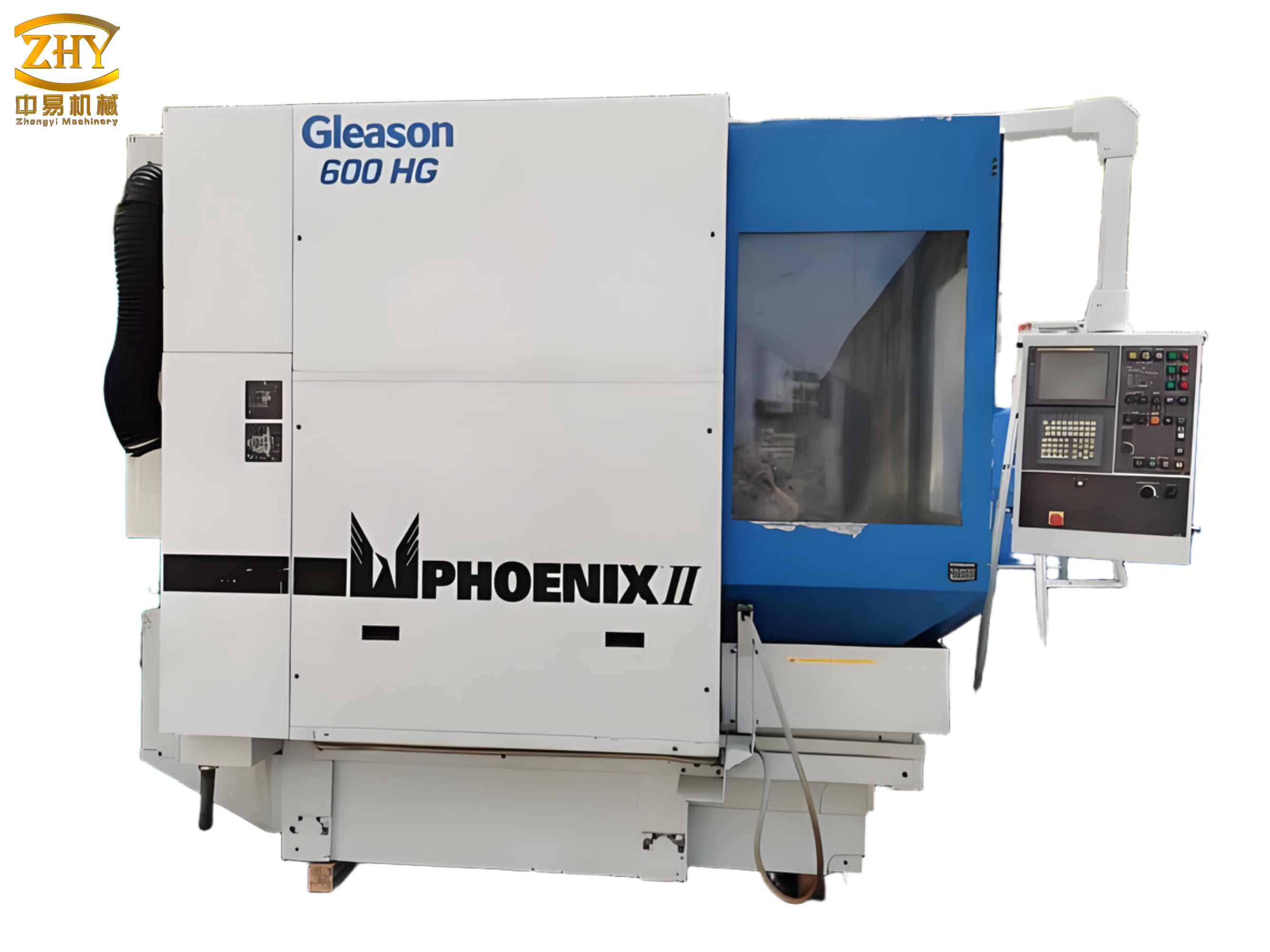
The simulation results in a parallel texture pattern on the tooth surface, which is characteristic of traditional gear grinding processes. To visualize this, we incorporate a graphical representation of the grinding process.
Next, we define the grinding direction angle \( c \) to quantitatively analyze the texture. The relative velocity at the contact point can be decomposed into three components: \( v_c \) (from meshing motion, increasing from root to tip), \( v_l \) (tangential to the surface, perpendicular to \( v_c \)), and \( v_n \) (due to synchronization errors). The grinding direction angle is given by:
$$ c = \arctan\left( \frac{v_l}{v_c} \right) $$
By sampling discrete points on the tooth surface, we plot \( c \) against tooth height \( h \), revealing that \( c \) remains nearly 90° across the tooth height, consistent with the parallel texture. This angle serves as a key metric for texture characterization in gear profile grinding.
We now investigate the influence of axial and tangential speed variations on the grinding direction. In continuous generating grinding, the relationship between the workpiece angular velocity \( \omega_1 \) and worm wheel angular velocity \( \omega_2 \), with axial velocity \( v_z \) and tangential velocity \( v_y \), is expressed as:
$$ \omega_1 = \frac{N_2}{N_1} \omega_2 + \frac{4 \sin \beta}{m_n N_1} v_z + \frac{4 \cos \lambda}{m_n N_1} v_y $$
Substituting this into the relative velocity equation yields:
$$ \mathbf{v}_{12} = \begin{pmatrix} -i y \omega_2 + \omega_2 (z \sin \Sigma + y \cos \Sigma) – i’ y v_z + i” y v_y \\ i y \omega_2 – \omega_2 (x – a) \cos \Sigma + i’ y v_z + (i” x + \sin \Sigma) v_y \\ -\omega_2 (x – a) \sin \Sigma + v_z + v_y \cos \Sigma \end{pmatrix} $$
where \( i \), \( i’ \), and \( i” \) are transmission ratios. Using the parameters from Table 1, we analyze how changes in \( v_z \) and \( v_y \) affect \( c \). For instance, with \( \omega_2 = 10 \, \text{rad/s} \), we vary \( v_z \) and \( v_y \) from 0 to 40 mm/s in increments of 10 mm/s. The results, summarized in Table 2, show that both axial and tangential speeds alter \( c \), with tangential changes having a more pronounced effect.
| Speed Type | Speed (mm/s) | \( c \) at Root (°) | \( c \) at Tip (°) | Change Magnitude |
|---|---|---|---|---|
| Axial (\( v_z \)) | 0 | 90.0 | 89.8 | 0.2 |
| Axial (\( v_z \)) | 20 | 89.5 | 88.9 | 0.6 |
| Axial (\( v_z \)) | 40 | 89.0 | 88.0 | 1.0 |
| Tangential (\( v_y \)) | 0 | 90.0 | 89.8 | 0.2 |
| Tangential (\( v_y \)) | 20 | 88.0 | 86.5 | 1.5 |
| Tangential (\( v_y \)) | 40 | 86.0 | 83.0 | 3.0 |
| Combined (\( v_z + v_y \)) | 20 each | 87.5 | 85.0 | 2.5 |
These findings indicate that increasing axial or tangential speeds reduces \( c \) along the tooth height, and combined changes amplify this effect. However, under constant speeds, the texture remains parallel in the tooth width direction. To disrupt this uniformity, we propose a variable-speed grinding method that modulates \( v_z \) and \( v_y \) dynamically.
The variable-speed approach involves periodic functions for axial and tangential velocities. We consider waveform functions such as trapezoidal, sinusoidal, and triangular, expressed as:
$$ V = A + B f(C t) $$
where \( A \) is the baseline speed, \( B \) is the fluctuation amplitude, and \( C \) controls the frequency. The optimal period is twice the workpiece rotation cycle to maximize speed differences between adjacent contact traces. For a worm wheel angular velocity \( \omega_2 = 100 \, \text{rad/s} \), axial baseline \( A = 5 \, \text{mm/s} \), and \( B = 0.5 \, \text{mm/s} \), the frequency parameter \( C \) is calculated as:
$$ C = \frac{N_2}{2 N_1} \omega_2 + \frac{2 \sin \beta}{m_n N_1} v_z + \frac{2 \cos \lambda}{m_n N_1} v_y $$
For the parameters in Table 1, \( C \approx 4.8842 \). Comparing waveforms, the sinusoidal function is preferred due to smooth transitions, reducing the risk of grinding cracks. Thus, we define:
$$ V = A + B \sin(C t) $$
We classify grinding methods based on speed variations: constant axial without tangential, constant axial with constant tangential, variable axial without tangential, variable axial with constant tangential, constant axial with variable tangential, and variable axial with variable tangential. For each, we model the grinding direction angle across the tooth surface. A case study with \( \omega_2 = 50 \, \text{rad/s} \), axial function \( V_z = 1 + 0.1 \sin(3.4878 t) \), and tangential function \( V_y = 10 + \sin(3.4878 t) \) demonstrates that variable speeds introduce irregular fluctuations in \( c \) along the tooth width, breaking the parallel pattern. The results for different methods are summarized in Table 3.
| Grinding Method | Axial Speed | Tangential Speed | Texture Pattern | Noise Reduction Potential |
|---|---|---|---|---|
| Constant Axial, No Tangential | Constant | 0 | Parallel | Low |
| Constant Axial, Constant Tangential | Constant | Constant | Parallel with reduced \( c \) | Medium |
| Variable Axial, No Tangential | Variable | 0 | Irregular in width direction | High |
| Variable Axial, Constant Tangential | Variable | Constant | Irregular with moderate change | High |
| Constant Axial, Variable Tangential | Constant | Variable | Irregular with significant change | Very High |
| Variable Axial, Variable Tangential | Variable | Variable | Highly irregular | Very High |
The mathematical model for the tooth surface grinding direction angle \( c \) as a function of tooth height \( h \) and width \( b \) is derived from the relative velocity components. For variable speeds, \( c \) becomes:
$$ c(h, b) = \arctan\left( \frac{v_l(h, b)}{v_c(h, b)} \right) $$
where \( v_l \) and \( v_c \) depend on the instantaneous speeds \( v_z(t) \) and \( v_y(t) \). For sinusoidal variations, \( v_z(t) = A_z + B_z \sin(C t) \) and \( v_y(t) = A_y + B_y \sin(C t) \), leading to:
$$ v_c = \omega_2 \left( r_b \sin(\delta_0 + \theta + \lambda) – i_{21} (x_1 – a) \cos \Sigma \right) $$
$$ v_l = i’ y v_z + (i” x + \sin \Sigma) v_y $$
Substituting these into the equation for \( c \) allows us to compute the grinding direction at any point on the tooth surface. This model confirms that variable-speed grinding effectively alters texture in both height and width directions, reducing the likelihood of grinding cracks by distributing stresses more evenly.
In conclusion, our research demonstrates that axial and tangential variable-speed methods in continuous generating grinding can transform parallel textures into irregular patterns, thereby improving meshing noise behavior. By carefully selecting parameters in the sinusoidal speed functions, we achieve significant changes in grinding direction angles, enhancing the performance of gear profile grinding processes. This approach not only addresses noise issues but also contributes to the prevention of grinding cracks, ensuring higher quality in gear manufacturing. Future work could explore real-time optimization of speed profiles for specific applications in gear grinding.