
In the field of mechanical transmission, helical gears play a pivotal role due to their ability to provide smooth and efficient power transfer. Specifically, double helical gears, characterized by their opposing helical teeth, offer enhanced load-carrying capacity and reduced axial thrust, making them indispensable in high-speed and heavy-duty applications such as marine propulsion, aerospace systems, and industrial machinery. As a researcher focused on gear dynamics, I have dedicated significant effort to understanding the intricate contact behaviors of these gears. The primary challenge lies in accurately modeling their transmission characteristics, which are influenced by factors like load distribution, axial support stiffness, and tooth surface modifications. In this article, I will present a comprehensive study on the transmission characteristics of double helical gears, incorporating advanced analytical models, optimization techniques, and experimental validation. Through this work, I aim to contribute to the design and optimization of helical gears for improved performance and reliability.
The study of helical gears has long been a topic of interest in mechanical engineering, with numerous researchers exploring their dynamic behavior and contact mechanics. Traditional models often simplify the analysis by neglecting axial flexibility or assuming ideal conditions, which can lead to inaccuracies in predicting transmission errors and vibration responses. For instance, prior studies have developed dynamic models considering time-varying mesh stiffness and manufacturing errors, but few have addressed the coupled effects of radial and axial load transmission errors in double helical gears. My research builds upon these foundations by introducing a three-dimensional loaded tooth contact analysis model that explicitly accounts for the axial support stiffness of the pinion. This approach allows for a more realistic simulation of the gear meshing process, enabling a deeper investigation into the transmission characteristics of helical gears under various operating conditions.
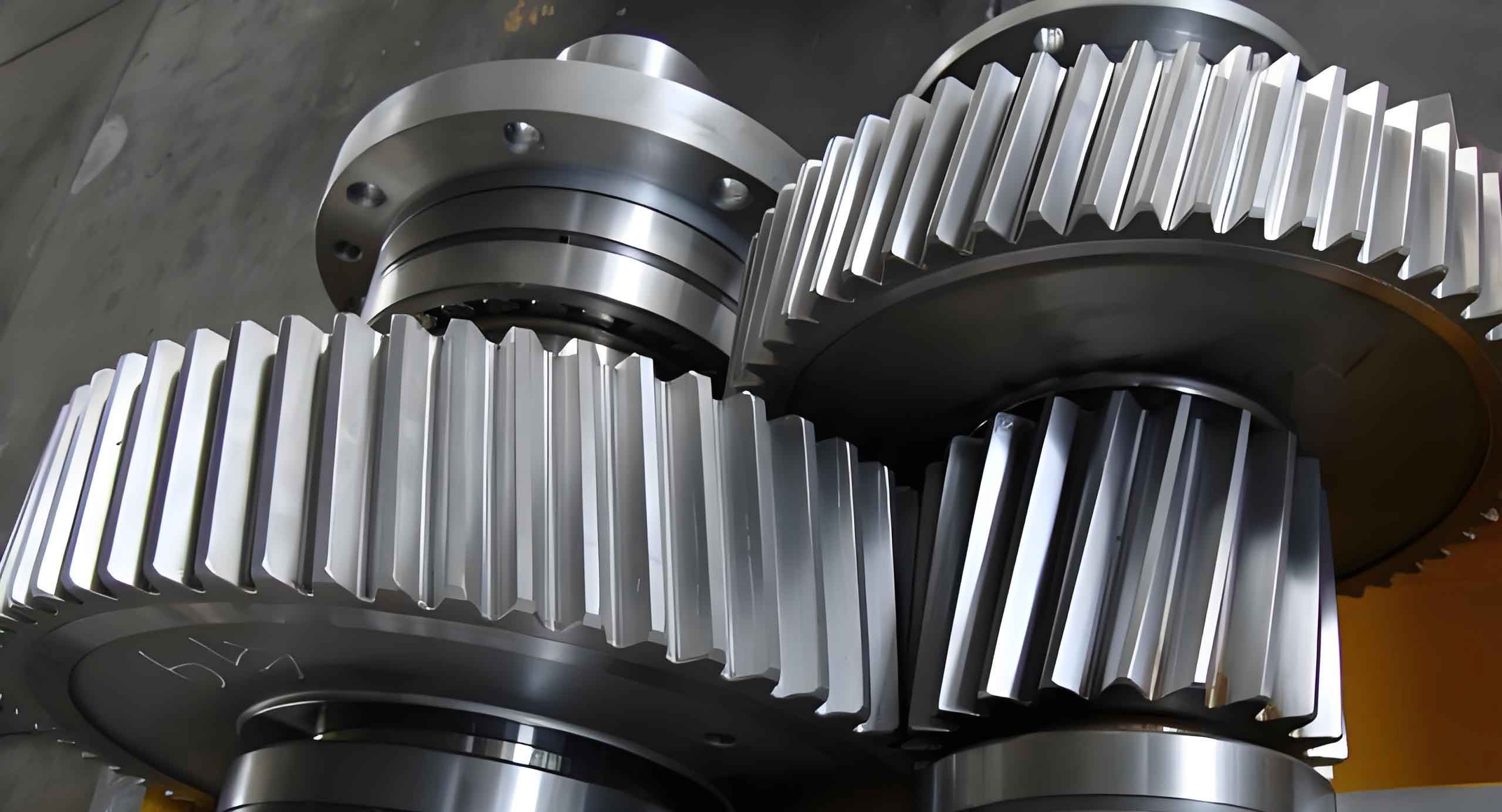
To begin, I developed a detailed tooth contact analysis model for double helical gears based on principles of differential geometry and mechanical analysis. The model considers the deformation compatibility conditions, force balance equations, and axial force balance constraints, which are crucial for accurately capturing the interaction between the left and right helical gear pairs. The normal clearance between the tooth surfaces is a key parameter, and it can be expressed mathematically to account for the pinion’s axial displacement. When the pinion moves axially by a distance $\delta_p$, the change in normal clearance for the left and right helical gear pairs is given by $\delta_{nl} = \delta_p \sin \beta \cos \alpha$ and $\delta_{nr} = -\delta_p \sin \beta \cos \alpha$, respectively, where $\alpha$ is the pressure angle and $\beta$ is the helix angle of the helical gears. This relationship is integrated into the deformation coordination condition as follows:
$$ -Fp + eZ + Id + A\delta_{nk} = w \quad (k = I, II, III, IV) $$
Here, $F$ represents the normal flexibility coefficient matrix, $p$ is the normal load vector, $e$ is a unit matrix, $Z$ denotes the normal displacement after loading, $I$ is an identity matrix, $d$ is the tooth surface clearance vector after deformation, $A$ is a coefficient matrix, and $w$ is the initial tooth surface clearance vector. This equation ensures that the gear system’s deformation is consistent under load, which is essential for analyzing the transmission characteristics of helical gears.
The force balance condition for the double helical gears is also critical, as it governs the distribution of loads across the contacting tooth surfaces. For a system with multiple teeth in contact, the total normal load $P$ must equal the sum of the normal loads at all discrete contact points. This can be expressed as:
$$ \sum_{j=1}^{n_I} p_j^I + \sum_{j=1}^{n_{II}} p_j^{II} + \sum_{j=1}^{n_{III}} p_j^{III} + \sum_{j=1}^{n_{IV}} p_j^{IV} = \sum_{j=1}^{m} p_j^l + \sum_{j=1}^{q} p_j^r = P \quad (l = I, II; r = III, IV) $$
Additionally, the contact conditions require that at any discrete point, either the normal load is positive and the clearance is zero (indicating contact), or the load is zero and the clearance is positive (indicating separation). This is represented as:
$$ p_j^k > 0; d_j^k = 0 \quad \text{or} \quad p_j^k = 0; d_j^k > 0 \quad (k = l, r) $$
To address the axial force balance in helical gears, I introduced an axial support stiffness $k_p$ for the pinion, which models the effect of bearings that allow limited axial movement. This leads to an axial force balance constraint:
$$ \sum_{j=1}^{m} p_j^l \cos \lambda_j^l – \sum_{j=1}^{q} p_j^r \cos \lambda_j^r – k_p \delta_p = 0 $$
In this equation, $\lambda_j^k$ is the angle between the normal load $p_j^k$ and the pinion’s axial direction, as illustrated in the mechanical setup. By combining these conditions, the load contact problem for double helical gears can be formulated as a quadratic programming problem, which I solved using an improved simplex method to obtain the radial load transmission error, axial load transmission error, and load distribution.
To better summarize the key parameters and variables used in the model, I have compiled them into the following table:
| Parameter | Symbol | Description |
|---|---|---|
| Normal Flexibility Matrix | $F$ | Matrix representing the flexibility of gear teeth under load |
| Normal Load Vector | $p$ | Vector of normal loads at discrete contact points |
| Normal Displacement | $Z$ | Normal displacement of tooth surfaces after loading |
| Tooth Surface Clearance | $d$ | Clearance between tooth surfaces after deformation |
| Axial Support Stiffness | $k_p$ | Stiffness of the pinion’s axial support system |
| Pinion Axial Displacement | $\delta_p$ | Axial movement of the pinion due to load imbalances |
| Pressure Angle | $\alpha$ | Angle defining the tooth profile in helical gears |
| Helix Angle | $\beta$ | Angle of the helical teeth relative to the gear axis |
Building on this model, I established a multi-objective optimization framework to minimize the three-dimensional load transmission error and improve the load distribution in helical gears. The optimization aims to reduce the maximum load-sharing coefficient, minimize the fluctuation amplitude of the radial load transmission error, and lower the maximum axial load transmission error. The objective functions are defined as:
$$ \min f_1(y_i, k_p) = \max(LSC) $$
$$ \min f_2(y_i, k_p) = \max(Z) – \min(Z) $$
$$ \min f_3(y_i, k_p) = \max(\text{abs}(\delta_p)) $$
Here, $y_i$ represents the tooth surface modification parameters, and $k_p$ is the pinion axial support stiffness. The load-sharing coefficient $LSC$ for each gear pair is calculated as $LSC_k = \sum_{j=1}^{n_k} p_j^k / P$, where $n_k$ is the number of discrete points on the contact line. The optimization variables are subject to constraints on modification limits and stiffness bounds, which I formulated as:
$$ h_{\min} \leq y_1, y_2, y_5, y_6, y_L, y_R \leq h_{\max} $$
$$ b_{\min} \leq y_3, y_4, y_7 \leq b_{\max} $$
$$ k_{\min} \leq k_p \leq k_{\max} $$
To solve this multi-objective optimization problem, I employed the NSGA-II algorithm, a popular evolutionary approach for handling complex, non-linear constraints. This algorithm efficiently explores the Pareto front, allowing for trade-offs between the conflicting objectives related to helical gears’ performance. The tooth surface modification involves a combination of longitudinal compensation and topological modifications, which can be mathematically described by superimposing the modification surface onto the theoretical tooth surface. The position vector and normal vector of the modified tooth surface are given by:
$$ R_1(u_1, l_1) = r_1(u_1, l_1) + \epsilon(x, y) n_1(u_1, l_1) $$
$$ N_1(u_1, l_1) = \left( \frac{\partial r_1}{\partial u_1} + \frac{\partial \epsilon}{\partial u_1} n_1 + \frac{\partial n_1}{\partial u_1} \epsilon \right) \times \left( \frac{\partial r_1}{\partial l_1} + \frac{\partial \epsilon}{\partial l_1} n_1 + \frac{\partial n_1}{\partial l_1} \epsilon \right) $$
In these equations, $u_1$ and $l_1$ are tool parameters, $\epsilon$ is the modification value at the mesh node, and $r_1$ and $n_1$ are the position and normal vectors of the theoretical tooth surface. This approach ensures that the modifications effectively compensate for deformation differences and manufacturing errors in helical gears.
To validate the model and optimization results, I conducted extensive numerical simulations using the parameters of a double helical gear pair. The basic gear parameters are summarized in the table below, which highlights the specifications relevant to helical gears analysis:
| Design Parameter | Pinion | Gear |
|---|---|---|
| Number of Teeth | 17 | 44 |
| Module (mm) | 6 | 6 |
| Pressure Angle (°) | 20 | 20 |
| Helix Angle (°) | 24.43 | -24.43 |
| Face Width (mm) | 55 × 2 | 55 × 2 |
| Slot Width (mm) | 58 | 58 |
The simulations investigated the effects of load, pinion axial support stiffness, and tooth surface modification on the radial and axial load transmission errors of helical gears. For instance, when the axial support stiffness $k_p = 0 \, \text{N/mm}$ (representing free axial movement) and the shaft angle error $\gamma_1 = 0.30’$ is constant, the transmission errors vary with load. As the load $T$ increases from 650 N·m to 6000 N·m, both the average value and amplitude of the radial load transmission error increase, while the axial load transmission error also shows gradual changes. This behavior underscores the sensitivity of helical gears to loading conditions, which must be carefully managed in design.
Another critical aspect is the influence of pinion axial support stiffness on the transmission characteristics of helical gears. With a fixed load $T = 2500 \, \text{N·m}$ and error $\gamma_1 = 0.30’$, I varied $k_p$ from $0$ to $1 \times 10^9 \, \text{N/mm}$. The results indicate that in the range of $0$ to $1 \times 10^4 \, \text{N/mm}$, the maximum radial and axial load transmission errors remain relatively constant. However, from $1 \times 10^4$ to $1 \times 10^6 \, \text{N/mm}$, the amplitude of the radial load transmission error decreases, while the maximum axial load transmission error drops rapidly. Beyond $1 \times 10^6 \, \text{N/mm}$, the radial error amplitude increases sharply, and the axial error slowly diminishes. At $k_p = 1 \times 10^9 \, \text{N/mm}$, the axial load transmission error approaches zero, effectively fixing the pinion axially. This demonstrates how axial support stiffness can be tuned to control the dynamic response of helical gears, balancing between flexibility and stability.
The load distribution on the tooth surfaces of helical gears is also significantly affected by the pinion’s axial condition. When the pinion is axially fixed ($k_p = 1 \times 10^9 \, \text{N/mm}$), the load concentrates more on one side, leading to uneven distribution. In contrast, with axial free floating ($k_p = 0 \, \text{N/mm}$), the loads on the left and right helical gear pairs become more balanced, though some partial loading persists due to edge contacts. This highlights the need for tooth surface modifications to optimize load sharing in helical gears. The optimization process yielded modified parameters such as $y_1 = 15.66 \, \mu\text{m}$, $y_2 = 18.43 \, \mu\text{m}$, $y_3 = 1.96 \, \text{mm}$, $y_4 = 3.41 \, \text{mm}$, $y_5 = 10.83 \, \mu\text{m}$, $y_6 = 10.83 \, \mu\text{m}$, $y_7 = 40.43 \, \text{mm}$, $y_L = 11.24 \, \mu\text{m}$, $y_R = 10.76 \, \mu\text{m}$, and $k_p = 6.78 \times 10^4 \, \text{N/mm}$. After modification, the contact pattern shifts away from the edges, reducing stress concentrations and improving the overall performance of helical gears.
To quantify the improvements, I compared the transmission errors and load-sharing coefficients before and after modification. The amplitude of the radial load transmission error decreased from 3.53 μm to 0.75 μm, while the maximum absolute axial load transmission error dropped from 20.53 μm to 2.56 μm. These reductions are attributed to the compensation of deformation differences and the optimized axial support stiffness. The load-sharing coefficients also showed a more balanced distribution, with the left tooth surface carrying slightly higher loads post-modification. This optimization effectively enhances the transmission characteristics of helical gears, minimizing vibrations and wear.
In addition to simulations, I performed experimental tests to validate the findings for helical gears. A gear transmission system test rig was set up, incorporating piezoelectric accelerometers to measure radial and axial vibration accelerations. The tests compared unmodified and modified double helical gears under various loads. The results indicated that the modified gears exhibited lower vibration accelerations in both radial and axial directions, confirming the effectiveness of the proposed model and optimization. For example, the radial vibration acceleration showed reduced peaks and smoother waveforms after modification, while the axial vibration acceleration demonstrated similar improvements. These experimental outcomes align with the simulation predictions, reinforcing the reliability of the analysis for helical gears.
The following table summarizes the key simulation and experimental results, emphasizing the impact of modifications on helical gears:
| Aspect | Before Modification | After Modification |
|---|---|---|
| Radial Load Transmission Error Amplitude | 3.53 μm | 0.75 μm |
| Maximum Axial Load Transmission Error | 20.53 μm | 2.56 μm |
| Load-Sharing Coefficient (Left) | Lower | Higher (More Balanced) |
| Radial Vibration Acceleration | Higher Peaks | Reduced Peaks |
| Axial Vibration Acceleration | Significant Fluctuations | Smoothed Waveforms |
Throughout this study, the importance of helical gears in mechanical systems has been underscored, with a focus on their transmission characteristics. The developed model provides a robust tool for analyzing double helical gears, incorporating axial support stiffness and tooth surface modifications. The multi-objective optimization framework enables designers to achieve a balance between load distribution and transmission error minimization, which is crucial for high-performance helical gears. Future work could explore the integration of real-time monitoring systems or advanced materials to further enhance the durability and efficiency of helical gears.
In conclusion, my research on helical gears has yielded significant insights into their transmission characteristics. The proposed three-dimensional loaded tooth contact analysis model accurately captures the complex interactions in double helical gears, while the optimization approach effectively reduces transmission errors and improves load distribution. The numerical simulations and experimental validations confirm the model’s validity, demonstrating that tooth surface modifications and controlled axial support stiffness can substantially enhance the dynamic performance of helical gears. This work contributes to the ongoing advancement of gear technology, offering practical solutions for designing quieter, more reliable helical gears in demanding applications.
To further elaborate on the mathematical foundations, the deformation coordination and force balance equations are integral to understanding helical gears behavior. The quadratic programming formulation used in the model can be generalized for various gear types, but it is particularly effective for helical gears due to their unique geometry. The use of NSGA-II algorithm in optimization highlights the importance of evolutionary methods in solving complex engineering problems related to helical gears. Additionally, the experimental setup described serves as a benchmark for validating analytical models of helical gears, ensuring that theoretical predictions align with real-world performance.
As helical gears continue to evolve, advancements in manufacturing techniques such as additive manufacturing or precision grinding could enable more intricate tooth modifications, further optimizing their transmission characteristics. Moreover, the integration of digital twins or machine learning algorithms could facilitate predictive maintenance and adaptive control for helical gears in dynamic environments. By continuing to refine these models and methods, the field of helical gears research can drive innovation across industries, from automotive to renewable energy systems.
In summary, the transmission characteristics of helical gears are multifaceted, involving mechanical, geometric, and dynamic factors. My study provides a comprehensive framework for analyzing and optimizing these characteristics, with a focus on double helical gears. Through detailed modeling, optimization, and validation, I have shown how targeted modifications and stiffness adjustments can lead to superior performance in helical gears. This work not only advances academic knowledge but also offers practical guidance for engineers designing helical gears for critical applications. The relentless pursuit of efficiency and reliability in helical gears will undoubtedly continue to shape the future of mechanical transmission systems.