
In the field of robotics and mechanical systems, the demand for efficient motion transmission between intersecting shafts has led to the widespread use of straight bevel gears. These gears are particularly favored due to their relative simplicity in design and manufacturing compared to spiral or hypoid gears. However, traditional machining methods for straight bevel gears, such as milling, present significant challenges, including low efficiency, high costs, and reliance on operator skill, which often results in inconsistent precision. To address these issues, we developed a novel approach using wire electrical discharge machining (WEDM) for fabricating small module straight bevel gears. This method leverages the precision of WEDM, combined with custom-designed fixtures and a numerical indexing system, to achieve high-accuracy gear production suitable for laboratory robots operating under low-speed, low-load conditions.
The core of our research focuses on overcoming the limitations of conventional machining by utilizing WEDM, which employs a thin wire electrode to cut complex shapes through electrical discharges. For straight bevel gears, the gear teeth are arranged on a conical surface, tapering from the large end to the small end. This geometry complicates machining, as the tooth profile is based on a spherical involute curve that cannot be easily flattened into a plane. Therefore, we adopted an approximation using the large-end parameters of the straight bevel gear, which are standardized according to industry norms, with a pressure angle of 20°, addendum coefficient of 1, and dedendum coefficient of 0.2. The large-end back cone is expanded to form a virtual spur gear, known as the equivalent gear, whose parameters guide the WEDM process. This equivalent gear concept simplifies the programming of the wire’s path, ensuring that the machined straight bevel gear meets functional requirements despite the geometric complexities.
To implement this approach, we designed a comprehensive machining system centered on a WEDM machine, specifically a DK7732M model capable of multiple cuts with reciprocating wire movement. This machine allows for high-speed roughing and low-speed finishing, reducing material deformation and wire wear, thereby achieving a surface roughness of Ra 0.8 μm and a dimensional accuracy of ±0.005 mm. The system integrates a specialized fixture and a numerical indexing mechanism, controlled by a custom-developed software program that automates the machining process. The fixture enables adjustable tilt angles from 0° to 90° to accommodate different root angles of straight bevel gears, while the indexing system ensures precise angular division during tooth cutting. Below, we detail the components and methodologies, supported by analytical models and experimental data.
System Design and Methodology
The overall machining system comprises the WEDM machine, a dedicated fixture, and a numerical indexing unit, all coordinated through a real-time control system. The fixture is crucial for holding the gear blank—typically pre-machined on a lathe to form the tooth crest cone angle, large-end back cone, and a central hole—and orienting it at the required cone angle. The indexing system, driven by a stepper motor, provides high-precision rotation to sequentially machine each tooth slot. The control system, based on a C8051F020 microcontroller, allows for automatic or manual operation modes, with input parameters such as gear tooth number set via a keyboard and displayed on digital tubes to prevent errors.
The design of the specialized fixture addresses the conical nature of straight bevel gears, where tooth dimensions vary along the axis. It consists of three main parts: an angle adjustment mechanism, a clamping unit, and a indexing connection. The angle adjustment uses a two-degree-of-freedom tilting machine vise as a base, allowing俯仰角调节 from 0° to 90°. This vise is connected to the numerical indexing table via a linking plate, which offsets the clamping mechanism to avoid interference with the machine bed during the machining of gears with small cone angles. The clamping unit employs a standard drill chuck (grade A, holding diameter 1–10 mm) with a radial runout error of 0.16 mm, secured to the indexing table through a threaded rod and connecting disk. To minimize alignment errors, we calibrated the assembly using a dial indicator during rotation, ensuring coaxiality within tolerable limits.
The numerical indexing system is pivotal for achieving uniform tooth spacing. It incorporates a stepper motor (model 42BYG250B) with a step angle of 1.8°, coupled to a worm gear set with a transmission ratio of 180:1. This configuration yields a theoretical indexing precision of 0.01° per pulse, sufficient for small module straight bevel gears. The stepper motor connects directly to the worm shaft via a rigid coupling, leveraging the self-locking property of the worm gear to prevent backlash and ensure accurate positioning. The control system architecture includes a main control unit, drive unit, keyboard input, interrupt input, and digital display, enabling real-time monitoring and adjustment. In automatic mode, a sensor on the WEDM machine triggers indexing after each cut, while manual mode allows operator verification for high-precision gears with fewer teeth.
Key to the machining process is the programming of the wire electrode’s path based on the equivalent gear concept. For a straight bevel gear, the equivalent spur gear has a virtual tooth number derived from the actual tooth number and the pitch cone angle. The relationship is given by:
$$ z_v = \frac{z}{\cos \delta} $$
where \( z_v \) is the equivalent tooth number, \( z \) is the actual tooth number, and \( \delta \) is the pitch cone angle. This equivalent gear simplifies the involute tooth profile calculation. The parametric equations for the involute curve of the large-end back cone are:
$$ x = r_b (\cos \phi + \phi \sin \phi) $$
$$ y = r_b (\sin \phi – \phi \cos \phi) $$
where \( r_b \) is the base circle radius, and \( \phi \) is the roll angle. These equations guide the WEDM programming, with the wire following this path to cut each tooth slot. The base circle radius relates to the module \( m \) and pitch diameter, and for straight bevel gears, the pitch diameter at the large end is used.
To illustrate the relationship between transmission ratio and pitch cone angles for straight bevel gears, consider the case where the shaft angle Σ is 90°. The transmission ratio \( i \) is defined as:
$$ i = \frac{\omega_1}{\omega_2} = \frac{z_2}{z_1} = \frac{d_2}{d_1} = \frac{\sin \delta_2}{\sin \delta_1} $$
which simplifies to:
$$ i = \cot \delta_1 = \tan \delta_2 $$
where \( \omega_1 \) and \( \omega_2 \) are angular velocities, \( z_1 \) and \( z_2 \) are tooth numbers, \( d_1 \) and \( d_2 \) are pitch diameters, and \( \delta_1 \) and \( \delta_2 \) are pitch cone angles. The table below summarizes typical values for small module straight bevel gears used in robotics:
| Transmission Ratio \( i \) | Pitch Cone Angle \( \delta_1 \) | Pitch Cone Angle \( \delta_2 \) |
|---|---|---|
| 1 | 45.00° | 45.00° |
| 2 | 63.43° | 26.56° |
| 3 | 71.57° | 18.43° |
This table aids in setting the fixture angle for specific gear pairs, ensuring proper meshing in applications such as laboratory robots.
Experimental Machining and Results
In practical experiments, we machined small module straight bevel gears using the described system. The gear blanks were prepared from standard materials, with pre-machined features including the root cone angle and a central hole for mounting. The fixture was installed on the WEDM worktable, and alignment was verified using a dial indicator to parallel the indexing table with the machine guides. The tilt angle was set to the root cone angle of the straight bevel gear, and the wire electrode (molybdenum wire, diameter 0.18 mm) was positioned at the starting point. The control software was programmed with the gear parameters, and the indexing system was set to automatic mode for seamless operation.
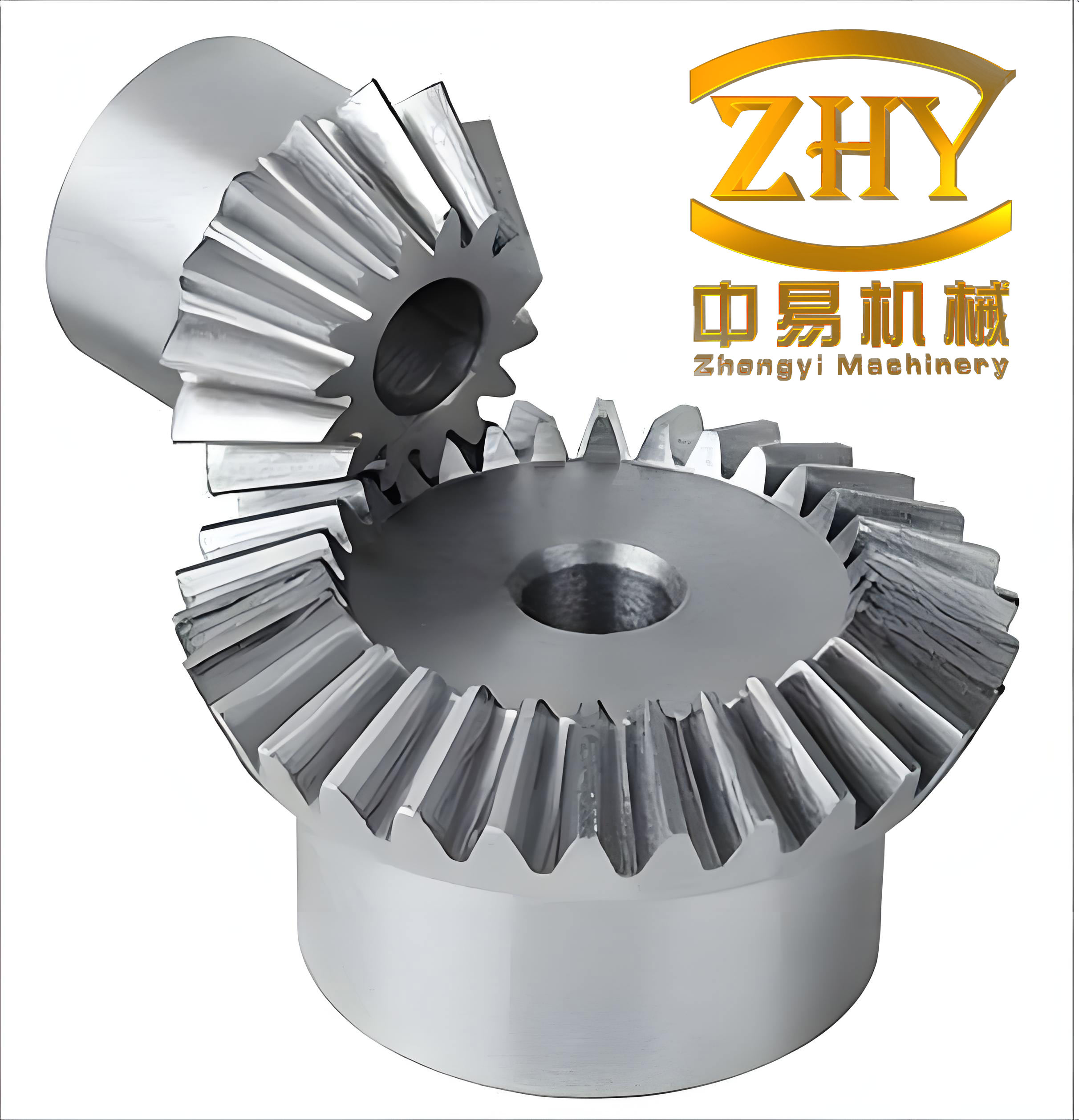
The machining process involved multiple passes: initial high-speed wire movement for rough cutting, followed by low-speed passes for finishing. This strategy minimized wire vibration and wear, enhancing surface quality. The involute tooth profile was generated based on the equivalent gear calculations, with the wire path controlled by the WEDM’s CNC system. After each tooth slot was cut, the indexing system rotated the gear blank by the appropriate angle, determined as \( 360^\circ / z \) for uniform division. The resulting straight bevel gears exhibited precise tooth forms and smooth surfaces, as demonstrated in the image above, which shows a machined gear suitable for robotic applications.
To quantify the performance, we measured key parameters such as tooth profile accuracy and surface roughness. The gears met the required specifications, with errors within acceptable limits for low-load scenarios. The success of this method highlights the versatility of WEDM for complex geometries like straight bevel gears, offering a cost-effective alternative to traditional machining.
Error Analysis and Mitigation
Despite the high precision of WEDM, various error sources affect the quality of machined straight bevel gears. Primary among these is the rotational error of the fixture system, which arises from multiple components. The main contributors include: deviation between the gear blank and the positioning mandrel (\( e_p \)), clamping deviation of the drill chuck (\( e_n \)), connection error between the linking rod and the indexing table (\( e_m \)), and rotational error of the worm gear set (\( e_f \)). These errors collectively cause geometric eccentricity, where the base circle center deviates from the workpiece axis. Assuming independent error sources, the combined rotational error \( e \) can be estimated using the root sum square method:
$$ e = \sqrt{e_p^2 + e_n^2 + e_m^2 + e_f^2} $$
Other error factors include installation inaccuracies of the tilting vise, manufacturing tolerances of the gear blank, and WEDM-specific issues like wire relaxation and wear. For instance, wire vibration during reversal in reciprocating WEDM can degrade surface roughness. To mitigate these, we implemented several measures: increasing the wire working length to reduce reversal frequency, calibrating wire perpendicularity with the worktable, and using dial indicators for precise fixture alignment. Additionally, the self-locking feature of the worm gear and the stepper motor’s holding torque minimized backlash, enhancing indexing accuracy.
In terms of practical impact, these errors are generally small and random, but for high-precision applications, further refinements such as improved component tolerances and real-time error compensation could be explored. Nonetheless, for laboratory robots operating at low speeds, the achieved accuracy is sufficient, as confirmed by functional testing of the straight bevel gears in actual mechanisms.
Conclusion
Our research demonstrates a viable method for manufacturing small module straight bevel gears using wire electrical discharge machining. By integrating a custom fixture and numerical indexing system, we achieved precise control over the machining process, resulting in gears that fulfill the demands of robotic applications. The use of the equivalent gear concept simplified the programming challenges associated with spherical involute profiles, while error analysis provided insights into potential improvements. This approach not only enhances manufacturing efficiency but also reduces reliance on skilled labor, making it accessible for small-scale production. Future work could focus on optimizing the fixture design for broader gear sizes and incorporating advanced sensors for real-time monitoring, further advancing the capabilities of WEDM for straight bevel gear fabrication.