
As a complex spatial transmission widely employed in fields such as aviation, specialized vehicles, and precision drive systems, the hyperboloid gear has its meshing quality directly determining the overall service performance of machinery. Over several decades, significant progress has been made in the design theory, generation mechanisms, geometrical optimization, and manufacturing of this type of gear transmission. The increasingly stringent service performance demands of high-end equipment present greater challenges for the forward design of such drives. This article, based on extensive literature analysis, market research, and project experience, elaborates on the state of the art and development trends in the active design methodology for hyperboloid gears. It covers configuration design, geometric parameter calculation, manufacturing parameter derivation, contact analysis, and tooth surface geometrical optimization. Finally, it systematically outlines future trends for this transmission type against the backdrop of artificial intelligence and the evolving needs of advanced equipment.
Hyperboloid gears, also known as hypoid gears, are characterized by the axial offset of the pinion and non-equal spiral angles between the driving and driven members. This configuration offers advantages such as strong tolerance capability, flexible spatial arrangement, and a more compact size for a given design strength. The initial theoretical framework was established in the early 20th century, laying the groundwork for spatial crossed-axis drives. Subsequent advancements in geometric design, tooth surface generation theory, and manufacturing equipment have formed a comprehensive technological system. However, several key challenges persist: 1) Existing design methods are not universally applicable for arbitrary shaft angles (0°–180°), with missing guidelines for selecting initial geometric parameters and avoiding severe tooth surface defects like undercutting and pointing under extreme geometrical scales. 2) A forward design method linking tooth surface topography to service performance—balancing low error sensitivity with high load capacity—is still underdeveloped, particularly for batch manufacturing in extreme environments like aerospace. 3) The influence of multi-source errors in the machine-tool-process system results in product consistency that is typically 1–2 accuracy grades below international advanced levels. A comprehensive, automatic compensation mechanism for composite manufacturing errors remains elusive.
1. Geometrical Design Methodology for Hyperboloid Gears
The design of hyperboloid gears begins with defining the fundamental geometrical relationships. The gear pair constitutes a spatial crossed-axis helical motion. Imagining the generatrix of the gear blank rotating about its axis forms a one-sheet hyperboloid. A finite width is taken from this surface, and the extended generatrices (considered straight lines) intersect at a point, defining the apex of the pitch cone. The design of the pitch cone pair parameters can be treated as solving for a pair of cones that satisfy known shaft angle, offset distance, and a spatial point of tangency.
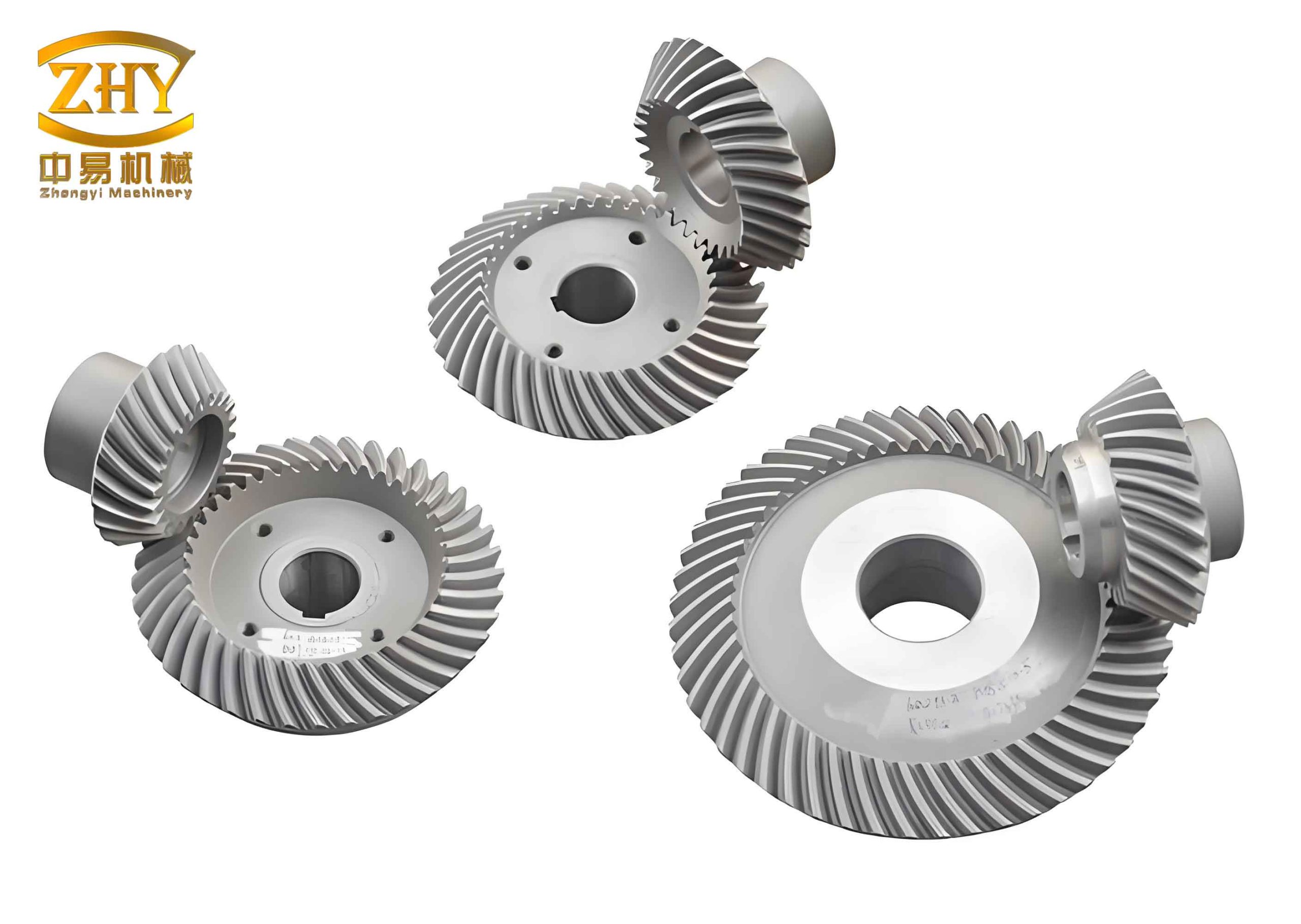
Hyperboloid gears can be classified based on several criteria, as summarized in Table 1.
| Classification Basis | Types | Key Characteristics & Typical Applications |
|---|---|---|
| Tooth Line Type | Arc (Face-milled) | Tooth line is an arc. Can be ground after heat treatment. Higher precision (AGMA 4-5). Used in aerospace, precision reducers. |
| Extended Epicycloid (Face-hobbed) | Tooth line is an extended epicycloid. Typically non-grindable, lapped only. Lower precision (AGMA 6-7). Predominant in automotive drive axles. | |
| Shaft Angle (Σ) | Orthogonal (Σ ≈ 90°) | Most common configuration. |
| Non-orthogonal: Small Angle (Σ < 90°) / Obtuse Angle (Σ > 90°) | Offers flexible spatial arrangement. Critical for helicopter transmissions, marine gearboxes. | |
| Reduction Ratio (i) | Standard Ratio | Common ratios for vehicle axles. |
| High-Reduction Ratio (HRH, i = 10–120) | Used in robotic joint reducers. Requires special design to avoid undercutting. | |
| Tooth Depth Taper | Standard Taper | Common for face-milled gears. |
| Double Taper, Root Tilt, Constant Depth | Constant depth is typical for face-hobbed gears. Small shaft angle designs often restricted to standard taper. |
The mathematical model for pitch cone tangency is central to the geometrical design of hyperboloid gears. Three fundamental geometrical relationships govern the design, involving the spiral angle, gear ratio, and offset.
1. Relationship involving the mean spiral angle (β_m):
$$ \cos \beta_m = \boldsymbol{\tau}_1 \cdot \boldsymbol{\tau}_2 $$
where $\boldsymbol{\tau}_1$ and $\boldsymbol{\tau}_2$ are unit vectors along the pitch cone generatrices. This leads to the relationship between pitch angles ($\gamma_{m1}$, $\gamma_{m2}$), spiral angle, and shaft angle (Σ):
$$ \cos \beta_m = \frac{\cos \Sigma}{\cos \gamma_{m1} \cos \gamma_{m2}} – \tan \gamma_{m1} \tan \gamma_{m2} $$
2. Relationship involving the gear ratio (i):
The relative velocity at the pitch point M must be zero along the common normal. This yields the speed ratio relation:
$$ i = \frac{\omega_1}{\omega_2} = \frac{r_{m2} \cos \beta_{m2}}{r_{m1} \cos \beta_{m1}} $$
where $r_{m1}$, $r_{m2}$ are the mean pitch cone radii and $\beta_{m1}$, $\beta_{m2}$ are the corresponding spiral angles.
3. Relationship involving the offset distance (E):
The offset is geometrically linked to the pitch radii and angles:
$$ E = \frac{(r_{m1} + r_{m2}) \sin \beta_m}{\sin \Sigma} $$
For hyperboloid gears with small shaft angles, the standard tooth depth taper is often the only viable option, as double taper or root tilt can lead to a negative sum of root angles, which is geometrically infeasible. The selection of key design parameters like the mean spiral angle and cutter radius is critical to avoid defects. An iterative design flow has been established to determine the qualified region for main design parameters, ensuring the final design is free from severe undercutting or pointing.
2. Tooth Surface Generation and Manufacturing Parameter Design
The tooth surface generation of hyperboloid gears is fundamentally different from cylindrical gears, requiring specific machine tool settings. The development of generation methods has evolved through four main stages: Local Conjugation, Local Synthesis, Higher-Order Design, and Global Synthesis. The kinematic generation motion consists of four components: cutter rotation, workpiece rotation, first cradle rotation (generating roll), and second cradle rotation (modified roll). Based on the generation principle, two main processes are distinguished, as defined in Table 2.
| Process Name | Principle | Tooth Line Type | Key Kinematic Relation |
|---|---|---|---|
| Face-Milling | Intermittent indexing cut. First cradle is stationary during cut. | Circular Arc | $ \omega_{c2} / \omega_p = z_p / z_0 $ (Single-indexing) |
| Face-Hobbing | Continuous indexing cut. Both cradles rotate. | Extended Epicycloid | $ (\omega_{c2} – \omega_{c1}) / \omega_p = z_p / z_0 $ (Continuous) |
Where $\omega_{c1}, \omega_{c2}$ are cradle angular velocities, $\omega_p$ is cutter head angular velocity, $\omega_t$ is workpiece angular velocity, $z_p$ is number of cutter blade groups, $z_0$ is number of imaginary generating gear teeth.
The “Local Synthesis” method is a cornerstone technique for the preliminary design of face-milled hyperboloid gears. It prescribes three meshing characteristics at the reference point: the semi-major axis length of the contact ellipse ($a$), the angle between the contact path and the first principal direction ($\zeta$), and the peak-to-peak transmission error ($\Delta \phi$). Based on these, the principal curvatures and directions of the pinion tooth surface at the reference point are calculated, which uniquely determine the pinion machine settings. The governing equations for establishing the relationship between gear and pinion curvatures are derived from differential geometry and the condition of continuous tangency.
The development of the tilt mechanism and CNC technology has significantly increased the degrees of freedom for tooth surface modification. Higher-order machine settings, often expressed as polynomial functions of the cradle angle, allow for precise control over the tooth profile and lead, enabling the design of desired ease-off topography and transmission error curves. Manufacturing errors from tools, fixtures, machine tools, and heat treatment manifest as deviations on the tooth surface and directly affect transmission error. Transmission Error (TE) can be decomposed into long-wave and short-wave components. Long-wave TE reflects gear blank geometry errors (e.g., runout, cumulative pitch error), while short-wave TE reflects individual tooth surface topography errors (e.g., mismatch). Research has shown that various installation errors (axial, offset, shaft angle) can be compensated to some extent by proactively adjusting the axial positions of the pinion or gear during assembly, a practical method for contact pattern repositioning.
3. Tooth Contact and Load Distribution Analysis
Tooth Contact Analysis (TCA) is a fundamental technique for simulating the unloaded meshing behavior of hyperboloid gears. The classical TCA method solves a system of five nonlinear equations stating the coincidence of position vectors and unit normals (or their opposites) for a point on both tooth surfaces in a fixed coordinate system. For a point contact pair, this yields the contact path and, via the Rodrigues’ formula, the instantaneous contact ellipse. While powerful, this method can struggle with edge contact and requires a good initial guess. Modern numerical TCA methods discretize the tooth surfaces into point clouds and search for points within a specified separation distance (e.g., 0.00635 mm, simulating bluing paste particle size). This approach is robust, handles edge contact naturally, and is independent of complex surface equations, making it the standard in contemporary gear analysis software.
While TCA predicts contact pattern location and motion transmission under no-load conditions, it cannot accurately simulate stress distribution or the expansion of the contact area under load. Loaded Tooth Contact Analysis (LTCA) addresses this. Methods have evolved from early analytical models based on Hertzian contact theory to sophisticated Finite Element Analysis (FEA) and semi-analytical approaches. Modern semi-analytical LTCA methods combine the efficiency of tooth slicing or discretization with numerical deformation models (like finite element-based tooth compliance) and Hertzian contact theory. These methods can efficiently compute time-varying load distribution, contact pressure, mesh stiffness, and loaded transmission error for multi-tooth contact. The governing equation for the deformation compatibility condition in a semi-analytical LTCA model often takes the form:
$$ \boldsymbol{\delta} + \boldsymbol{e} + \boldsymbol{\lambda} = \boldsymbol{C} \cdot \boldsymbol{p} $$
where $\boldsymbol{\delta}$ is the initial separation vector between tooth surfaces, $\boldsymbol{e}$ is the composite error vector (including misalignment), $\boldsymbol{\lambda}$ is the approach vector, $\boldsymbol{C}$ is the flexibility matrix of the gear teeth, and $\boldsymbol{p}$ is the load vector. Solving this system yields the load distribution $\boldsymbol{p}$.
4. Meshing Behavior Control and Tooth Surface Optimization
The core of modern forward design for hyperboloid gears lies in actively controlling meshing behavior through targeted tooth surface modification. The concept of “Ease-off” topography is central to this process. Ease-off is defined as the normal deviation between the real tooth surface and a theoretical reference surface (often a conjugate surface). By designing a target ease-off topography that yields desirable meshing characteristics—such as low and parabolic transmission error, controlled contact pattern size/location, and low sensitivity to misalignment—the corresponding machine settings can be calculated via optimization algorithms.
The relationship between ease-off modification and key performance indicators can be summarized as follows:
| Performance Target | Typical Ease-off Topography Feature | Effect |
|---|---|---|
| Low Transmission Error (Low Noise) | Minimal crowning, optimized profile/lead slopes. | Reduces kinematic excitation, lowers vibration and whine noise. |
| Parabolic Transmission Error | Symmetrical parabolic profile modification. | Provides a “soft” entry and exit of contact, reducing impact. |
| Low Misalignment Sensitivity | Increased crowning (longer and narrower contact ellipse). | Prevents edge contact under expected misalignments, but may increase contact stress. | High Load Capacity | Optimized longitudinal and profile curvature. | Promotes favorable load distribution, minimizes peak contact and bending stresses. |
| Edge Contact Avoidance | Relief at toe, heel, top, and root regions (Tip/root relief, end relief). | Prevents stress concentration at tooth edges, improving durability. |
The optimization process is typically formulated as a multi-objective problem. An objective function $F(\boldsymbol{X})$ is minimized, where $\boldsymbol{X}$ is the vector of machine setting parameters (or their polynomial coefficients).
$$ \min F(\boldsymbol{X}) = w_1 \cdot f_{TE}(\boldsymbol{X}) + w_2 \cdot f_{stress}(\boldsymbol{X}) + w_3 \cdot f_{sensitivity}(\boldsymbol{X}) + … $$
subject to constraints such as no undercutting, sufficient tooth thickness, and practical machine limits. Here, $w_i$ are weighting factors, and $f_{TE}$, $f_{stress}$, etc., are functions evaluating transmission error, contact stress, etc. Advanced techniques like sensitivity analysis, the Levenberg-Marquardt algorithm for nonlinear least-squares problems, and modern metaheuristic algorithms (e.g., genetic algorithms) are employed to solve this optimization efficiently.
For high-ratio hyperboloid gears or gears under significant misalignment, a zoning modification strategy is often used. The tooth surface is divided into regions (e.g., toe, central, heel along the face width; root, central, tip along the profile), and different modification amounts are applied to each zone. This allows for independent control over contact initiation, progression, and termination across the tooth flank. The use of multi-blade cutter profiles (e.g., 4-blade “TopRem” design) physically implements such zoned relief, particularly for avoiding edge contact at the tooth tips and roots.
5. Trends and Future Perspectives
The research and application of hyperboloid gears have reached a high level of maturity. However, the demands of next-generation high-end equipment and the rise of artificial intelligence point to several key future directions:
1. Generalized Geometrical Design Methodology: Future work will focus on developing a unified design framework valid for arbitrary shaft angles, offset distances, and ratios. This involves mapping the feasible design space boundaries to avoid tooth surface defects automatically and establishing intelligent rules for the initial selection of parameters like tool radius and addendum modification coefficients.
2. High-Fidelity, Efficient Performance Simulation: There is a trend towards creating ultra-fast semi-analytical LTCA models that incorporate real measured tooth surface data (considering all manufacturing errors) and accurate system boundary conditions (including housing flexibility and bearing stiffness). This will enable rapid, high-precision simulation of real-world meshing behavior, forming a reliable digital twin for design iteration and optimization.
3. Performance-Driven, Manufacturing-Efficient Design: The goal is to shift from theory-centric design to true performance-driven design. This requires simultaneous consideration of high load capacity, low error sensitivity, and manufacturing efficiency (e.g., favoring duplex or complete generating methods for higher productivity). Advanced optimization algorithms will be crucial to navigate this multi-objective, highly constrained design space, fully leveraging the degrees of freedom offered by CNC and tilt mechanisms.
4. Comprehensive Error Compensation and Smart Manufacturing: Research will deepen into tracing composite errors throughout the entire process chain (tool-fabrication-fixture-machine-heat treatment). Breakthroughs in high-precision, efficient in-process measurement for hyperboloid gears are needed. The future lies in developing a closed-loop compensation system that uses on-machine measurement data to reconstruct the actual tooth surface and then intelligently calculates combined corrections for both tool geometry and higher-order machine settings to minimize the overall ease-off deviation across the entire gear.
5. AI-Enabled Forward Design: Artificial intelligence will fundamentally transform the design process. By training AI models (using physics-informed neural networks or other techniques) on large datasets of successful designs and their performance outcomes, it will be possible to predict optimal geometric and machine parameters directly from a set of service performance requirements and constraints. This AI-driven approach promises to bypass the traditional iterative “design-analysis-adjust” loop, enabling the rapid synthesis of high-performance hyperboloid gear designs tailored for specific extreme operating conditions.
In conclusion, the field of hyperboloid gear transmission is poised for significant advancement by integrating deeper mechanical understanding with digital technologies and artificial intelligence. The convergence of generalized design theory, high-fidelity simulation, performance-driven optimization, smart manufacturing, and AI will drive the development of next-generation hyperboloid gears that meet the ever-increasing demands for power density, efficiency, reliability, and quiet operation in the most challenging applications.