
In my experience maintaining and retrofitting heavy machinery, the challenges posed by worn or damaged herringbone gears are particularly complex due to their intricate design and critical role in power transmission. The case of a planer’s main reducer, where several teeth on a herringbone gear assembly were broken after prolonged use, presented a significant engineering puzzle. The original design utilized a heat-press fit to combine the helical gear segments into a single herringbone gear unit. Replacing only the damaged segment while preserving the other was deemed practically impossible without specialized herringbone gear machining equipment, as reassembling them to the required precision would be extraordinarily difficult. This compelled a comprehensive structural retrofit of the herringbone gear assembly, transforming it from a monolithic, press-fit component into a modular, adjustable system. The core of this modification was converting the helical gear segments into combined units with flanges, connected via dowel-pinned screws. This article details the entire process, from conceptualization to implementation and long-term validation, while also exploring related issues of welded rotor failure, all through the lens of practical engineering problem-solving.
The fundamental operation of a herringbone gear, essentially two helical gears of opposite hand placed side-by-side, is crucial for understanding the retrofit. These gears are renowned for their high load capacity and smooth, axial-force-canceling operation. The torque transmission and meshing forces in such a system can be described by fundamental gear equations. The tangential force $F_t$ at the pitch circle is given by:
$$F_t = \frac{2T}{d_p}$$
where $T$ is the transmitted torque and $d_p$ is the pitch diameter. For helical and thus herringbone gears, the normal force $F_n$ acting on the tooth is:
$$F_n = \frac{F_t}{\cos(\beta) \cos(\alpha_n)}$$
Here, $\beta$ is the helix angle and $\alpha_n$ is the normal pressure angle. The axial force component $F_a$, which cancels out in a true herringbone arrangement, is:
$$F_a = F_t \tan(\beta)$$
The original heat-press fit was designed to withstand these forces as a single entity. However, its failure mode and the impossibility of precise post-repair alignment were the key drivers for change.
The retrofit strategy was elegantly simple yet mechanically sound. Instead of a single-piece herringbone gear or a permanently joined pair, we designed it as three independent helical gear segments (let’s denote them as G1, G2, and G3) that would be individually mounted onto two central flange plates. The flanges, rather than the gears themselves, would carry the bearing seats and provide the reference surfaces for alignment. The assembly sequence and critical tolerances are best summarized in the following table:
| Component | Feature | Design Specification / Tolerance | Post-Assembly Machining |
|---|---|---|---|
| New Helical Gears (G1, G2, G3) | Tooth Profile (Module, Helix Angle) | Must match original design spec precisely. | None. Gear teeth are finished before assembly. |
| Flange Plates (2 units) | Bore for Gear Hub | Light interference fit (e.g., H7/p6). | None. Gears are pressed onto flanges. |
| Flange Plates | Bearing Seat Diameters (φA, φB) | Initial oversize with machining allowance. | Final machining to h6 tolerance after gear-flange assembly. |
| Flange Plates | Dowel Pin Holes (n×φC) | Oversize pilot holes. | Finish reaming in place after alignment. |
| Assembly | Gear Meshing Backlash | Adjusted manually during alignment; target: 0.05-0.10 mm. | Fixed by dowel pins after optimization. |
| Connection | Dowel-Pinned Screws | Grade 12.9, preload torque applied. | Installed after joint reaming. |
The process began with manufacturing the new helical gear segments to exact specifications. The two flange plates were machined with oversized bearing seat diameters (φA and φB) and undersized pilot holes for the future dowel pins. The gears were then thermally or hydraulically pressed onto their respective flanges, creating a gear-flange sub-assembly. It was at this stage that the genius of the design became apparent: the final, critical dimensions of the bearing seats—the surfaces that would interface with the tapered roller bearings in the reducer housing—were not machined on the flanges in isolation. Instead, after the gears were mounted, the entire sub-assembly was placed on a precision lathe or grinder, and the φA and φB diameters were finished to their required尺寸 and surface finish (typically IT6 tolerance). This guaranteed perfect concentricity between the gear’s pitch circle and the bearing seats, a prerequisite for smooth, low-vibration operation.
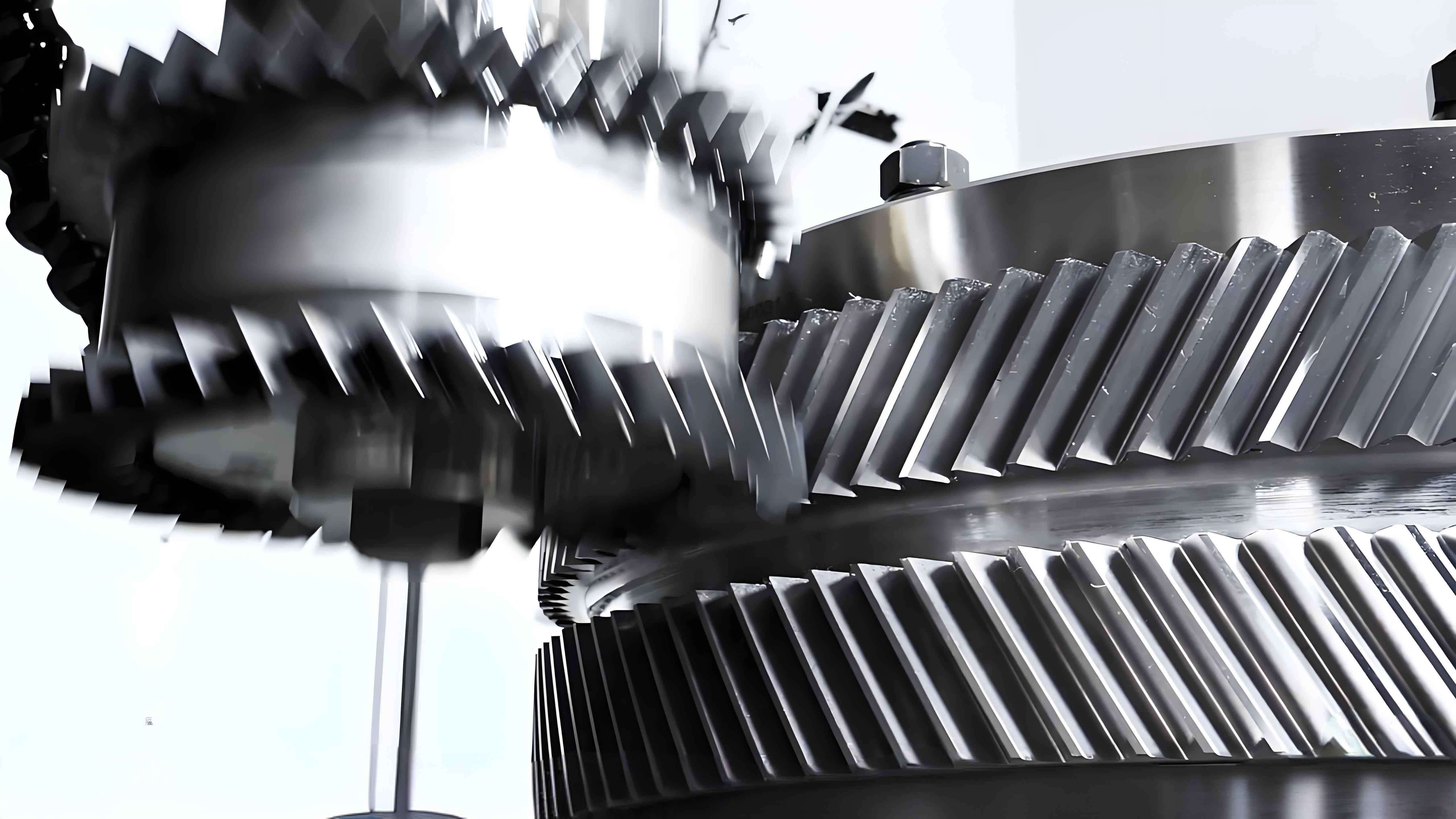
The most delicate phase was the in-situ assembly and alignment within the reducer housing. The three gear-flange sub-assemblies were loosely placed on their shaft. The mating pinion, itself a small herringbone gear, was engaged. Through careful manual rotation and the use of feeler gauges or dial indicators, the contact pattern and meshing backlash between each helical gear segment and the pinion were meticulously adjusted. This adjustment involved minute radial and axial shifts of the flange plates relative to each other until the contact was even across the tooth face and the backlash was uniform and within specification. The importance of this step for the longevity and noise performance of herringbone gears cannot be overstated. Once the optimal position was found, the flanges were clamped tightly together. The pilot holes were then simultaneously reamed to final size, creating a perfect match for the dowel pins. Finally, high-strength dowel-pinned screws were inserted and torqued, permanently locking the entire herringbone gear assembly in its perfectly aligned state. This method effectively decoupled the manufacturing tolerance stack from the final operational alignment, a significant advantage over the original solid design.
The success of this herringbone gear retrofit prompted a deeper reflection on failure analysis in power transmission components, leading to the examination of a parallel issue: the cracking of welded rotor spars in large rotating equipment. The principles of stress and fatigue are universal. A typical welded rotor spar connects a central hub to an outer rim. The welding process, especially with high heat input, induces significant residual stresses. The fatigue life under cyclic loading (low-cycle fatigue in startups/shutdowns) is governed by the Paris’ law for crack growth:
$$\frac{da}{dN} = C (\Delta K)^m$$
where $da/dN$ is the crack growth per cycle, $\Delta K$ is the stress intensity factor range, and $C$ and $m$ are material constants. For a weld with undercut (a notch-like defect), the stress concentration factor $K_t$ severely reduces fatigue strength. The initial residual stress $\sigma_{res}$ from welding acts as a mean stress, modifying the effective stress range. The combined effect can be modeled for preliminary assessment:
$$\Delta \sigma_{eff} = K_t \cdot \Delta \sigma_{applied} + \sigma_{res}$$
Where $\Delta \sigma_{applied}$ is the nominal bending stress range on the spar. If post-weld heat treatment (PWHT) is not performed—often the case in repair scenarios—$\sigma_{res}$ remains high, drastically accelerating crack initiation and propagation from stress concentrators like weld toes.
| Failure Factor | Physical Cause | Consequence | Mathematical Relation / Note |
|---|---|---|---|
| High Heat Input Welding | Excessive energy per unit length. | Coarse grain structure in HAZ, high residual stress. | Residual stress $\sigma_{res} \propto$ (Heat Input, Constraint). |
| Lack of PWHT | No stress relief after welding. | Retained tensile stress at weld toe. | Critical for low-cycle fatigue; often omitted in field repairs. |
| Weld Undercut (Notch) | Poor welding technique. | Sharp stress concentrator, $K_t$ can be 3-5 or higher. | Local stress: $\sigma_{local} = K_t \cdot \sigma_{nominal}$. |
| Cyclic Bending Load | Rotor imbalance, axial oscillation. | Initiation and propagation of fatigue cracks. | Governed by Paris’ Law: $da/dN = C(\Delta K)^m$. |
| Crack Propagation Path | Crack reaches critical length. | Loss of stiffness, eccentric loading, unstable growth. | Stress Intensity: $K_I = Y\sigma\sqrt{\pi a}$; Failure when $K_I \ge K_{IC}$. |
In the specific rotor case mentioned, cracks initiated at the weld toe (the heat-affected zone) due to the combined action of residual stress and stress concentration. As the crack propagated circumferentially, it reduced the effective weld area, increasing the stress on the remaining ligament. Once the crack extended approximately halfway around the circumference, the outer rim could deflect significantly during operation, applying a peeling (mode I) bending moment to the crack front. This changed the stress state from primarily shear to a mixed-mode condition, further accelerating growth. The crack would then propagate radially inward toward the spar’s lightening holes, ultimately leading to functional failure. The repair involved complete removal of the old, cracked weld material by machining, followed by a controlled re-welding procedure with stringent control over heat input, preheat, interpass temperature, and, ideally, a subsequent stress-relief heat treatment—though this last step is often a major logistical challenge for in-situ repairs of large rotors.
Returning to the theme of herringbone gears, their design and maintenance principles share conceptual ground with the welded rotor analysis. Both involve managing high stresses and ensuring structural integrity under complex loading. The contact stress between meshing herringbone gear teeth is a critical design parameter, calculated using the Hertzian contact stress formula for cylinders. The maximum contact pressure $p_{max}$ (often called Hertzian stress) is:
$$p_{max} = \sqrt{\frac{F_n / L}{\pi \left(\frac{1-\nu_1^2}{E_1} + \frac{1-\nu_2^2}{E_2}\right) \cdot \frac{1}{\rho_{eq}}}}$$
where $L$ is the face width, $\nu$ is Poisson’s ratio, $E$ is Young’s modulus, and $\rho_{eq}$ is the equivalent radius of curvature at the contact point. For helical gears, the radius of curvature and load distribution vary along the line of contact. The face width $L$ in this formula must account for the effective contact length in herringbone gears, which is typically less than the sum of the two helical halves due to the central gap or run-out region. The bending stress at the tooth root, which likely caused the original failure, is given by the Lewis formula modified for helical gears:
$$\sigma_b = \frac{F_t}{b m_n} \cdot \frac{K_v K_o K_m}{Y_J \cos(\beta)}$$
Here, $b$ is the face width, $m_n$ is the normal module, $K_v$ (dynamic factor), $K_o$ (overload factor), and $K_m$ (load distribution factor) are application-specific factors, and $Y_J$ is the geometry factor for bending strength. The retrofit, by ensuring perfect alignment, optimizes $K_m$, reducing uneven load distribution that can lead to localized overstress and tooth breakage.
The long-term performance of the retrofitted herringbone gear assembly has been excellent, operating for years without issue. This success validates the modular, alignment-focused approach as a viable alternative to monolithic construction, especially in repair and retrofit contexts where original manufacturing capabilities are unavailable. It underscores a fundamental principle in mechanical design: systems that allow for precise adjustment during assembly often yield superior and more reliable results than those relying solely on manufacturing precision. The parallel study of rotor spar welding failures reinforces another key principle: the control of manufacturing and repair processes—be it heat input in welding or alignment in gear assembly—is paramount for long-term durability under cyclic loads. Both cases highlight that understanding and applying core mechanical and material science principles, from Hertzian contact and fatigue crack growth to thermal stress management, is essential for effective problem-solving in industrial maintenance.
To further elaborate on the engineering considerations, let’s delve into the optimization of the herringbone gear geometry itself. The helix angle $\beta$ is a primary design variable. A larger $\beta$ increases axial force cancellation and smoothness but also increases axial thrust bearing loads if not perfectly balanced and increases bending moments on the teeth. The contact ratio $ε_γ$ for a herringbone gear is the sum of the transverse contact ratio $ε_α$ and the face contact ratio $ε_β$:
$$ε_γ = ε_α + ε_β = \frac{\sqrt{r_{a1}^2 – r_{b1}^2} + \sqrt{r_{a2}^2 – r_{b2}^2} – a \sin\alpha_t}{\pi m_t \cos\alpha_t} + \frac{b \tan\beta}{\pi m_n}$$
where $r_a$ is addendum radius, $r_b$ is base radius, $a$ is center distance, $\alpha_t$ is transverse pressure angle, and $m_t$ is transverse module. A high total contact ratio ($>2$) is desirable for quiet operation and load sharing. Our retrofit maintained the original $\beta$ and contact ratios to preserve the reducer’s kinematic characteristics. The following table contrasts key attributes of the original and retrofitted herringbone gear assembly, highlighting the philosophical shift in design for maintainability.
| Aspect | Original Design (Heat-Press Fit) | Retrofitted Design (Modular Flange) | Engineering Implication |
|---|---|---|---|
| Assembly Method | Permanent, thermal shrink fit. | Modular, mechanical fastening (screws & dowels). | Retrofit allows disassembly; original does not. |
| Alignment Source | Entirely from manufacturing precision of gear teeth and bore. | From in-situ adjustment and post-assembly machining of bearing seats. | Retrofit decouples gear tooth machining from system alignment, forgiving manufacturing variances. |
| Repairability | Very low. Damage to one segment necessitates replacement of entire, costly herringbone gear. | High. Individual helical segments or flanges can potentially be replaced if damaged. | Lifecycle cost is reduced; maintenance strategy is more flexible. |
| Stress State at Joint | Uniform compressive hoop stress from interference fit. | Shear and clamping stress at screw/dowel interfaces; requires careful preload calculation. | Original relies on friction; retrofit relies on precise clamping and positive location (dowels). |
| Process Dependency | Requires precise gear hobbing/shaping for herringbone AND precise bore machining. | Requires standard helical gear machining + precision boring of flanges AFTER assembly. | Retrofit eliminates need for specialized herringbone gear cutters, using more common capabilities. |
| Failure Risk | Catastrophic tooth breakage leads to complete failure. Press fit could loosen under extreme load. | Localized tooth damage possible. Fastener loosening is a failure mode but is detectable and re-tightenable. | Retrofit may offer more gradual failure modes and easier inspection points. |
The calculation for the dowel-pinned screw connection is vital. Each screw must be preloaded to a tension $F_{pre}$ high enough to prevent joint separation under the maximum operating tensile load $F_{ext}$ (from gear meshing forces resolved at the joint). The condition is:
$$F_{pre} > F_{ext} \cdot (1 – \Phi)$$
where $\Phi$ is the load factor dependent on the relative stiffness of the clamped members and the bolt. For a joint subject to shear, the dowel pins carry the primary shear load, while the screws, tightened to create high friction, provide a secondary shear resistance. The shear force $F_s$ on each dowel pin is:
$$F_s = \frac{T_{gear-shaft}}{n_{dowel} \cdot r_{dowel-circle}}$$
where $T_{gear-shaft}$ is the torque transmitted through the joint, $n_{dowel}$ is the number of dowel pins, and $r_{dowel-circle}$ is the radius of the dowel circle. The bearing stress on the dowel and the hole must be checked:
$$\sigma_{bearing} = \frac{F_s}{d_{dowel} \cdot t_{flange}} \le \sigma_{bearing, allow}$$
These calculations ensure the retrofitted joint is as robust as the original solid construction.
In conclusion, the journey from a broken herringbone gear to a successfully retrofitted, high-performance system encapsulates the essence of practical mechanical engineering. It required a deep understanding of gear mechanics, manufacturing processes, assembly techniques, and force analysis. The solution transformed a fragile, monolithic design into a resilient, adjustable, and maintainable modular assembly. The tangential but relevant exploration of welded rotor failures further cemented the importance of controlling process-induced stresses in any high-integrity mechanical component. Whether dealing with the precise meshing of herringbone gears or the welded joints of a rotor, the principles of stress management, alignment, and controlled manufacturing/assembly are universally critical. This experience demonstrates that even without access to original specialized equipment, through thoughtful redesign rooted in fundamental principles, reliable and durable solutions can be engineered, extending the service life of critical industrial machinery for years to come. The herringbone gear, in its retrofitted form, continues to operate flawlessly, a testament to the power of innovative, principles-based problem-solving.