
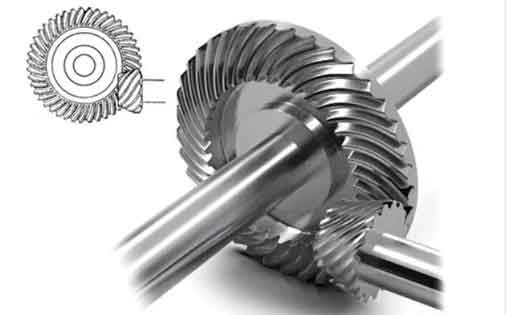
Spiral bevel gears are widely utilized in aerospace, automotive, and heavy machinery due to their high load capacity, smooth transmission, and low noise characteristics. However, their meshing performance is highly sensitive to manufacturing tolerances, assembly errors, and operational uncertainties. Robust optimization design (ROD) has emerged as a critical methodology to enhance gear reliability under stochastic variations. This review systematically examines current advancements in ROD for spiral bevel gears, focusing on error sensitivity mitigation, multi-objective optimization frameworks, and computational strategies.
1. Fundamentals of Robust Optimization Design
Robust optimization aims to minimize performance variability caused by uncontrolled factors while maintaining optimal functionality. For spiral bevel gears, the general formulation combines deterministic objectives with stochastic constraints:
$$
\begin{aligned}
\text{Minimize } & \quad f(\mathbf{x}, \mathbf{p}) \\
\text{Subject to } & \quad g_i(\mathbf{x}, \mathbf{p}) \leq 0, \quad i=1,2,…,m \\
& \quad \mathbf{x}^L \leq \mathbf{x} \leq \mathbf{x}^U
\end{aligned}
$$
Where $\mathbf{x}$ represents controllable design variables (e.g., tooth profile parameters), and $\mathbf{p}$ denotes uncontrollable noise factors (e.g., assembly errors). Key methodologies include:
| Method | Advantages | Limitations |
|---|---|---|
| Taguchi Method | Handles mixed variables effectively | Requires prior knowledge of solution space |
| Response Surface | Accurate for nonlinear systems | Sensitive to data scarcity |
| Genetic Algorithm | Global optimization capability | High computational cost |
| 6σ Design | Quantifies process capability | Complex constraint handling |
2. Assembly Error Sensitivity Analysis
Installation errors significantly impact spiral bevel gear performance through three primary components:
$$
\begin{cases}
\Delta X = \text{Axial displacement error} \\
\Delta V = \text{Vertical misalignment} \\
\Delta \Sigma = \text{Shaft angle deviation}
\end{cases}
$$
The resultant transmission error (TE) can be modeled as:
$$
TE = \frac{1}{2} \left[ \left( \frac{\partial \phi_2}{\partial \Delta X} \right)^2 \Delta X^2 + \left( \frac{\partial \phi_2}{\partial \Delta V} \right)^2 \Delta V^2 + \left( \frac{\partial \phi_2}{\partial \Delta \Sigma} \right)^2 \Delta \Sigma^2 \right]^{1/2}
$$
where $\phi_2$ represents the pinion rotation angle. Modern approaches employ sensitivity matrices to quantify error impacts:
$$
\mathbf{S} = \begin{bmatrix}
\frac{\partial C_p}{\partial \Delta X} & \frac{\partial C_p}{\partial \Delta V} & \frac{\partial C_p}{\partial \Delta \Sigma} \\
\frac{\partial C_a}{\partial \Delta X} & \frac{\partial C_a}{\partial \Delta V} & \frac{\partial C_a}{\partial \Delta \Sigma}
\end{bmatrix}
$$
where $C_p$ and $C_a$ denote contact pattern position and area, respectively.
3. Multi-Objective Robust Optimization Strategies
Advanced ROD frameworks for spiral bevel gears typically integrate:
- Ease-off topography modification
- Loaded tooth contact analysis (LTCA)
- Dynamic meshing simulation
A typical multi-objective formulation combines transmission error, contact stress, and sensitivity measures:
$$
\begin{aligned}
\text{Minimize } & \quad w_1 \cdot \text{TE} + w_2 \cdot \sigma_c + w_3 \cdot \|\mathbf{S}\|_F \\
\text{Where } & \quad \sum w_i = 1, \quad w_i > 0
\end{aligned}
$$
Pareto-optimal solutions are obtained through hybrid algorithms:
| Algorithm | Convergence Rate | Solution Quality |
|---|---|---|
| NSGA-II | 0.82 | Pareto front diversity |
| MOPSO | 0.75 | Local refinement |
| CMA-ES | 0.68 | High precision |
4. Computational Implementation
The optimization workflow for spiral bevel gears typically involves:
- Parametric tooth surface modeling
- Finite element analysis (FEA) verification
- Surrogate model construction
- Uncertainty quantification
Kriging surrogate models demonstrate superior performance for nonlinear systems:
$$
\hat{y}(\mathbf{x}) = \sum_{i=1}^n \beta_i \psi_i(\mathbf{x}) + Z(\mathbf{x})
$$
where $Z(\mathbf{x})$ represents a Gaussian process with spatial correlation:
$$
\text{Cov}(Z(\mathbf{x}_i), Z(\mathbf{x}_j)) = \sigma^2 \exp\left(-\sum_{k=1}^d \theta_k |x_{ik} – x_{jk}|^{p_k}\right)
$$
5. Emerging Challenges and Future Directions
Current limitations in spiral bevel gear ROD include:
- High-dimensional uncertainty propagation
- Time-dependent reliability analysis
- Manufacturing cost-performance tradeoffs
Promising research directions focus on:
$$
\begin{cases}
\text{Digital twin integration} \\
\text{AI-driven topology optimization} \\
\text{Multi-physics coupling analysis}
\end{cases}
$$
The integration of quantum computing for probabilistic analysis shows particular potential for complex spiral bevel gear systems:
$$
H = -\sum_{i<j} $$="" -=""
where $H$ represents the Hamiltonian for quantum annealing processes.
6. Conclusion
Robust optimization design has become indispensable for enhancing spiral bevel gear performance under real-world uncertainties. Through advanced sensitivity analysis, multi-objective algorithms, and computational intelligence, modern methodologies significantly improve error resistance while maintaining optimal load distribution. Future developments in digital manufacturing and quantum-enhanced optimization promise to revolutionize spiral bevel gear design paradigms, enabling unprecedented levels of reliability and efficiency in power transmission systems.