
In practical engineering applications, particularly within aerospace transmissions, spiral bevel gears are fundamental components for transferring power and motion between intersecting shafts. Their performance is critically dependent on the quality of meshing contact between the pinion and gear teeth. However, in real-world assembly and operating conditions, the presence of various errors is inevitable. Among these, installation errors—deviations from the theoretically perfect relative positions and orientations of the gear axes—pose a significant challenge. These misalignments can drastically alter the contact pattern, shift the bearing contact, and modify the transmission error (TE) function. Such changes often lead to increased vibration, noise, premature wear, and reduced reliability of the gear drive. The traditional approach to mitigate these effects involves tightening manufacturing tolerances and improving assembly precision, which is often economically prohibitive and technically challenging. Therefore, a more feasible and cost-effective strategy is to design the tooth surfaces of the spiral bevel gears to be inherently robust, or less sensitive, to the expected ranges of installation errors. This philosophy is known as robust design. This article delves into a comprehensive methodology for achieving such robustness by integrating advanced contact analysis with a Six Sigma (6σ) robust optimization framework.
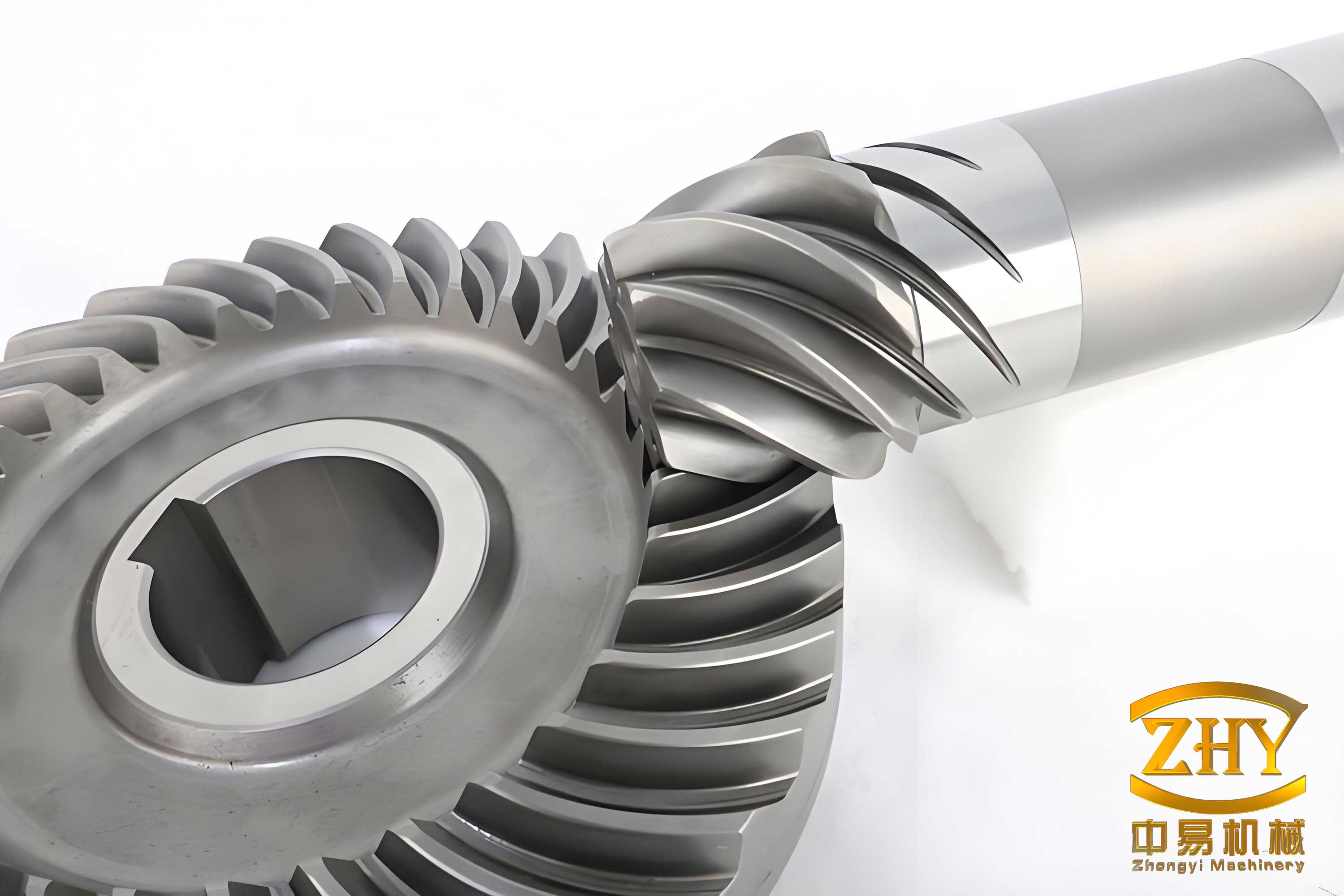
The core of designing a robust spiral bevel gear pair lies in the precise definition and control of the second-order contact parameters during the tooth surface generation process. The Local Synthesis method, a well-established technique, allows for the pre-design of the contact path, transmission error, and contact ellipse dimensions at a chosen design point. By optimizing these second-order parameters, we can influence how the contact behavior changes in the presence of misalignment. The primary installation errors, as defined in standards, include: pinion axial offset \(H_p\), gear axial offset \(H_g\), offset error (vertical separation) \(V\), and shaft angle error \(\Sigma\). A systematic mathematical model is required to incorporate these errors into the gear contact analysis.
Mathematical Modeling of Installation Errors
To analyze the effect of misalignment, we establish coordinate systems attached to the pinion \(S_1(O_1, X_1, Y_1, Z_1)\), the gear \(S_2(O_2, X_2, Y_2, Z_2)\), and a fixed global frame \(S_h(O_h, X_h, Y_h, Z_h)\). An auxiliary coordinate system \(S_d\) is also used for the gear. The transformation from the pinion coordinate system \(S_1\) to the global system \(S_h\) is given by the matrix \(M_{h1}\), which includes the pinion’s rotation \(\phi_1\) and its axial offset \(H_p\).
$$ M_{h1} = \begin{bmatrix}
1 & 0 & 0 & H_p \\
0 & \cos\phi_1 & \sin\phi_1 & 0 \\
0 & -\sin\phi_1 & \cos\phi_1 & 0 \\
0 & 0 & 0 & 1
\end{bmatrix} $$
The transformation from the gear’s auxiliary system \(S_d\) to the global system \(S_h\) is described by \(M_{hd}\), incorporating the gear’s nominal shaft angle \(\Gamma\), the shaft angle error \(\Sigma\), the gear axial offset \(H_g\), and the offset error \(V\).
$$ M_{hd} = \begin{bmatrix}
\cos(\Gamma + \Sigma) & 0 & \sin(\Gamma + \Sigma) & H_g \cos(\Gamma + \Sigma) \\
0 & 1 & 0 & V \\
-\sin(\Gamma + \Sigma) & 0 & \cos(\Gamma + \Sigma) & -H_g \sin(\Gamma + \Sigma) \\
0 & 0 & 0 & 1
\end{bmatrix} $$
Finally, the transformation from the gear system \(S_2\) to its auxiliary system \(S_d\) is given by \(M_{d2}\), which includes the gear’s rotation \(\phi_2\).
$$ M_{d2} = \begin{bmatrix}
1 & 0 & 0 & 0 \\
0 & -\cos\phi_2 & \sin\phi_2 & 0 \\
0 & -\sin\phi_2 & -\cos\phi_2 & 0 \\
0 & 0 & 0 & 1
\end{bmatrix} $$
The complete transformation from the gear tooth surface to the global frame, considering all installation errors \(E = [H_p, H_g, V, \Sigma]^T\), is therefore \(M_{h2} = M_{hd} \cdot M_{d2}\).
Quantification of Contact Pattern Characteristics
The contact pattern, or imprint, on the tooth surface is a critical visual indicator of meshing quality. For a robust spiral bevel gear design, it is essential not only to have a favorable pattern under ideal conditions but also to ensure its stability (minimal shift and distortion) under misalignment. We quantify the contact pattern using three main characteristics: Area, Center Location, and Orientation.
Assuming the contact pattern is discretized into a polygon defined by points \(p_1, p_2, …, p_n\) with coordinates \((x_i, y_i)\) in a local tooth coordinate system, these metrics are calculated as follows:
1. Contact Area (S): The area of the contact patch can be approximated by summing the areas of triangles formed by consecutive points.
$$ S = \sum_{i=1}^{n-2} \frac{1}{2} \left| \det \begin{bmatrix}
x_i & y_i & 1 \\
x_{i+1} & y_{i+1} & 1 \\
x_{i+2} & y_{i+2} & 1
\end{bmatrix} \right| $$
2. Pattern Center \((\bar{x}, \bar{y})\): The centroid of the polygon provides a measure of the pattern’s location on the tooth flank.
$$ \bar{x} = \frac{1}{n} \sum_{i=1}^{n} x_i, \quad \bar{y} = \frac{1}{n} \sum_{i=1}^{n} y_i $$
3. Pattern Orientation (\(\theta\)): The overall direction of the contact path can be represented by the angle of the line connecting the entry and exit points of the contact.
$$ \theta = \arctan\left( \frac{y_n – y_1}{x_n – x_1} \right) $$
To facilitate optimization, these physical metrics are often normalized into dimensionless “equivalent” values \(S’\), \(d’\) (for location), and \(e’\) (for TE) that range between 0 and 1, where lower values are better.
Loaded Tooth Contact Analysis with Installation Errors (ELTCA)
Traditional Tooth Contact Analysis (TCA) solves for the unloaded contact conditions. However, under operational loads, teeth deflect, and the contact pattern changes. Loaded Tooth Contact Analysis (LTCA) incorporates these elastic deformations. To account for misalignments, we must integrate the installation error transformations into the LTCA process, leading to Error-sensitive Loaded Tooth Contact Analysis (ELTCA).
The fundamental ELTCA equations extend the LTCA system to include the error vector \(E\):
$$
\begin{cases}
\mathbf{F} \cdot \mathbf{p}(E) + \mathbf{w}(E) = \Theta(E) \cdot \mathbf{r}_1(E) + \mathbf{d}(E) \\
\mathbf{p}(E)^T \cdot \mathbf{r}_2(E) = T_1
\end{cases}
$$
Where:
- \(\mathbf{F}\) is the flexibility matrix of the contacting tooth pair.
- \(\mathbf{p}(E)\) is the load distribution vector among discrete potential contact points.
- \(\mathbf{w}(E)\) is the initial separation vector, which is now a function of misalignment \(E\).
- \(\Theta(E)\) is the loaded angular displacement of the gear.
- \(\mathbf{r}_1(E), \mathbf{r}_2(E)\) are the position vectors of contact points on the pinion and gear relative to their axes, transformed by \(E\).
- \(\mathbf{d}(E)\) is the final separation vector after deformation.
- \(T_1\) is the input torque.
The solution to this nonlinear system provides the true contact pressure, contact ellipse (pattern) under load, and the loaded transmission error curve, all considering the specified installation errors. The ELTCA model, denoted as a function \(f_{\text{ELTCA}}\), is the core simulation tool for evaluating any given spiral bevel gear design under misaligned conditions.
Six Sigma (6σ) Robust Optimization Framework
Deterministic optimization seeks the best performance at nominal conditions. In contrast, robust optimization aims to find a design that not only performs well nominally but also exhibits minimal performance variation when input variables (like installation errors) fluctuate within their expected ranges. The 6σ methodology, originating from statistical process control, is a powerful paradigm for this. It aims to ensure that the probability of a product’s performance falling outside specification limits is extremely low (statistically, 6σ corresponds to 3.4 defects per million opportunities).
The key idea is to treat installation errors as random variables with known or assumed probability distributions (e.g., Normal distribution). The design parameters, which are the second-order contact parameters we can control, are the design variables. The optimization then targets both the mean (\(\mu_y\)) and the standard deviation (\(\sigma_y\)) of the performance outputs (\(y\)), such as contact pattern location or TE.
A comparative illustration between deterministic and robust optimization is conceptually vital. A deterministic optimum might lie on a steep slope of the performance function. While it offers the best nominal value, a small random perturbation \(\Delta x_1\) in an input variable causes a large performance shift \(\Delta f_1\), potentially violating constraints. A robust optimum, however, is found on a flatter region of the performance landscape. Here, a similar input perturbation \(\Delta x_2\) results in a much smaller performance variation \(\Delta f_2\), making the design far more stable and reliable against variations.
6σ Robust Optimization Model for Spiral Bevel Gears
We formulate the robust design problem for the spiral bevel gear as follows. The goal is to minimize the sensitivity of the contact pattern center location to installation errors.
Design Variables (X): These include the second-order contact parameters from the Local Synthesis and the nominal installation settings (which can also be adjusted within assembly tolerances).
$$ \mathbf{X} = [\eta, m’_{21}, \delta, H_p, H_g, V, \Sigma] $$
Where:
- \(\eta\): Angle between the contact path and the root line.
- \(m’_{21}\): First derivative of the transmission ratio function (related to the parabolic profile of TE).
- \(\delta\): Ratio of the contact ellipse semi-major axis to the face width.
- \(H_p, H_g, V, \Sigma\): Nominal values of the installation errors.
Objective Function: A weighted sum aiming to bring the mean of the pattern center equivalent value \(IE\) to a target \(IE_0\) while minimizing its standard deviation.
$$ \min f = \frac{W_1}{S_1} (\mu_{IE} – IE_0)^2 + \frac{W_2}{S_2} \sigma_{IE}^2 $$
Here, \(\mu_{IE}\) and \(\sigma_{IE}\) are the mean and standard deviation of \(IE\) calculated over many random error samples. \(W_1, W_2\) are weighting factors, and \(S_1, S_2\) are scaling factors for normalization.
Constraints: Ensure other important performance metrics remain acceptable under the 6σ variation.
$$
\begin{aligned}
&[S’, d’, e’] = f_{\text{ELTCA}}(\mathbf{X}) \\
&S’ \leq 0.6, \quad d’ \leq 0.6, \quad e’ \leq 1 \\
&x_{\min,i} + n\sigma_{x_i} \leq \mu_{x_i} \leq x_{\max,i} – n\sigma_{x_i} \quad (i=1,…,7)
\end{aligned}
$$
The last set of constraints are the *6σ design constraints*, ensuring that the mean of each design variable is at least \(n\) standard deviations (\(\sigma_{x_i}\)) away from its lower and upper bounds (\(x_{\min,i}, x_{\max,i}\)). For a true 6σ design, \(n=6\). This guarantees the design is robust against variations in the design variables themselves (e.g., manufacturing variations in the machine settings that produce \(\eta, m’_{21}, \delta\)).
The optimization workflow is:
- For a candidate design vector \(\mathbf{X}\), define the statistical distributions for the installation errors (e.g., \(E \sim N(\mu_E, \sigma_E)\)).
- Use Monte Carlo Simulation (MCS) to draw a large number (e.g., 100) of random error samples from these distributions.
- For each error sample, perform the ELTCA simulation to compute the performance outputs (contact pattern metrics, TE).
- Calculate the statistical moments (mean \(\mu\), standard deviation \(\sigma\)) of the key performance outputs from the MCS results.
- Evaluate the objective function \(f\) and check constraints using these statistical moments.
- Employ a global optimization algorithm, such as the Multi-Island Genetic Algorithm (MIGA), to search for the design \(\mathbf{X}\) that minimizes \(f\) while satisfying all constraints.
Case Study: Application and Results
To demonstrate the effectiveness of the proposed method, a case study of an aerospace spiral bevel gear pair is presented. The basic gear blank parameters are as follows:
| Parameter | Pinion | Gear |
|---|---|---|
| Number of Teeth | 34 | 43 |
| Module at Outer End (mm) | 2.0 | 2.0 |
| Face Width (mm) | 15 | 15 |
| Pressure Angle (deg) | 20 | 20 |
| Shaft Angle (deg) | 90 | |
| Hand of Spiral | Right | Left |
The installation errors are treated as random variables following a Normal distribution, with their 3σ limits treated as the tolerance bounds. The optimization boundaries for the variables are set as:
| Parameter | Lower Bound | Upper Bound |
|---|---|---|
| \(\eta\) (deg) | 30 | 90 |
| \(m’_{21}\) | -0.008 | 0.008 |
| \(\delta\) | 0.15 | 0.20 |
| \(H_p\) (mm) | -0.10 | 0.10 |
| \(H_g\) (mm) | -0.10 | 0.10 |
| \(V\) (mm) | -0.08 | 0.08 |
| \(\Sigma\) (rad) | -0.0045 | 0.0045 |
Three scenarios are compared:
- Initial Design: A baseline design with non-optimized second-order parameters.
- Deterministically Optimized Design: Optimized for best nominal performance without considering error variations statistically.
- 6σ Robust Optimized Design: Optimized using the proposed 6σ robust framework.
The optimization was performed, and the resulting key design variables for the robust solution are shown below, compared to the initial values.
| Parameter | Initial Design | 6σ Robust Optimal Design |
|---|---|---|
| \(\eta\) (deg) | 60.00 | 74.69 |
| \(m’_{21}\) | 0.0080 | 0.0037 |
| \(\delta\) | 0.180 | 0.152 |
| Nominal \(H_p\) (mm) | 0 | -0.0596 |
| Nominal \(H_g\) (mm) | 0 | -0.0508 |
| Nominal \(V\) (mm) | 0 | 0.0762 |
| Nominal \(\Sigma\) (rad) | 0 | 0.00485 |
To evaluate robustness, a Monte Carlo simulation with 100 samples was run for each of the three designs, with installation errors randomly varying according to their Normal distributions. The statistical results for the contact pattern center equivalent value (\(IE\)) and the transmission error equivalent value are the critical metrics.
| Metric for \(IE\) | Initial Design | Deterministic Optimum | 6σ Robust Optimum |
|---|---|---|---|
| Mean (\(\mu_{IE}\)) | 0.8174 | 0.4702 | 0.4334 |
| Standard Deviation (\(\sigma_{IE}\)) | 0.0104 | 0.0206 | 0.0057 |
| σ-Level (Reliability) | 2.454σ | 3.52σ | >8σ |
| Metric for TE | Initial Design | Deterministic Optimum | 6σ Robust Optimum |
|---|---|---|---|
| Mean (\(\mu_{TE}\)) | 0.7598 | 0.3981 | 0.3838 |
| Standard Deviation (\(\sigma_{TE}\)) | 0.0096 | 0.0057 | 0.0054 |
| σ-Level (Reliability) | 2.454σ | >8σ | >8σ |
The results are conclusive:
- The Initial Design shows high sensitivity. The σ-levels for both IE and TE are low (~2.45σ), indicating a high probability of performance failure (contact pattern shifting too much or TE becoming too high) under error variation.
- The Deterministic Optimization improves the nominal (mean) performance significantly, bringing mean IE and TE down. It also achieves high robustness for TE (>8σ). However, for the primary target—contact pattern location (IE)—the standard deviation is actually higher than the initial design, and its σ-level (3.52σ) is still below the 6σ target, indicating it is not fully robust against installation error variations.
- The 6σ Robust Optimization successfully finds a design that excels in both aspects. It achieves the lowest mean value for IE (0.4334) and, most importantly, the lowest standard deviation (0.0057). This combination results in a σ-level exceeding 8σ, meaning the design is extremely robust. The fluctuation in IE is reduced by over 45% compared to the deterministic optimum and over 30% for TE fluctuation. The nominal transmission error is also minimized effectively.
Conclusion
This article has presented a comprehensive and systematic methodology for the robust design of spiral bevel gears against installation errors. By integrating the physics-based Error-sensitive Loaded Tooth Contact Analysis (ELTCA) with the statistically driven Six Sigma (6σ) robust optimization framework, a powerful design tool is created. The key conclusions are:
- Significant Robustness Improvement: The proposed method transforms a design highly sensitive to misalignment (σ-level ~2.45) into one with exceptional robustness (σ-level >8), effectively increasing reliability to over 99.999% against installation error variations.
- Superiority Over Deterministic Optimization: While deterministic optimization improves nominal performance, it may inadvertently increase sensitivity to variations. The 6σ approach explicitly minimizes performance variation (\(\sigma\)), yielding a design that is both high-performing and stable.
- Effective Control of Key Metrics: The method successfully optimizes second-order contact parameters to minimize and stabilize the contact pattern location and transmission error. The case study demonstrated reductions in the sensitivity (standard deviation) of these outputs by more than 30% compared to deterministic results.
- Practical Feasibility: This approach provides a practical pathway to achieve high reliability in aerospace spiral bevel gear transmissions without relying solely on costly and ultra-tight manufacturing and assembly tolerances. It designs robustness into the tooth surface geometry itself.
Therefore, the integration of 6σ robust optimization design techniques with advanced contact analysis for spiral bevel gears is a highly feasible and effective strategy for developing high-performance, reliable gear drives capable of tolerating real-world installation imperfections.