
In my experience as a mechanical engineer, gear shafts are fundamental components in power transmission systems, especially in precision applications like aerospace, automotive, and robotics. Small module gear shafts, typically with a module less than 1 mm, demand high manufacturing accuracy to ensure operational stability and safety. One persistent challenge is the root step problem, where a protrusion or step forms at the tooth root after grinding, exceeding tolerances and compromising performance. This article analyzes the causes and solutions for root step issues in gear shafts, emphasizing process optimization, error control, and heat treatment stability. Throughout, I will incorporate tables and formulas to summarize key points, and the term “gear shaft” will be frequently highlighted to maintain focus.
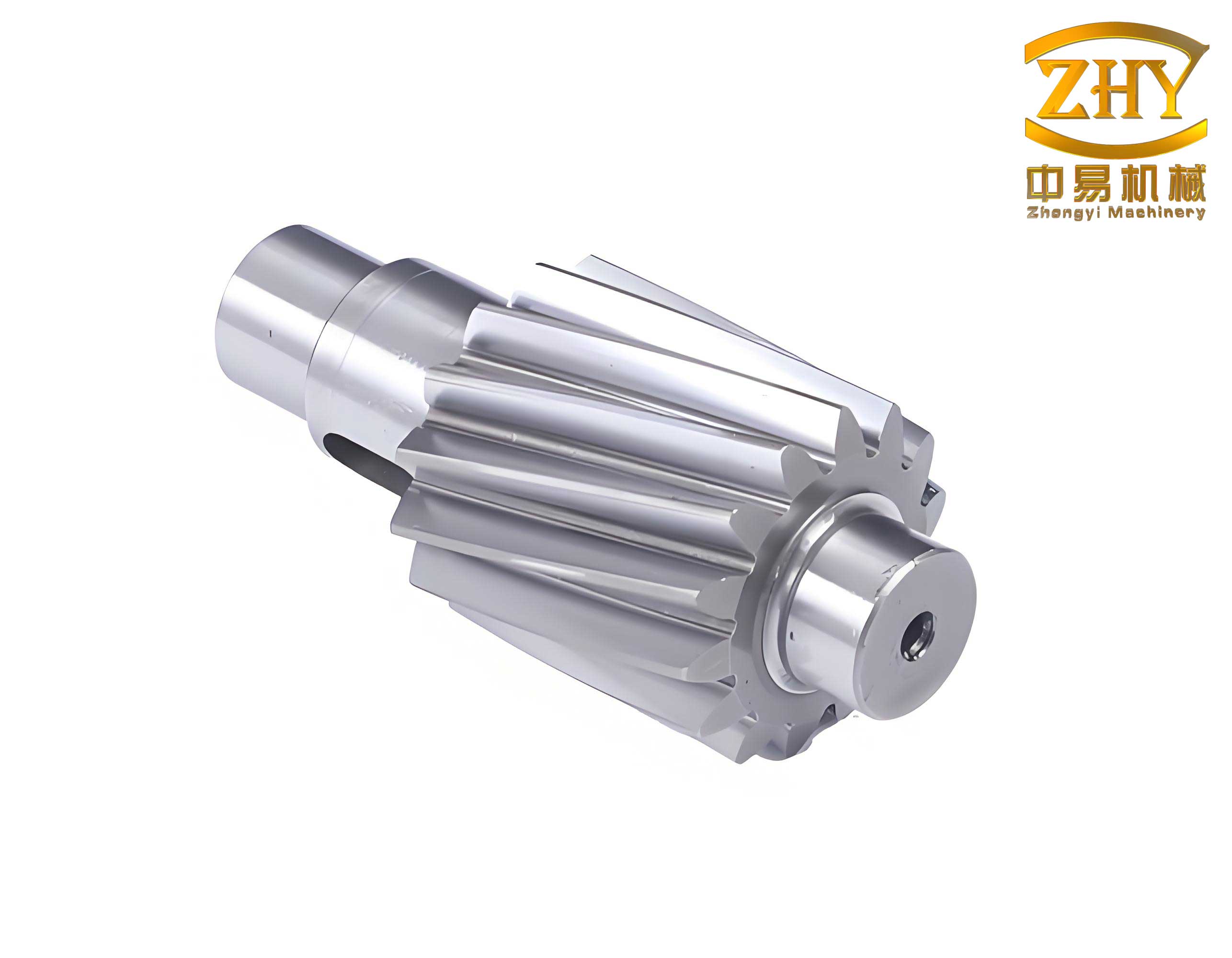
The root step defect not only affects the aesthetic of a gear shaft but also leads to stress concentration, noise, and reduced fatigue life. Understanding its origins is crucial for improving gear shaft quality. In this analysis, I will delve into factors such as improper processes, heat treatment deformation, and machining errors, while proposing mitigation strategies. The integration of mathematical models and empirical data will provide a comprehensive view, aiming to enhance the manufacturing precision of gear shafts for future applications.
Fundamentals of Gear Shaft Design and Root Step Definition
A gear shaft combines a shaft with gear teeth, transmitting torque and motion. For small module gear shafts, geometric parameters like module, pressure angle, and number of teeth are critical. The module \( m \) is defined as the ratio of pitch diameter \( d \) to number of teeth \( z \):
$$ m = \frac{d}{z} $$
The root diameter \( d_f \) for a standard spur gear shaft is calculated as:
$$ d_f = d – 2.5m $$
Root step refers to an unintended凸棱 at the tooth root after grinding, often measured as a height deviation \( \Delta h \) from the ideal profile. This deviation can be modeled using geometric relations, where the root radius \( r_f \) is typically \( 0.38m \). The stress concentration factor \( K_t \) due to a root step of height \( t \) is approximated by:
$$ K_t = 1 + 2\sqrt{\frac{t}{r_f}} $$
Thus, even minor steps can severely impact the gear shaft’s durability. The following sections break down the causes and solutions, with tables and formulas to encapsulate the information.
Causes of Root Step in Gear Shafts
Based on my observations, root step formation in gear shafts stems from multiple interrelated factors. I categorize them into process-related, material-related, and machine-related causes, each contributing to geometric inaccuracies.
1. Improper Manufacturing Processes
Inadequate process planning, especially in grinding, is a primary cause. When using a hob or grinding wheel, the allowance left for grinding must be precise. If the grinding allowance \( A_g \) is too small, the tooth profile may be incomplete; if too large, excessive material removal creates a step. The allowance is defined as:
$$ A_g = W_{\text{initial}} – W_{\text{final}} $$
where \( W_{\text{initial}} \) and \( W_{\text{final}} \) are tooth thicknesses before and after grinding. For small module gear shafts, \( A_g \) typically ranges from 0.1 to 0.3 mm, depending on module and heat treatment effects. Additionally, hob design parameters like convex angle \( \theta_c \) and convex height \( h_c \) must match the gear shaft geometry. Mismatches lead to poor root transitions. The table below summarizes common process-related causes.
| Cause | Description | Impact on Gear Shaft |
|---|---|---|
| Incorrect Grinding Allowance | \( A_g \) outside optimal range | Root step or incomplete profile |
| Hob Design Flaws | Mismatched \( \theta_c \) or \( h_c \) | Poor root transition, step formation |
| Improper Operation Sequencing | e.g., grinding before heat treatment | Inconsistent material removal, steps |
| Insufficient Tool Calibration | Worn or misaligned hobs | Increased error accumulation |
2. Heat Treatment Deformation
Heat treatment enhances mechanical properties but introduces deformation due to thermal expansion and contraction. For gear shafts, this deformation can manifest as root steps. The thermal strain \( \epsilon_{\text{th}} \) is given by:
$$ \epsilon_{\text{th}} = \alpha \cdot \Delta T $$
where \( \alpha \) is the coefficient of thermal expansion (e.g., \( 12 \times 10^{-6} \, \text{K}^{-1} \) for steel) and \( \Delta T \) is the temperature change. The resulting dimensional change \( \Delta L \) in a gear shaft of initial length \( L_0 \) is:
$$ \Delta L = L_0 \cdot \epsilon_{\text{th}} $$
Non-uniform heating or cooling exacerbates distortion, affecting root geometry. Controlling parameters like heating rate, quenching medium, and tempering temperature is vital. The table below outlines key heat treatment parameters influencing gear shaft deformation.
| Parameter | Typical Range | Effect on Root Step |
|---|---|---|
| Heating Rate | 50-150°C/hour | High rates cause cracking and distortion |
| Quenching Medium | Oil, water, or polymer | Variable cooling rates induce stress |
| Tempering Temperature | 150-300°C | Reduces residual stress but may alter dimensions |
| Carburizing Depth | 0.5-1.5 mm | Affects surface hardness and deformation |
3. Machining and Alignment Errors
Machining errors arise from tool wear, machine inaccuracies, and setup misalignment. For gear shaft production, cumulative error \( E_{\text{total}} \) can be modeled as:
$$ E_{\text{total}} = \sqrt{E_{\text{machine}}^2 + E_{\text{tool}}^2 + E_{\text{setup}}^2 + E_{\text{thermal}}^2} $$
where each component represents errors from machines, tools, setup, and thermal effects. Parameters like pressure angle \( \alpha \), module \( m \), and number of teeth \( z \) must be accurately set. For instance, a gear shaft with \( m = 3 \) mm, \( \alpha = 20^\circ \), and single-side grinding allowance of 0.15 mm requires a hob convex height \( h_c = 0.28 \) mm. Deviations cause root steps. The table below lists critical parameters for small module gear shafts.
| Parameter | Symbol | Typical Value (Module 3 Example) |
|---|---|---|
| Module | \( m \) | 3 mm |
| Pressure Angle | \( \alpha \) | 20° |
| Number of Teeth | \( z \) | 20 (varies with design) |
| Grinding Allowance (单边) | \( A_g \) | 0.15 mm |
| Hob Convex Height | \( h_c \) | 0.28 mm |
| Root Radius | \( r_f \) | \( 0.38m = 1.14 \) mm |
Solutions to Mitigate Root Step in Gear Shafts
Addressing root step issues requires a holistic approach. I propose strategies focusing on process optimization, heat treatment control, and error reduction, all tailored for gear shaft manufacturing.
1. Optimal Process Planning
Designing correct grinding allowances and tool parameters is essential. The required grinding allowance \( A_{g,\text{req}} \) should account for module and heat treatment deformation \( \delta_{\text{ht}} \):
$$ A_{g,\text{req}} = k \cdot m + \delta_{\text{ht}} $$
where \( k \) is an empirical coefficient (0.05 to 0.1). For a gear shaft with \( m = 3 \) mm and \( \delta_{\text{ht}} = 0.05 \) mm, \( A_{g,\text{req}} \approx 0.2 \) mm. Hob design must ensure the convex angle matches the tooth root radius. Simulation tools can verify designs before production. The table below outlines steps for optimal process planning.
| Step | Action | Purpose |
|---|---|---|
| 1 | Calculate \( A_g \) based on \( m \), \( \alpha \), and \( z \) | Ensure sufficient material for grinding |
| 2 | Design hob with verified \( \theta_c \) and \( h_c \) | Avoid root step formation |
| 3 | Sequence operations: roughing, heat treatment, finishing | Minimize cumulative errors |
| 4 | Use CNC grinding machines with feedback | Enhance precision and repeatability |
| 5 | Implement in-process inspection | Detect deviations early |
2. Stable Heat Treatment Process
Controlling heat treatment minimizes deformation in gear shafts. Following standards like ISO 683 and ASTM A29, parameters should be optimized for the material. For steel gear shafts, a typical cycle includes carburizing at 900°C, quenching at 850°C, and tempering at 200°C. The deformation model can be refined as:
$$ \Delta D = D_0 \cdot \beta \cdot \Delta T + C $$
where \( \Delta D \) is dimensional change, \( D_0 \) is initial dimension, \( \beta \) is a material coefficient, and \( C \) is a constant for phase transformations. Statistical process control (SPC) monitors parameters like temperature uniformity and cooling rate. The table below recommends heat treatment parameters for common gear shaft steels.
| Process | Temperature Range | Duration | Key Control Points |
|---|---|---|---|
| Carburizing | 850-950°C | 2-10 hours | Carbon potential, atmosphere |
| Quenching | 800-850°C | Minutes | Cooling rate, medium agitation |
| Tempering | 150-300°C | 1-4 hours | Temperature uniformity, time |
| Stress Relieving | 500-600°C | 1-2 hours | Slow cooling to room temperature |
3. Error Correction and Quality Control
Implementing rigorous quality control reduces machining errors in gear shafts. Regular calibration of machines using laser interferometry, tool wear monitoring via sensors, and setup verification with dial indicators are crucial. The corrected error \( \Delta_{\text{corrected}} \) is:
$$ \Delta_{\text{corrected}} = \Delta_{\text{measured}} – \Delta_{\text{tolerance}} $$
where \( \Delta_{\text{measured}} \) is measured deviation and \( \Delta_{\text{tolerance}} \) is allowable tolerance. If \( \Delta_{\text{corrected}} > 0 \), adjustments are needed. Advanced methods like Six Sigma and process capability indices (e.g., \( C_p \), \( C_{pk} \)) help maintain consistency. The table below summarizes error sources and correction methods.
| Error Source | Detection Method | Correction Action |
|---|---|---|
| Machine Tool Inaccuracy | Laser alignment, ballbar tests | Recalibrate or replace components |
| Tool Wear | Optical measurement, force sensors | Replace or re-sharpen hob |
| Workpiece Misalignment | Dial indicator, CMM | Realign fixture or chuck |
| Thermal Drift | Thermocouples, IR cameras | Implement thermal compensation |
| Parameter Calculation Errors | Software simulation, manual check | Recompute using verified formulas |
Mathematical Modeling and Case Study
To solidify the analysis, I present a mathematical model and case study for a small module gear shaft. Consider a gear shaft with \( m = 2 \) mm, \( \alpha = 20^\circ \), \( z = 30 \), and material: AISI 8620 steel. The goal is to minimize root step through process optimization.
First, compute basic geometry:
$$ d = m \cdot z = 2 \cdot 30 = 60 \, \text{mm} $$
$$ d_f = d – 2.5m = 60 – 5 = 55 \, \text{mm} $$
$$ r_f = 0.38m = 0.76 \, \text{mm} $$
The theoretical tooth thickness \( W_{\text{final}} \) after grinding is:
$$ W_{\text{final}} = \frac{\pi m}{2} = \frac{\pi \cdot 2}{2} = 3.1416 \, \text{mm} $$
Assuming heat treatment deformation \( \delta_{\text{ht}} = 0.04 \) mm per side, and using \( k = 0.08 \), the grinding allowance is:
$$ A_{g,\text{req}} = k \cdot m + \delta_{\text{ht}} = 0.08 \cdot 2 + 0.04 = 0.20 \, \text{mm} $$
Thus, initial tooth thickness \( W_{\text{initial}} = W_{\text{final}} + 2A_{g,\text{req}} = 3.1416 + 0.4 = 3.5416 \, \text{mm} \). The hob convex height \( h_c \) should be:
$$ h_c = 0.1 \cdot m + 0.05 = 0.1 \cdot 2 + 0.05 = 0.25 \, \text{mm} $$
During heat treatment, control parameters: heating rate 100°C/hour, quenching in oil at 50°C, tempering at 180°C for 2 hours. Using the deformation model, predicted dimensional change \( \Delta D \) for a 60 mm diameter is:
$$ \Delta D = 60 \cdot (12 \times 10^{-6}) \cdot (900 – 20) + 0.01 \approx 0.64 \, \text{mm} $$
This is compensated by the grinding allowance. In practice, iterative testing refines these values. The stress concentration factor for a root step of \( t = 0.05 \) mm is:
$$ K_t = 1 + 2\sqrt{\frac{0.05}{0.76}} \approx 1.51 $$
Highlighting the need to keep \( t \) minimal.
Advanced Techniques and Future Directions
Beyond traditional methods, advanced techniques can further reduce root step in gear shafts. Finite element analysis (FEA) simulates heat treatment deformation and grinding stresses. For a gear shaft, FEA equations involve thermal and structural modules:
$$ \rho C_p \frac{\partial T}{\partial t} = \nabla \cdot (k \nabla T) + Q $$
$$ \sigma = E \epsilon + \sigma_{\text{residual}} $$
where \( \rho \) is density, \( C_p \) specific heat, \( T \) temperature, \( k \) thermal conductivity, \( Q \) heat source, \( \sigma \) stress, \( E \) Young’s modulus, and \( \epsilon \) strain. Simulation results guide parameter adjustments. Additionally, adaptive grinding with real-time feedback adjusts \( A_g \) based on in-situ measurements. The table below compares traditional and advanced methods for gear shaft manufacturing.
| Aspect | Traditional Method | Advanced Method |
|---|---|---|
| Process Design | Empirical formulas, trial-and-error | FEA simulation, digital twins |
| Heat Treatment Control | Manual monitoring, fixed cycles | Closed-loop control, AI optimization |
| Error Correction | Post-process inspection | Real-time sensing and compensation |
| Tool Design | Standard hobs, off-the-shelf | Customized hobs via additive manufacturing |
| Quality Assurance | Sampling inspection | 100% automated inspection with machine vision |
Future directions include integrating IoT sensors for continuous monitoring of gear shaft production, and using machine learning to predict root step formation based on historical data. These innovations will enhance precision and reduce waste.
Conclusion
In conclusion, the root step problem in small module gear shafts is a multifaceted issue influenced by process, heat treatment, and machining factors. Through detailed analysis, I have identified key causes and proposed solutions involving optimal process planning, stable heat treatment, and error correction. Mathematical models and tables summarize critical parameters and relationships. By adopting these strategies, manufacturers can improve gear shaft quality, ensuring reliability in demanding applications. Continuous advancement in simulation and control technologies will further drive precision, making gear shafts more robust and efficient for future mechanical systems.