
In my extensive research and practical experience within the gear manufacturing industry, the precise measurement of spiral bevel gears has always been a critical challenge. The dynamic performance of spiral bevel gears, which are widely used in automotive and aviation transmissions, is profoundly influenced by the micro-geometry of their tooth flanks. Unlike involute cylindrical gears, spiral bevel gears do not possess a common reference tooth surface; their tooth flank forms are typically defined by specific machine settings and cutting processes, often resulting in deviations from the theoretical design after manufacturing steps like cutting, heat treatment, and lapping. These deviations, even at micron levels, can lead to significant noise, vibration, and harshness (NVH) issues. Therefore, developing high-precision, efficient measurement methods is paramount for quality control and performance prediction. In this article, I will delve into the scanning measurement method for spiral bevel gears, which utilizes a virtual conjugate reference tooth flank and enables rapid, automated, and comprehensive assessment of tooth surface errors. I will explore its technical principles, data processing techniques, and practical applications in industrial settings, supported by formulas and tables to summarize key concepts.
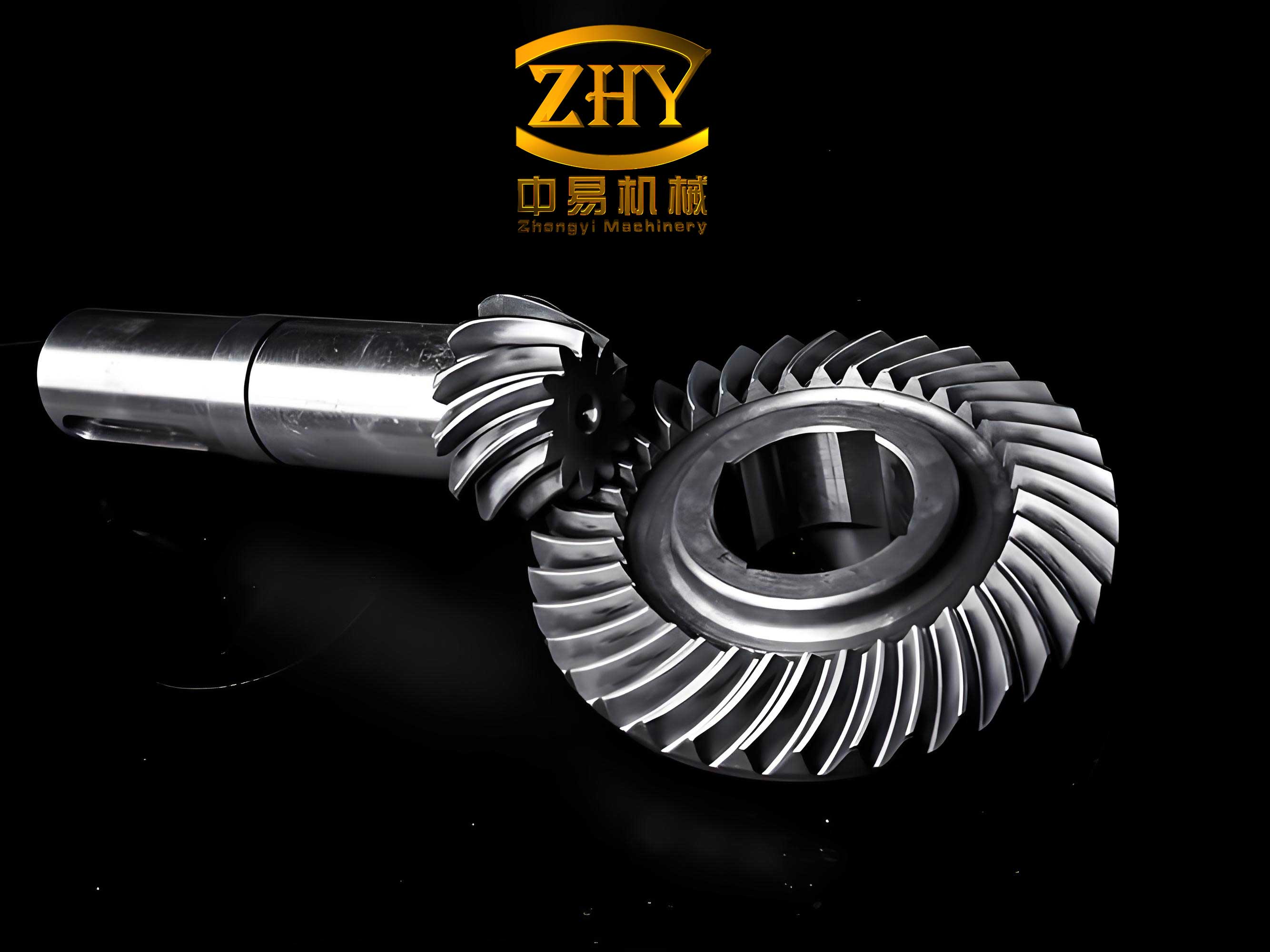
The complexity of spiral bevel gear tooth flank geometry arises from its generation process, which involves relative motions between the cutter and gear blank in multi-axis machine tools. The theoretical tooth surface can be described mathematically based on machine settings. For a spiral bevel gear, the position vector \(\mathbf{r}(u, \theta)\) of a point on the tooth flank can be expressed in terms of surface parameters \(u\) and \(\theta\), incorporating parameters such as cutter radius \(R_c\), machine root angle \(\gamma\), and offset \(E\). A common form is:
$$ \mathbf{r}(u, \theta) = \begin{bmatrix} x(u, \theta) \\ y(u, \theta) \\ z(u, \theta) \end{bmatrix} = \begin{bmatrix} (R_c \pm u \sin \alpha) \cos \theta + E \\ (R_c \pm u \sin \alpha) \sin \theta \\ u \cos \alpha \end{bmatrix} $$
where \(\alpha\) is the pressure angle, and the sign depends on the convex or concave side. However, in practice, the actual tooth flank deviates from this theoretical model due to manufacturing errors. The scanning measurement method addresses this by using a virtual conjugate reference tooth flank. For the wheel (gear), the reference is the theoretical tooth flank calculated from machine settings. For the pinion, the reference is a virtual tooth flank that is conjugate to the wheel’s reference, ensuring zero transmission error under ideal conditions. This concept allows us to define tooth flank form error \(\Delta \mathbf{r}\) as the deviation in the normal direction between the actual surface \(\mathbf{r}_{\text{act}}\) and the reference surface \(\mathbf{r}_{\text{ref}}\):
$$ \Delta \mathbf{r} = \mathbf{r}_{\text{act}} – \mathbf{r}_{\text{ref}} $$
The magnitude of error in the normal direction, \(\delta_n\), is critical for performance analysis and is given by:
$$ \delta_n = \Delta \mathbf{r} \cdot \mathbf{n}_{\text{ref}} $$
where \(\mathbf{n}_{\text{ref}}\) is the unit normal vector of the reference tooth flank at the corresponding point. This error definition mirrors that used for involute cylindrical gears, facilitating easier interpretation and management.
To implement scanning measurement, specialized gear measurement machines like the OSK Hyb-35 are employed. These machines utilize a two-dimensional (2D) probe that measures deviations in two orthogonal directions (e.g., X and Z axes), while the gear is continuously rotated to keep the probe within a plane where the Y-axis component of the normal direction approaches zero. This ingenious approach converts three-dimensional error into two-dimensional data, avoiding the friction effects that plague three-dimensional probes in scanning measurements. The probe is pre-displaced in the X-axis direction by a set amount (typically 0.15 mm), ensuring constant contact with the tooth flank during rapid scanning. The measurement principle can be summarized with the following equations for probe outputs. Let \(d_X\) and \(d_Z\) be the measured displacements in X and Z directions, respectively. The actual error components \(\delta_X\) and \(\delta_Z\) are derived from these readings after compensating for pre-displacement and geometric transformations. For a point on the tooth flank with coordinates \((X, Y, Z)\) in the machine coordinate system, the relationship is:
$$ \delta_X = d_X – \delta_{X0}, \quad \delta_Z = d_Z $$
where \(\delta_{X0}\) is the pre-displacement value. The normal error \(\delta_n\) is then computed using the direction cosines of the reference surface normal. This method ensures high accuracy (sub-micron level) and speed, enabling measurement of an entire tooth flank area in minutes.
The scanning measurement pattern is highly flexible, covering the entire tooth flank region where the pinion engages. A typical pattern includes multiple tooth height scanning lines and tooth width scanning lines. For instance, for a spiral bevel gear with module 3.9, 40 teeth, and tooth width 27 mm, a pattern might have 29 height lines and 1 width line, each with 113 sampling points, totaling over 3,000 data points per flank. This rich dataset contrasts sharply with traditional point-to-point matrix methods (e.g., 5×9 dots) that offer limited coverage. The table below compares scanning measurement with conventional methods:
| Aspect | Scanning Measurement | Point-to-Point Matrix Measurement |
|---|---|---|
| Data Density | High (1000s of points per flank) | Low (e.g., 45 points per flank) |
| Measurement Area | Entire tooth flank, including root zone | Limited to small, predefined grid |
| Speed | Fast (e.g., 10 minutes for 4 teeth) | Slow (due to point-by-point approach) |
| Error Detection | Captures high-frequency components and jumps | Misses local variations and jumps |
| Reference Surface | Virtual conjugate tooth flank | Theoretical tooth flank from machine settings |
The advantages of scanning measurement for spiral bevel gears become evident in data application. One key application is managing lapped-off material on the tooth flank. During lapping, material removal is non-uniform, leading to “jump errors” where un-lapped sections cause abrupt deviations. Scanning measurement captures these jumps across the entire flank, as shown in error curves that exhibit convexity for pinions and concavity for wheels. The error \(\delta_n\) as a function of tooth width \(w\) and height \(h\) can reveal lapping patterns. For example, if \(\delta_n(w, h)\) shows a sudden increase at certain coordinates, it indicates an un-lapped region. This allows for corrective actions in the lapping process to ensure uniform material removal, directly improving the contact pattern and noise performance of spiral bevel gears.
Another critical application is controlling heat treatment distortion. Spiral bevel gears undergo carburizing or induction hardening, which can warp the tooth flank. By measuring the tooth flank before and after heat treatment using scanning methods, the distortion vector \(\mathbf{D}\) can be quantified as:
$$ \mathbf{D}(u, \theta) = \mathbf{r}_{\text{post}}(u, \theta) – \mathbf{r}_{\text{pre}}(u, \theta) $$
where \(\mathbf{r}_{\text{pre}}\) and \(\mathbf{r}_{\text{post}}\) are tooth flank positions pre- and post-heat treatment. The distortion magnitude \(|\mathbf{D}|\) tends to be higher in the tooth tip and root zones. Scanning measurement covers these zones, enabling statistical analysis. For instance, the table below summarizes typical distortion ranges for automotive spiral bevel gears based on my observations:
| Gear Component | Distortion Magnitude (µm) | Primary Direction |
|---|---|---|
| Pinion Concave Flank | 5–15 | Normal inward |
| Pinion Convex Flank | 3–10 | Normal outward |
| Wheel Concave Flank | 4–12 | Normal outward |
| Wheel Convex Flank | 6–18 | Normal inward |
By correlating distortion with process parameters (e.g., temperature, quenching rate), manufacturers can optimize heat treatment to minimize errors, thereby enhancing the durability and performance of spiral bevel gears.
Perhaps the most innovative aspect of scanning measurement with virtual conjugate reference is its ability to predict contact pattern shape and position directly from measured data. In traditional quality control, contact patterns are assessed subjectively via grease tests, but scanning measurement provides quantitative insight. For a pair of spiral bevel gears, the instantaneous contact lines on the virtual conjugate wheel tooth flank are known from simulation. By aligning the measured error curves of the wheel and pinion along these contact lines, the effective transmission error \(\Delta \phi\) can be estimated. For a given mesh position \(\psi\), the composite error \(\delta_{\text{comp}}(\psi)\) is:
$$ \delta_{\text{comp}}(\psi) = \delta_n^{\text{wheel}}(s(\psi)) + \delta_n^{\text{pinion}}(t(\psi)) $$
where \(s(\psi)\) and \(t(\psi)\) map the mesh position to points on the wheel and pinion tooth flanks, respectively. A positive \(\delta_{\text{comp}}\) indicates separation, while negative indicates interference, affecting contact stress. The contact pattern outline can be derived by thresholding \(\delta_{\text{comp}}\) values. For example, if the allowable error range is \([-10, 10]\) µm, the contact area corresponds to where \(|\delta_{\text{comp}}| \leq 10\) µm. This method allows visual and rapid judgment of contact conditions, facilitating proactive adjustments in manufacturing to achieve optimal spiral bevel gear performance.
Furthermore, scanning measurement data integrates seamlessly with dynamic performance simulation systems. These systems use numerical models to predict NVH characteristics based on tooth flank geometry. The equation of motion for a spiral bevel gear pair can be expressed as:
$$ I_p \ddot{\phi}_p + c(\dot{\phi}_p – \dot{\phi}_w) + k(t)(\phi_p – \phi_w – \Delta \phi_{\text{TE}}) = T_p $$
where \(I_p\) is pinion inertia, \(c\) is damping, \(k(t)\) is time-varying mesh stiffness, \(\Delta \phi_{\text{TE}}\) is static transmission error from tooth flank errors, and \(T_p\) is input torque. The mesh stiffness \(k(t)\) depends on the contact pattern, which is derived from scanning data. By inputting measured \(\delta_n\) values into simulation software, engineers can predict vibration spectra and noise levels. For instance, high-frequency error components (e.g., from tool marks) excite resonances, quantified by Fourier transforms of \(\delta_n\). The power spectral density \(S(\omega)\) of tooth flank error is:
$$ S(\omega) = \left| \int_{-\infty}^{\infty} \delta_n(x) e^{-i\omega x} dx \right|^2 $$
where \(\omega\) is spatial frequency. Peaks in \(S(\omega)\) correspond to periodic errors that cause gear whine. Scanning measurement captures these details, enabling targeted corrections in cutting or lapping processes to suppress unwanted frequencies.
In mass production, the speed of scanning measurement enables intelligent pairing of spiral bevel gears. By measuring all gears in a batch, the error distributions can be clustered using algorithms like k-means to group gears with complementary errors. For a set of \(N\) gears, the error matrix \(\mathbf{E}\) has rows representing gears and columns representing sampled points. The pairing objective is to minimize the composite error for each pair. This can be formulated as an optimization problem:
$$ \min \sum_{i,j} \| \mathbf{e}_i + \mathbf{e}_j \|^2 $$
where \(\mathbf{e}_i\) is the error vector of gear \(i\). Implementing such pairing reduces variability in transmission error, leading to consistent dynamic performance across all assembled units. This is crucial for automotive applications where batch-to-batch consistency is demanded.
To summarize the technical parameters and capabilities of scanning measurement for spiral bevel gears, the following table provides a comprehensive overview:
| Parameter | Typical Value or Range | Description |
|---|---|---|
| Measurement Accuracy | ±0.5 µm | Normal direction error resolution |
| Scanning Speed | 10–30 mm/s | Probe traversal speed along flank |
| Data Points per Flank | 1,000–10,000 | Depends on pattern density |
| Coverage Area | Up to 100% of engageable flank | Includes root and tip zones |
| Probe Pre-displacement | 0.15 mm | In X-axis for constant contact |
| Reference Surface | Virtual conjugate tooth flank | Zero transmission error ideal |
| Compatible Gear Sizes | Module 2–10, diameter up to 500 mm | For automotive and industrial gears |
In conclusion, the scanning measurement method for spiral bevel gears represents a significant advancement in metrology, combining high precision, speed, and comprehensive data acquisition. By leveraging a virtual conjugate reference tooth flank, it bridges the gap between theoretical design and practical manufacturing, enabling direct prediction of contact patterns and dynamic performance. The rich dataset supports applications from lapping management to heat treatment control and intelligent pairing, making it indispensable for quality assurance in mass production. As spiral bevel gears continue to evolve for electric vehicles and aerospace, scanning measurement will play a pivotal role in achieving quieter, more efficient, and reliable transmissions. My experience confirms that adopting this method leads to tangible improvements in product quality and customer satisfaction, underscoring its value in the gear industry.