
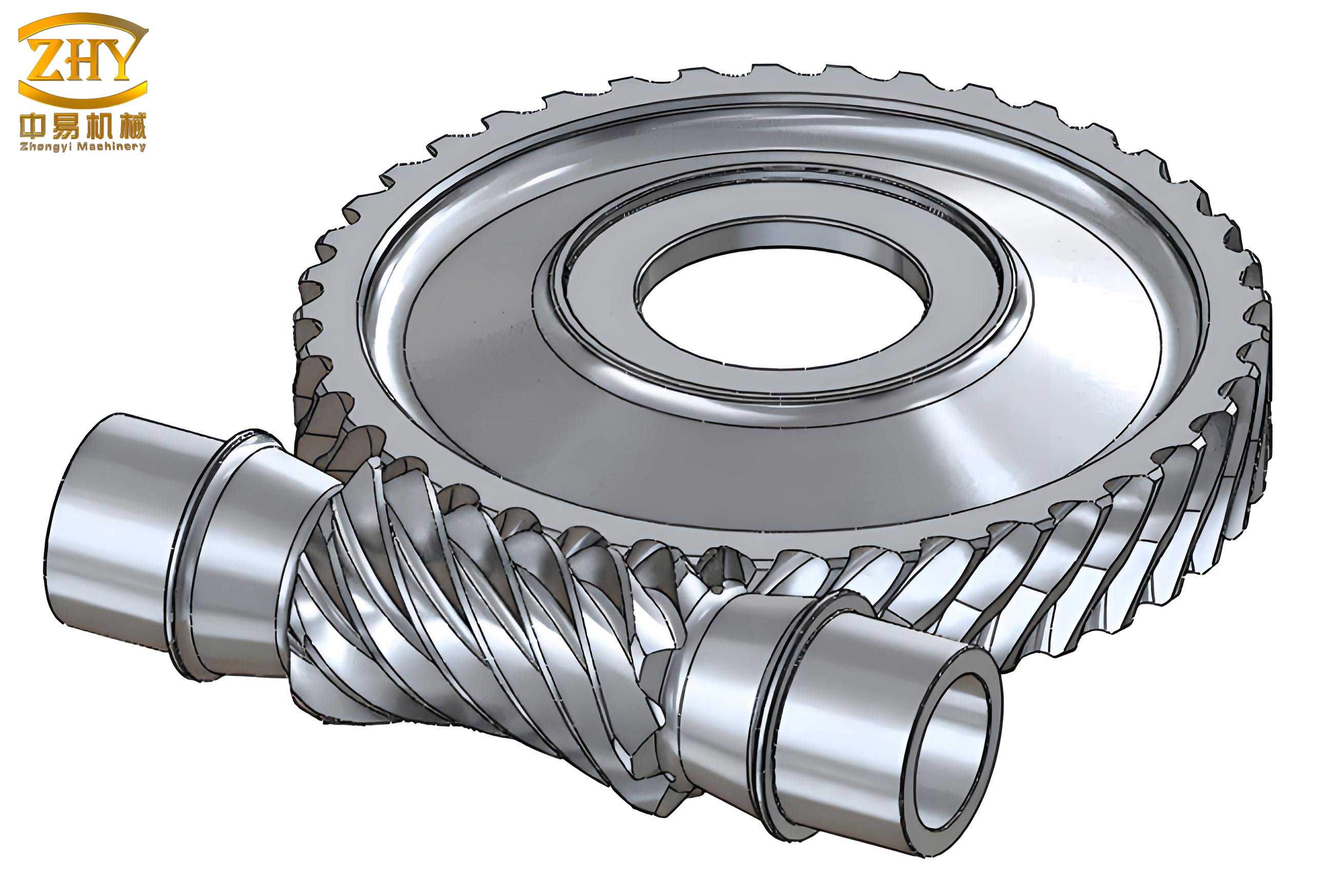
Based on gear meshing theory, this investigation focuses on the analysis of the contact zone for the torus-generated (ZC1) cylindrical worm gear set, a specific and high-performing type of screw gear. The screw gear drive, particularly the worm and worm wheel pair, is renowned for its compact design, high single-stage reduction ratios, self-locking capability, and smooth, quiet operation. The primary drawbacks have traditionally been lower transmission efficiency and higher manufacturing costs. The development of the circular-arc tooth profile represents a significant advancement, substantially increasing load capacity and efficiency compared to conventional worm designs. Among these, the ZC1 type, where the worm thread surface is the envelope of a convex toroidal grinding wheel and the worm wheel tooth surface is subsequently the envelope of the worm helicoid, offers excellent manufacturability and has seen widespread adoption. To achieve optimal transmission performance for this screw gear, a detailed understanding of its meshing characteristics is paramount for parametric optimization.
Previous research has laid a strong foundation. Studies have derived methods to calculate the meshing area, a critical indicator for transmission smoothness and noise. Analyses of instantaneous contact lines on the worm wheel tooth surface have been performed to improve engagement quality. Furthermore, optimization studies using the meshing area as an objective function have been conducted. This work aims to build upon these foundations by providing a comprehensive numerical analysis of the meshing zone for the ZC1 screw gear, uniquely integrating the consideration of the undercutting boundary curve. The influence of key design parameters—namely the pressure angle (α), the profile arc radius (ρ), and the profile shift coefficient (x)—on the meshing zone and the potential for undercutting is systematically investigated and presented through characteristic curves and summary tables, offering direct guidance for optimal design.
Mathematical Model of the ZC1 Screw Gear
The derivation begins by establishing the coordinate systems necessary to describe the generation process. Let $s_u [o_u, x_u, y_u, z_u]$ be the coordinate system fixed to the grinding wheel axis, with the $z_u$-axis coinciding with the wheel’s axis of rotation. The system $s_1 [o_1, x_1, y_1, z_1]$ is fixed to the worm, with its $z_1$-axis aligned with the worm axis. The system $s_u’ [o_u’, x_u’, y_u’, z_u’]$ is attached to the circular-arc profile of the grinding wheel. A fixed coordinate system is denoted as $s [o, x, y, z]$. The worm helicoid is the envelope surface generated by the grinding wheel. The locus of instantaneous contact lines between the grinding wheel and the worm in $s_1$ constitutes the worm thread surface. The parametric equations for the ZC1 worm surface are derived as follows:
$$
\begin{aligned}
x_1 &= (\rho \sin \theta + d)(-\cos \beta \cos \psi + \sin \beta \sin \psi \cos \gamma_n) \\
&\quad – (\rho \cos \theta – a) \sin \psi \sin \gamma_n + A_u \cos \psi \\
y_1 &= (\rho \sin \theta + d)(\cos \beta \sin \psi + \sin \beta \cos \psi \cos \gamma_n) \\
&\quad – (\rho \cos \theta – a) \cos \psi \sin \gamma_n – A_u \sin \psi \\
z_1 &= (\rho \sin \theta + d) \sin \beta \sin \gamma_n + (\rho \cos \theta – a) \cos \gamma_n – p\psi \\
\tan \theta &= \frac{A_u – p \cot \gamma_n – d \cos \beta}{a \cos \beta + (A_u \cot \gamma_n + p) \sin \beta}
\end{aligned}
$$
Where $\rho$ is the radius of the circular-arc profile on the grinding wheel, $p$ is the screw motion parameter, $d$ is the distance from the arc center to the wheel axis, $a$ and $b$ are coordinates of the arc center, $\gamma_n$ is the crossed-axis angle between the worm and wheel during grinding, $\beta$ is the rotational parameter of the wheel profile, $\psi$ is the rotation angle of the worm-fixed coordinate system relative to the fixed system, $A_u$ is the center distance during grinding, and $\theta$ is the parameter defining a point on the wheel profile.
The angle between the radius vector to an arbitrary point on the worm’s transverse profile and the positive direction of the profile tangent is given by:
$$
\mu = 90^\circ – \arctan\left(\frac{y_1}{x_1}\right) + \arctan\left(\frac{n_{y1}}{n_{x1}}\right)
$$
Here, $n_{x1}$ and $n_{y1}$ are the components of the surface normal vector at that point on the worm, derived as:
$$
\begin{aligned}
n_x &= \sin \theta [\cos \beta \cos(\psi – \phi_1) – \sin \beta \sin(\psi – \phi_1) \cos \gamma_u] \\
&\quad + \cos \theta \sin(\psi – \phi_1) \cos \gamma_u \\
n_y &= -\sin \theta [\cos \beta \sin(\psi – \phi_1) + \sin \beta \cos(\psi – \phi_1) \cos \gamma_u] \\
&\quad + \cos \theta \cos(\psi – \phi_1) \sin \gamma_u \\
n_z &= -\sin \theta \sin \beta \sin \gamma_u – \cos \theta \cos \gamma_u
\end{aligned}
$$
Meshing Zone and Undercutting Boundary
The meshing zone in the plane of action is defined as the region enclosed between two boundary curves: curve $a$-$a$, traced by points on the worm tip cylinder as they enter and exit mesh, and curve $b$-$b$, traced by points on the worm wheel tip cylinder. Deriving these curves is essential for visualizing and quantifying the contact area of the screw gear pair.
The equation for curve $a$-$a$ is:
$$
\begin{cases}
x = r_a \cos(\theta_e + \zeta + \phi_1) \\
y = r_a \sin(\theta_e + \zeta + \phi_1) \\
z = \dfrac{ r_a \left[ r_a \cos(\theta_e + \zeta + \phi_1) + A_0 \right] – \dfrac{p}{i_{21}} \cos \mu_e }{ p \sin(\theta_e + \zeta + \phi_1 + \mu_e) }
\end{cases}
$$
where $r_a$ is the worm tip radius, $\phi_1$ is the worm rotation angle, $\zeta$ is the angular parameter due to screw motion, $\mu_e$ is the angle $\mu$ calculated at the worm tip, $\theta_e$ is the corresponding polar angle on the transverse section, $A_0$ is the operating center distance, and $i_{21}$ is the gear ratio. For a given parameter $\beta$, the system of equations (1) is solved subject to the condition $r_a = \sqrt{x_1^2 + y_1^2}$ to find the necessary values for plotting.
Similarly, the equation for curve $b$-$b$ is:
$$
\begin{cases}
x = r \cos(\theta + \zeta + \phi_1) \\
y = r \sin(\theta + \zeta + \phi_1) \\
z = \dfrac{ r \left[ r \cos(\theta + \zeta + \phi_1) + A_0 \right] – \dfrac{p}{i_{21}} \cos \mu }{ p \sin(\theta + \zeta + \phi_1 + \mu) }
\end{cases}
$$
where $r$ is the radial coordinate of a point on the worm transverse profile. The area between these two curves represents the potential path of contact points, i.e., the meshing zone.
A critical constraint in screw gear design is avoiding undercutting on the worm wheel tooth flank. The undercutting boundary (a line of regression on the worm wheel surface) is determined by the condition where the relative velocity of the contact point along the common normal is zero. This is defined by the system:
$$
\begin{cases}
\vec{n} \cdot \vec{V}^{(12)} = 0 \\
\Psi^{(12)} = 0
\end{cases}
$$
where $\Psi^{(12)}$ is the so-called first-order meshing function. The set of equations determining this boundary curve on the wheel surface can be expressed as:
$$
\begin{aligned}
&r^{(1)} \left[ r^{(1)} \cos(\theta + \phi_1 + \zeta) + A_0 \right] – \frac{P}{i_{21}} \cos \mu = p^2 \zeta \sin \tau \\
&\Psi^{(12)} = 0 \\
&\vec{r}^{(1)} = r^{(1)}(\theta) \cos(\theta + \zeta) \vec{i_1} + r^{(1)}(\theta) \sin(\theta + \zeta) \vec{j_1} + p\zeta \vec{k_1} \\
&\vec{r}^{(2)} = x_2 \vec{i_2} + y_2 \vec{j_2} + z_2 \vec{k_2} \\
&x_2 = x_1 \cos \phi_1 \cos \phi_2 – y_1 \sin \phi_1 \cos \phi_2 – z_1 \sin \phi_2 + A_0 \cos \phi_2 \\
&y_2 = -x_1 \cos \phi_1 \sin \phi_2 + y_1 \sin \phi_1 \sin \phi_2 – z_1 \cos \phi_2 – A_0 \sin \phi_2 \\
&z_2 = x_1 \sin \phi_1 + y_1 \cos \phi_1
\end{aligned}
$$
Plotting this curve within the meshing zone reveals regions where undercutting occurs, which must be avoided in a viable screw gear design.
Parametric Influence on Meshing Characteristics
Using the derived mathematical models and numerical simulation software, the influence of key parameters on the meshing zone and undercutting boundary for a ZC1 screw gear is analyzed. A baseline set of parameters is used: center distance $a = 180$ mm, module $m = 8.7$ mm, number of worm starts $Z_1 = 1$, diameter quotient $q = 10$. The parameters $\alpha$, $\rho$, and $x$ are varied individually to isolate their effects.
1. Influence of Pressure Angle ($\alpha$)
Holding $\rho = 48$ mm and $x = 0.5$ constant, the pressure angle $\alpha$ is varied from $21^\circ$ to $24^\circ$. The results of the meshing zone simulation are summarized below.
| Pressure Angle $\alpha$ | Observed Meshing Zone Size | Undercutting Region | Qualitative Assessment |
|---|---|---|---|
| $21^\circ$ | Largest | Most extensive, encroaches significantly into mesh | Maximum potential contact area but high risk of severe undercutting. |
| $22^\circ$ | Slightly reduced | Reduced compared to $21^\circ$ | Good balance, but undercutting may still affect part of the active profile. |
| $23^\circ$ | Moderately reduced | Minimal, near the boundary of the zone | Recommended value. Offers a sufficiently large meshing zone while effectively minimizing or eliminating undercutting. |
| $24^\circ$ | Smallest | Virtually absent | Undercutting is avoided, but the loss in meshing zone area may impact load-sharing and smoothness. |
The analysis confirms that increasing the pressure angle has a mild reducing effect on the absolute size of the meshing zone. However, its most significant benefit is the drastic reduction in the undercutting area. This validates the common design handbook recommendation to select a pressure angle between $21^\circ$ and $25^\circ$, with $23^\circ$ being a standard, optimal choice for this type of screw gear to ensure robustness and performance.
2. Influence of Profile Arc Radius ($\rho$)
Holding $\alpha = 23^\circ$ and $x = 0.5$ constant, the profile arc radius $\rho$ is varied: 45 mm, 48 mm, 50 mm, 52 mm.
| Arc Radius $\rho$ (mm) | Observed Meshing Zone Size | Undercutting Region | Qualitative Assessment |
|---|---|---|---|
| 45 | Largest | Largest encroachment | Similar to a low pressure angle: large area but high undercutting risk. |
| 48 | Slightly reduced | Clearly reduced | Favorable compromise for the given center distance and module. |
| 50 | Moderately reduced | Minimal | Further reduction in undercutting at the cost of some contact area. |
| 52 | Smallest | Absent | Eliminates undercutting but may overly constrain the meshing zone. |
The influence of $\rho$ parallels that of $\alpha$. A larger $\rho$ slightly reduces the meshing zone area but is highly effective in pushing the undercutting boundary curve away from the active contact region. The selection of $\rho$ is therefore a critical tool for controlling tooth strength and contact geometry in the ZC1 screw gear design process.
3. Influence of Profile Shift Coefficient ($x$)
Holding $\alpha = 23^\circ$ and $\rho = 48$ mm constant, the profile shift coefficient $x$ is varied: 0.4, 0.5, 0.75, 1.0.
| Shift Coefficient $x$ | Observed Meshing Zone Size | Undercutting Region | Qualitative Assessment |
|---|---|---|---|
| 0.4 | Very Large | Extensive, covers a major portion | Theoretical area is large, but a significant part is unusable due to undercutting. |
| 0.5 | Large | Present but limited | Improved, with a good portion of the zone remaining effective. |
| 0.75 | Moderate | Very small or absent | Dramatic improvement. Undercutting is virtually eliminated, leaving a clean, effective meshing zone. |
| 1.0 | Smaller | Absent | No undercutting, but the meshing zone area is significantly reduced. |
The profile shift coefficient $x$ exhibits the most pronounced effect on the meshing characteristics of this screw gear. Increasing $x$ causes a rapid and significant reduction in the overall meshing zone area defined by the $a$-$a$ and $b$-$b$ curves. Crucially, it also causes an even more rapid recession of the undercutting boundary. Therefore, the net effective meshing area (total zone minus undercut region) may actually increase with an initial increase in $x$, reaching an optimum before decreasing again. Furthermore, a positive profile shift alters the shape of the contact lines, promoting the formation of a more favorable elastohydrodynamic lubrication film and improving the friction state within the mesh. Consequently, for ZC1 screw gear designs, selecting a larger positive profile shift coefficient is generally advantageous, provided other design constraints (like tooth thickness) are satisfied.
Conclusion
This detailed analysis of the ZC1 torus-generated cylindrical worm gear set provides clear guidelines for the parametric optimization of this efficient type of screw gear. The meshing zone and the undercutting boundary are mathematically defined and their interdependence is clarified. The systematic investigation of the pressure angle ($\alpha$), profile arc radius ($\rho$), and profile shift coefficient ($x$) yields the following conclusions for design practice:
- Pressure Angle ($\alpha$): A value in the range of $22^\circ$ to $24^\circ$ is optimal, with $23^\circ$ serving as a robust standard. It offers a good compromise, providing a sufficiently large contact area while effectively suppressing undercutting.
- Profile Arc Radius ($\rho$): This parameter is a powerful tool for controlling undercutting. A larger $\rho$ should be chosen to minimize undercutting, but its value must be coordinated with the module and center distance to avoid excessively reducing the meshing zone.
- Profile Shift Coefficient ($x$): This is the most influential parameter. A larger positive shift is highly beneficial. It drastically reduces or eliminates undercutting and can improve the lubrication conditions. Designers should aim to maximize $x$ within the limits of other geometric and strength requirements to enhance the overall performance and durability of the screw gear drive.
In summary, the optimal design of a ZC1 screw gear involves a holistic consideration of these parameters. The analysis presented, combining meshing zone evaluation with undercutting limits, provides a solid foundation for achieving high-performance, reliable worm gear transmissions through informed parameter selection.