
In my extensive experience working with mechanical transmission systems, I have found that screw gear drives, particularly worm and worm wheel sets, play a crucial role in transmitting motion and power between non-intersecting, perpendicular shafts. The screw gear mechanism, often referred to as a worm drive, offers significant advantages such as high reduction ratios, compact design, and self-locking capabilities, making it indispensable in applications ranging from machine tools and metallurgical equipment to lifting devices and conveyor systems. The widespread use of screw gear reducers has established them as a standalone category in power transmission. However, in practical industrial settings, screw gear components are prone to wear or unexpected damage, necessitating replacement to ensure machinery longevity and prevent premature asset failure. Therefore, rapid mapping and design of cylindrical screw gear pairs—specifically worm wheels and worms—are vital for maintenance and repair operations. This process not only extends the lifecycle of capital equipment but also reduces costs and enhances productivity, holding substantial practical significance. Through years of practice, research, and summarization, I have developed a set of efficient technical methods for this purpose, which I will elaborate on in this discussion.
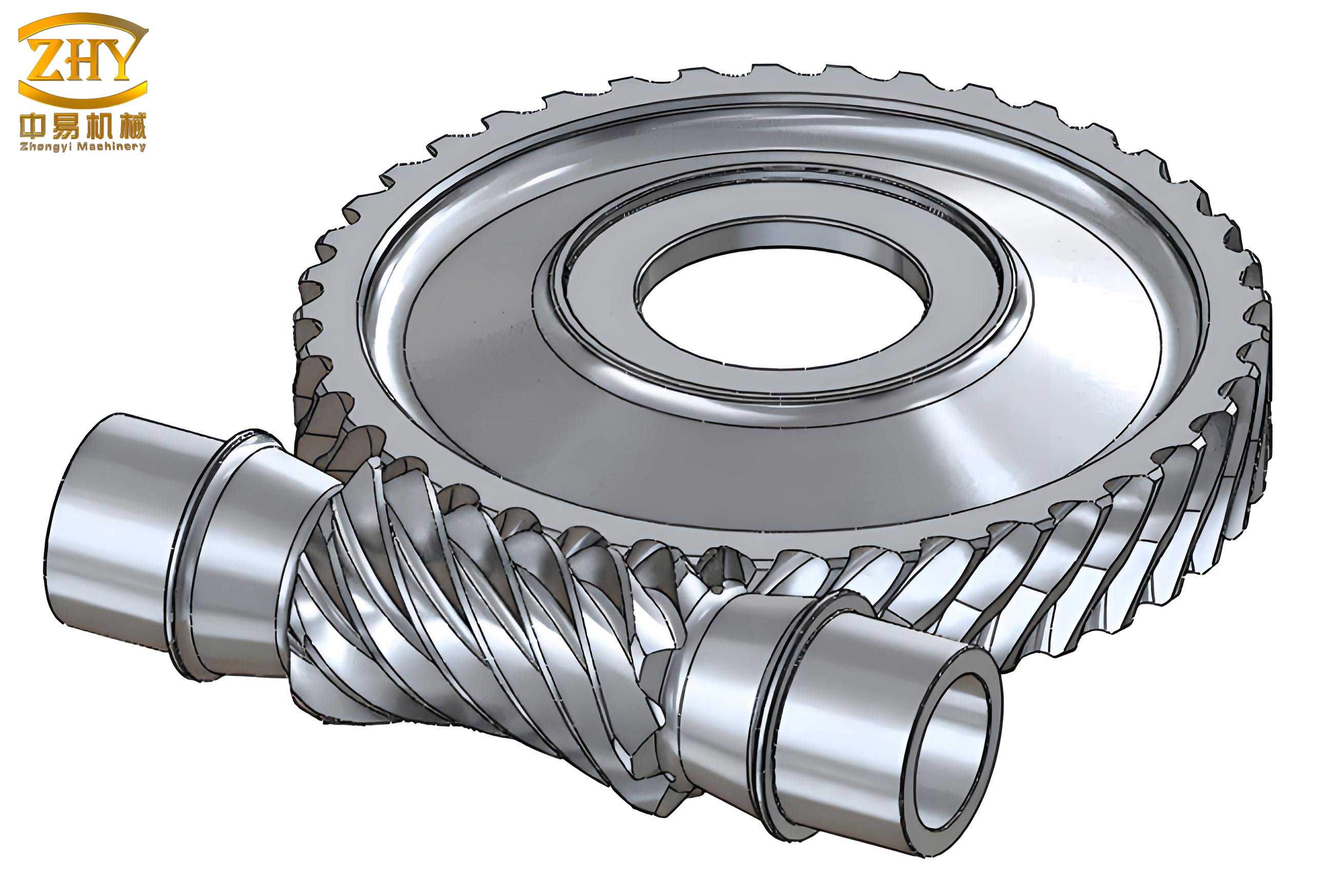
The screw gear drive, commonly implemented as a worm and worm wheel, is a type of gear system where the worm resembles a screw thread that meshes with a gear wheel. This configuration allows for smooth and quiet operation, high torque transmission, and precise motion control. In many industries, screw gear assemblies are subjected to harsh conditions, leading to degradation over time. Rapid mapping enables quick replacement without lengthy downtime, which is critical for continuous production lines. My approach focuses on the Archimedean spiral worm, which is prevalent in many applications, and involves a systematic procedure to measure key geometric parameters accurately. While standard design calculations, material selection, and manufacturing processes for screw gear drives are well-documented in mechanical engineering handbooks, the emphasis here is on the expedited mapping technique tailored for field maintenance.
To begin the rapid mapping process for an Archimedean screw gear drive, I follow a structured flowchart program to determine the relevant geometric parameters. This program ensures that all necessary data is collected efficiently, minimizing errors and speeding up the design phase. The core parameters include the number of worm threads (Z1), the number of worm wheel teeth (Z2), the worm tip diameter (D1), the worm wheel tip diameter (D2), the worm tooth height (h1), the axial pitch of the worm (ta), the tooth profile angle (α), and the center distance (A). Each of these plays a pivotal role in reconstructing the screw gear pair for manufacturing or replacement. Below, I outline the measurement methods in detail, supplemented with formulas and tables to facilitate understanding.
First, the worm thread count Z1 and worm wheel tooth count Z2 can be directly counted by visual inspection or using marking techniques. For instance, on a worm shaft, I often use a dye to highlight the threads for accurate counting. Similarly, the worm wheel teeth are enumerated by rotating the wheel and marking each tooth. This step is straightforward but essential for defining the gear ratio, which is given by:
$$ i = \frac{Z2}{Z1} $$
where i is the transmission ratio. A higher ratio indicates greater speed reduction, a key feature of screw gear drives.
Next, the tip diameters are measured. For the worm tip diameter D1, I employ a precision vernier caliper, ensuring that measurements are taken at multiple points along the worm axis to account for any wear or irregularities. The average value is then used. For the worm wheel tip diameter D2, direct measurement can be challenging due to the gear’s shape; hence, I utilize gauge blocks or cylindrical pins inserted between teeth to derive the diameter indirectly. The formula for calculating D2 using gauge blocks of size G and tooth count Z2 is:
$$ D2 = \frac{G}{\sin\left(\frac{180^\circ}{Z2}\right)} + d_p $$
where d_p is the pin diameter. This method enhances accuracy in screw gear mapping.
The worm tooth height h1 is another critical parameter. It can be measured directly with a depth gauge by assessing the difference between the tip and root of the worm thread. Alternatively, if the worm root diameter D0 is accessible, h1 is computed as:
$$ h1 = \frac{D1 – D0}{2} $$
In practice, I prefer using a micrometer to measure D1 and D0 separately, then applying this formula for consistency. For worn screw gear components, I take multiple measurements along the worm length to capture variations.
The axial pitch ta of the worm defines the distance between corresponding points on adjacent threads. To measure it, I use a precision caliper to span several threads—say, n threads—and record the total distance L_n. The axial pitch is then:
$$ ta = \frac{L_n}{n} $$
Typically, I measure over 5 to 10 threads to average out errors, which is crucial for accurate screw gear reproduction. This parameter directly influences the lead of the worm, given by:
$$ L = Z1 \cdot ta $$
where L is the lead, representing axial advancement per worm revolution.
The tooth profile angle α is vital for ensuring proper meshing in the screw gear pair. For Archimedean worms, the standard pressure angle is often 20° or 30°, but field measurements may deviate due to wear. I use profile gauges or optical comparators to assess α. In absence of specialized tools, a practical method involves rolling the worm against a known gear hob and observing the contact pattern; discrepancies indicate angle variations. The profile angle is related to the normal pressure angle α_n by:
$$ \tan\alpha = \frac{\tan\alpha_n}{\cos\lambda} $$
where λ is the lead angle of the worm, calculated as:
$$ \lambda = \arctan\left(\frac{L}{\pi D1}\right) $$
Accurate determination of α ensures that the new screw gear will mesh smoothly without excessive noise or wear.
Finally, the center distance A is measured indirectly. I first measure the worm shaft diameter d1 and worm wheel shaft diameter d2 using calipers. Then, the distance L between the two shaft centers is gauged with a telescoping gauge or inside caliper. The center distance is derived from:
$$ A = L – \frac{d1 + d2}{2} $$
This parameter is fundamental for positioning the screw gear pair in the housing and affects backlash and efficiency. All measured values are recorded in a table for subsequent design calculations. Below is a summary table of the measurement procedures for screw gear mapping:
| Parameter | Symbol | Measurement Method | Formula (if applicable) |
|---|---|---|---|
| Worm Thread Count | Z1 | Direct counting | – |
| Worm Wheel Tooth Count | Z2 | Direct counting | – |
| Worm Tip Diameter | D1 | Precision caliper | – |
| Worm Wheel Tip Diameter | D2 | Gauge blocks and pins | $$ D2 = \frac{G}{\sin(180^\circ/Z2)} + d_p $$ |
| Worm Tooth Height | h1 | Depth gauge or caliper | $$ h1 = (D1 – D0)/2 $$ |
| Axial Pitch | ta | Caliper over multiple threads | $$ ta = L_n / n $$ |
| Tooth Profile Angle | α | Profile gauge or hob test | $$ \tan\alpha = \tan\alpha_n / \cos\lambda $$ |
| Center Distance | A | Shaft diameter and distance measurement | $$ A = L – (d1 + d2)/2 $$ |
Once these parameters are obtained, I proceed to the design phase. For an Archimedean screw gear, the design equations are well-established. The module m, a key parameter for screw gear sizing, is derived from the axial pitch and the number of worm threads. Specifically, the module in the axial plane is:
$$ m = \frac{ta}{\pi} $$
However, since screw gear drives often use module-based standardization, I cross-reference measured values with standard module series to select the closest match. The worm wheel pitch diameter D2_p is then calculated as:
$$ D2_p = m \cdot Z2 $$
and the worm pitch diameter D1_p is:
$$ D1_p = D1 – 2m $$
assuming standard addendum coefficients. These calculations ensure compatibility in the screw gear pair. Additionally, the lead angle λ is recalculated using the pitch diameter for design accuracy:
$$ \lambda = \arctan\left(\frac{Z1 \cdot m}{D1_p}\right) $$
This angle influences the efficiency and self-locking properties of the screw gear. For self-locking screw gear drives, λ must be less than the friction angle φ, where:
$$ \varphi = \arctan(\mu) $$
with μ being the coefficient of friction. Typically, if λ ≤ 5°, the screw gear is considered self-locking, a desirable trait in hoisting applications.
To further illustrate the design process, I compile the derived parameters into a design specification table. This table serves as a blueprint for manufacturing the replacement screw gear components. Below is an example based on a typical mapping scenario:
| Design Parameter | Symbol | Value | Remarks |
|---|---|---|---|
| Module (axial) | m | 4 mm | From standard series |
| Worm Threads | Z1 | 2 | Measured |
| Worm Wheel Teeth | Z2 | 40 | Measured |
| Transmission Ratio | i | 20 | Calculated as Z2/Z1 |
| Worm Pitch Diameter | D1_p | 40 mm | Calculated from D1 and m |
| Worm Wheel Pitch Diameter | D2_p | 160 mm | Calculated as m·Z2 |
| Center Distance | A | 100 mm | Measured and verified |
| Lead Angle | λ | 5.71° | Calculated using D1_p and m |
| Tooth Profile Angle | α | 20° | Assumed standard, verified |
This systematic approach allows for rapid and accurate screw gear design, fulfilling the needs of industrial maintenance. Beyond the technical mapping, I have also explored the economic implications of screw gear applications, particularly in energy-saving contexts. For instance, in boiler systems, screw gear reducers are often used in fan and pump drives, where variable speed control via frequency converters can yield significant energy savings. The integration of screw gear mechanisms with modern electronics highlights their adaptability and efficiency.
Consider a case study involving a 10-ton boiler with a forced draft fan and induced draft fan driven by screw gear reducers. The fans originally operated with dampers or valves for flow control, leading to substantial energy losses. By implementing frequency conversion technology, the screw gear-driven fans can be speed-adjusted to match load demands, reducing power consumption. The economic analysis for such an upgrade involves calculating energy savings based on motor power, operating hours, and electricity costs. Below is a detailed table summarizing the economic benefits for a screw gear-based fan system:
| Component | Motor Power (kW) | Traditional Control Cost (USD) | Frequency Converter Cost (USD) | Additional Investment (USD) | Speed Reduction (%) | Energy Saving Rate (%) | Annual Energy Saved (kWh) | Annual Cost Saving (USD) |
|---|---|---|---|---|---|---|---|---|
| Forced Draft Fan | 30 | 300 | 25,000 | 24,700 | 70 | 66 | 95,040 | 57,024 |
| Induced Draft Fan | 55 | 400 | 72,000 | 71,600 | 70 | 66 | 174,240 | 104,544 |
| Total | 85 | 700 | 97,000 | 96,300 | – | – | 269,280 | 161,568 |
In this analysis, the speed reduction to 70% of rated speed corresponds to a cubic relationship with power for fan loads, as per the affinity laws. The power saving is derived from:
$$ P \propto n^3 $$
where P is power and n is speed. Thus, at 70% speed, the power consumption is approximately (0.7)^3 = 0.343 of the full load, leading to about 66% savings when accounting for losses. The annual energy saved is calculated as:
$$ E_{\text{saved}} = P_{\text{rated}} \times \text{Operating hours} \times \text{Saving rate} $$
For the forced draft fan with 30 kW, operating 16 hours daily for 300 days a year, and a 66% saving rate:
$$ E_{\text{saved}} = 30 \times 16 \times 300 \times 0.66 = 95,040 \text{ kWh} $$
Assuming an electricity rate of $0.6 per kWh, the cost saving is $57,024. The payback period for the additional investment in frequency converters is:
$$ \text{Payback period} = \frac{\text{Additional investment}}{\text{Annual cost saving}} = \frac{96,300}{161,568} \approx 0.6 \text{ years} $$
This quick return on investment underscores the economic viability of upgrading screw gear drives with energy-efficient controls. Moreover, benefits such as soft starting, reduced mechanical stress, and extended screw gear lifespan further enhance the overall value. Screw gear systems, when optimized, contribute significantly to industrial energy conservation.
Expanding on the screw gear theme, it is important to delve into the design nuances that affect performance. For example, the contact ratio in a screw gear pair influences load capacity and smoothness. The contact ratio CR can be estimated using:
$$ CR = \frac{\sqrt{(D2_a/2)^2 – (D2_p/2 \cos\alpha)^2} – \sqrt{(D2_f/2)^2 – (D2_p/2 \cos\alpha)^2}}{p_n} $$
where D2_a is the worm wheel tip diameter, D2_f is the root diameter, p_n is the normal pitch, and α is the pressure angle. A higher contact ratio, typically above 1.2 for screw gear drives, ensures multiple teeth are in contact, distributing load and reducing wear. Additionally, the efficiency η of a screw gear drive is given by:
$$ \eta = \frac{\tan\lambda}{\tan(\lambda + \varphi)} $$
for forward driving, and for self-locking conditions, efficiency drops below 50%. This formula highlights the trade-off between self-locking and efficiency in screw gear design.
In terms of materials, screw gear components are often made from bronze for the worm wheel and hardened steel for the worm to minimize friction and wear. The selection depends on application requirements such as load, speed, and environmental conditions. For high-duty screw gear sets, I recommend using phosphor bronze (CuSn12) for the wheel and case-hardened steel (e.g., 16MnCr5) for the worm, with surface hardening to HRC 58-62. The wear resistance can be calculated based on the surface pressure p:
$$ p = \frac{F_t}{b \cdot d2_p} $$
where F_t is the tangential force, b is the face width, and d2_p is the worm wheel pitch diameter. Ensuring p remains within allowable limits, typically 10-20 MPa for bronze wheels, prolongs screw gear life.
Furthermore, lubrication is critical for screw gear operation. Due to the sliding contact in worm meshes, proper lubricant selection reduces friction and heat generation. I advise using EP (extreme pressure) gear oils with viscosity grades suited to the operating temperature. The oil bath level should be maintained to ensure the screw gear is adequately immersed, with splash lubrication common in enclosed reducers. Heat dissipation calculations may be necessary for high-power screw gear drives to prevent overheating, using:
$$ Q = \frac{P_{\text{loss}}}{k \cdot A} $$
where Q is the temperature rise, P_loss is the power loss (often 5-10% of input power for screw gear drives), k is the heat transfer coefficient, and A is the housing surface area.
To enhance the mapping process, I incorporate digital tools such as 3D scanning and CAD software. By creating a point cloud of the worn screw gear component, I can reverse-engineer the geometry and compare it to standard parameters. This approach is particularly useful for complex or non-standard screw gear profiles. The data can be processed to generate CNC programs for direct manufacturing, streamlining the repair cycle. However, the manual measurement methods described earlier remain valuable for field technicians without access to advanced equipment.
In conclusion, the rapid mapping and design of cylindrical screw gear drives are essential skills for maintaining industrial machinery. My methodology, centered on precise measurement and systematic calculation, enables quick turnaround times for replacement parts. The screw gear, with its unique advantages, continues to be a cornerstone in power transmission systems. By integrating energy-efficient practices, such as variable speed control, the economic benefits of screw gear applications are amplified. As technology advances, the adoption of materials, lubrication, and digital tools will further optimize screw gear performance. I believe that ongoing exploration and innovation in screw gear design will drive sustainability and productivity across industries, making this field both challenging and rewarding for engineers like myself.
Throughout this discussion, I have emphasized the practicality of screw gear mapping, supported by formulas and tables. The iterative nature of design—from measurement to analysis—ensures reliability in real-world scenarios. Whether dealing with a simple reducer or a complex industrial drive, the principles remain consistent: understand the geometry, apply sound engineering principles, and consider operational economics. The screw gear, in all its forms, exemplifies the ingenuity of mechanical design, and I am committed to advancing its applications through continuous learning and sharing of knowledge. In future endeavors, I plan to explore noise reduction techniques and advanced coatings for screw gear surfaces, which could open new frontiers in transmission technology.