
In my extensive experience with gear manufacturing, the selection of quenching media is undeniably one of the most critical factors determining the success of the heat treatment process. The wrong choice can directly lead to a multitude of heat treatment defects, including unacceptable distortion, cracking, insufficient hardness, soft spots, or inadequate case depth. Conversely, a well-considered selection not only achieves the desired microstructure and mechanical properties but also minimizes distortion, improves precision, and reduces the need for subsequent machining, thereby lowering overall costs. This article consolidates practical knowledge on selecting and applying various quenching media, with a constant focus on avoiding common heat treatment defects.
The choice of quenching medium must be evaluated against five key parameters of the gear: the carbon content of the steel, its hardenability, the effective section thickness, the geometric complexity of the part, and the permissible level of distortion. The primary media used in industry today include water (and its variants), polymer solutions, various types of oils, molten salts, and high-pressure gases.
1. Water and Aqueous Solutions
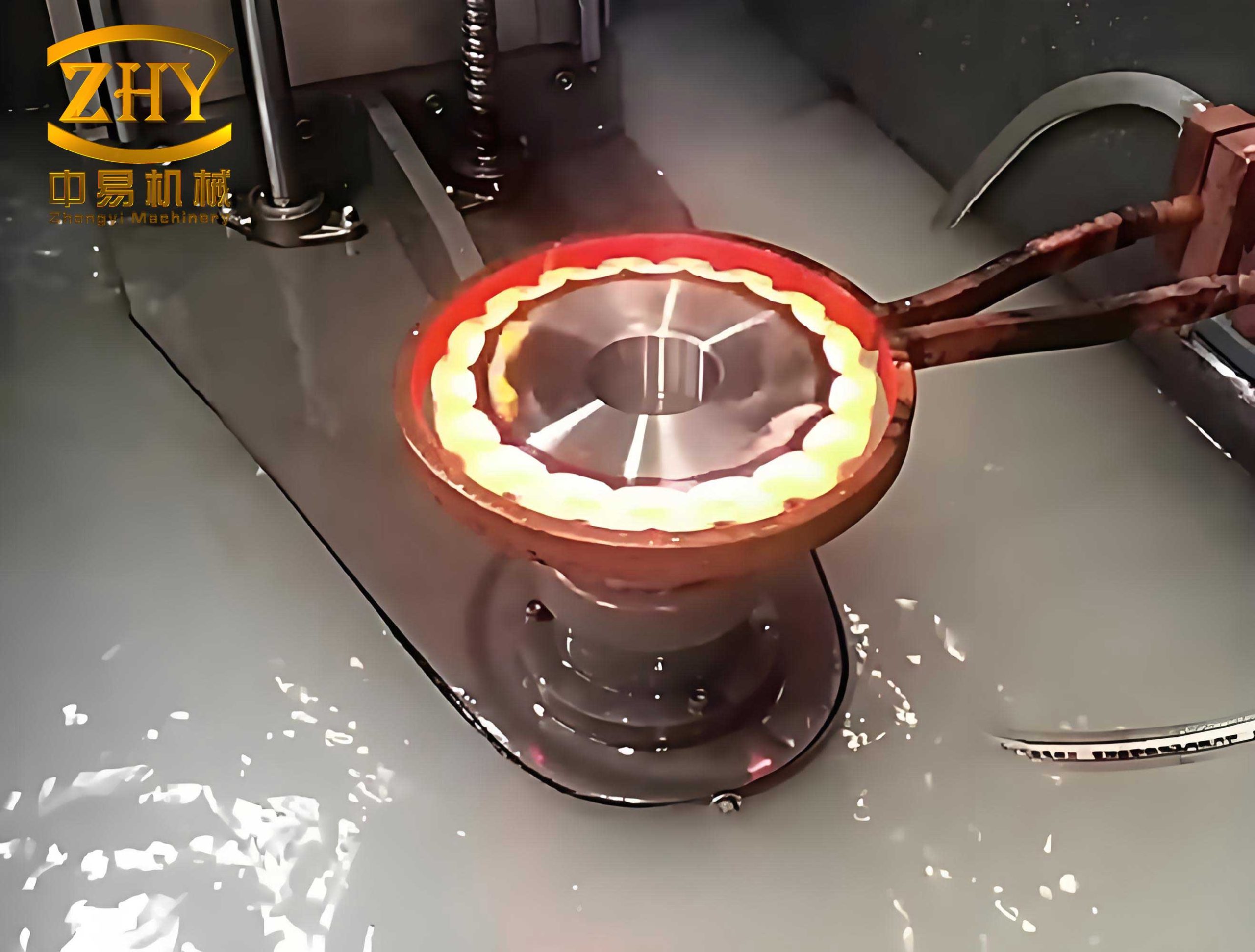
Plain water, brine, and caustic solutions are among the most severe quenchants. They exhibit a very high cooling rate, particularly in the vapor stage and at intermediate temperatures. While effective for achieving high hardness in simple, low-hardenability steel parts like some low-carbon gears for induction hardening, their use is fraught with risk. The intense and non-uniform cooling generates massive thermal and transformational stresses, making gears highly susceptible to cracking and excessive distortion—classic heat treatment defects. The cooling intensity can be slightly modified by adjusting water temperature or using additives.
- Tap Water: Used for spray or immersion quenching of simple-shaped, medium-carbon steel gears. For simultaneous induction heating and spray quenching, the cooling time \( t_c \) can be estimated as:
$$ t_c = (1 \sim 2) t_h $$
where \( t_h \) is the heating time in seconds. Water pressure typically ranges from 0.1 to 0.4 MPa at 15-30°C. - Brine (e.g., Salt Water): The addition of salts (NaCl, NaOH) disrupts the insulating vapor film more rapidly, increasing the cooling speed compared to plain water. This can help achieve more uniform hardness on carbon steel gears but further increases the risk of quench cracking and distortion.
2. Polymer Quenchants (Water-Soluble Media)
Polymer solutions, most notably Polyalkylene Glycol (PAG) types, have revolutionized quenching by offering adjustable cooling speeds between those of water and oil. Their cooling performance is controlled by concentration, temperature, and agitation. This tunability makes them exceptionally valuable for preventing heat treatment defects in alloy steel gears and complex shapes where water would cause cracks and oil would result in insufficient hardness.
The mechanism is based on inverse solubility: the polymer dissolves in cold water but comes out of solution (forms a film) on the hot gear surface, moderating the initial cooling rate. This film redissolves during the final, slow cooling stage. The table below classifies common polymer types.
| Polymer Type | Key Characteristics |
|---|---|
| PAG (Polyalkylene Glycol) | Exhibits inverse solubility (cloud point 65–85°C). Offers stable cooling performance but is sensitive to contamination by salts. Widely used for immersion and spray quenching. |
| PEOX (Polyethylene Oxazoline) | Non-viscoelastic, often used specifically for induction hardening applications. |
| PVA (Polyvinyl Alcohol) | Provides cooling between water and oil. Requires strict temperature control (25–45°C). Used for spray quenching in induction hardening. |
| PVP (Polyvinyl Pyrrolidone) | Does not show inverse solubility. Cooling performance is very sensitive to small changes in concentration, temperature, and agitation. |
Selecting the correct concentration is paramount to avoiding heat treatment defects. For instance, a low concentration (e.g., 5-10%) may be suitable for 40Cr or 42CrMo, while a higher concentration (12-18%) is necessary for more crack-sensitive steels like 38CrMoAl or for carburized gears made from 20CrMnTi to control distortion. The following table provides generalized guidance.
| Target Steel Grade Examples | Suggested PAG Concentration (wt.%) | Purpose & Defect Prevention |
|---|---|---|
| 45, 40Cr, 42CrMo (for through-hardening) | 5 – 10 | Achieve sufficient hardness and depth while reducing cracking risk vs. water. |
| 20CrMnTi, 20CrMo (for carburizing) | 10 – 15 | Control distortion and minimize non-martensitic transformation products post-carburize. |
| 38CrMoAl, High-alloy steels | 12 – 18 | Provide a near-oil cooling rate to prevent cracking in high-hardenability steels. |
Other popular polymer brands and series (e.g., Ucon, Aqua-Quench) function on similar principles, with specific formulations offering varying cloud points and stability. Their main advantage is replacing flammable oils and hazardous salt baths, thereby reducing the incidence of environmental and safety-related heat treatment defects, while providing excellent process control.
3. Quenching Oils
Oils remain the cornerstone for precision gear heat treatment, especially after carburizing or for through-hardening alloy steels. They provide a much slower cooling rate in the pearlite and bainite transformation ranges compared to water, significantly reducing stresses. However, selecting the wrong oil type or using degraded oil can lead to soft spots, shallow case depth, excessive distortion, or staining—all severe heat treatment defects.
Quenching oils are scientifically classified by their maximum cooling speed and operating temperature, as per standards like ISO 9950.
| Oil Type | Maximum Cooling Speed Range | Typical Application for Gears |
|---|---|---|
| Normal Speed Oil | 60 – 80 °C/s | General purpose for low-hardenability steels. |
| Fast Quench Oil | 80 – 100 °C/s | Most common for alloy steel gears (e.g., 20CrMnTi, 8620). |
| Super-Fast Quench Oil | 100 – 120 °C/s | Large cross-sections or steels requiring high hardenability. |
More specifically, oils are formulated for different stages of the process:
- Fast and Accelerated Oils: These are the workhorses for gear quenching. They are designed with additives to increase the speed of vapor film collapse and improve wetting characteristics, ensuring uniform cooling. Using a regular mechanical oil instead can result in inconsistent hardness and increased distortion, clear signs of heat treatment defects.
- Hot/Martempering Oils: Used at elevated temperatures (typically 120-200°C), these oils allow gears to be quenched to a temperature just above the Ms point, held to equalize temperature, and then air-cooled. This martempering process drastically reduces thermal gradient-induced stresses, effectively controlling distortion and eliminating cracking in complex, thin-webbed gears.
- Vacuum Oils: Specially formulated with low vapor pressure and high stability for use in vacuum furnaces. They prevent sooting and ensure bright, clean gears after low-pressure carburizing. Using a standard oil in a vacuum would lead to rapid degradation and poor surface quality.
- Gas Quenching: While not a liquid, high-pressure gases like Nitrogen (N2) or Helium (He) act as the quenching medium in vacuum furnaces. Cooling is highly uniform and controllable via pressure and gas velocity, minimizing distortion. The cooling power can be approximated by heat transfer coefficients. For example, the cooling intensity can be described relative to a reference. The effective heat transfer coefficient \( h \) increases with pressure \( P \), improving the ability to through-harden larger sections without the heat treatment defects associated with liquid quenching.
$$ h \propto P^n $$
where \( n \) is a positive exponent depending on gas type and flow dynamics. A mixture of He/H2 at 20 MPa can achieve cooling rates comparable to fast quench oil.
4. Molten Salt Baths
Molten nitrate/nitrite salt baths operating between 160°C and 400°C are excellent media for austempering and martempering. They offer several advantages: very high cooling rates in the initial stage (due to no vapor phase), excellent temperature uniformity, and no fire hazard. They are superb for minimizing distortion in precision gears.
The cooling characteristic is highly dependent on bath temperature and the presence of water. A small, controlled amount of water (0.5-1.0%) can significantly accelerate the cooling rate in the intermediate range, making salts adaptable. For a standard nitrate/nitrite bath, the cooling curve lacks a vapor phase, leading to immediate rapid cooling. The cooling speed \( v(T) \) is a function of bath temperature \( T_{bath} \) and gear temperature \( T \).
Typical application temperatures for carburized gears:
- 20CrNi2Mo: 160-180°C
- 20CrMnMo: 150-170°C
This process yields lower distortion than oil quenching, often eliminating the need for post-heat-treatment straightening or hard finishing, thus avoiding associated heat treatment defects from those secondary operations.
Conclusion: A Systematic Approach to Prevent Defects
There is no universal “best” quenching medium. The optimal choice is a strategic decision based on the steel grade, part geometry, and required properties. A systematic approach is essential to prevent costly heat treatment defects.
- Define Requirements: Start with the required hardness, case depth, core microstructure, and permissible distortion levels.
- Analyze the Gear: Evaluate material hardenability (using Jominy data or CCT diagrams), section thickness, and shape complexity (holes, keyways, thin ribs).
- Select Media Class: Use the guidelines and tables provided. Simple low-carbon gears may tolerate water/polymer spray; critical alloy steel transmission gears typically require fast oil, martempering oil, or high-pressure gas; ultra-precision, low-distortion gears point to salt or martempering oil.
- Control Process Parameters: Once selected,严格控制介质浓度(聚合物)、温度、搅拌/ agitation, and maintenance (filtration, removal of water/contaminants in oil) is critical. Degraded media are a primary source of inconsistent results and heat treatment defects.
By understanding the cooling characteristics and application scope of each quenching medium type, heat treatment engineers can make informed choices that optimize gear performance, maximize yield, and consistently produce components free from the distortions and failures that characterize poor quenching practice.