
In the field of mechanical transmission, straight bevel gears play a critical role in transmitting motion and power between intersecting shafts. However, during assembly, installation errors inevitably arise due to human factors, measurement inaccuracies, and environmental conditions. These errors can lead to undesirable effects such as noise, vibration, impact loads, and edge contact, which compromise the performance and longevity of straight bevel gear systems. Therefore, analyzing the sensitivity of modified tooth surfaces to installation errors is essential for improving the reliability and efficiency of straight bevel gear drives. This study focuses on developing a comprehensive methodology to assess and mitigate the impact of installation errors on straight bevel gears, utilizing mathematical models and optimization techniques.
To address this issue, we establish a meshing coordinate system that incorporates various installation errors, including axial misalignment, axis separation, and shaft angle variation. This system allows for precise modeling of the gear pair interaction under realistic conditions. We then introduce a novel approach to quantify the sensitivity of the modified tooth surface to installation errors by employing the Gauss curvature of the difference surface between two tangent contact tooth surfaces. This metric serves as a key indicator of how installation errors affect the contact behavior in straight bevel gears. Furthermore, we apply a penalty function method to optimize the long axis of the contact ellipse, aiming to minimize sensitivity and achieve favorable contact patterns. Our analysis reveals that the contact ellipse long axis has the most significant influence on sensitivity, and by optimizing it, we can obtain contact paths that are less susceptible to installation errors, particularly when the contact path is perpendicular to the root cone.
The foundation of our analysis lies in the development of a coordinate system that accounts for installation errors in straight bevel gear pairs. We define dynamic coordinate systems attached to the pinion (small gear) and gear (large gear), denoted as $S_1$ and $S_2$, respectively, with origins at $O_1$ and $O_2$, and rotational axes along $x_1$ and $x_2$. A fixed coordinate system $S_f$, tied to the machine frame, has its origin at $O_f$ and rotational axis $x_f$. Auxiliary coordinate systems $S_h$, $S_i$, and $S_j$ are used to describe the relationships between installation errors. Key parameters include $R_f$ (installation distance of the gear along $x_f$), $\phi_1’$ and $\phi_2’$ (rotation angles of the pinion and gear during meshing), $\Delta A$ (axial misalignment error), $\Delta B$ (axis separation error), and $\Delta \beta$ (shaft angle variation error). The Tooth Contact Analysis (TCA) equations are formulated in the fixed coordinate system $S_f$ as follows:
$$ \mathbf{r}^{(1)}_f (l_1, d_1, \phi_1′) = \mathbf{r}^{(2)}_f (l_2, d_2, \phi_2′) $$
$$ \mathbf{n}^{(1)}_f (l_1, d_1, \phi_1′) = \mathbf{n}^{(2)}_f (l_2, d_2, \phi_2′) $$
Here, $l_1$, $d_1$, $l_2$, and $d_2$ are tooth surface parameters for the pinion and gear, and $\phi_1’$ and $\phi_2’$ are the meshing rotation angles. By decomposing these vector equations into nonlinear algebraic equations and solving them iteratively for different pinion rotation angles, we determine the instantaneous contact points and the corresponding gear rotation angles, which collectively form the contact path on the tooth surface.
The sensitivity analysis centers on the concept of the difference surface between two tooth surfaces that are tangent at a point of contact. Consider tooth surfaces $\Sigma_1$ and $\Sigma_2$ in contact at point $M$, where they share a common normal vector. The distance between the surfaces along a tangent direction $\alpha$ can be expressed as $\Delta \delta = \delta_1 – \delta_2 = \frac{1}{2} \Delta k_n (\Delta L)^2$, where $\Delta k_n = k_{n1} – k_{n2}$ is the relative normal curvature (or difference curvature) along $\alpha$, and $\Delta L$ is the projection length in the tangent direction. Using Euler’s formula, the normal curvatures for $\Sigma_1$ and $\Sigma_2$ along $\alpha$ are given by:
$$ k_{1n} = k_{1n1} \cos^2 \theta + 2 \tau_{1g1} \sin \theta \cos \theta + k_{1n2} \sin^2 \theta $$
$$ k_{2n} = k_{2n1} \cos^2 \theta + 2 \tau_{2g1} \sin \theta \cos \theta + k_{2n2} \sin^2 \theta $$
where $\theta$ is the angle between $\alpha$ and the principal direction $\alpha_1$, $k_{1n1}$, $k_{1n2}$, $\tau_{1g1}$ and $k_{2n1}$, $k_{2n2}$, $\tau_{2g1}$ are the principal curvatures and geodesic torsions for $\Sigma_1$ and $\Sigma_2$, respectively. The relative normal curvature $k_{12n}$ is then:
$$ k_{12n} = k_{12n1} \cos^2 \theta + 2 \tau_{12g1} \sin \theta \cos \theta + k_{12n2} \sin^2 \theta $$
with $k_{12n1} = k_{1n1} – k_{2n1}$, $k_{12n2} = k_{1n2} – k_{2n2}$, and $\tau_{12g1} = \tau_{1g1} – \tau_{2g1}$. The Gauss curvature of the difference surface, which is invariant under coordinate transformations, is defined as:
$$ k_{12} = k_{12n1} k_{12n2} – (\tau_{12g1})^2 = k_{121} k_{122} $$
where $k_{121}$ and $k_{122}$ are the relative principal curvatures. This Gauss curvature $k_{12}$ serves as the sensitivity coefficient for installation errors in straight bevel gears. A value of zero indicates line contact, which is highly sensitive to errors, while a positive value denotes point contact. For practical gear surfaces, $k_{12}$ must be greater than zero to avoid interference, and higher values imply lower sensitivity to installation errors. Thus, we use $k_{12}$ as a quantitative measure to evaluate and optimize the sensitivity of modified straight bevel gear tooth surfaces.
To compute $k_{12}$ at a meshing point, we determine the position vector $\mathbf{r}_M(l, d)$ and normal vector $\mathbf{n}_M(l, d)$ at point $M$. The principal directions and curvatures for both gear surfaces are derived, and since $k_{12}$ is invariant, we can choose any tangent direction for calculation. For simplicity, we align $\alpha$ with the principal direction $\mathbf{e}_s$ of the gear surface. The sensitivity coefficient $k_{12}$ is then calculated using the above equations, providing a basis for further analysis.
We investigate the influence of reference point position and second-order contact parameters on the sensitivity coefficient $k_{12}$ for straight bevel gears. The reference point $M$ is initially set at the midpoint of the tooth width on the pitch cone. Variations include $\Delta x$ (movement along the pitch line, negative towards the toe, positive towards the heel) and $\Delta y$ (movement along the tooth height, negative towards the root, positive towards the top). The second-order parameters are $\eta_2$ (angle between the contact path tangent and the root cone), $m’_{21}$ (parameter controlling transmission error amplitude), and $a$ (half-length of the contact ellipse long axis). The effects on $k_{12}$ are summarized in the table below:
| Parameter | Variation | Effect on $k_{12}$ | Sensitivity Change |
|---|---|---|---|
| $\Delta x$ | Toe to heel | Decreases | More sensitive |
| $\Delta y$ | Root to top | Increases | Less sensitive |
| $\eta_2$ | Increase | Increases | Less sensitive |
| $m’_{21}$ | Increase | Decreases | More sensitive |
| $a$ | Increase | Decreases | More sensitive |
From this analysis, we observe that moving the reference point towards the heel or root increases sensitivity, while moving towards the toe or top reduces it. Increasing $\eta_2$ decreases sensitivity, but increasing $m’_{21}$ or $a$ increases sensitivity. Notably, the contact ellipse long axis $2a$ has the most pronounced effect on $k_{12}$, with a unit change resulting in a significant variation of approximately -2.23, compared to smaller changes for other parameters (e.g., $\eta_2$ has a unit change of $1.26 \times 10^{-5}$). This highlights the critical role of the contact ellipse in governing installation error sensitivity for straight bevel gears.
Based on these findings, we optimize the tooth surface sensitivity by focusing on the contact ellipse long axis. The objective is to minimize the deviation of sensitivity coefficients $k_{12i}$ at various meshing points from the initial value $k_{12}$ at the reference point $M$. The optimization function is formulated as:
$$ f(2a) = \min \sum_{i=1}^{n} \| k_{12i} – k_{12} \| $$
We employ the penalty function method to constrain the solution within practical limits, considering the bending strength requirements of straight bevel gears. The modification involves parabolic crowning in the lengthwise direction and altered roll ratio in the profile direction for the pinion. The modified pinion tooth surface is defined by the equation:
$$ \mathbf{r}_1(l, d) = [l_1, -a_1 l_1^2, d_1, 1] $$
and the roll ratio $I$ is given by:
$$ I = \frac{\cos \theta}{\sin \delta} + 2b (\gamma + \gamma_0) $$
where $a_1 = 0.0046$ is the parabolic crowning coefficient, $b = 0.003$ is the profile modification coefficient, $l_1$ and $d_1$ are pinion surface parameters, $\theta$ is the dedendum angle, $\delta$ is the pitch angle, $\gamma$ is the machine tool rotation angle, and $\gamma_0$ is the initial rotation angle. Through optimization, we adjust the contact ellipse long axis to achieve a contact path that is perpendicular to the root cone, thereby reducing sensitivity to installation errors in straight bevel gears.
To validate our approach, we present a case study using the basic parameters of a straight bevel gear pair, as listed in the table below:
| Parameter | Pinion | Gear |
|---|---|---|
| Number of teeth | 32 | 37 |
| Module (mm) | 2.5 | 2.5 |
| Pressure angle (°) | 20 | 20 |
| Shaft angle (°) | 90 | 90 |
| Addendum (mm) | 2.5 | 2.5 |
| Dedendum (mm) | 3 | 3 |
| Face width (mm) | 18.344 | 18.344 |
| Outer cone distance (mm) | 61.148 | 61.148 |
| Face angle (°) | 40.8553 | 49.1449 |
| Root angle (°) | 38.0444 | 46.3351 |
Installation error tolerances are derived from typical practices for straight bevel gears, as shown in the following table:
| Installation Error | Minimum | Maximum | Tolerance Band |
|---|---|---|---|
| Axial misalignment $\Delta A$ (mm) | -0.5631 | 1.2511 | 1.8142 |
| Axis separation $\Delta B$ (mm) | -0.6207 | 1.7926 | 2.4133 |
| Shaft angle variation $\Delta \beta$ (°) | -2.5216 | 3.0315 | 5.5531 |
After optimization, we analyze the contact patterns under different installation error conditions. The results demonstrate that the modified straight bevel gear tooth surface exhibits low sensitivity to installation errors, with contact paths remaining stable and nearly perpendicular to the root cone. For instance, under axial misalignment errors, negative values shift the contact path towards the heel, while positive values shift it towards the toe. Conversely, axis separation errors show the opposite trend. This behavior indicates that the optimized straight bevel gear can effectively absorb installation errors, maintaining desirable contact characteristics.
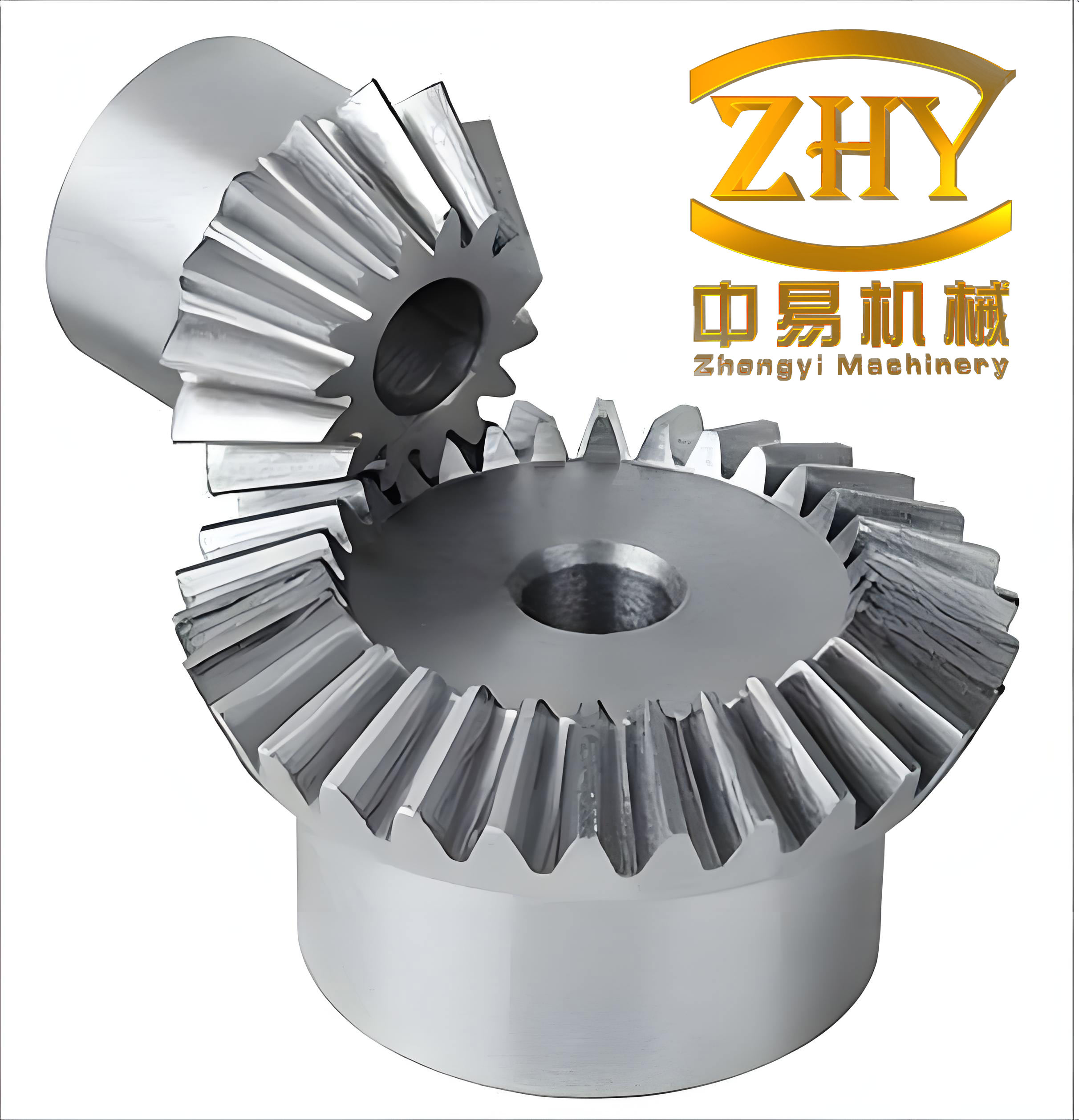
In conclusion, our study provides a comprehensive framework for analyzing and optimizing the sensitivity of straight bevel gear modification tooth surfaces to installation errors. Key findings include the dominant influence of the contact ellipse long axis on sensitivity coefficients and the effectiveness of optimizing this parameter to achieve robust contact paths. Specifically, when the contact path is perpendicular to the root cone, the straight bevel gear demonstrates reduced sensitivity to installation errors, enhancing overall meshing performance. This approach not only improves the reliability of straight bevel gear systems but also offers practical insights for design and manufacturing processes, ensuring better performance in real-world applications. Future work could explore additional modification techniques and dynamic effects to further advance the understanding of straight bevel gear behavior under various operational conditions.