
The reliable transmission of power within critical aerospace systems, such as aero-engines, is fundamentally dependent on the performance of gear systems. Among these, spiral bevel gears are pivotal components due to their ability to transmit power between non-parallel, intersecting shafts with high efficiency and load capacity. The operational longevity and reliability of these spiral bevel gears are inextricably linked to their lubrication performance. Effective lubrication directly governs resistance to wear, scuffing, and pitting failures. While theoretical frameworks for gear lubrication, particularly based on elastohydrodynamic lubrication (EHL) theory, are well-established, the direct experimental measurement of lubricant film thickness within the complex contact of meshing spiral bevel gears under realistic operating conditions presents significant challenges. Conventional electrical methods lack the spatial resolution for detailed film mapping, and advanced optical techniques are constrained by the geometry, size, and load requirements of actual gear contacts.
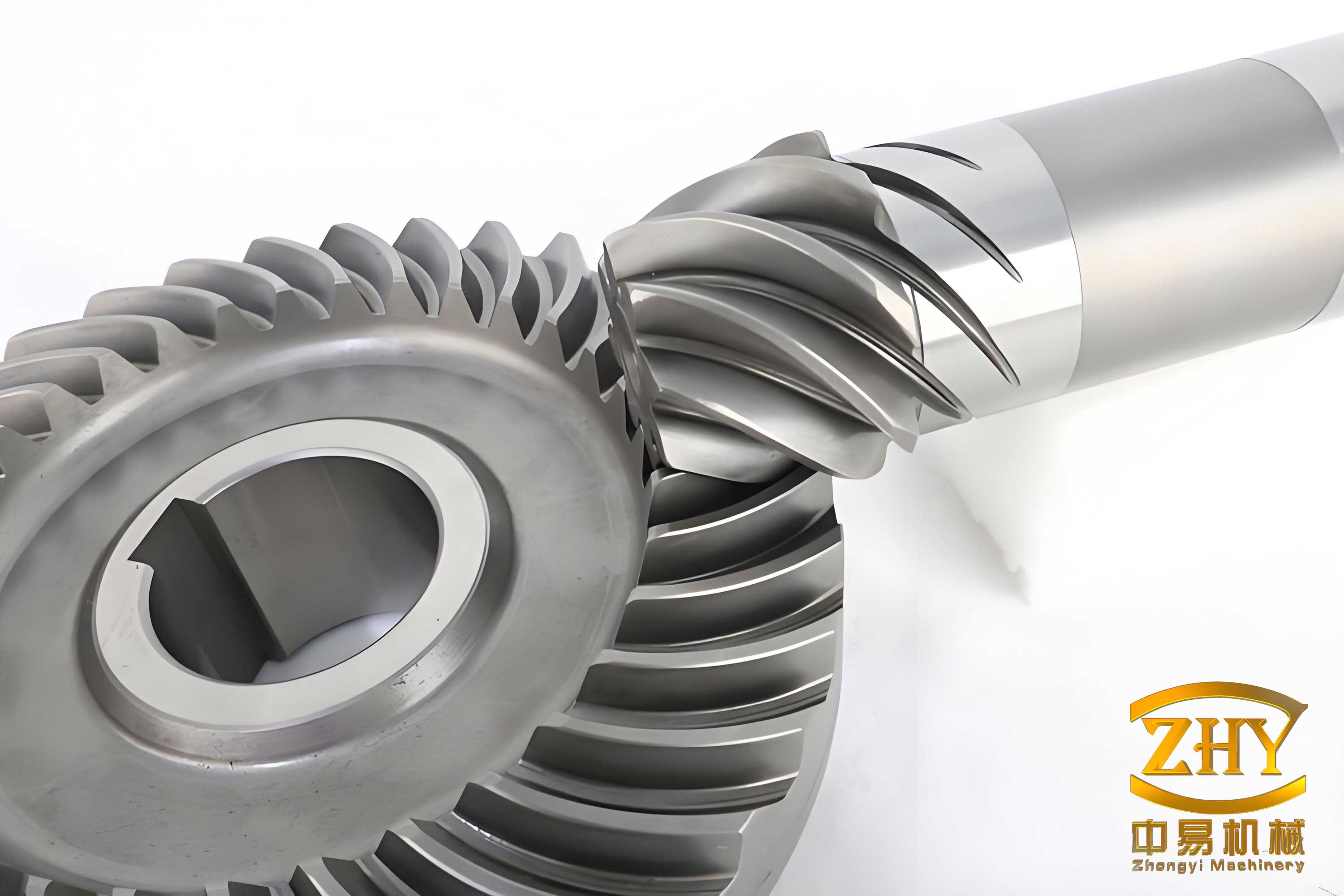
This work addresses this challenge by developing a similarity-based modeling approach. The core idea is to establish a scaled-down, physically similar point-contact system that replicates the essential EHL conditions of the spiral bevel gear mesh. This allows for the indirect investigation of gear contact lubrication using controlled bench tests, such as optical interferometry. The methodology involves discretizing the gear meshing process into a series of equivalent point contacts, deriving similarity criteria using dimensional analysis, and systematically analyzing the influence of various operational and material parameters on the fidelity of the similarity model.
Discretization of Spiral Bevel Gear Contact into Equivalent Point Contact
The complex line contact along the tooth flank of meshing spiral bevel gears can be analyzed at any instantaneous point as a local elliptical point contact problem. This simplification is valid under full-film EHL conditions. The critical step is to determine the equivalent geometrical and kinematic parameters for this point contact from the gear’s design and operating conditions.
Calculation of Equivalent Contact Geometry
Using the results from loaded tooth contact analysis (LTCA) for the spiral bevel gears, the principal relative curvatures and orientation of the contact ellipse at any meshing point can be obtained. The contact between two tooth surfaces is modeled as an equivalent ellipsoid against a plane. The principal relative curvatures, $\Delta K_{\text{max}}$ and $\Delta K_{\text{min}}$, are calculated from the LTCA output parameters: the relative normal curvatures $\Delta A$ and $\Delta B$, and the relative geodesic torsion $\Delta C$.
$$
\Delta K_{\text{min}} = \frac{\Delta A + \Delta B}{2} – \frac{\sqrt{(\Delta A – \Delta B)^2 + 4\Delta C^2}}{2}
$$
$$
\Delta K_{\text{max}} = \frac{\Delta A + \Delta B}{2} + \frac{\sqrt{(\Delta A – \Delta B)^2 + 4\Delta C^2}}{2}
$$
The sign convention in the $\Delta K_{\text{max}}$ formula depends on whether the contact is between the concave side of the gear and convex side of the pinion (+) or vice versa (-). The principal radii of curvature in the contact plane are then:
$$ R_x = 1 / \Delta K_{\text{max}}, \quad R_y = 1 / \Delta K_{\text{min}} $$
where $R_x$ and $R_y$ are the equivalent radii along the minor and major axes of the contact ellipse, respectively.
Calculation of Kinematic Parameters and Entrainment Velocity
The lubrication condition is primarily driven by the entrainment velocity, which is the average of the surface velocities of the two gears projected onto the tangent plane at the contact point. For a representative analysis, the midpoint of the meshing path, which typically experiences the highest load, is often chosen.
Let $\boldsymbol{v}_1$ and $\boldsymbol{v}_2$ be the velocity vectors of the gear and pinion surfaces at the contact point. Their projections onto the tangent plane ($\boldsymbol{u}_1$, $\boldsymbol{u}_2$) are found by dotting with the orthogonal unit vectors $\boldsymbol{\eta}$ (along the contact ellipse major axis) and $\boldsymbol{\zeta}$ (along the minor axis), derived from LTCA.
$$
u_{1\eta} = \boldsymbol{v}_1 \cdot \boldsymbol{\eta}, \quad u_{1\zeta} = \boldsymbol{v}_1 \cdot \boldsymbol{\zeta}
$$
$$
u_{2\eta} = \boldsymbol{v}_2 \cdot \boldsymbol{\eta}, \quad u_{2\zeta} = \boldsymbol{v}_2 \cdot \boldsymbol{\zeta}
$$
The entrainment velocity vector $\boldsymbol{u}_m$ and its magnitude $u_m$ are:
$$
\boldsymbol{u}_m = \frac{\boldsymbol{u}_1 + \boldsymbol{u}_2}{2}
$$
$$
u_m = \frac{1}{2} \sqrt{(u_{1\eta} + u_{2\eta})^2 + (u_{1\zeta} + u_{2\zeta})^2}
$$
The angle $\theta$ between the entrainment velocity direction and the minor axis ($\boldsymbol{\zeta}$) is critical for setting up experiments:
$$
\theta = \arctan\left( \frac{u_{1\eta} + u_{2\eta}}{u_{1\zeta} + u_{2\zeta}} \right)
$$
Development of the Similarity Model for Point Contact EHL
To enable testing of the gear contact EHL conditions on a standard ball-on-disc optical interferometry test rig, a similarity model is constructed. The goal is to define a scaled system (the “model”) that maintains a constant relationship with the full-scale gear system (the “prototype”) such that the dimensionless groups governing the EHL physics are identical.
Dimensional Analysis and Derivation of Similarity Criteria
The isothermal point contact EHL problem is governed by a set of independent physical parameters. Using the FLT (Force-Length-Time) system of dimensions, the seven key parameters and their dimensions are identified:
| Physical Parameter | Symbol | Dimensions (FLT) |
|---|---|---|
| Load per contact | $w$ | $F$ |
| Entrainment Speed | $u$ | $L T^{-1}$ |
| Ambient Viscosity | $\eta_0$ | $F L^{-2} T$ |
| Pressure-Viscosity Coefficient | $\alpha$ | $F^{-1} L^{2}$ |
| Equivalent Radius (x-direction) | $R_x$ | $L$ |
| Equivalent Elastic Modulus | $E’$ | $F L^{-2}$ |
| Film Thickness | $h$ | $L$ |
Applying the Buckingham $\Pi$ theorem, the number of independent dimensionless groups is $7 – 3 = 4$. Through systematic dimensional matrix analysis, the following four $\Pi$ terms, which constitute the similarity criteria, are derived:
$$
\Pi_1 = \frac{R_x}{h}
$$
$$
\Pi_2 = \frac{u \eta_0}{E’ h}
$$
$$
\Pi_3 = \frac{u h \eta_0}{w}
$$
$$
\Pi_4 = \frac{h}{\alpha u \eta_0}
$$
According to the principles of similitude, if these four $\Pi$ terms are kept identical between the prototype gear contact and the model test contact, then the two systems are dynamically similar. The film thickness ratio, pressure distribution, and other dimensionless outputs will be the same. This forms the theoretical foundation for designing a scaled experiment that accurately reflects the EHL state of the actual spiral bevel gears.
Theoretical EHL Calculation for Model Verification
To verify the similarity model and analyze parameter sensitivity, a numerical solution for the point contact EHL problem is implemented. The governing equations for isothermal, steady-state EHL are:
Reynolds Equation:
$$
\frac{\partial}{\partial x}\left(\frac{\rho h^3}{12 \eta} \frac{\partial p}{\partial x}\right) + \frac{\partial}{\partial y}\left(\frac{\rho h^3}{12 \eta} \frac{\partial p}{\partial y}\right) = u_m \frac{\partial (\rho h)}{\partial x}
$$
Film Thickness Equation:
$$
h(x,y) = h_0 + \frac{x^2}{2R_x} + \frac{y^2}{2R_y} + \frac{2}{\pi E’} \iint \frac{p(x’,y’) \, dx’ \, dy’}{\sqrt{(x-x’)^2 + (y-y’)^2}}
$$
Roelands Viscosity-Pressure Equation:
$$
\eta(p) = \eta_0 \exp\left( (\ln \eta_0 + 9.67) \left[ -1 + \left(1 + \frac{p}{p_0}\right)^z \right] \right)
$$
where $p_0 = 1.96 \times 10^8$ Pa and $z = 0.68$.
Density-Pressure Equation:
$$
\rho(p) = \rho_0 \left( \frac{5.9 \times 10^8 + 1.34 p}{5.9 \times 10^8 + p} \right)
$$
Load Balance Equation:
$$
w = \iint p(x,y) \, dx \, dy
$$
A numerical solver based on the multi-grid method is used to compute the central film thickness $h_c$ and minimum film thickness $h_m$ for a given set of input parameters $(w, u, \eta_0, \alpha, R_x, R_y, E’)$.
Analysis of Parameter Influence on Similarity Fidelity
Using a case study of an aero-engine spiral bevel gear pair (450 kW, 6000 rpm), the equivalent parameters at the meshing midpoint are calculated as the “Prototype System”. Several “Similar Systems” are then designed by scaling different combinations of parameters while attempting to keep the four $\Pi$ terms constant. The film thickness results from the direct EHL numerical simulation for each Similar System are compared with the values predicted by the similarity model ($h_{\text{model}} = h_{\text{prototype}} \times \text{scale factor}$). The relative error indicates the fidelity of the similarity transformation for that particular parameter change.
| System | Parameter Changes (vs. Prototype) | Key Scaling | Error in $h_m$ | Error in $h_c$ | Primary Cause of Error |
|---|---|---|---|---|---|
| Prototype | Baseline | – | – | – | – |
| Similar System A | $u$ halved, $\eta_0$ doubled | $u\eta_0$ = constant | ~1% | ~1% | Negligible; perfect adherence to $\Pi_2$, $\Pi_3$, $\Pi_4$. |
| Similar System B | $w$ halved, $\alpha$ doubled, $E’$ halved | Multiple $\Pi$ term adjustments | ~5.5% | ~1.5% | Non-linear viscosity-pressure relationship; approximation in maintaining all $\Pi$ terms. |
| Similar System C | $u$ halved, $w$ quartered, $R_{x,y}$ halved | Geometric scaling | ~9.8% | ~8.5% | Cumulative effect of changing multiple parameters; error superposition. |
| Similar System D | Multiple changes: $w$ reduced 8x, $u$ halved, $\eta_0$ halved, $\alpha$ doubled, $R$ halved, $E’$ halved | Aggressive down-scaling | ~12.6% | ~14.0% | Significant superposition of individual parameter change errors; practical limits of similitude. |
The analysis leads to critical insights for designing effective similarity experiments for spiral bevel gears:
- Dominance of $u\eta_0$ Product: Changes that keep the product of entrainment speed and ambient viscosity ($u \eta_0$) constant have a minimal impact on similarity error. This is because this product appears directly in key $\Pi$ terms ($\Pi_2$, $\Pi_3$, $\Pi_4$). This finding is extremely useful for experimentation, as it allows for compensating low speed with high-viscosity oil, or vice versa, to achieve a desired $u\eta_0$ value.
- Challenges with Load and Material Properties: Accurately scaling the load $w$, pressure-viscosity coefficient $\alpha$, and equivalent modulus $E’$ is more difficult. These parameters are often linked to material properties (lubricant and gear steel) which cannot be varied arbitrarily in an experiment. The non-linearity of the viscosity-pressure equation makes exact scaling of $\alpha$ particularly challenging.
- Error Superposition: The similarity error tends to increase as more parameters are changed from their prototype values. This superposition effect means that an experimental design should aim to change the fewest parameters necessary, prioritizing the maintenance of the $u\eta_0$ product and geometric ratio $R/h$, while accepting approximations in $\alpha$ and $E’$ scaling if needed.
Experimental Validation and Discussion of Model Limits
The core prediction of the similarity model—that systems with identical $\Pi$ terms, particularly those maintaining constant $u\eta_0$, will have proportionally scaled film thicknesses—can be validated against published experimental data from ball-on-disc optical interferometry tests. The following table compares measured central film thicknesses under two different contact pressures for scenarios where $u\eta_0$ was held constant by varying $u$ and $\eta_0$ inversely.
| Test Case | Pressure [GPa] | Entrainment $u$ [m/s] | Viscosity $\eta_0$ [Pa·s] | Product $u\eta_0$ [Pa·m] | Measured $h_c$ [μm] | Model Prediction $h_c$ [μm] | Relative Error |
|---|---|---|---|---|---|---|---|
| Case 1 (Baseline) | 0.47 | 0.0801 | 3.028 | 0.2425 | 0.39 | – | – |
| Case 2 (Similar) | 0.47 | 0.1382 | 1.756 | 0.2425 | 0.41 | 0.39 | +5.1% |
| Case 3 (Similar) | 0.47 | 0.2783 | 0.8717 | 0.2425 | 0.44 | 0.39 | +12.8% |
| Case 4 (Baseline) | 1.272 | 0.5566 | 0.8717 | 0.4850 | 0.60 | – | – |
| Case 5 (Similar) | 1.272 | 0.2763 | 1.756 | 0.4850 | 0.59 | 0.60 | -1.7% |
The data for Cases 1-3 and 4-5 show good agreement between the similarity model prediction and experimental measurement when the $u\eta_0$ product is maintained, with errors generally within 13%. This validates the practical usefulness of the model for designing experiments where speed and lubricant viscosity can be adjusted.
However, a significant limitation is observed when the scaling requires a very large increase in entrainment speed to compensate for a large reduction in viscosity. For instance, an attempt to scale from a baseline of $u=0.5566$ m/s to a similar point at $u=2.0$ m/s (with corresponding $\eta_0$ reduction to keep $u\eta_0$ constant) resulted in a measured film thickness 35% higher than the model predicted. This large deviation is attributed to a key assumption in the isothermal similarity model: it neglects viscous shear heating and the associated thermal reduction in lubricant viscosity. At significantly higher sliding/entrainment speeds, frictional heating becomes substantial, lowering the effective viscosity in the contact zone beyond what is accounted for by the ambient $\eta_0$. This thermal effect breaks the isothermal similitude. Therefore, the similarity model is most accurate for scaling scenarios where the change in operating speed (and thus shear rate) is moderate, or when a thermal correction factor can be applied.
Guidelines for Application in Spiral Bevel Gear Testing
Based on the theoretical and experimental analysis, the following structured approach is recommended for applying the similarity model to investigate the lubrication of spiral bevel gears:
- Prototype Parameter Extraction: For the critical meshing point (e.g., the pitch point or load midpoint) of the target spiral bevel gears, calculate the equivalent parameters: contact load $w$, entrainment speed $u$, principal radii $R_x$, $R_y$, and entrainment angle $\theta$. Use the gear’s designated lubricant properties $\eta_0$ and $\alpha$, and material property $E’$.
- Model System Design: Design a ball-on-disc test where the ball radius matches $R_x$, and the disc is a transparent window. The key scaling rule is to maintain the $u\eta_0$ product constant between the prototype and the model. For example, to test a high-speed gear contact ($u_{proto}$ is high) on a low-speed rig ($u_{model}$ is low), select a test lubricant with a higher viscosity such that $u_{model} \cdot \eta_{0,model} = u_{proto} \cdot \eta_{0,proto}$. The load $w_{model}$ should ideally be scaled according to $\Pi_3$, but this may be limited by test rig capacity; a close approximation is often acceptable.
- Test Setup Alignment: Crucially, align the ball-on-disc contact so that the direction of entrainment on the test rig matches the calculated angle $\theta$ relative to the contact ellipse’s minor axis. This ensures the correct kinematic conditions for the elliptical contact.
- Execution and Interpretation: Conduct the optical interferometry test under the scaled $(u, \eta_0, w)$ conditions. Measure the central and minimum film thicknesses ($h_{c,model}$, $h_{m,model}$). The corresponding film thicknesses for the prototype spiral bevel gears are then obtained by inverting the geometrical scale factor derived from maintaining $\Pi_1$: $h_{proto} = h_{model} \times (R_{x,proto} / R_{x,model})$.
- Awareness of Limitations: Be mindful of the model’s limits. Avoid scaling that leads to extreme differences in entrainment speed to minimize thermal discrepancy. Understand that differences in pressure-viscosity coefficient $\alpha$ and elastic modulus $E’$ between the model and prototype fluids/materials will introduce some error, which the analysis shows can be in the 5-15% range for aggressive scaling.
Conclusion
This work presents a comprehensive framework for analyzing and experimentally investigating the elastohydrodynamic lubrication of spiral bevel gears through a rigorously derived similarity model. By discretizing the gear mesh into an equivalent point contact and applying dimensional analysis, a set of four dimensionless $\Pi$ terms governing the isothermal EHL state is established. The model reveals that maintaining the product of entrainment speed and lubricant viscosity ($u\eta_0$) is the most critical and practical factor for ensuring similarity, allowing for effective compensation between these two parameters in experimental design. Numerical and experimental validation confirms the model’s utility, showing good agreement for moderate scaling factors. The primary limitation is identified as thermal effects at high scaling ratios of entrainment speed, which are not captured by the isothermal assumption. This similarity-based approach provides a viable and scientifically grounded pathway to indirectly measure and analyze the crucial lubricant film conditions in complex spiral bevel gear contacts using standardized, instrumented bench testers, thereby informing lubrication design and failure prevention for these critical aerospace transmission components.