
In mechanical engineering, helical gears are widely used for power transmission due to their smooth operation and high load capacity. One critical aspect in the design, manufacturing, and inspection of helical gears is the measurement of tooth thickness, often achieved through the base tangent length, specifically the normal base tangent length. Traditional methods for calculating this length and the corresponding span number of teeth involve complex formulas or reliance on charts, which can be tedious and error-prone, especially for helical gears with large helix angles or significant profile shifts. In this article, I present a simplified graphical approach using CAXA CAD software to determine the span number and normal base tangent length for helical gears. This method leverages CAXA’s precise drafting and dimensioning tools to visualize and solve the problem geometrically, reducing computational effort and minimizing errors. The focus will be on helical gears, and I will emphasize this term throughout to highlight its relevance. The approach is intuitive, applicable to various helical gear configurations, and provides results with minimal deviation from theoretical values.
Helical gears are characterized by their teeth that are cut at an angle to the gear axis, resulting in a helical form. This geometry introduces complexities when calculating parameters like the base tangent length. The normal base tangent length, denoted as $W_{kn}$, is measured in the normal plane perpendicular to the tooth flank, while the transverse base tangent length, $W_{kt}$, is measured in the transverse plane (perpendicular to the gear axis). For helical gears, the relationship between these lengths depends on the base helix angle $\beta_b$, which itself derives from the gear’s helix angle $\beta$ and pressure angle. Accurately determining the span number $k$—the number of teeth spanned during measurement—is crucial, as an incorrect span number can lead to inaccurate measurements. Traditional methods, such as formula-based calculations or chart lookups, often struggle with non-standard helical gears, e.g., those with high helix angles or large profile shifts. Hence, a graphical solution using CAXA offers a viable alternative by visualizing the gear geometry directly.
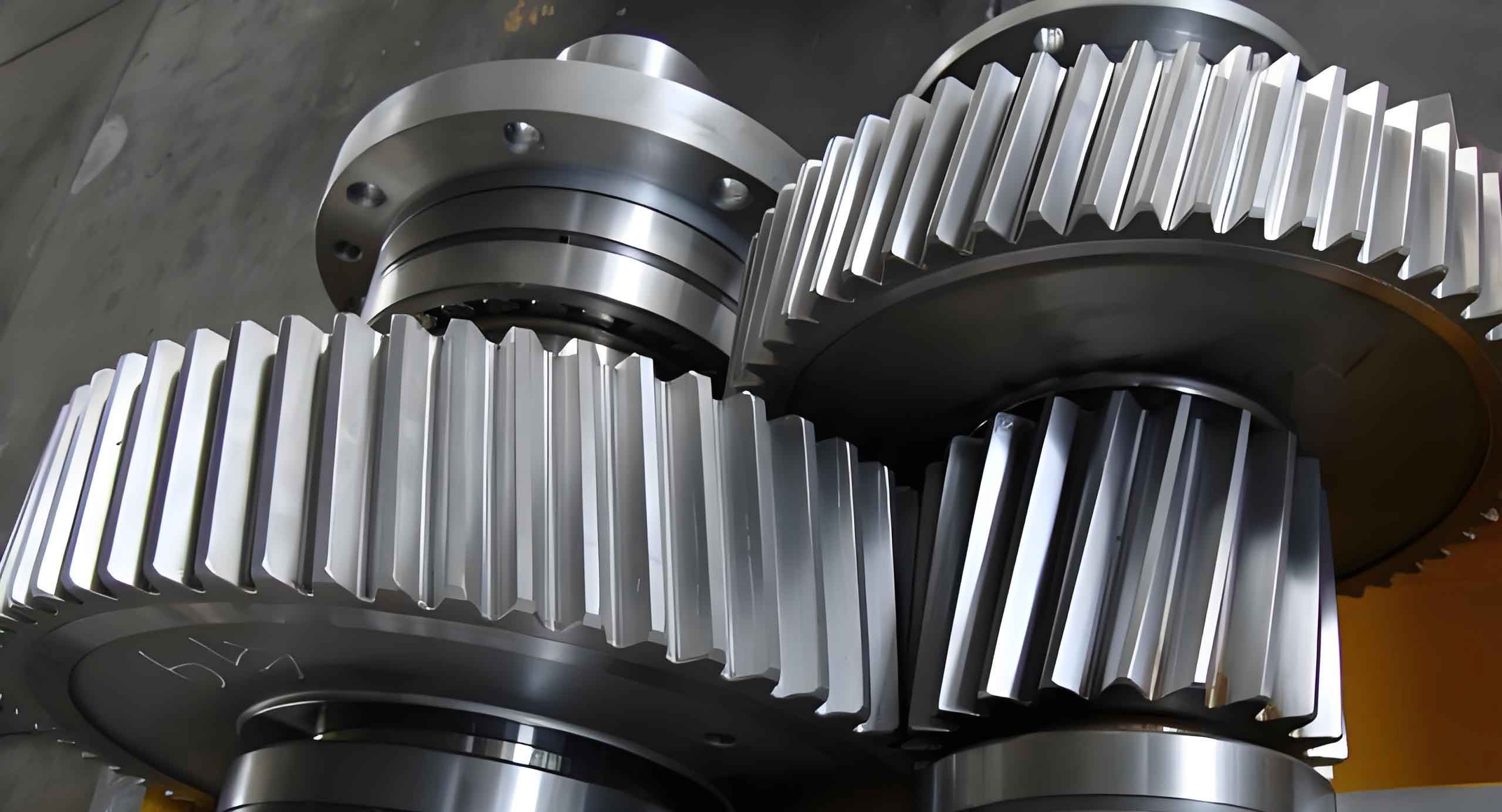
To begin, let’s establish the fundamental formulas for helical gears. The transverse parameters are derived from the normal parameters using the helix angle $\beta$. The key equations are as follows:
The transverse pressure angle $\alpha_t$ is calculated from the normal pressure angle $\alpha_n$:
$$ \tan \alpha_t = \frac{\tan \alpha_n}{\cos \beta} $$
The transverse module $m_t$ relates to the normal module $m_n$:
$$ m_t = \frac{m_n}{\cos \beta} $$
The transverse profile shift coefficient $\chi_t$ is derived from the normal profile shift coefficient $\chi_n$:
$$ \chi_t = \chi_n \cos \beta $$
The base circle diameter $d_b$ is essential for graphical construction:
$$ d_b = m_t z \cos \alpha_t $$
where $z$ is the number of teeth.
The transverse addendum coefficient $h_{at}^*$ and transverse dedendum coefficient $c_t^*$ are similarly adjusted:
$$ h_{at}^* = h_{an}^* \cos \beta $$
$$ c_t^* = c_n^* \cos \beta $$
Here, $h_{an}^*$ and $c_n^*$ are the normal addendum and dedendum coefficients, respectively. These formulas allow us to convert the normal parameters of helical gears into transverse parameters, which are used for drawing the gear profile in the transverse plane using CAXA. This conversion is critical because the graphical method operates in the transverse plane to exploit the properties of involute curves.
Now, I’ll describe the step-by-step graphical procedure using CAXA. The software includes a gear module that generates involute tooth profiles, making it ideal for this task. The goal is to graphically determine the transverse base tangent length $W_{kt}$ and the span number $k$, then compute the normal base tangent length $W_{kn}$ using the base helix angle. The process involves drawing the transverse tooth profile, constructing auxiliary lines, and measuring distances directly in the CAD environment.
First, launch CAXA and access the gear tool from the drafting panel. Input the transverse parameters calculated from the above formulas—not the normal parameters—into the gear parameter dialog. For instance, for a helical gear with normal parameters, compute $\alpha_t$, $m_t$, $\chi_t$, etc., and enter these as the gear’s basic data. Ensure to select “external gear” for external helical gears and set the tooth count. In the preview dialog, adjust settings to facilitate graphical measurement: set the tip rounding radius to zero, use the automatic root fillet, disable “effective tooth number,” set precision to a high value (e.g., 0.001), and enable centerline extension. This generates a transverse tooth profile diagram, which represents the helical gear’s teeth as viewed in the transverse section.
Next, augment this diagram with essential circles. Draw the base circle with diameter $d_b$ using the circle tool, centered at the gear origin. Additionally, draw a circle that passes through the ideal measurement points for the normal base tangent length; I denote this circle’s diameter as $d_{Lk}$. In practice, $d_{Lk}$ can be set to pass through the midpoint of the involute tooth flank. To do this, click the gear center, move the cursor to an involute curve until the midpoint snap appears, and click to create the circle. This circle will later help in relating the transverse and normal lengths.
The core of the graphical method lies in constructing the transverse base tangent line. In the transverse plane, the tooth profile is an involute, and any line tangent to the base circle is perpendicular to the involute at the point of tangency. For measuring base tangent length, two parallel measurement jaws contact the tooth flanks on opposite sides, and the line connecting these contact points is the transverse base tangent, tangent to the base circle. To graphically find this, start by drawing a rectangle that encloses the gear’s tip circle, providing a boundary for construction lines.
For an even span number, select a tooth space and identify the points where the involute curves intersect the tip circle, say points M and N. Draw line MN. From the gear center O, draw a line OF perpendicular to MN, intersecting the base circle at F. Then, create an offset line parallel to MN through point F, extending it to the rectangle edges using the trim or extend tools. This offset line represents the transverse base tangent line. Label its intersections with the ideal measurement circle $d_{Lk}$ as points G and H. Measure the distance GH using CAXA’s dimension tool; this distance is a key intermediate value.
For an odd span number, a similar procedure applies: pick a tooth’s involute intersections with the tip circle, draw a line between them, and construct the perpendicular from the center to this line. Offset through the base circle intersection to get the transverse base tangent line. By analyzing both even and odd cases, we can determine which yields the appropriate span number and length.
To link the graphical measurements to the normal base tangent length, we need the relationship between transverse and normal lengths. The normal base tangent length $W_{kn}$ is related to the transverse base tangent length $W_{kt}$ by the base helix angle $\beta_b$:
$$ W_{kn} = W_{kt} \cos \beta_b $$
where $\beta_b$ is calculated from the helix angle $\beta$ and normal pressure angle $\alpha_n$:
$$ \sin \beta_b = \sin \beta \cos \alpha_n $$
Additionally, the diameter $d_k$ of the cylinder passing through the actual measurement points on the tooth flanks satisfies:
$$ d_k^2 = (W_{kn} \cos \beta_b)^2 + d_b^2 $$
Substituting $W_{kn}$ gives:
$$ d_k^2 = (W_{kt} \cos^2 \beta_b)^2 + d_b^2 $$
For the ideal measurement circle $d_{Lk}$, we define the ideal normal base tangent length $W_{Lkn}$ and ideal transverse base tangent length $W_{Lkt}$, with a similar relation:
$$ W_{Lkn} = W_{Lkt} \cos \beta_b $$
$$ d_{Lk}^2 = (W_{Lkt} \cos^2 \beta_b)^2 + d_b^2 $$
From the graphical construction, $d_{Lk}^2 – d_b^2 = GH^2$, so we can solve for $W_{Lkt}$:
$$ W_{Lkt} = \frac{GH}{\cos^2 \beta_b} $$
This formula allows us to compute the ideal transverse base tangent length from the measured GH distance.
With $W_{Lkt}$ known, we proceed to graphically find the actual transverse base tangent length $W_{kt}$. Draw offset lines parallel to the transverse base tangent line at a distance of $W_{Lkt}/2$ on either side. These lines represent the positions of the measurement jaws when set to the ideal length. Their intersections with the tooth involutes will indicate the actual contact points. If the involutes intersect these offset lines within the tooth space, we can measure the distance between corresponding points on opposite sides to get $W_{kt}$. However, if the involutes do not intersect, we may need to extend the tooth profile by drawing a modified gear diagram with a larger tip diameter—say, increased by at least $2m_n$—to ensure intersection. This involves generating a new gear profile in CAXA with an enlarged tip circle, then overlaying it onto the original diagram.
Once the extended profile is in place, measure the distance between the intersection points on the offset lines. This distance is $W_{kt}$. Simultaneously, count the number of teeth spanned between these contact points to get the span number $k$. Finally, compute the normal base tangent length $W_{kn}$ using $W_{kn} = W_{kt} \cos \beta_b$.
To illustrate, consider an example of helical gears with the following parameters: number of teeth $z=26$, normal module $m_n=5$, normal pressure angle $\alpha_n=20^\circ$, helix angle $\beta=40^\circ$, normal profile shift coefficient $\chi_n=0.8$, normal addendum coefficient $h_{an}^*=1$, and normal dedendum coefficient $c_n^*=0.25$. Using the formulas, we compute the transverse parameters: $\alpha_t \approx 25.4138^\circ$, $m_t \approx 6.5270$, $\chi_t \approx 0.6128$, $d_b \approx 153.2812$, $h_{at}^* \approx 0.7660$, $c_t^* \approx 0.1915$. Following the graphical steps in CAXA, we draw the transverse tooth profile, add the base circle and ideal measurement circle, and construct the transverse base tangent lines. Measuring GH yields approximately 90.806. Calculating $\beta_b$ from $\beta$ and $\alpha_n$ gives $\beta_b \approx 37.1586^\circ$. Then, $W_{Lkt} = GH / \cos^2 \beta_b \approx 142.97$. After drawing offset lines and potentially extending the profile, we measure $W_{kt} \approx 147.1775$ and observe a span number $k=8$. Finally, $W_{kn} = W_{kt} \cos \beta_b \approx 117.296$. Comparing this to traditional formula-based calculation, which gives $W_{kn} \approx 117.298$, the error is only 0.002, demonstrating the method’s accuracy.
To summarize the key formulas and conversions for helical gears, I present the following tables. These tables help in organizing the parameters and steps involved in the graphical method.
| Normal Parameter | Symbol | Transverse Parameter Formula |
|---|---|---|
| Normal pressure angle | $\alpha_n$ | $\tan \alpha_t = \frac{\tan \alpha_n}{\cos \beta}$ |
| Normal module | $m_n$ | $m_t = \frac{m_n}{\cos \beta}$ |
| Normal profile shift coefficient | $\chi_n$ | $\chi_t = \chi_n \cos \beta$ |
| Normal addendum coefficient | $h_{an}^*$ | $h_{at}^* = h_{an}^* \cos \beta$ |
| Normal dedendum coefficient | $c_n^*$ | $c_t^* = c_n^* \cos \beta$ |
| Base circle diameter | $d_b$ | $d_b = m_t z \cos \alpha_t$ |
| Relationship | Formula |
|---|---|
| Base helix angle | $\sin \beta_b = \sin \beta \cos \alpha_n$ |
| Normal to transverse base tangent length | $W_{kn} = W_{kt} \cos \beta_b$ |
| Ideal transverse base tangent length from graphical measurement | $W_{Lkt} = \frac{GH}{\cos^2 \beta_b}$ |
| Measurement point diameter | $d_k^2 = (W_{kt} \cos^2 \beta_b)^2 + d_b^2$ |
The graphical method using CAXA is not only applicable to external helical gears but can also be adapted for internal helical gears, with adjustments for the span number (which becomes the number of tooth spaces spanned) and the construction of the transverse base tangent line. However, due to limitations in CAXA’s internal gear modeling, the method may not be fully accurate for internal helical gears in current versions; thus, it is recommended primarily for external helical gears. For helical gears with profile shifts or high helix angles, the graphical approach remains robust because it visualizes the actual geometry without relying on approximate formulas.
One advantage of this method is its independence from involute functions or imaginary tooth numbers, which are often used in traditional calculations for helical gears. By directly manipulating the gear profile in CAXA, we bypass complex trigonometric computations and potential errors in span number determination. The process is intuitive: by seeing the gear teeth and measurement lines, we can adjust the construction until the contact points are correctly identified. This visual feedback is particularly useful for educational purposes or when dealing with non-standard helical gears, such as those in custom machinery or aerospace applications.
Moreover, the CAXA software provides high precision in drafting and dimensioning, typically up to several decimal places, ensuring that the graphical measurements are accurate. The error introduced is mainly due to the software’s numerical resolution and the precision settings chosen during drawing. In practice, this error is negligible compared to the tolerances in gear manufacturing. For instance, in the example above, the error of 0.002 in $W_{kn}$ is far smaller than typical manufacturing tolerances for helical gears, which might be on the order of 0.01 to 0.1 mm. Thus, the method is reliable for practical engineering work.
To further elaborate on the graphical steps, let’s consider another example with different parameters to showcase the method’s versatility. Suppose we have helical gears with $z=15$, $m_n=4$, $\alpha_n=25^\circ$, $\beta=30^\circ$, $\chi_n=0.5$, $h_{an}^*=1$, $c_n^*=0.25$. First, compute transverse parameters: $\alpha_t = \arctan(\tan 25^\circ / \cos 30^\circ) \approx 28.025^\circ$, $m_t = 4 / \cos 30^\circ \approx 4.6188$, $\chi_t = 0.5 \cos 30^\circ \approx 0.4330$, $d_b = 4.6188 \times 15 \times \cos 28.025^\circ \approx 61.123$. In CAXA, input these to draw the transverse profile. Follow the same construction: draw base circle, ideal measurement circle, and transverse base tangent lines for both even and odd span cases. Measure GH, compute $W_{Lkt}$, draw offset lines, and determine $W_{kt}$ and $k$. Finally, calculate $W_{kn}$. This process reinforces that the method works across various helical gear specifications.
In terms of implementation, CAXA’s user interface facilitates this graphical approach. The gear tool automatically generates accurate involute curves based on input parameters, saving time compared to manual drawing. The dimension tool allows direct measurement of distances and angles, which can be recorded for documentation. Additionally, CAXA supports layers, which can be used to organize the different elements—e.g., one layer for the gear profile, another for construction lines, and another for measurements—making the diagram clear and manageable. This is especially helpful when dealing with complex helical gears with multiple teeth or when iterating to find the optimal span number.
It’s worth noting that the graphical method also provides insights into the geometry of helical gears. For instance, by observing the positions of the measurement jaws relative to the tooth flanks, we can infer aspects like undercut or tip interference, which might affect the measurement feasibility. This visual inspection complements analytical checks and can inform design modifications. Moreover, for helical gears with large helix angles, the transverse base tangent line may intersect teeth differently than in spur gears, and the graphical method naturally accounts for this through the construction process.
From a practical standpoint, this approach reduces the need for specialized gear calculation software or extensive reference manuals. Engineers and technicians with access to CAXA can quickly determine the base tangent length and span number for helical gears, even in field conditions or during prototyping. The method is also educational, helping students understand the spatial relationships in helical gear geometry. By engaging with the graphical construction, learners can grasp concepts like the base circle, involute shape, and the effect of helix angle on measurement.
In conclusion, the graphical method using CAXA to determine the span number and normal base tangent length for helical gears offers a simplified, accurate, and intuitive alternative to traditional calculation methods. It leverages CAD software’s capabilities to visualize and measure gear parameters directly, minimizing computational errors and handling complex cases like high helix angles or profile shifts. The key formulas and steps, as summarized in the tables, provide a structured approach that can be applied to various helical gear designs. While primarily suited for external helical gears due to software limitations, the method underscores the value of graphical solutions in mechanical engineering. By integrating this technique into design and inspection workflows, engineers can enhance efficiency and accuracy in working with helical gears, ultimately contributing to better gear performance and reliability in mechanical systems.
To further reinforce the concepts, here is a summary of the graphical procedure in a step-by-step format:
- Compute the transverse parameters from the normal parameters of the helical gears using the conversion formulas.
- In CAXA, use the gear tool to draw the transverse tooth profile based on the transverse parameters.
- Add the base circle (diameter $d_b$) and an ideal measurement circle (diameter $d_{Lk}$) to the diagram.
- Construct the transverse base tangent lines for both even and odd span number cases by drawing lines through the gear center perpendicular to lines connecting tip circle intersections.
- Measure the distance GH on the ideal measurement circle between intersections with the transverse base tangent lines.
- Calculate the base helix angle $\beta_b$ and then the ideal transverse base tangent length $W_{Lkt} = GH / \cos^2 \beta_b$.
- Draw offset lines parallel to the transverse base tangent lines at a distance of $W_{Lkt}/2$ to represent measurement jaw positions.
- If necessary, extend the tooth profile by drawing a new gear diagram with a larger tip diameter to ensure the offset lines intersect the involute curves.
- Measure the distance between intersection points on opposite sides to get the actual transverse base tangent length $W_{kt}$.
- Count the number of teeth spanned to obtain the span number $k$.
- Compute the normal base tangent length $W_{kn} = W_{kt} \cos \beta_b$.
This procedure, combined with the formulas and tables provided, forms a comprehensive guide for applying the graphical method to helical gears. As helical gears continue to be integral in industries like automotive, aerospace, and manufacturing, such simplified techniques can streamline design and quality control processes, ensuring that these critical components meet precise specifications.