
The transmission of power and motion is a fundamental requirement in mechanical systems, and among the various methods available, gear transmission stands out for its efficiency, reliability, and precision. Cylindrical gears, particularly the spur type, are one of the most prevalent and widely used forms due to their simplicity in design and manufacture, absence of axial thrust under ideal conditions, and suitability for a broad range of applications from low-speed, high-torque machinery to high-speed automotive transmissions. These gears primarily function to bear significant loads and transmit motion between parallel shafts. However, in demanding operational environments characterized by high rotational speeds, heavy loading, or frequent engagement cycles, the dynamic interactions between meshing teeth become critically important. These interactions directly influence key performance metrics such as transmission stability, noise and vibration levels, fatigue life, and overall system reliability.
Traditional experimental methods for analyzing gear dynamics, while valuable, often involve long research cycles, high costs associated with prototyping and instrumentation, and practical limitations in measuring intricate dynamic phenomena. The advent and maturation of virtual simulation technology have revolutionized this field. Utilizing Multi-Body Dynamics (MBD) software like ADAMS (Automatic Dynamic Analysis of Mechanical Systems) allows for the creation of accurate virtual prototypes. This approach offers unparalleled advantages: it significantly reduces development time and cost, enables the investigation of complex dynamic behaviors that are difficult to measure physically, and provides highly accurate computational data for forces, velocities, and accelerations. Consequently, dynamic simulation has become an indispensable tool for in-depth analysis and optimization of gear systems.
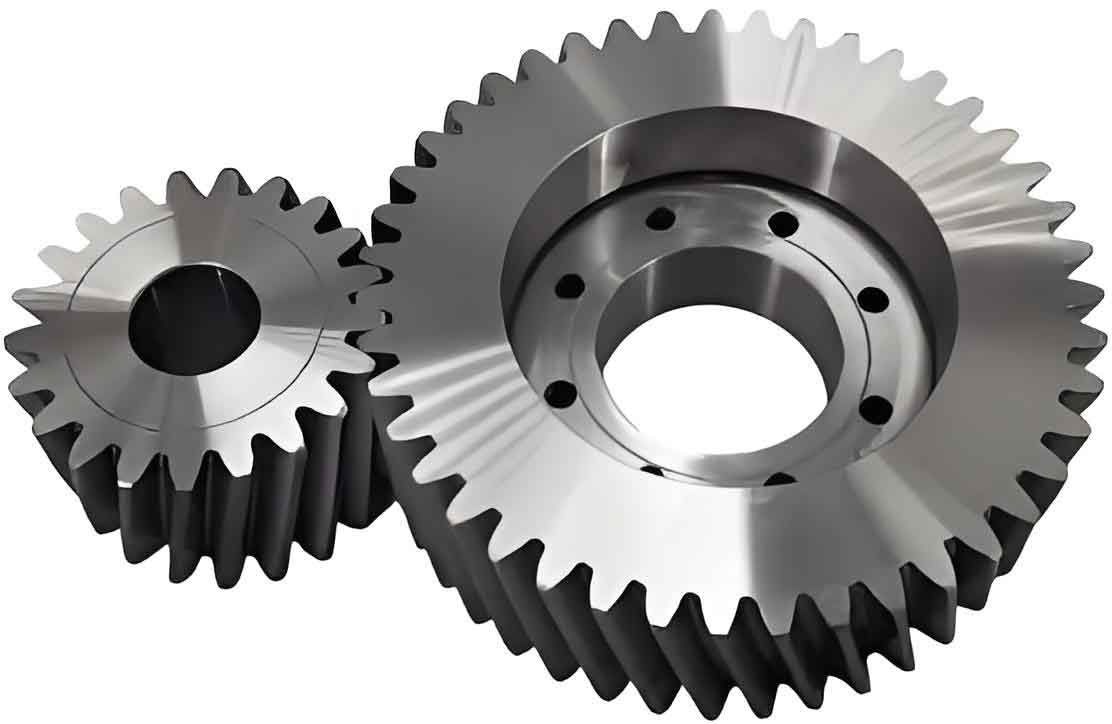
The primary objective of this study is to conduct a comprehensive dynamic performance analysis of a spur cylindrical gear pair using ADAMS. This involves constructing a detailed virtual prototype model, simulating its operation under realistic loading conditions, and extracting critical dynamic parameters. A key focus is the analysis of the dynamic meshing force between gear teeth, which is the primary source of vibration and noise. Furthermore, the dynamic response of the gears, including their rotational velocity profiles and the effects of parametric variations, will be investigated. The insights gained from this simulation-based analysis are intended to provide a robust theoretical foundation for improving the transmission performance, optimizing meshing characteristics to reduce dynamic loads, and enhancing the durability of cylindrical gears.
Theoretical Foundation for Gear Dynamics Simulation
The dynamic simulation of cylindrical gears rests on several interconnected theoretical pillars from mechanics and contact physics. Understanding these principles is crucial for correctly interpreting simulation results.
1. Fundamentals of Gear Kinematics and Dynamics:
The basic kinematic relationship for a pair of spur cylindrical gears is defined by the gear ratio (i), which is a function of the number of teeth (Z) on the driving (pinion) and driven (gear) gears:
$$ i = \frac{\omega_p}{\omega_g} = \frac{N_g}{N_p} = \frac{d_g}{d_p} $$
where $\omega_p$ and $\omega_g$ are the angular velocities, $N_p$ and $N_g$ are the numbers of teeth, and $d_p$ and $d_g$ are the pitch diameters of the pinion and gear, respectively. Under ideal, static conditions, this ratio is constant. However, under dynamic conditions, factors like tooth deflection, manufacturing errors, and variable loading cause instantaneous fluctuations in the velocity ratio, leading to transmission error.
The equations of motion for a gear pair can be derived using Lagrange’s equations or Newton-Euler methods. A simplified, lumped-parameter model for a single-degree-of-freedom torsional system is often represented as:
$$ J_p \ddot{\theta}_p + c(t) (\dot{\theta}_p r_{bp} – \dot{\theta}_g r_{bg}) + k(t) (r_{bp} \theta_p – r_{bg} \theta_g + e(t)) = T_p $$
$$ J_g \ddot{\theta}_g – c(t) (\dot{\theta}_p r_{bp} – \dot{\theta}_g r_{bg}) – k(t) (r_{bp} \theta_p – r_{bg} \theta_g + e(t)) = -T_g $$
Here, $J$ represents mass moment of inertia, $\theta$ is angular displacement, $c(t)$ is the mesh damping, $k(t)$ is the time-varying mesh stiffness (a critical parameter), $r_b$ is the base radius, $e(t)$ is the static transmission error, and $T$ is the applied torque. The time-varying nature of $k(t)$ and $e(t)$ is the primary source of parametric excitation in gear systems.
2. Contact and Impact Theory in ADAMS:
ADAMS typically uses a penalty-based method to model contact between gear teeth. The contact force ($F_n$) is composed of two main components: an elastic (spring) force based on penetration and a damping (dissipative) force.
$$ F_n = F_{spring} + F_{damper} = K \delta^e + C \dot{\delta} $$
Where:
– $K$ is the contact stiffness.
– $\delta$ is the penetration depth between the two contacting geometries.
– $e$ is the force exponent (usually 1.5 for metal-to-metal contact, based on Hertzian contact theory).
– $C$ is the damping coefficient, often a function of penetration and a user-defined damping ratio.
– $\dot{\delta}$ is the penetration velocity.
For metallic cylindrical gears, the Hertzian contact theory provides the foundation for the stiffness parameter. The contact between two cylindrical surfaces (approximating gear teeth) results in a semi-elliptical pressure distribution. The maximum contact pressure ($p_0$) and half-width ($a$) are given by:
$$ p_0 = \sqrt{\frac{F E^*}{\pi R^* L}}, \quad a = \sqrt{\frac{4 F R^*}{\pi L E^*}} $$
$$ \frac{1}{E^*} = \frac{1-\nu_1^2}{E_1} + \frac{1-\nu_2^2}{E_2}, \quad \frac{1}{R^*} = \frac{1}{R_1} \pm \frac{1}{R_2} $$
Here, $F$ is the normal load, $E$ is Young’s modulus, $\nu$ is Poisson’s ratio, $R$ is the radius of curvature at the contact point, and $L$ is the face width. The $\pm$ sign is `+` for external contact (as in two external gears) and `-` for internal contact.
3. Finite Element Theory for Flexible Bodies:
For a more accurate dynamic analysis, especially concerning stress and vibration modes, one or both cylindrical gears can be modeled as flexible bodies. ADAMS uses a component mode synthesis (CMS) approach. The gear’s complex elasticity is represented by a superposition of a limited set of its natural vibration modes (eigenmodes). The physical displacements $\mathbf{u}$ are approximated by:
$$ \mathbf{u} = \mathbf{\Phi} \mathbf{q} $$
where $\mathbf{\Phi}$ is the matrix of retained mode shapes (from a prior Finite Element Analysis in software like ANSYS or NASTRAN), and $\mathbf{q}$ is the vector of modal coordinates. The equations of motion are then solved in this reduced modal space, drastically improving computational efficiency while capturing essential deformation dynamics.
4. Modal Analysis and Dynamic Response:
The natural frequencies and mode shapes of the cylindrical gear are critical for predicting resonance conditions. The undamped free vibration equation is:
$$ (\mathbf{K} – \omega_i^2 \mathbf{M})\mathbf{\phi}_i = 0 $$
where $\mathbf{K}$ is the stiffness matrix, $\mathbf{M}$ is the mass matrix, $\omega_i$ is the i-th natural frequency (rad/s), and $\mathbf{\phi}_i$ is the corresponding mode shape (eigenvector). Excitation forces at frequencies close to these natural frequencies can lead to amplified vibrations and high dynamic mesh forces.
Methodology: Virtual Prototype Development and Simulation
This section details the step-by-step methodology employed to build, validate, and simulate the dynamic behavior of the spur cylindrical gear pair.
1. Gear Parameters and Design Specification:
The study focuses on a single-stage, speed-reducing spur gear pair. The primary design parameters are summarized in Table 1. These parameters are the foundational input for all subsequent modeling steps.
| Component | Number of Teeth (N) | Module (m) [mm] | Pressure Angle (α) [°] | Face Width (L) [mm] | Pitch Diameter (d = m*N) [mm] |
|---|---|---|---|---|---|
| Pinion (Driver) | 17 | 10 | 20 | 100 | 170 |
| Gear (Driven) | 25 | 10 | 20 | 100 | 250 |
The theoretical gear ratio is therefore:
$$ i_{theoretical} = \frac{N_{gear}}{N_{pinion}} = \frac{25}{17} \approx 1.4706 $$
This value serves as a key validation point for the kinematic accuracy of the simulation.
2. Three-Dimensional Solid Modeling:
Using the parameters from Table 1, precise three-dimensional solid models of the pinion and gear were created in a CAD software package (e.g., SolidWorks, CATIA, or Creo). The modeling process involves:
– Generating the base circles, pitch circles, and addendum/dedendum circles.
– Creating the involute tooth profile using parametric equations.
– Performing a circular pattern to generate all teeth.
– Extruding the profile to create the solid gear body with hubs and webs as necessary for structural integrity.
The two models are then virtually assembled with their axes parallel and at the correct center distance, ensuring proper initial meshing alignment. The center distance $a$ is given by:
$$ a = \frac{m(N_p + N_g)}{2} = \frac{10(17+25)}{2} = 210 \text{ mm} $$
3. Creation of the Rigid/Flexible Multi-Body Model:
The assembled CAD model is exported in a neutral format (like Parasolid `.x_t` or STEP) and imported into ADAMS/View. The initial model consists of rigid bodies. To enhance accuracy, the larger driven gear is converted into a flexible body using the ADAMS/Flex module:
– A finite element mesh of the gear is generated (or imported from an external FEA preprocessor).
– A Craig-Bampton modal neutral file (.mnf) is created, retaining a sufficient number of modes (e.g., modes up to 5000 Hz) to capture the relevant dynamic deformations.
– The rigid gear is replaced with this flexible body, connected to the ground via a flexible joint that represents the bearing support stiffness.
The pinion is initially kept rigid to simplify contact but can also be flexibilized for a fully coupled analysis. This results in a rigid-flexible coupled dynamic model.
4. Definition of Material Properties and Constraints (Joints):
Material properties are assigned to define mass and inertia. For steel gears, standard properties are used: Density $\rho = 7850 \text{ kg/m}^3$, Young’s Modulus $E = 2.1 \times 10^{11} \text{ Pa}$, Poisson’s Ratio $\nu = 0.3$. Kinematic joints are applied to define permissible motions, as outlined in Table 2.
| Component 1 | Component 2 | Joint Type | Purpose/Description |
|---|---|---|---|
| Pinion (Rigid) | Ground | Revolute Joint | Allows only rotational motion about its central axis. |
| Gear (Flexible Body Node) | Ground | Flexible Joint (Bushing) | Provides translational and rotational stiffness/damping to simulate bearing support compliance. Parameters (Kxx, Kyy, Cxx, Cyy, etc.) are defined based on bearing specifications. |
| Pinion Teeth | Gear Teeth | Contact Force | Not a joint, but a force element defining the interaction between the two sets of teeth. This is the core of the dynamic analysis. |
5. Formulation of the Gear Mesh Contact Force:
The interaction between the involute tooth surfaces is modeled using the ADAMS impact function. The parameters for this force law are critical and are selected based on material properties and Hertzian theory approximations. A standard set is shown in Table 3.
| Parameter | Symbol | Value | Remarks / Justification |
|---|---|---|---|
| Stiffness | K | 1.0e+05 to 1.0e+07 N/mm | Derived from Hertzian contact theory for the given geometry and material. Higher stiffness reduces penetration but requires smaller integration steps. |
| Force Exponent | e | 1.5 | Standard for metallic contact (Hertzian). |
| Damping Coefficient | C | 0.1% to 1% of K | Represents energy dissipation during impact. Often defined via a damping ratio (e.g., 0.01) at a specified penetration depth. |
| Penetration Depth | d_max | 0.01 – 0.1 mm | Threshold for full damping application. A smaller value increases accuracy but can cause numerical stiffness. |
| Static Coefficient | μ_s | 0.08 – 0.15 | Friction between lubricated steel surfaces. |
| Dynamic Coefficient | μ_d | 0.05 – 0.10 | Typically lower than static coefficient. |
| Stiction Transition Vel. | v_s | 0.1 – 1.0 mm/s | Velocity below which static friction applies. |
| Friction Transition Vel. | v_d | 1.0 – 10.0 mm/s | Velocity at which friction transitions from static to dynamic. |
6. Application of Motions and Loads (Driving and Loading Conditions):
To simulate a realistic operational cycle, time-dependent functions are applied:
– Rotational Motion on Pinion: A smooth step function is used to avoid numerical instabilities from instantaneous acceleration. The angular velocity $\omega_p(t)$ is defined as:
$$ \omega_p(t) = \text{STEP}(time, 0, 0, 1.0, 3000) \text{ deg/s} = \text{STEP}(time, 0, 0, 1.0, 52.36) \text{ rad/s} $$
This ramps the speed from 0 to 3000 deg/s (≈ 524 RPM) over 1 second and holds it constant for the remainder of the simulation.
– Resistive Torque on Gear: A load torque $T_g$ is applied to the output shaft of the gear to simulate the driven machinery’s resistance. A similar step function is used:
$$ T_g(t) = -\text{STEP}(time, 0, 0, 1.0, 450000) \text{ N-mm} = -450 \text{ N-m} $$
The negative sign indicates it opposes the motion. For a more complex analysis, a torque profile representing actual working cycles (e.g., crusher load) can be applied.
7. Simulation Setup and Execution:
Before running the dynamic analysis, a static equilibrium analysis may be performed to settle the model under gravity. The dynamic simulation is then configured:
– Simulation Type: Dynamic.
– End Time: 5.0 seconds (covers ramp-up and steady-state operation).
– Number of Steps: 5000 to 10000. A higher number ensures capturing high-frequency contact events but increases computation time.
– Integrator: GSTIFF or WSTIFF (stiff integrators suitable for contact problems).
– Error Tolerance: Set to a tight value (e.g., 1.0e-006) for accuracy.
The model is then run, and ADAMS solves the differential-algebraic equations of motion for the entire system.
Results and In-Depth Dynamic Analysis
The post-processing phase involves analyzing the vast amount of data generated to extract meaningful insights into the behavior of the cylindrical gears.
1. Kinematic Validation: Angular Velocities and Transmission Ratio:
The primary kinematic output is the angular velocity of both gears. Plotting $\omega_p(t)$ and $\omega_g(t)$ confirms the input motion and reveals the system’s kinematic response.
– The pinion velocity plot shows a perfect step increase, matching the input function.
– The driven gear’s velocity plot is of greater interest. After the initial 1-second transient ramp-up period, the gear’s speed fluctuates around a mean value. The average steady-state speed is calculated. For the given parameters:
$$ \bar{\omega}_g \approx 2040 \text{ deg/s} $$
The simulated, time-averaged gear ratio is:
$$ i_{simulated} = \frac{\bar{\omega}_p}{\bar{\omega}_g} = \frac{3000}{2040} \approx 1.4706 $$
This exact match with the theoretical ratio ($i_{theoretical} = 25/17 \approx 1.4706$) is a crucial first-step validation of the model’s geometric and kinematic integrity. However, the instantaneous ratio varies due to dynamic effects.
2. Dynamic Meshing Force Analysis:
The contact force between a single pair of teeth, or the total mesh force shared among all contacting pairs, is the most critical dynamic output. The plot of $F_{mesh}(t)$ reveals several key phenomena:
– Ramp-Up Phase (0-1s): The force magnitude increases as the load torque is applied. The profile shows significant oscillations, reflecting the violent initial engagements and settling of the system.
– Steady-State Phase (1-5s): The force settles into a periodic pattern. The period of this pattern corresponds to the tooth meshing frequency ($f_m$):
$$ f_m = N_p \cdot f_p = N_g \cdot f_g $$
where $f_p$ and $f_g$ are the rotational frequencies (Hz) of the pinion and gear. For a pinion speed of 3000 deg/s (≈ 8.333 rev/s or 8.333 Hz):
$$ f_m = 17 \text{ teeth} \times 8.333 \text{ Hz} \approx 141.7 \text{ Hz} $$
This means the force signal should have a fundamental period of $T_m = 1 / f_m \approx 0.00706$ seconds.
– Force Fluctuations: Within each mesh cycle, the force is not constant. It rises sharply as a new tooth pair comes into contact (impact), reaches a peak, and then decays as the pair rolls through the mesh. The peak-to-peak variation is the dynamic load factor, which is a measure of the severity of dynamic loading compared to the static (nominal) load. The nominal tangential force $F_t$ is:
$$ F_t = \frac{2 T_g}{d_g} = \frac{2 \times 450 \text{ N-m}}{0.250 \text{ m}} = 3600 \text{ N} $$
The dynamic mesh force peak will often exceed this value significantly.
3. Frequency Domain Analysis (FFT of Dynamic Signals):
Performing a Fast Fourier Transform (FFT) on the steady-state mesh force or gear vibration acceleration signals provides deep insight into the excitation sources.
– The spectrum will show a prominent peak at the tooth meshing frequency ($f_m \approx 141.7$ Hz) and its harmonics ($2f_m, 3f_m, …$). These are due to the periodic variation in mesh stiffness as the number of teeth in contact changes (from 1 to 2 and back, for spur gears).
– Peaks at the gear rotational frequencies ($f_p \approx 8.33$ Hz, $f_g \approx 5.67$ Hz) and their harmonics may also appear, often caused by manufacturing errors like eccentricity or profile deviation.
– Sidebands around the mesh frequency harmonics, spaced at the rotational frequencies, are indicators of modulated signals, potentially from local tooth defects or time-varying transmission error.
4. Modal Participation and Stress Analysis:
When using a flexible gear model, additional critical results become available:
– Modal Coordinates: The time-history of the modal coordinates ($\mathbf{q}(t)$) shows which natural modes of the gear are being excited. Modes with natural frequencies close to the mesh frequency or its harmonics will show high participation.
– Dynamic Stress/Strain: The simulation can recover the dynamic stress distribution on the gear body, especially at the tooth root (critical for bending fatigue) and on the tooth flank (critical for contact fatigue/pitting). The maximum von Mises stress at the tooth root fillet over time can be plotted and compared to the material’s endurance limit.
5. Parametric Study and Sensitivity Analysis:
The power of the virtual prototype lies in easily modifying parameters to study their influence. Key studies include:
– Effect of Load: Running simulations with different load torques (e.g., 225, 450, 900 N-m) to see how dynamic force amplitude and vibration levels scale.
– Effect of Speed: Varying the input pinion speed to identify critical speeds where dynamic forces peak, indicating potential resonance. A “Campbell diagram” can be constructed by plotting dynamic response amplitude vs. speed.
– Effect of Mesh Stiffness/Damping: Altering the contact parameters in Table 3 to understand their role in controlling impact forces and vibration.
– Effect of Design Parameters: Modifying the face width, module, or adding profile modifications (tip relief) to see their effect on transmission error and dynamic load. For instance, tip relief can reduce the initial impact force as teeth come into mesh.
| Parameter Varied | Direction of Change | Effect on Peak Dynamic Mesh Force | Effect on Vibration Amplitude | Primary Reason |
|---|---|---|---|---|
| Load Torque | Increase | Increase (approx. linear) | Increase | Higher nominal force leads to greater deflection and potential for heavier impacts. |
| Pinion Speed | Increase | Increase, with peaks at resonances | Sharply increase at resonances | Higher kinetic energy of impacting teeth; excitation frequency aligns with structural natural frequencies. |
| Contact Stiffness (K) | Increase | Increase (sharper impacts) | Increase (higher freq. content) | Stiffer contact reduces damping penetration, leading to harder, shorter-duration impacts. |
| Contact Damping (C) | Increase | Decrease | Decrease | More energy is dissipated during the contact event, cushioning the impact. |
| Tooth Profile (Add Tip Relief) | Applied | Decrease (especially at entry) | Decrease at mesh frequency | Reduces the initial geometric interference (transmission error), smoothing the transfer of load between tooth pairs. |
Discussion and Implications for Cylindrical Gear Design
The simulation results provide actionable insights for the design and application of cylindrical gears.
1. Interpretation of Dynamic Fluctuations:
The observed periodic fluctuations in the driven gear’s speed and the oscillatory meshing force are inherent to spur gear dynamics. They are primarily caused by the time-varying mesh stiffness. As the contact point moves along the tooth profile and as the number of tooth pairs in contact alternates, the effective spring connecting the two gears changes stiffness, exciting the system. This is a fundamental source of vibration and noise in gearboxes. The magnitude of these fluctuations is a direct indicator of dynamic load, which is a key factor in fatigue life calculations (e.g., using AGMA or ISO standards where dynamic load factors $K_v$ are applied).
2. Significance for Noise, Vibration, and Harshness (NVH):
The mesh force is the primary excitation source for gearbox vibration. This force is transmitted through the shafts and bearings to the gearbox housing, which radiates sound. The frequency spectrum from the FFT analysis directly informs NVH engineers about the dominant tonal frequencies (mesh frequency and harmonics) that need to be addressed. Strategies to reduce NVH include:
– Profile Modification: As indicated in the parametric study, tip and root relief can optimize the load sharing and reduce transmission error, the primary excitation.
– Increasing Overlap: Using helical cylindrical gears instead of spur gears provides gradual tooth engagement and higher average mesh stiffness, drastically reducing vibration and noise.
– Damping: Incorporating damping in bearings or through specialized gear coatings can help attenuate vibrations.
3. Implications for Durability and Fatigue Life:
The dynamic mesh force peaks, not the nominal static load, drive fatigue failure. Bending fatigue at the tooth root and contact fatigue (pitting) on the flank are both highly sensitive to load magnitude.
– Bending Stress: The dynamic force should be used in the Lewis bending equation or finite element analysis to find the maximum cyclic stress at the root fillet: $\sigma_b = \frac{F_{dynamic} \cdot Y}{L \cdot m}$, where $Y$ is the Lewis form factor.
– Contact Stress: The dynamic force should be used in the Hertzian contact stress formula to find the maximum subsurface shear stress: $\sigma_H = \sqrt{\frac{F_{dynamic} \cdot E^*}{\pi \cdot R^* \cdot L}}$.
A reliable simulation that predicts dynamic force amplitudes under various operating conditions allows for more accurate fatigue life prediction using S-N curves and Miner’s rule, leading to more robust and optimally sized gears.
4. Model Limitations and Future Work:
While powerful, the current MBD approach has limitations that point to future research directions:
– Lubrication Effects: The model uses a dry or simple Coulomb friction model. A full elastohydrodynamic lubrication (EHL) film between teeth significantly affects damping and friction. Coupling MBD with EHL analysis is a complex but valuable advancement.
– Thermal Effects: High-speed or heavily loaded gears generate heat, which affects material properties, clearances, and lubricant viscosity. A coupled dynamic-thermal analysis would provide more realism.
– System-Level Analysis: This study focused on a gear pair. A more complete analysis would include the entire drivetrain: prime mover (motor), couplings, shafts, bearings, and the driven load inertia. This system-level model can reveal torsional vibrations and other coupled phenomena not visible in an isolated gear pair model.
– Advanced Contact Detection: Using precise imported tooth geometry for contact detection, rather than simplified geometries, can improve accuracy, especially for modified profiles.
| Aspect | Current Model Capability | Potential Enhancement | Expected Benefit |
|---|---|---|---|
| Friction | Simple Coulomb model | Implement traction curves based on EHL theory | More accurate prediction of power loss and surface wear. |
| Flexibility | One flexible gear, rigid pinion | Full flexible model of both gears and shafts | Capture shaft whirling and housing deformation effects on mesh. |
| Excitation | Perfect geometry (theoretical involute) | Introduce manufacturing errors (lead, profile, pitch errors) as function inputs | Predict the dynamic impact of real-world imperfections on noise and vibration. |
| Control | Fixed speed input | Co-simulate with motor and drive controller (e.g., in MATLAB/Simulink) | Analyze dynamic response during start-up, shut-down, and load transients controlled by real electronics. |
| Wear & Durability | Outputs dynamic forces/stresses | Post-process results with fatigue analysis software (e.g., nCode) or archard wear model | Direct prediction of service life and wear progression over time. |
Conclusion
This comprehensive study demonstrates the significant value of using multi-body dynamic simulation software, specifically ADAMS, for analyzing the complex dynamic performance of spur cylindrical gears. By constructing a detailed virtual prototype that incorporates rigid and flexible body dynamics, realistic contact mechanics based on Hertzian theory, and accurate operational loads, it is possible to gain profound insights that are difficult or costly to obtain experimentally. The simulation successfully validated fundamental kinematics, revealed the critical time-varying nature of the meshing force—which is the root cause of vibration and dynamic loading—and allowed for frequency-domain and parametric sensitivity analyses.
The key takeaway is that the dynamic behavior of cylindrical gears is governed by the interaction between time-varying mesh stiffness, system inertia, and applied loads, leading to forces and vibrations that far exceed those predicted by static analysis. Understanding these dynamics is not merely academic; it is essential for modern gear design. The results directly inform strategies to improve transmission stability, reduce noise and vibration through design modifications like profile relief, and accurately assess durability and fatigue life by using dynamic load factors. Furthermore, the virtual prototyping methodology outlined provides a powerful, flexible, and cost-effective platform for optimizing gear systems before physical manufacturing, thereby reducing development risk, enhancing product performance, and extending the service life of mechanical power transmission systems reliant on cylindrical gears.