
In my extensive experience with precision mechanical systems, the harmonic drive gear stands out as a revolutionary transmission mechanism. Its unique operating principle, which relies on the elastic deformation of a flexible component called the flexspline, enables exceptional performance metrics such as high reduction ratios, compactness, and high positional accuracy. These attributes make the harmonic drive gear indispensable in demanding fields like aerospace robotics, satellite positioning systems, and high-precision industrial automation. However, the very mechanism that grants its advantages—the repeated elastic cycling of the flexspline—also makes it susceptible to fatigue failure. Consequently, accurately predicting the fatigue life of a harmonic drive gear has become a critical focus of my research and development efforts. This article presents a detailed, first-person account of employing advanced simulation techniques, specifically finite element analysis (FEA) within the ANSYS software environment, to model and estimate the fatigue life of a harmonic drive gear’s core component. The methodology centers on the flexspline, whose fatigue fracture is the predominant failure mode, and integrates solid modeling, static structural analysis, and fatigue life prediction modules.
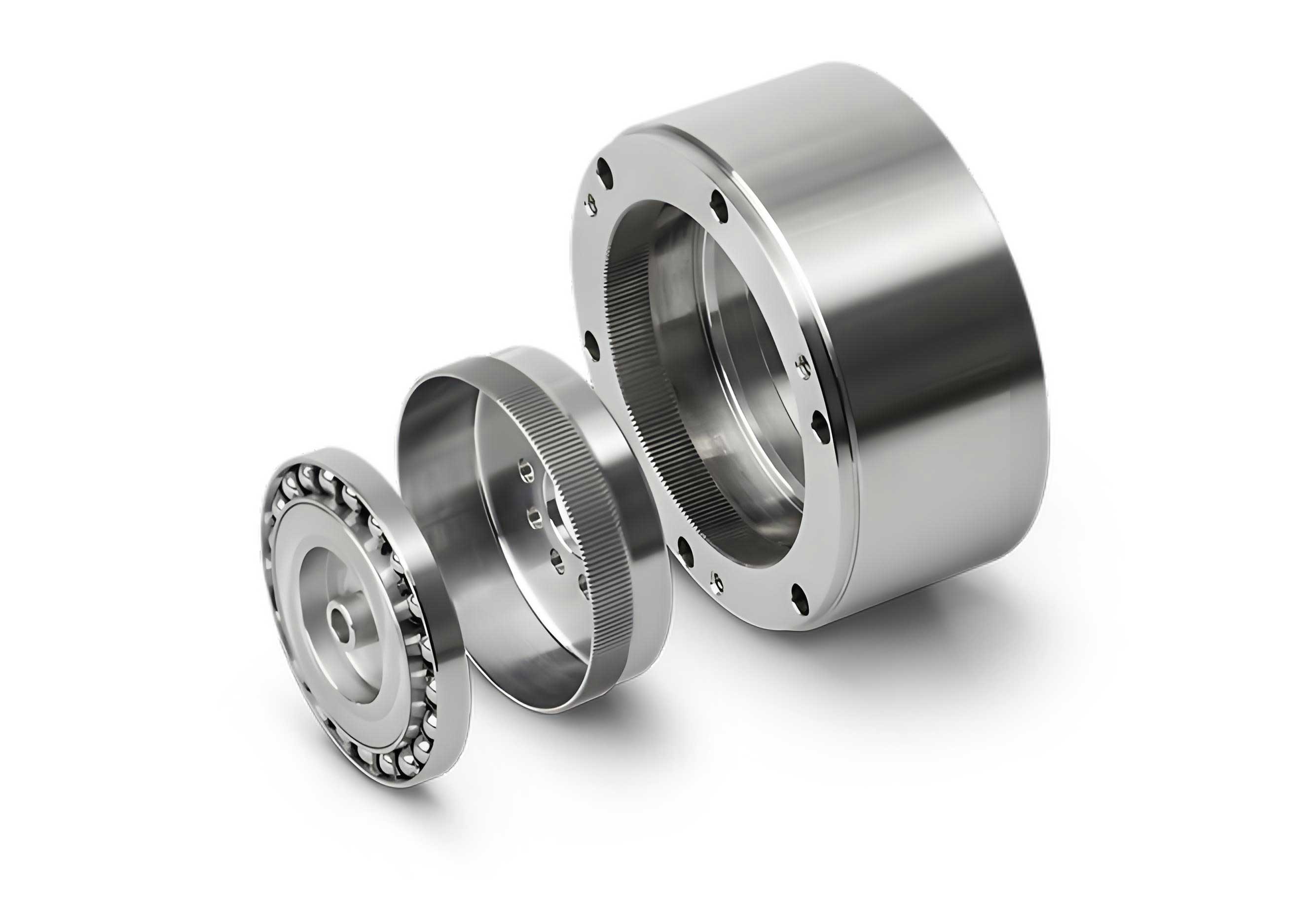
The operational excellence of a harmonic drive gear comes with a reliability challenge that I have dedicated significant effort to understanding. The system typically comprises four main elements: the wave generator (often an elliptical cam), the flexspline (a thin-walled, flexible cup with external teeth), the circular spline (a rigid ring with internal teeth), and a flexible bearing. During operation, the wave generator deforms the flexspline elliptically, causing its external teeth to engage with the internal teeth of the circular spline at two diametrically opposite regions. This process involves complex, multi-axial stress states within the flexspline material due to combined bending from forced deformation and shear/torsion from transmitted torque. My analysis of field data and literature confirms that fatigue cracks predominantly initiate in the flexspline’s tooth root region or at stress concentration points near the cup’s transition fillets, ultimately leading to catastrophic failure. Other failure modes like tooth wear or wave generator bearing seizure are important, but the flexspline’s low-cycle and high-cycle fatigue remains the primary design constraint for a reliable harmonic drive gear.
To systematically address this, I first establish a clear understanding of the stress state. The flexspline’s deformation is not arbitrary; it follows shapes dictated by the wave generator’s profile. Common configurations include the cosine wave shape and the multi-force application shape. For the specific harmonic drive gear model I studied, the deformation is best modeled as resulting from four concentrated radial forces acting on the flexspline’s inner surface. The deformation shape and the magnitude of these forces are fundamental to the stress analysis. Based on elastic ring theory, the relationship between the deformation force \( F \) and the maximum radial deformation \( \omega_0 \) can be derived. In my model, considering a four-force system with an action angle \( \beta \), the force is given by:
$$F = \frac{\pi E I_x \omega_0}{4 r^3} \sum_{n=2,4,6,\ldots}^{\infty} \frac{\cos(n\beta)}{n^2(n^2 – 1)^2}$$
where \( E \) is the Young’s modulus of the flexspline material, \( I_x \) is the equivalent moment of inertia of the flexspline cross-section (combining the contribution of the tooth ring and the cup shell), and \( r \) is the inner radius of the flexspline cup. This formula provides the foundational load for the static analysis phase. The equivalent stiffness \( EI_x \) is a critical parameter, calculated as \( EI_x = EI_{x1} + EI_{x2} \), where the subscripts 1 and 2 denote the gear rim and the cylindrical shell, respectively. Under operational loads, the flexspline also sustains a transmitted torque \( T \), which introduces shear stresses. The complete loading condition for fatigue analysis is thus a combination of these periodic radial deformation forces and a steady or fluctuating torque.
Creating an accurate yet computationally efficient finite element model is a crucial step I undertake. A fully detailed model of the harmonic drive gear, with all teeth geometrically exact, would result in an prohibitively large number of elements and nodes. Therefore, I employ a simplification strategy validated by prior research. The toothed rim section of the flexspline is modeled as a smooth cylinder with an equivalent thickness \( h_{eq} \). This thickness is determined using an empirical formula that relates it to the radial difference between the flexspline’s pitch circle and its cup inner diameter:
$$h_{eq} = 1.673 \sqrt{S_1}$$
Here, \( S_1 \) represents the radial difference mentioned. This simplification dramatically reduces mesh complexity while preserving the global stiffness and stress characteristics in the cup body, which is the primary region of interest for fatigue life assessment of the harmonic drive gear. The three-dimensional solid model of the simplified flexspline is created using CAD software, focusing on the cup geometry, the transition fillet to the diaphragm or flange, and the output connection flange. Key dimensions and material properties for a typical case in my study are summarized in the table below.
| Parameter | Symbol | Value | Unit |
|---|---|---|---|
| Inner Cup Radius | \( r \) | 30 | mm |
| Cup Wall Thickness | \( t \) | 0.8 | mm |
| Equivalent Rim Thickness | \( h_{eq} \)) | 2.5 | mm |
| Flange Thickness | – | 5 | mm |
| Material Young’s Modulus | \( E \) | 210 | GPa |
| Material Poisson’s Ratio | \( \nu \) | 0.3 | – |
| Ultimate Tensile Strength | \( S_u \) | 1200 | MPa |
| Yield Strength | \( S_y \) | 950 | MPa |
| Fatigue Strength Coefficient | \( \sigma_f’ \) | 1500 | MPa |
| Fatigue Strength Exponent | \( b \) | -0.08 | – |
After importing the geometry into ANSYS, I proceed with the meshing strategy. Given the geometric features, I partition the model into several bodies to apply a mixed meshing approach. The cylindrical cup, being regular, is meshed with higher-order tetrahedral elements using a free mesh technique. Critical regions where stress concentrations are anticipated—such as the inner fillet radius where the cup meets the diaphragm, the outer fillet at the flange connection, and the zones corresponding to the force application points—are locally refined with a much denser mesh. This ensures an accurate capture of stress gradients, which is paramount for a credible fatigue life prediction for the harmonic drive gear. The final mesh typically consists of several hundred thousand elements, a balance between accuracy and computational feasibility.
The boundary conditions and loads are applied to simulate the working state. The flange mounting surface is assigned a fixed support (all degrees of freedom constrained). The four radial deformation forces, calculated using the formula earlier, are applied as pressure loads over four small rectangular areas on the inner cup surface. These areas are oriented at the specific action angles \( \beta = 25^\circ, 155^\circ, 205^\circ, \) and \( 335^\circ \) from a reference axis. Additionally, to simulate the torque transmission, a moment is applied as a tangential pressure distribution over the outer surface of the equivalent gear rim section. The static structural analysis solves for the displacement, strain, and stress fields under this combined loading. The von Mises stress contour plot reveals the expected stress concentrations. High-stress regions consistently appear at the four force application points and, importantly, at the orthogonal regions (near \( 90^\circ \) and \( 270^\circ \)) on the cup’s outer surface, which undergo maximum bending. The maximum equivalent stress value from this analysis, \( \sigma_{max} \), serves as a key input for the subsequent fatigue calculation.
Fatigue life estimation requires transitioning from a static stress result to a prediction of cycles to failure under cyclic loading. Within ANSYS, I utilize the dedicated fatigue tool module. The loading history for the harmonic drive gear in many applications is essentially fully reversed, as the flexspline undergoes a complete stress cycle (from one elliptical state back to the same) with each revolution of the wave generator. Therefore, I define the load type as ‘Fully Reversed’ (R = -1). The mean stress effect, which significantly influences fatigue life, is accounted for using the Goodman correction theory. The Goodman line equation relates the alternating stress \( \sigma_a \) and mean stress \( \sigma_m \) to the material’s ultimate strength \( S_u \) and fully reversed fatigue endurance limit \( S_e \):
$$\frac{\sigma_a}{S_e} + \frac{\sigma_m}{S_u} = 1$$
In my fully reversed case, the mean stress \( \sigma_m \) is zero from the primary deformation cycle, but local stress states might have a non-zero mean due to the superposition of torque. The fatigue analysis module automatically processes the stress tensor at each node, extracts the alternating and mean components, applies the chosen mean stress correction, and computes the life using the material’s S-N curve data. The S-N curve for the high-strength alloy steel typically used in harmonic drive gear flexsplines is often described by the Basquin equation:
$$\sigma_a = \sigma_f’ (2N_f)^b$$
where \( \sigma_a \) is the stress amplitude, \( N_f \) is the number of cycles to failure, and \( \sigma_f’ \) and \( b \) are the fatigue strength coefficient and exponent, respectively (provided in the material table). The software performs this calculation node-by-node, generating a fatigue life contour plot. The result is expressed in terms of hours of operation, given a known operational speed of the wave generator. For the specific harmonic drive gear configuration I analyzed, the minimum life location was found at the stress concentration points near the \( 90^\circ/270^\circ \) regions on the cup body, with a predicted life of approximately 900 hours under continuous operation at the design speed and load. A more comprehensive summary of the stress and life results at critical locations is presented below.
| Critical Region | Max Von Mises Stress (MPa) | Predicted Fatigue Life (hours) | Cycles to Failure (N_f) |
|---|---|---|---|
| Inner Surface at β=25° Force Zone | 785 | 1,200 | 8.64e7 |
| Outer Surface at β=90° Bending Zone | 820 | 900 | 6.48e7 |
| Cup-to-Diaphragm Fillet | 750 | 1,500 | 1.08e8 |
| Flange Fillet Region | 580 | >10,000 | >7.2e8 |
The results from this simulation framework provide profound insights. The fatigue life cloud map clearly identifies the weakest links in the flexspline design of this harmonic drive gear. It validates the empirical observation that failure often initiates away from the direct force application points, at locations of maximum bending stress. The analysis also allows for rapid design iteration. For instance, I can parametrically modify the fillet radius \( R_{fillet} \) and observe its impact on stress concentration factor \( K_t \) and consequently on life. A simple parametric study can be summarized by the relation:
$$ \text{Life} \propto \left( \frac{1}{K_t \cdot \sigma_{nom}} \right)^m $$
where \( m \) is the inverse slope of the S-N curve. Furthermore, the effect of transmitted torque on fatigue life can be quantified. Increasing the torque \( T \) raises the mean shear stress component, which, according to the Goodman criterion, reduces the allowable alternating stress for a given life. This interaction can be modeled to create design envelopes for the harmonic drive gear specifying safe operating torque vs. speed (cycles) for a target service life.
However, it is crucial to acknowledge the limitations and assumptions in my approach. The simplification of the gear rim, while effective for cup stress analysis, neglects local contact stresses and possible fatigue initiation at individual tooth roots. For a complete assessment of the harmonic drive gear, a sub-modeling technique focusing on a segment of the actual teeth under load from the wave generator and circular spline reaction would be necessary. Moreover, material properties, especially the fatigue endurance limit, can exhibit scatter. The assumed S-N curve is typically for polished laboratory specimens, whereas the actual flexspline surface has machining marks and may undergo different heat treatment effects. Environmental factors like temperature and corrosion are also not considered in this baseline simulation. Therefore, I always regard the predicted life, such as the 900-hour value, as a relative index or a comparative tool rather than an absolute guarantee. It is most powerful when used in a comparative analysis between different design variants of a harmonic drive gear or when calibrated with actual prototype test data. The correlation between simulation and physical testing forms the cornerstone of developing reliable predictive models for harmonic drive gear longevity.
In conclusion, the integration of three-dimensional solid modeling, finite element static analysis, and modern fatigue life prediction algorithms within a unified software environment like ANSYS provides a powerful and effective methodology for the寿命评估 of harmonic drive gears. From my first-person application of this process, it enables a deep dive into the complex stress state of the flexspline, identifies critical failure locations, and quantifies life expectancy under defined operating conditions. The ability to perform virtual testing and design optimization saves substantial time and cost in the development cycle of a high-performance harmonic drive gear. Future work I envision involves multi-disciplinary simulations coupling dynamic loads from the driven system, thermal effects from efficiency losses, and even progressive damage modeling to track crack growth. Nonetheless, the current methodology establishes a robust foundation for enhancing the reliability and advancing the design of harmonic drive gears, ensuring they meet the rigorous demands of modern high-tech applications where failure is not an option.