
In the field of gear engineering, hyperboloidal gears, also known as hypoid gears, play a critical role in transmitting motion between non-parallel and non-intersecting shafts. Their complex geometry and high load-bearing capacity make them essential in automotive differentials, aerospace applications, and industrial machinery. However, designing and analyzing these gears is challenging due to their intricate tooth surfaces and contact patterns. Traditional theoretical methods, while accurate, often lack visual intuition. Therefore, I explore the use of three-dimensional geometric simulation techniques to model the meshing process and perform tooth contact analysis (TCA) for hyperboloidal gears. This approach not only validates design parameters but also provides a direct link between manufacturing adjustments and gear performance, enabling optimization in a virtual environment.
The core of this work lies in creating accurate digital models of hyperboloidal gears. Two primary methods are employed: the first involves deriving mathematical tooth surface models based on cutting process parameters, while the second utilizes computer-aided geometric modeling through Boolean operations between gear blanks and tool bodies. I focus on the latter method because it allows for the simultaneous generation of tooth surfaces, fillets, and root surfaces, facilitating comprehensive gear inspection. By discretizing the cutting motion into incremental steps and performing Boolean subtractions at each step, the tool envelope is formed on the gear blank, resulting in a digital replica of the manufactured gear. This method is versatile and applicable to various cutting techniques, such as formate, helical, and Freeform methods. The accuracy of the digital model can be enhanced by increasing the number of discrete steps, ensuring that the simulated tooth surface closely approximates the theoretical one. For hyperboloidal gears, this modeling process captures the unique curvature and twist of the teeth, which are crucial for proper meshing.
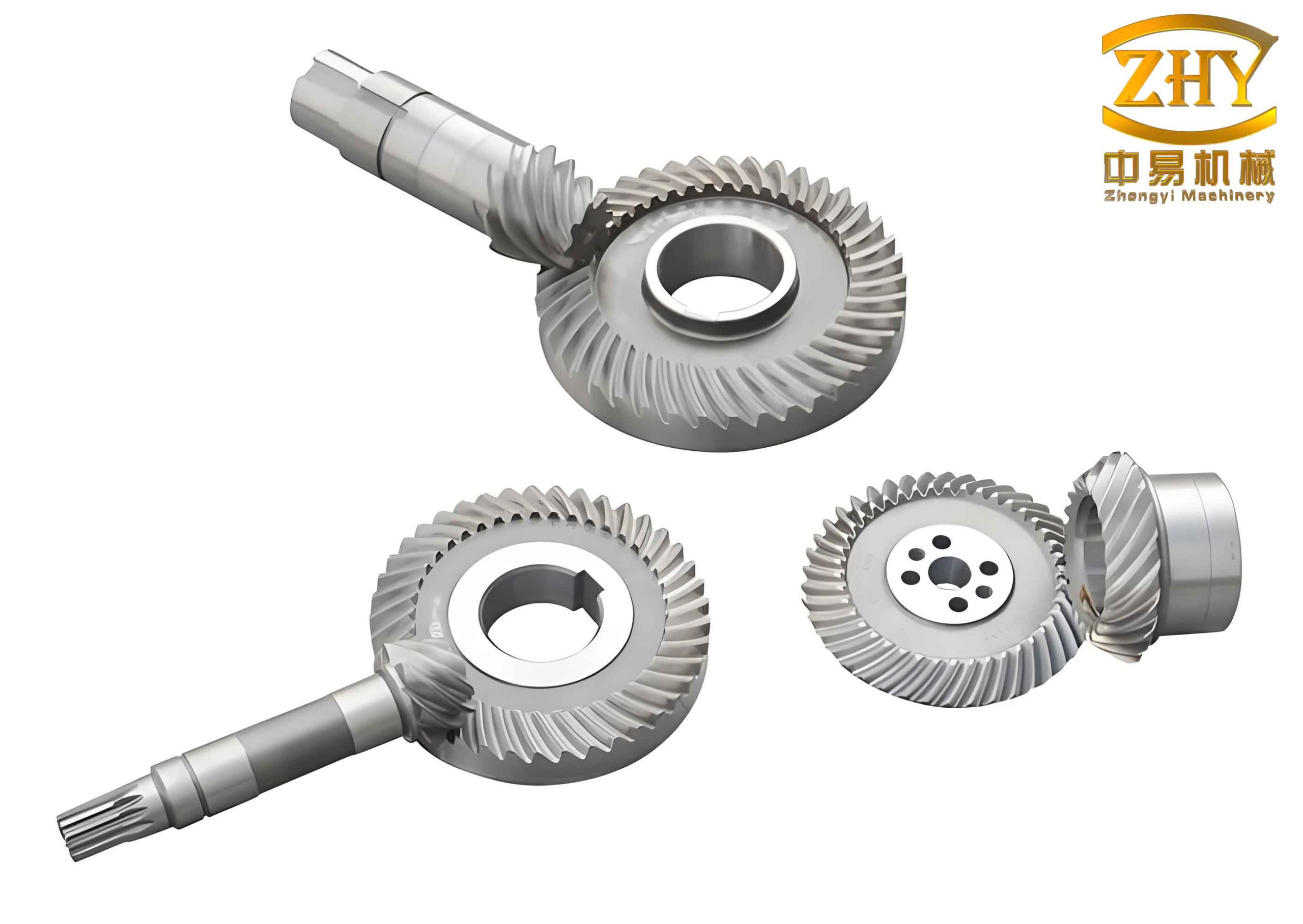
Once the digital models are constructed, the next step is to simulate the meshing process. This involves assembling the pinion and gear in a virtual environment based on design parameters. The assembly coordinates are defined with reference to the cutting principle: for a typical hyperboloidal gear pair, the pinion is often left-handed with a downward offset, and the gear is right-handed. The coordinate transformation from the pinion system to the gear system is given by:
$$ \mathbf{i}_1 = \cos \Delta \, \mathbf{i} – \sin \Delta \, \mathbf{k} $$
$$ \mathbf{j}_1 = \mathbf{j} $$
$$ \mathbf{k}_1 = \sin \Delta \, \mathbf{i} + \cos \Delta \, \mathbf{k} $$
where $\Delta = \Sigma – (\delta_{M1} + \delta_{M2})$, with $\Sigma$ as the shaft angle, and $\delta_{M1}$ and $\delta_{M2}$ as the mounting root angles of the pinion and gear, respectively. The assembly must satisfy three conditions: the angle between pinion and gear axes equals $\Sigma$, their coordinate axes align appropriately, and the pinion offset distance $e$ is maintained. This setup ensures that the gears are positioned correctly for meshing simulation.
To simulate meshing, I develop an algorithm that detects contact points between tooth surfaces during rotation. For point-contact hyperboloidal gears, the ideal condition is that only a single point on each tooth surface interacts at any given moment. This is transformed into an interference detection problem in the digital model. Using a software platform like Solidworks for secondary development, I implement an iterative process to find contact points. The algorithm works as follows: starting from an initial position, the pinion (driving gear) is rotated by a small increment $\Delta \varepsilon$, and the gear (driven gear) is adjusted iteratively until the interference volume between the tooth surfaces is below a threshold $\mu$ (e.g., $1 \times 10^{-8}$ mm³). At this point, the interference region is considered a “contact point,” and its geometric center is recorded. This process is repeated across multiple rotation increments to trace the contact path and generate the transmission error curve. The transmission error $\Delta \varepsilon_i$ for each step is calculated as the difference between the actual gear rotation and the ideal rotation based on the gear ratio $z_1/z_2$, where $z_1$ and $z_2$ are the tooth numbers. The meshing process simulation captures the entire engagement from initial contact to disengagement, allowing for analysis of multiple teeth in contact simultaneously.
To illustrate the application, I consider an example of a hyperboloidal gear pair designed using the HFT (Hypoid Formate) method. The pinion is cut with a single-side rolling process, while the gear is generated via a formate method. The key machining and assembly parameters are summarized in tables below. These parameters are input into the digital modeling and simulation system to create the gear pair and analyze its meshing behavior.
| Parameter | Value |
|---|---|
| Cutter Tilt Angle (degrees) | 17.14 |
| Cutter Swivel Angle (degrees) | 321.8 |
| Vertical Wheel Position (mm) | 28.6986 |
| Radial Cutter Position (mm) | 141.1213 |
| Machine Center to Crossing Point Distance (mm) | -4.0833 |
| Roll Ratio | 3.489811 |
| Cutter Nominal Diameter (mm) | 300.48 |
| Cutter Pressure Angle (degrees) | 14 |
| Parameter | Value |
|---|---|
| Horizontal Cutter Position (mm) | 77.6534 |
| Vertical Cutter Position (mm) | 129.4356 |
| Mounting Root Angle (degrees) | 67.23 |
| Machine Center to Crossing Point Distance (mm) | 0.5487 |
| Cutter Nominal Diameter (mm) | 304.80 |
| Cutter Pressure Angle (degrees) | 22.5 |
| Parameter | Value |
|---|---|
| Mounting Offset Distance (mm) | 35 |
| Shaft Angle (degrees) | 90 |
| Gear Mounting Distance (mm) | 55.29 |
| Pinion Mounting Distance (mm) | 175.13 |
The digital models of the pinion and gear are created based on these parameters, with the pinion concave surface (drive side) and gear convex surface as the contact pair. The simulation involves multiple teeth to capture interactions during meshing. The contact points are determined using the interference detection algorithm, and the geometric contact area is defined as the region where the surface gap $\delta$ is less than or equal to 0.00635 mm. This results in a series of contact ellipses along the tooth surfaces, illustrating the contact pattern. For instance, during meshing, the contact starts near the gear tooth tip at the outer end and moves toward the root at the inner end. The transmission error curve is derived from the gear rotation adjustments, showing deviations from ideal motion due to tooth surface modifications.
The simulation outputs include the contact path and transmission error. To validate the results, I compare them with theoretical calculations and outputs from commercial software like Gleason’s TCA tools. The theoretical contact points are derived from tooth surface equations based on gear geometry. The mathematical representation of a tooth surface point $\mathbf{r}(u, \theta)$ can be expressed as:
$$ \mathbf{r}(u, \theta) = \mathbf{r}_0(u) + \mathbf{M}(\theta) \cdot \mathbf{t}(u) $$
where $u$ is a parameter along the tooth profile, $\theta$ is the rotation angle, $\mathbf{r}_0$ is the initial position vector, $\mathbf{M}$ is the transformation matrix accounting for gear motion, and $\mathbf{t}$ is the tool vector. The contact condition requires that the normal vectors at the contact point align, leading to the equation:
$$ \mathbf{n}_1 \cdot \mathbf{v}_{12} = 0 $$
where $\mathbf{n}_1$ is the normal vector on the pinion tooth surface, and $\mathbf{v}_{12}$ is the relative velocity vector between the pinion and gear. Solving this equation yields the contact point coordinates. In simulation, these points are approximated through interference detection. The comparison shows that the simulated contact points closely match the theoretical ones, with deviations on the order of micrometers, confirming the accuracy of the digital models. For the example gear pair, the contact path on the gear tooth surface forms a curve from the outer tip to the inner root, and the transmission error curve exhibits smooth variations, indicating stable meshing.
Furthermore, the simulation allows for comprehensive gear analysis. It can detect unwanted interferences, such as edge contacts at the tooth tips or roots, which are critical for preventing noise and wear. By adjusting machining parameters like cutter tilt, swivel angles, or offset distances, the contact pattern can be optimized. For instance, increasing the cutter pressure angle might shift the contact toward the tooth center, reducing stress concentrations. The simulation system enables virtual testing of these adjustments without physical prototyping, saving time and cost. Additionally, the geometric contact area derived from simulation provides insights into load distribution. The size and shape of the contact ellipse influence the contact stress, which can be estimated using Hertzian contact theory. The maximum contact pressure $p_{\text{max}}$ for an elliptical contact area is given by:
$$ p_{\text{max}} = \frac{3F}{2\pi a b} $$
where $F$ is the normal load, and $a$ and $b$ are the semi-major and semi-minor axes of the contact ellipse, respectively. These axes can be extracted from the simulation results by fitting an ellipse to the contact points. This integration of geometric simulation with mechanical analysis enhances the design process for hyperboloidal gears.
To delve deeper into the algorithm, the meshing simulation process is iterative. For each rotation increment $\Delta \varepsilon$ of the pinion, the gear rotation angle $\varepsilon_2$ is adjusted to minimize interference. The adjustment step size is halved iteratively until the interference volume $V$ satisfies $V \leq \mu$. This binary search approach ensures efficiency. The interference volume is computed using the software’s API functions, which return the overlapping region between the two tooth surfaces. Once a contact point is found, its coordinates are transformed back to the global assembly coordinate system for analysis. The sequence of contact points forms the contact trajectory, which can be plotted on the tooth surface. Moreover, the transmission error curve is generated by calculating the difference between the actual gear rotation and the ideal rotation for each pinion angle. The root mean square (RMS) of the transmission error can be used as a performance metric; lower RMS values indicate smoother meshing. The formula is:
$$ \text{RMS} = \sqrt{\frac{1}{N} \sum_{i=1}^{N} (\Delta \varepsilon_i)^2 } $$
where $N$ is the number of simulation steps. This metric helps in comparing different design variants.
In terms of computational aspects, the simulation of hyperboloidal gears requires careful discretization. The tooth surfaces are represented as tessellated meshes in the digital model. The mesh resolution affects both accuracy and computation time. A finer mesh yields more precise contact points but increases processing load. I balance this by using adaptive meshing, where regions near the expected contact zone have higher density. The Boolean operations for cutting simulation also depend on mesh quality. To improve efficiency, the simulation can be parallelized, as each meshing step is independent. However, for dynamic meshing analysis, the steps are sequential due to gear rotation. The overall simulation time for a full meshing cycle of a hyperboloidal gear pair with three pinion teeth and four gear teeth might take several minutes on a standard workstation, which is acceptable for design purposes.
The application of this simulation method extends beyond design validation. It can be used for educational purposes to visualize the meshing of hyperboloidal gears, which is often difficult to grasp from equations alone. Additionally, it supports reverse engineering by allowing the reconstruction of tooth surfaces from coordinate measurement machine (CMM) data. The measured points can be used to create a digital model, and then the simulation can predict meshing behavior under different assembly conditions. This is particularly useful for troubleshooting noise or vibration issues in existing gear systems. For hyperboloidal gears used in automotive differentials, slight misalignments can lead to significant performance degradation. The simulation can model these misalignments by varying the assembly parameters, such as offset distance or shaft angle, and observe the resulting contact pattern shifts. This helps in setting tolerance limits during manufacturing.
Another advantage is the ability to simulate multi-tooth contact. In hyperboloidal gears, multiple teeth may share the load simultaneously, especially under heavy loads. The simulation captures this by including several teeth in the model and analyzing their interactions. The contact ellipses on adjacent teeth can overlap or merge, indicating load sharing. The contact ratio, defined as the average number of teeth in contact during meshing, can be estimated from the simulation by counting the number of teeth with non-zero interference at each step. A higher contact ratio improves load capacity and smoothness. For the example gear pair, the simulation shows that up to two pairs of teeth are in contact at certain positions, which is desirable for reducing stress.
To further illustrate the mathematical foundation, the tooth surface geometry of hyperboloidal gears can be described using differential geometry. The surface curvature parameters, such as principal curvatures $\kappa_1$ and $\kappa_2$, influence the contact ellipse dimensions. According to Hertz theory, the semi-axes $a$ and $b$ of the contact ellipse are related to the relative curvatures of the surfaces at the contact point. The relative curvature sum $\Sigma \rho$ is given by:
$$ \Sigma \rho = \rho_{11} + \rho_{12} + \rho_{21} + \rho_{22} $$
where $\rho_{ij}$ are the principal curvatures of the pinion and gear surfaces along principal directions. Then, $a$ and $b$ can be computed using elliptical integrals. In simulation, these curvatures can be approximated from the digital model mesh, allowing for stress analysis integration. This bridges the gap between geometric simulation and mechanical performance prediction.
In conclusion, the three-dimensional geometric simulation approach for hyperboloidal gears provides a powerful tool for design, analysis, and optimization. By creating accurate digital models through Boolean operations and simulating meshing via interference detection, I can visualize contact patterns, transmission errors, and multi-tooth interactions. The method validates machining parameters and allows rapid testing of design modifications. Compared to theoretical calculations, it offers intuitive insights and can complement traditional TCA software. Future work could involve integrating dynamic load simulations or thermal effects to further enhance realism. For now, this simulation framework serves as a vital link between manufacturing setup and gear performance, aiding in the development of more efficient and reliable hyperboloidal gear systems. The repeated emphasis on hyperboloidal gears throughout this discussion underscores their complexity and the value of advanced simulation techniques in mastering their design.