
The study and optimization of meshing in mismatched, or non-conjugate, worm gear drives have traditionally relied on costly and time-consuming physical trial-and-error methods. In conventional practice, the worm is coated with a marking compound, assembled with the worm wheel, and run to produce contact patterns on the gear teeth. Analyzing these patterns reveals the quality of the mesh. If the contact is unsatisfactory, the worm wheel is re-machined with adjusted parameters, and the assembly test is repeated. This iterative cycle demands significant resources in terms of labor, materials, and time to achieve an optimal meshing state. The advent of virtual simulation technology offers a transformative alternative, enabling researchers to create a digital twin of the entire manufacturing and assembly process. Within this virtual environment, one can observe, evaluate, and modify procedures, validating machining schemes before any physical part is produced. This approach drastically reduces experimental costs and eliminates speculative development. Our work is dedicated to establishing such a virtual simulation system specifically for analyzing the tooth contact pattern in mismatched worm gear drives. The core methodology leverages the powerful parametric modeling and motion simulation capabilities of Pro/ENGINEER Wildfire 4.0 (Pro/E), extended through secondary development using VC++ 6.0. This system meticulously replicates the real-world machining and testing workflow, effectively creating a “virtual factory” inside the computer. Within this digital realm, we investigate the meshing behavior of mismatched worm gear pairs. By simulating the application of contact markers and performing virtual cross-sectioning of the engaged teeth, we can clearly visualize the contact zone between the tooth surfaces. This visibility allows for the systematic adjustment of machining and assembly parameters to optimize the contact pattern, thereby guiding practical manufacturing towards the best possible meshing performance.
The fundamental principle for analyzing a mismatched worm gear drive is based on ensuring favorable contact geometry at the point of mesh. For the specific industrial case we studied, the driving component is a three-start, left-hand, conical enveloping worm. The driven worm wheel is generated by a single-start, normal straight-sided hob, resulting in a wheel with 36 teeth designed to mate with the three-start worm. The essential geometric parameters for the worm are provided, and the corresponding hob parameters must be derived from the principles of gear generation to ensure proper, albeit non-conjugate, meshing. The spiral lead angle of the worm wheel hob, \(\lambda_0\), is determined by the worm’s geometry to correctly generate the wheel teeth:
$$\lambda_0 = \arcsin\left( \frac{m}{d_0} \cos \lambda_1 \right)$$
Here, \(d_0\) is the pitch diameter of the hob, \(\lambda_1\) is the spiral lead angle of the worm, and \(m\) is the axial module of the worm. The axial module of the hob, \(m_0\), is then calculated as:
$$m_0 = \frac{d_0 \tan \lambda_0}{z_0}$$
where \(z_0\) is the number of starts on the hob (which is 1 in this case). Furthermore, the axial pressure angle of the hob, \(\alpha_0\), must relate to the worm’s axial pressure angle, \(\alpha_1\), through the spiral angles to maintain correct tooth profile generation:
$$\tan \alpha_0 \cos \lambda_0 = \tan \alpha_1 \cos \lambda_1$$
Using these fundamental equations, the key parameters for the mismatched pair and its generating hob are computed. A comprehensive summary is presented in the table below, which serves as the foundational dataset for all subsequent virtual modeling and simulation activities.
| Component | Type | Number of Starts / Teeth | Axial Module (mm) | Pitch Diameter (mm) | Pressure Angle (°) | Lead Angle |
|---|---|---|---|---|---|---|
| Worm | Conical Enveloping | 3 | 1.25 | 13.5 | 20 (Axial) | 15° 31′ 27″ |
| Additional Data: Addendum Diameter = 16 mm, Dedendum Diameter = 10.375 mm, Lead = 11.781 mm. | ||||||
| Worm Wheel Hob | Normal Straight-Sided (Actual) | 1 | 1.219 (Axial) | 20.0 | 19.3378 (Axial) | 3° 29′ 19″ |
| Derived Data: Normal Module = 1.217 mm, Addendum Diameter = 23.2 mm, Dedendum Diameter = 16.4 mm. | ||||||
| Theoretical Setup: When using this hob, the theoretical machine setting angle (swivel angle) for cutting the worm wheel is \(\lambda_1 – \lambda_0 = 12.07^\circ\). | ||||||
| Worm Wheel | Generated by above Hob | 36 | 1.25 (Mating) | 45.0 | Defined by Hob | — |
For a high-performance mismatched worm gear drive, the contact condition between the worm and gear teeth is critical. The optimal meshing form requires that the profiles of both tooth surfaces, when viewed in the plane normal to the relative velocity vector at the contact point, create a geometry conducive to hydrodynamic lubrication. Specifically, this means the relative normal curvature in that direction should be sufficiently large to promote the formation and maintenance of a lubricant wedge, minimizing wear and power loss.
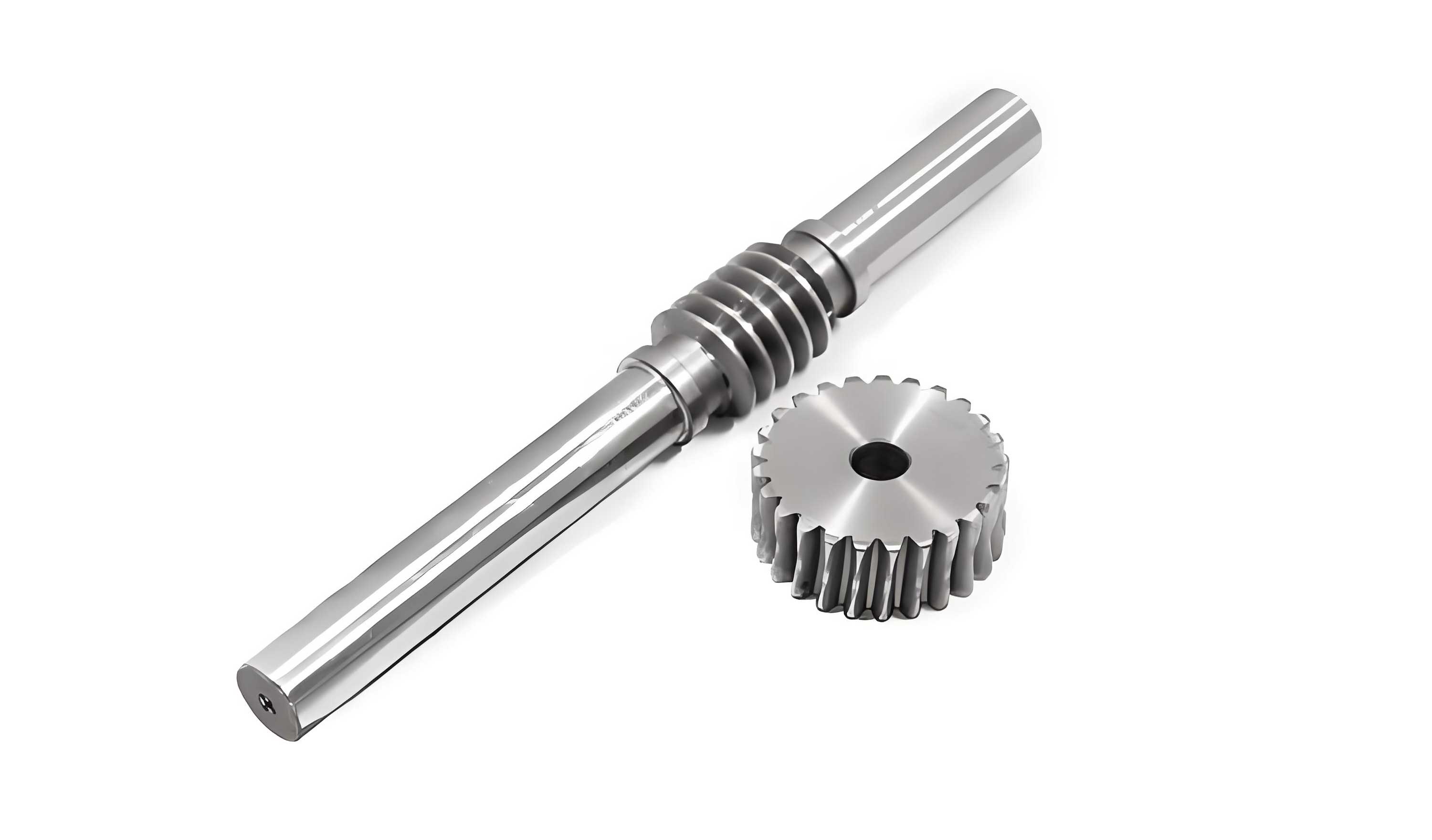
The virtual simulation methodology is built upon a fully parametric and automated modeling pipeline. The first step involves the parametric modeling of the three-start conical enveloping worm. Within the Pro/E environment, we utilize its Program and Relation features to define the worm’s basic parameters—such as number of starts, axial module, pressure angle, lead angle, grinding wheel radius, and pitch diameter—as user-input variables. The dimensions for the addendum, dedendum, and pitch cylinders are then expressed as functions of these input parameters. The worm blank is created via an extrusion operation. The complex tooth profile, including the active flank and root transition curves, is generated using Pro/E’s “Curve from Equation” function, which allows for the precise definition of the axial tooth profile based on the mathematical model of the conical grinding process. This 2D profile is then swept along a helical trajectory with a constant section scan to form a single thread of the worm. The complete worm thread form is finally generated by patterning this single thread around the axis. This entire process is encapsulated into a user-friendly dialog box developed with Pro/TOOLKIT and VC++ 6.0. Users simply input the required parameters into this interface, and the system automatically generates the corresponding three-dimensional solid model of the worm, ensuring accuracy and repeatability.
The next phase simulates the virtual machining of the three-start worm wheel using the designed single-start hob. A similar parametric approach is adopted for the hob model. Its key parameters—normal module, normal pressure angle, lead angle, and pitch diameter—are parameterized. The hob blank is modeled, and its tooth profile is defined based on the normal straight-sided geometry. The helical gashes are created via a helical sweep. This results in a precise digital model of the worm wheel hob. The virtual hobbing process is then simulated using Pro/E’s advanced assembly and Boolean operation capabilities. The digital hob and a worm wheel blank are assembled with the correct center distance and the specified machine setting angle (the swivel angle). A motion simulation mimics the rotation of the hob and the indexing of the wheel blank. Through a virtual cutting operation (material removal), the hob teeth progressively generate the worm wheel teeth in the blank. This process yields a digital model of the worm wheel with perfectly simulated hob-generated geometry, complete with partial or full tooth forms as required for analysis.
The core of the investigation lies in the meshing contact simulation and its analysis. Using the Pro/E Mechanism module, we assemble the digitally modeled worm and the virtually machined worm wheel with their specified working center distance and alignment. A servo motor is applied to the worm to drive the rotation, and the motion is simulated. To analyze the contact, we employ a virtual “marking compound” technique. This is implemented by defining interference or contact analysis within the motion study, which visually highlights the areas of contact between the worm and gear teeth during mesh, analogous to the blue/red lead stain in physical testing. Furthermore, to gain a deeper geometrical understanding, we intersect the mating tooth surfaces at specific contact points with a plane that is normal to the relative velocity vector at that point. The resulting cross-sectional profiles of both the worm and gear teeth in this critical plane are examined. We evaluate various worm wheels that were virtually machined with different setting parameters—primarily different machine setting (swivel) angles around the theoretical value. For each case, we observe the simulated contact pattern on the worm wheel teeth and analyze the relative normal curvature from the cross-sectional profiles.
First, we simulated the meshing with the worm wheel machined at the theoretical setting angle of 12.07° and a working center distance of 32.5 mm. The virtual contact pattern showed the characteristic imprint on the worm wheel teeth. The corresponding normal section profiles at the contact point revealed a certain degree of conformity. Subsequently, we explored deviations from this theoretical angle. When the setting angle was decreased to 9.3° (with the same center distance), the simulated contact pattern shifted. The analysis of the normal section profiles in this configuration indicated a tendency toward edge contact or a less favorable curvature match, which would be detrimental to forming a stable lubricant wedge and would likely lead to increased stress and wear in the worm gear system. Conversely, when the setting angle was increased to 12.5°, the contact pattern also deviated from the optimal central position. The normal section profiles again showed a geometry that might promote point or edge contact rather than a broad, well-distributed area conducive to load carrying and lubrication. The comparison clearly indicated that the contact pattern and the sectional profile geometry were most favorable near the theoretically calculated setting angle of 12.07°. In this regime, the contact area was situated more centrally on the tooth flank, and the relative curvatures in the normal plane supported better conditions for hydrodynamic film formation, which is essential for the smooth, efficient, and durable operation of the mismatched worm gear drive.
In conclusion, the developed computer-aided virtual simulation system provides a powerful and efficient platform for the design and analysis of mismatched worm gear drives. We have successfully implemented a complete digital workflow encompassing the parametric modeling of a conical enveloping worm, the parametric design of a normal straight-sided worm wheel hob, the virtual machining of the worm wheel, and the dynamic simulation of the meshing contact. The system’s ability to visually replicate contact patterns and generate precise geometric cross-sections at the point of mesh offers unparalleled insight into the complex interaction between non-conjugate tooth surfaces. This virtual environment allows for the rapid exploration and optimization of key machining and assembly parameters—such as the hob setting angle and center distance—to achieve the most favorable contact conditions. By identifying the optimal configuration digitally, the need for numerous physical prototypes, trial assemblies, and costly test runs is virtually eliminated. This methodology represents a significant advancement, conserving substantial material resources, engineering time, and financial cost in the development and refinement of high-performance worm gear drives, while simultaneously enhancing the reliability and performance of the final product through guided, simulation-informed design.