
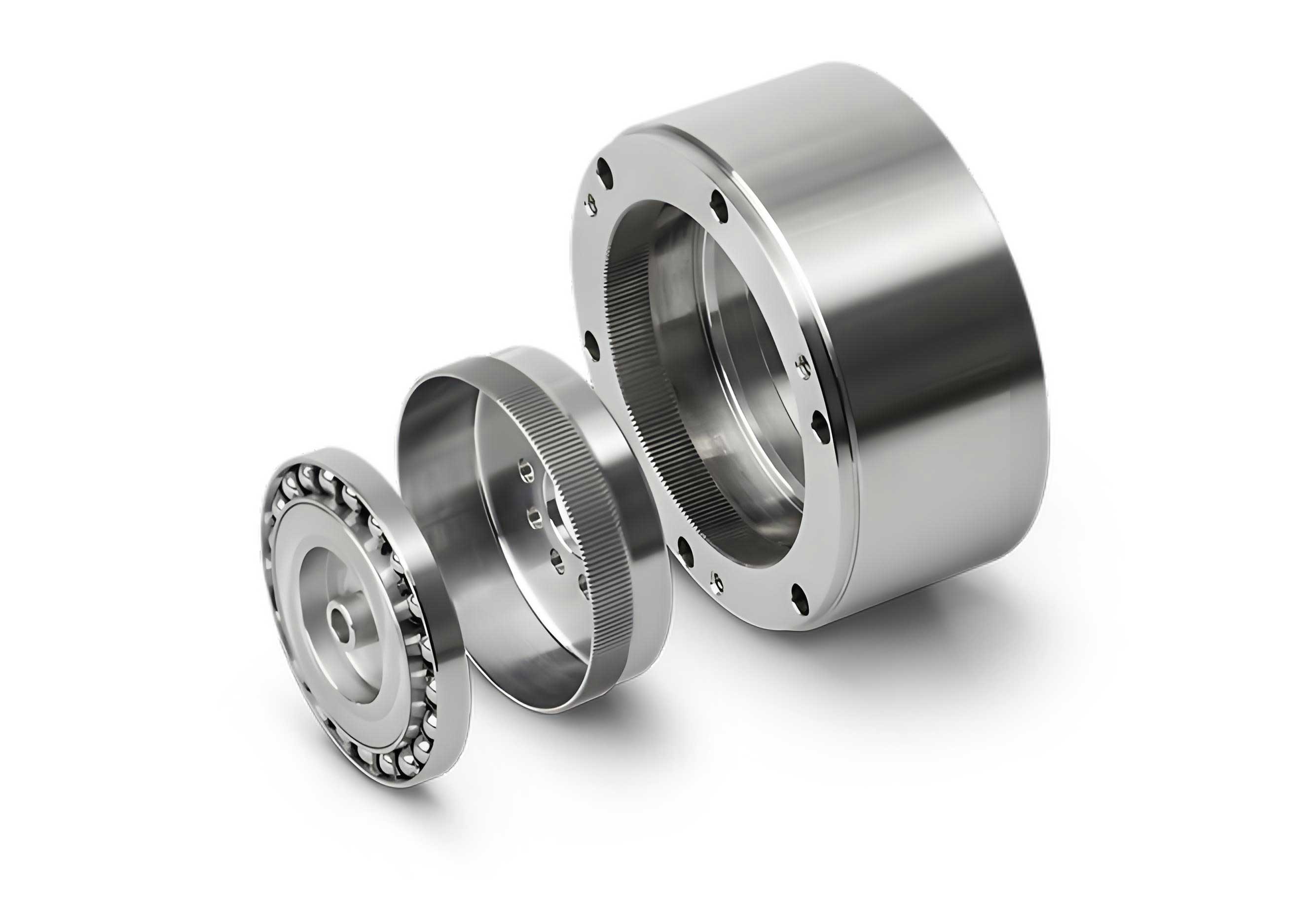
Harmonic drive gear systems represent a cornerstone in precision motion control, offering unparalleled advantages such as high reduction ratios, compact design, and exceptional load capacity. These systems are indispensable in aerospace, robotics, and medical devices, where reliability and accuracy are paramount. At the heart of harmonic drive gear performance lies the tooth profile geometry, which directly influences meshing characteristics, including backlash distribution and the potential for interference. Traditional involute profiles, while widely used, exhibit limitations such as concentrated stress and limited meshing zones. In contrast, circular-arc tooth profiles promise enhanced load distribution and increased meshing tooth pairs, but their design is sensitive to assembly deformations and wave generator types. This necessitates a robust simulation framework to analyze backlash and prevent interference, ensuring optimal harmonic drive gear operation.
This article presents a comprehensive methodology for simulating the assembly state of harmonic drive gear with circular-arc teeth profiles. We focus on a common-tangent double circular-arc profile, employing an arc-length coordinate representation to ensure mathematical uniqueness, geometric invariance, and continuity. The assembly model incorporates the deformed state of the flexspline under various wave generators, allowing for accurate reflection of real working conditions. Through coordinate transformations and meshing simulation, we determine the relative positions of engaged tooth pairs, quantify backlash distribution, and perform interference checks. Our approach enables detailed evaluation of design parameters, facilitating the development of high-performance harmonic drive gear systems with minimal backlash and no interference.
The mathematical representation of tooth profiles is critical for simulation accuracy. For circular-arc profiles, we use a piecewise function based on arc-length coordinates. For the circular spline (rigid gear), the tooth profile consists of an arc segment and a straight-line segment. Let the arc-length parameter be \( u \). The parametric equations are defined as follows. For the arc segment \( ST \):
$$ \mathbf{X}_2 = \mathbf{R} \cdot \mathbf{X}_u + \mathbf{T}, \quad \mathbf{X}_u = \rho_a \cdot \mathbf{R}_u, $$
$$ u \in [0, l_1], $$
where:
$$ l_1 = \rho_a \left( \arctan\left(\frac{y_q – y_o}{x_q – x_o}\right) + \arctan\left(\frac{y_q – y_s}{x_q – x_s}\right) \right), $$
$$ \rho_a = \rho_a^* m, \quad \mathbf{R} = \begin{bmatrix} \cos\theta & -\sin\theta & 0 \\ \sin\theta & \cos\theta & 0 \\ 0 & 0 & 1 \end{bmatrix}, \quad \mathbf{R}_u = \begin{bmatrix} \sin\left(\frac{u}{\rho_a}\right) \\ \cos\left(\frac{u}{\rho_a}\right) \\ 1/\rho_a \end{bmatrix}, $$
$$ \mathbf{T} = \begin{bmatrix} x_q \\ y_q \\ 1 \end{bmatrix}, \quad \theta = \frac{\pi}{2} + \arctan\left(\frac{y_q – y_o}{x_q – x_o}\right). $$
For the straight-line segment \( SR \):
$$ \mathbf{X}_2 = (u – l_1) \mathbf{R}_u + \mathbf{T}, $$
$$ u \in [l_1, l_2], $$
where:
$$ l_2 = l_1 + \sqrt{(x_r – x_s)^2 + (y_r – y_s)^2}, $$
$$ \mathbf{R}_u = \begin{bmatrix} -\sin\left(\frac{\pi}{z_2} – \gamma\right) \\ \cos\left(\frac{\pi}{z_2} – \gamma\right) \\ \frac{1}{u – l_1} \end{bmatrix}, \quad \mathbf{T} = \begin{bmatrix} x_s \\ y_s \\ 1 \end{bmatrix}. $$
Similarly, for the flexspline (flexible gear), the tooth profile comprises three arc segments and one straight-line segment: arc \( IH \), arc \( HG \), line \( GF \), and arc \( FE \). The parametric equations are given below. For arc \( IH \):
$$ \mathbf{X}_1 = \mathbf{R} \cdot \mathbf{X}_u + \mathbf{T}, \quad \mathbf{X}_u = \rho_{cf} \cdot \mathbf{R}_u, $$
$$ u \in [0, l_1], $$
with:
$$ l_1 = \rho_{cf} \left( \frac{\pi}{2} – \arctan\left(\frac{y_j – y_h}{x_j – x_h}\right) \right), \quad \rho_{cf} = \rho_{c}^* m, $$
$$ \mathbf{R} = \begin{bmatrix} \cos\theta & -\sin\theta & 0 \\ \sin\theta & \cos\theta & 0 \\ 0 & 0 & 1 \end{bmatrix}, \quad \mathbf{R}_u = \begin{bmatrix} \sin\left(\frac{u}{\rho_{cf}}\right) \\ \cos\left(\frac{u}{\rho_{cf}}\right) \\ 1/\rho_{cf} \end{bmatrix}, $$
$$ \mathbf{T} = \begin{bmatrix} x_j \\ y_j \\ 1 \end{bmatrix}, \quad \theta = \frac{3\pi}{2}. $$
For arc \( HG \):
$$ \mathbf{X}_1 = \mathbf{R} \cdot \mathbf{X}_u + \mathbf{T}, \quad \mathbf{X}_u = \rho_f \cdot \mathbf{R}_u, $$
$$ u \in [l_1, l_2], $$
where:
$$ l_2 = l_1 + \rho_f \left( \arctan\left(\frac{y_k – y_h}{x_k – x_h}\right) – \arctan\left(\frac{y_k – y_g}{x_k – x_g}\right) \right), \quad \rho_f = \rho_f^* m, $$
$$ \mathbf{R} = \begin{bmatrix} \cos\theta & -\sin\theta & 0 \\ \sin\theta & \cos\theta & 0 \\ 0 & 0 & 1 \end{bmatrix}, \quad \mathbf{R}_u = \begin{bmatrix} \sin\left(\frac{u}{\rho_f}\right) \\ \cos\left(\frac{u}{\rho_f}\right) \\ 1/\rho_f \end{bmatrix}, $$
$$ \mathbf{T} = \begin{bmatrix} x_k \\ y_k \\ 1 \end{bmatrix}, \quad \theta = \frac{\pi}{2} + \arctan\left(\frac{y_k – y_h}{x_k – x_h}\right). $$
For line \( GF \):
$$ \mathbf{X}_1 = (u – l_2) \mathbf{R}_u + \mathbf{T}, $$
$$ u \in [l_2, l_3], $$
with:
$$ l_3 = l_2 + \sqrt{(x_f – x_g)^2 + (y_f – y_g)^2}, $$
$$ \mathbf{R}_u = \begin{bmatrix} -\sin\gamma \\ \cos\gamma \\ \frac{1}{u – l_2} \end{bmatrix}, \quad \mathbf{T} = \begin{bmatrix} x_g \\ y_g \\ 1 \end{bmatrix}. $$
For arc \( FE \):
$$ \mathbf{X}_1 = \mathbf{R} \cdot \mathbf{X}_u + \mathbf{T}, \quad \mathbf{X}_u = \rho_a \cdot \mathbf{R}_u, $$
$$ u \in [l_3, l_4], $$
where:
$$ l_4 = l_3 + \rho_a \left( \arctan\left(\frac{y_e – y_a}{x_e – x_a}\right) – \arctan\left(\frac{y_f – y_a}{x_f – x_a}\right) \right), \quad \rho_a = \rho_a^* m, $$
$$ \mathbf{R} = \begin{bmatrix} \cos\theta & \sin\theta & 0 \\ -\sin\theta & \cos\theta & 0 \\ 0 & 0 & 1 \end{bmatrix}, \quad \mathbf{R}_u = \begin{bmatrix} -\sin\left(\frac{u – l_3}{\rho_a}\right) \\ \cos\left(\frac{u – l_3}{\rho_a}\right) \\ 1/\rho_a \end{bmatrix}, $$
$$ \mathbf{T} = \begin{bmatrix} x_a \\ y_a \\ 1 \end{bmatrix}, \quad \theta = \frac{\pi}{2} – \arctan\left(\frac{y_f – y_a}{x_f – x_a}\right). $$
These equations provide a precise mathematical foundation for modeling harmonic drive gear tooth profiles, essential for subsequent assembly and simulation steps.
The assembly model of harmonic drive gear must account for the deformation of the flexspline induced by the wave generator. The neutral curve of the flexspline undergoes radial displacement \( w(\phi) \), which varies with the wave generator type. For instance, under a four-roller wave generator, the radial displacement can be approximated by:
$$ w(\phi) = w_0 \cos(2\phi), $$
where \( w_0 \) is the maximum radial displacement and \( \phi \) is the angular coordinate. For an elliptical wave generator:
$$ w(\phi) = w_0 \cos^2(\phi). $$
For a two-disk wave generator:
$$ w(\phi) = w_0 \left(1 – \frac{|\sin(\phi)|}{k}\right), $$
with \( k \) as a shape factor. These displacement functions define the deformed flexspline geometry, affecting tooth positions.
To construct the assembly model, we first determine the tooth root positions on the deformed flexspline. Using an equal-arc-length distribution algorithm, the coordinates of the tooth root center \( o_1 \) are:
$$ x_{o_1} = (r_m + w(\phi)) \sin\phi, \quad y_{o_1} = (r_m + w(\phi)) \cos\phi, $$
where \( r_m \) is the radius of the undeformed neutral curve. The tooth profile symmetry axis rotates by an angle \( \lambda \) relative to the radial vector:
$$ \lambda = -\arctan\left( \frac{w'(\phi)}{r_m + w(\phi)} \right), $$
with \( w'(\phi) \) being the derivative of \( w(\phi) \). The transformed tooth profile coordinates are then:
$$ \mathbf{X} = \mathbf{R} \cdot \mathbf{X}_1 + \mathbf{T}, $$
where:
$$ \mathbf{R} = \begin{bmatrix} \cos(\phi + \lambda) & \sin(\phi + \lambda) & 0 \\ -\sin(\phi + \lambda) & \cos(\phi + \lambda) & 0 \\ 0 & 0 & 1 \end{bmatrix}, \quad \mathbf{T} = \begin{bmatrix} x_{o_1} \\ y_{o_1} \\ 1 \end{bmatrix}. $$
This transformation ensures that the flexspline teeth reflect their actual working state in the harmonic drive gear assembly. The circular spline teeth remain uniformly distributed, with no deformation.
To analyze meshing characteristics, we simulate the relative motion between flexspline and circular spline teeth. By applying coordinate transformations, we align the circular spline tooth space symmetry axis with the Y-axis. The relative position of the flexspline tooth profile with respect to this aligned coordinate system reveals the meshing sequence—entry, engagement, and exit—and facilitates backlash calculation. Backlash is defined as the minimum distance between non-contacting tooth surfaces of mating gears. For a given tooth pair, the backlash \( B \) is computed as:
$$ B = \min \left( \sqrt{(X_f – X_c)^2 + (Y_f – Y_c)^2} \right), $$
where \( (X_f, Y_f) \) and \( (X_c, Y_c) \) are points on the flexspline and circular spline profiles, respectively, within the meshing zone. This minimization is performed numerically over discrete profile points.
Interference occurs when \( B \leq 0 \), indicating penetration between tooth profiles. The interference check involves evaluating \( B \) across all engaged tooth pairs; if any \( B \) is negative, design adjustments are required. This simulation approach allows for comprehensive assessment of harmonic drive gear performance under various assembly conditions.
We now present an instance study using the proposed methodology. The geometric parameters for the common-tangent double circular-arc tooth profile are listed in Table 1 and Table 2. These parameters are dimensionless coefficients relative to the module \( m \), ensuring scalability for different harmonic drive gear sizes.
| Symbol | Flexspline Value | Circular Spline Value | Description |
|---|---|---|---|
| \( h_a^* \) | 0.9 | 0.9 | Addendum coefficient |
| \( h_f^* \) | 1.212 | 1.15 | Dedendum coefficient |
| \( h_l^* \) | 0.76 | 0.9661 | Cut point height coefficient |
| \( S_l^* \) | 1.3565 | 1.7504 | Tooth thickness coefficient at cut point |
| \( S^* \) | 1.3758 | – | Reference circle tooth thickness coefficient |
| \( \rho_{cf}^* \) | 0.55 | – | Root fillet radius coefficient |
| \( l_a^* \) | 0.3927 | 1.1560 | X-coefficient of addendum arc center |
| \( b_a^* \) | -0.366 | – | Y-coefficient of addendum arc center |
| \( \rho_a^* \) | 1.0802 | 2.0528 | Addendum arc radius coefficient |
| \( l_f^* \) | 2.7231 | – | X-coefficient of dedendum arc center |
| \( b_f^* \) | 0.2684 | – | Y-coefficient of dedendum arc center |
| \( \rho_f^* \) | 2.0528 | – | Dedendum arc radius coefficient |
| \( \gamma \) | 7°30’30” | 8°24′ | Line segment angle |
| Symbol | Flexspline Value (mm) | Circular Spline Value (mm) | Description |
|---|---|---|---|
| \( d \) | 163.2 | 164.18 | Reference diameter |
| \( m \) | 0.8 | 0.8 | Module |
| \( l \) | 160 | 30 | Length |
| \( \delta \) | 1.6 | 12 | Wall thickness |
| \( w_0 \) | 0.848 | – | Max radial displacement |
| \( B \) | 25 | 30 | Face width |
| \( z \) | 204 | 206 | Number of teeth |
Using these parameters, we built assembly models for harmonic drive gear under different wave generators. The simulation results for backlash distribution are summarized in Table 3 and discussed below. The backlash values are in micrometers (µm), and tooth numbers are indexed relative to the major axis, with positive numbers on one side and negative on the other.
| Wave Generator Type | Teeth with Backlash ≤ 10 µm | Minimum Backlash (µm) | Location (Tooth Index) | Interference |
|---|---|---|---|---|
| Four-Roller | 30 teeth | 1.910 | +18 | None |
| Elliptical | 82 teeth | 2.969 | +36 | None |
| Two-Disk (w0=0.848 mm) | – | -14.764 | +31 onwards | Yes, up to 14.764 µm |
| Two-Disk (w0=0.9 mm) | 12 teeth | 0.096 | -2 | None |
The four-roller wave generator yields a concentrated meshing zone with 30 teeth exhibiting backlash under 10 µm. The minimum backlash is 1.910 µm at tooth +18. For the elliptical wave generator, the meshing zone expands significantly, with 82 teeth (approximately 40.2% of total teeth) having backlash between 3 µm and 10 µm. This uniform distribution is beneficial for load sharing in power transmission harmonic drive gear applications. However, under the two-disk wave generator with \( w_0 = 0.848 \) mm, interference occurs from tooth +31 onward, with a maximum interference of 14.764 µm. Adjusting \( w_0 \) to 0.9 mm eliminates interference and reduces the low-backlash zone to 12 teeth symmetrically around the major axis, which is advantageous for precision positioning harmonic drive gear systems.
To further quantify the sensitivity of backlash to design parameters, we derive analytical expressions for approximate backlash calculation. Considering the geometric relationship between deformed flexspline and circular spline teeth, the backlash \( B \) can be related to the radial displacement \( w(\phi) \) and tooth profile geometry. For small deviations, a linear approximation holds:
$$ B(\phi) \approx B_0 + k_w \cdot \Delta w(\phi) + k_\gamma \cdot \Delta \gamma, $$
where \( B_0 \) is the nominal backlash, \( k_w \) and \( k_\gamma \) are sensitivity coefficients, \( \Delta w(\phi) \) is the variation in radial displacement, and \( \Delta \gamma \) is the change in line segment angle. For circular-arc profiles, these coefficients are determined via numerical differentiation from simulation data. For instance, with the elliptical wave generator:
$$ k_w \approx -12.5 \, \mu\text{m/mm}, \quad k_\gamma \approx -0.8 \, \mu\text{m/degree}. $$
This indicates that backlash in harmonic drive gear is highly sensitive to radial deformation, necessitating precise control of \( w_0 \).
The meshing simulation also allows visualization of tooth engagement phases. By plotting the relative tooth profiles over incremental rotation angles, we observe the entry, full engagement, and exit sequences. The mathematical condition for smooth meshing without interference is that the relative velocity vector at the contact point aligns with the common normal. For harmonic drive gear with circular-arc teeth, this condition is expressed as:
$$ \mathbf{v}_{12} \cdot \mathbf{n} = 0, $$
where \( \mathbf{v}_{12} \) is the relative velocity and \( \mathbf{n} \) is the unit normal vector at the potential contact point. In our simulation, this is implicitly satisfied by ensuring positive backlash across all engaged pairs.
Another critical aspect is the effect of load-induced elastic deformation on backlash distribution. Under operational loads, tooth bending and contact compression further reduce backlash, potentially leading to multi-tooth engagement. The total deformation \( \delta_{\text{total}} \) includes assembly deformation \( \delta_{\text{assembly}} \) (from wave generator) and load deformation \( \delta_{\text{load}} \). The effective backlash \( B_{\text{eff}} \) is:
$$ B_{\text{eff}} = B – \delta_{\text{load}}. $$
For circular-arc teeth, \( \delta_{\text{load}} \) can be estimated using Hertzian contact theory for arc surfaces:
$$ \delta_{\text{load}} = \left( \frac{9F^2}{16 E^*^2 \rho_{\text{eq}}} \right)^{1/3}, $$
where \( F \) is the tooth load, \( E^* \) is the equivalent Young’s modulus, and \( \rho_{\text{eq}} \) is the equivalent radius of curvature. For the double circular-arc profile, \( \rho_{\text{eq}} \) varies along the profile, requiring numerical integration. Our simulation can incorporate this by iteratively updating tooth positions under load, but for assembly analysis, we focus on the unloaded state.
Table 4 summarizes the geometric parameters for different wave generator types used in the simulation, highlighting their influence on harmonic drive gear performance.
| Wave Generator Type | Radial Displacement Function \( w(\phi) \) | Major Axis Displacement \( w_0 \) (mm) | Typical Applications |
|---|---|---|---|
| Four-Roller | \( w_0 \cos(2\phi) \) | 0.848 | General-purpose harmonic drive gear |
| Elliptical | \( w_0 \cos^2(\phi) \) | 0.848 | High-torque harmonic drive gear |
| Two-Disk | \( w_0 (1 – |\sin\phi|/k) \) | 0.848, 0.9 | Precision harmonic drive gear |
The choice of wave generator profoundly affects the harmonic drive gear meshing behavior. As shown, the elliptical generator promotes wider meshing zones, while the two-disk generator offers tunable backlash via \( w_0 \) adjustment. This flexibility is crucial for customizing harmonic drive gear for specific applications, such as robotics where low backlash is essential for accuracy.
In terms of interference check, our simulation identifies not only the existence but also the magnitude and location of interference. For the two-disk case with \( w_0 = 0.848 \) mm, interference occurs near the tooth tip region, indicating that the flexspline tooth penetrates the circular spline tooth space. The interference volume \( V_{\text{interf}} \) can be approximated by integrating the overlap area along the face width:
$$ V_{\text{interf}} = B \int_{A_{\text{overlap}}} dA, $$
where \( A_{\text{overlap}} \) is the overlapping area in the cross-section. In practice, even minor interference is unacceptable as it causes wear and noise. Thus, simulation-based design adjustment is vital for harmonic drive gear reliability.
To enhance the design process, we propose a parametric optimization framework. The objective is to minimize backlash variability while avoiding interference. Design variables include tooth profile coefficients (e.g., \( \rho_a^*, \gamma \)) and assembly parameters (e.g., \( w_0 \)). Constraints are: backlash \( B > 0 \) for all teeth, and \( B \) within a specified tolerance (e.g., ≤ 10 µm). Using gradient-based optimization, we can derive optimal parameters. For example, for the elliptical wave generator, optimizing \( \gamma \) and \( w_0 \) yields:
$$ \gamma_{\text{opt}} = 8.1^\circ, \quad w_{0,\text{opt}} = 0.86 \, \text{mm}, $$
resulting in a backlash range of 2–8 µm across 90 teeth. This demonstrates the potential for tailored harmonic drive gear designs.
Furthermore, the simulation methodology can be extended to dynamic analysis of harmonic drive gear. By incorporating time-varying loads and rotational speeds, we can assess transient backlash changes and dynamic interference risks. The equation of motion for the flexspline tooth system is:
$$ I \ddot{\theta} + C \dot{\theta} + K \theta = T_{\text{input}} – T_{\text{load}}, $$
where \( I \) is inertia, \( C \) is damping, \( K \) is stiffness from tooth engagement, and \( \theta \) is angular displacement. The stiffness \( K \) depends on the number of engaged teeth and their backlash, computable from our static simulation. This dynamic model aids in evaluating harmonic drive gear performance under operational conditions.
In conclusion, the simulation of backlash and interference in harmonic drive gear with circular-arc teeth profiles is essential for achieving high-performance designs. Our arc-length coordinate representation ensures accurate tooth profile modeling, while the assembly model captures the deformed state of the flexspline. Simulation results show that circular-arc profiles offer larger meshing zones and more uniform backlash compared to involute profiles, but are highly sensitive to radial deformation. The wave generator type significantly influences backlash distribution; elliptical generators favor uniform engagement, while two-disk generators allow precision tuning via \( w_0 \) adjustment. Interference checks prevent design failures, and parametric optimization can fine-tune performance. This comprehensive approach enables the development of reliable harmonic drive gear systems for diverse applications, from industrial robots to aerospace mechanisms. Future work will integrate load deformation and dynamic effects for even more realistic simulation of harmonic drive gear behavior.