
This study investigates the lubrication characteristics and stress distribution of spiral bevel gears under transient operating conditions. By combining finite element analysis with elastohydrodynamic lubrication theory, the research establishes a computational framework to evaluate oil film thickness variations and lubrication states during gear meshing.
1. Transient Stress Analysis
1.1 Gear Parameters and Material
The spiral bevel gear pair consists of a 10-tooth driving gear and 37-tooth driven gear with the following specifications:
| Parameter | Driving Gear | Driven Gear |
|---|---|---|
| Module (mm) | 9.73 | 9.73 |
| Face Width (mm) | 59.48 | 54.00 |
| Spiral Angle | 17°34′ | 72°02′ |
| Material | 20CrMnTi (E = 206 GPa, ν = 0.25) | |
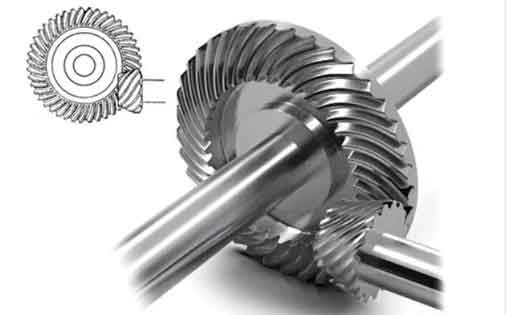
1.2 Transient Contact Analysis
The ANSYS transient analysis reveals distinct stress patterns:
$$ \sigma_{max} = \frac{3F}{2\pi ab} $$
where \( \sigma_{max} \) = maximum contact stress, \( F \) = normal load, \( a \) and \( b \) = semi-axes of contact ellipse.
| Speed (rpm) | Primary Surface Stress (MPa) | Secondary Surface Stress (MPa) |
|---|---|---|
| 200 | 2,800-3,200 | 1,800-2,200 |
| 400 | 4,500-5,000 | 2,500-3,000 |
| 600 | 6,800-7,500 | 3,800-4,500 |
2. Elastohydrodynamic Lubrication Modeling
2.1 Oil Film Thickness Equations
The Zheng Xuyun equations for minimum and central film thickness:
$$ h_{min} = R_x\left(12c\frac{\eta_0\alpha U}{R_x}\right)^{\frac{\pi}{2}}\left(\frac{P}{E_0}\right)^{\frac{1-2n}{2-n}} $$
$$ h_c = 2.69(1-0.61e^{-0.73k})\alpha^{0.53}(\eta_0 u)^{0.67}R^{0.464}E_0^{-0.043}P^{-0.067} $$
Lubricant properties:
| Viscosity (Pa·s) | Density (kg/m³) | Pressure Coefficient (1/Pa) |
|---|---|---|
| 0.0135 | 895 | 1.4409×10⁻⁸ |
2.2 Film Thickness Variation
Numerical results demonstrate significant speed-load dependencies:
| Condition | 200 rpm | 400 rpm | 600 rpm |
|---|---|---|---|
| 50 Nm (hmin×10⁻⁷ m) | 5.5-6.2 | 4.8-5.3 | 3.9-4.4 |
| 200 Nm (hmin×10⁻⁷ m) | 3.2-3.8 | 2.9-3.3 | 2.4-2.8 |
3. Lubrication State Evaluation
The dimensionless film thickness ratio determines lubrication regimes:
$$ \lambda = \frac{h}{\sqrt{Ra_1^2 + Ra_2^2}} $$
| λ Range | Lubrication Regime |
|---|---|
| λ > 3 | Full-film EHL |
| 1 ≤ λ ≤ 3 | Mixed Lubrication |
| λ < 1 | Boundary Lubrication |
For spiral bevel gears with Ra = 0.4-0.6 μm:
$$ \sigma’ = \sqrt{(1.25Ra_1)^2 + (1.25Ra_2)^2} = 0.707-1.06\ \mu m $$
Calculated λ values (600 rpm):
| Load (Nm) | Min λ | Max λ |
|---|---|---|
| 50 | 2.16 | 2.91 |
| 200 | 1.89 | 2.54 |
4. Conclusion
The spiral bevel gear system exhibits mixed lubrication characteristics under typical operating conditions. Higher rotational speeds significantly reduce oil film thickness, while increased loads amplify this effect through nonlinear stress-film thickness relationships. These findings emphasize the need for optimized lubrication strategies in spiral bevel gear applications subjected to variable speed-load conditions.