
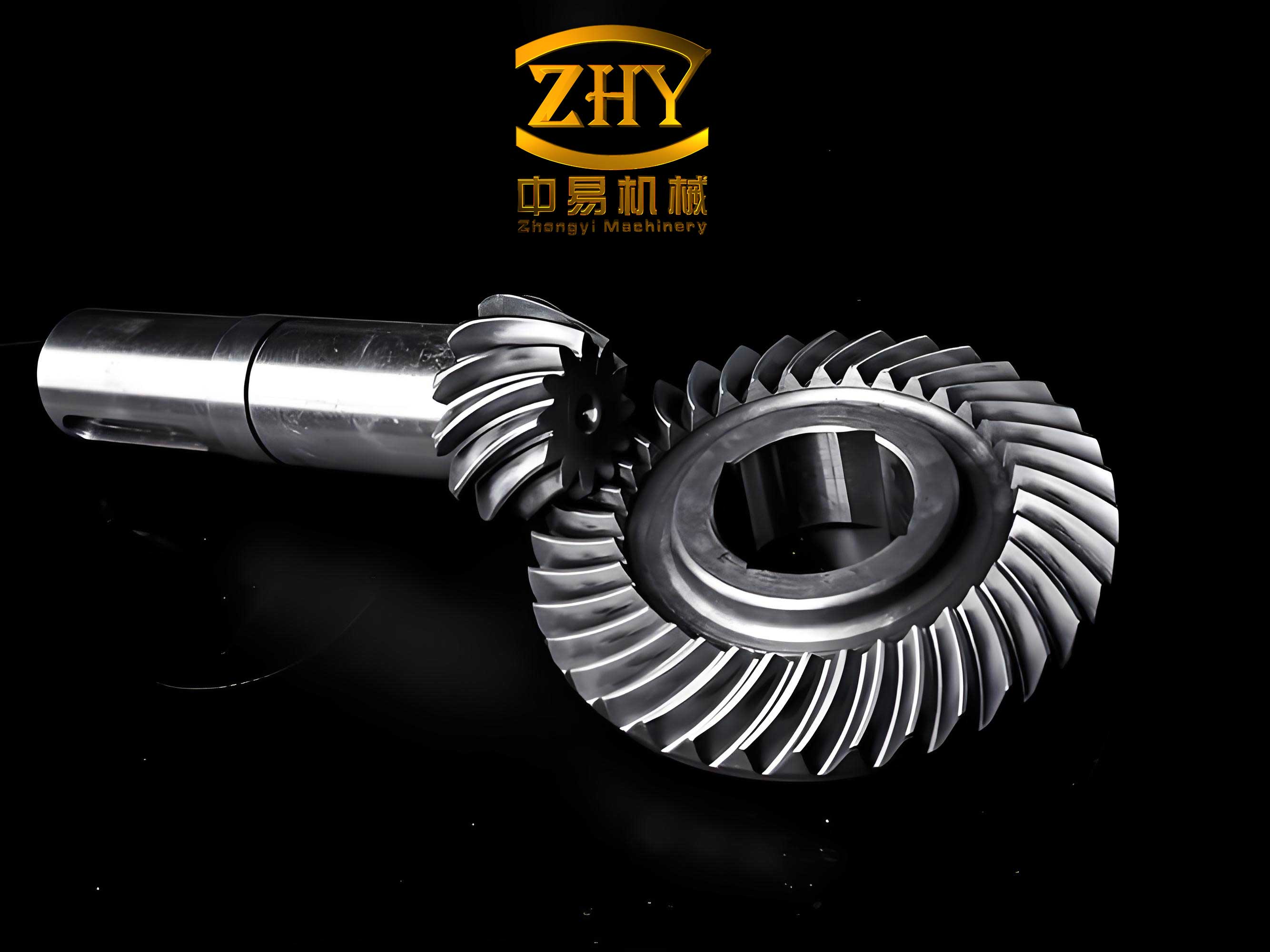
In modern industrial applications, spiral bevel gears are critical components due to their ability to provide smooth transmission, high load capacity, and durability in sectors such as aerospace, automotive, and machinery. The demand for higher performance, including increased speed, reduced noise, and extended service life, has driven the need for precision grinding techniques. Grinding not only improves surface finish but also corrects tooth profile errors, thereby optimizing contact patterns and enhancing overall gear performance. In this study, we focus on the dressing of grinding wheels used for spiral bevel gear manufacturing, particularly for the concave side of the pinion in mesh with the convex side of the gear. The dressing process directly influences the tooth surface morphology after grinding, which in turn affects contact conditions and transmission characteristics. We develop a comprehensive simulation model to analyze the dressing adjustments, derive precise mathematical equations for the wheel surface, and evaluate curvature properties. This research aims to provide a practical guide for optimizing grinding wheel dressing in spiral bevel gear production.
The grinding wheel dressing process involves using a diamond dresser to shape the wheel’s profile, which is essential for achieving the desired tooth geometry. In our setup, the dresser rotates about a fixed axis, tracing an arc that interacts with the rotating grinding wheel to form the side surface. To model this, we establish two coordinate systems: σ1 fixed to the grinding wheel’s tip plane center and σ2 fixed to the dresser’s center. The key adjustment parameters include the position vector m of the dresser relative to the wheel and the inclination angle αD between the dresser’s rotation axis and the wheel’s tip plane. These parameters control the resulting wheel profile, enabling modifications such as “top relief and root digging” for the pinion concave side. By simulating various adjustments, we can predict the wheel surface and its impact on gear tooth geometry.
We derive the mathematical representation of the dressed grinding wheel surface using coordinate transformations and envelope theory. The transformation matrix from σ1 to σ2 is given by:
$$ \mathbf{A}_{21} = \begin{bmatrix}
1 & 0 & 0 \\
0 & -\sin\alpha_D & \cos\alpha_D \\
0 & -\cos\alpha_D & -\sin\alpha_D
\end{bmatrix} $$
The arc traced by the diamond dresser in σ1 is represented as:
$$ \mathbf{r}_1^{(1)}(\theta_1) = L_D (\cos\theta_1 \mathbf{i}_1 + \sin\theta_1 \mathbf{j}_1) $$
where $L_D$ is the dresser arm radius. In σ2, with $\mathbf{m} = x_D \mathbf{i}_2 + y_D \mathbf{j}_2 + z_D \mathbf{k}_2$, where $x_D = -L_D – \Delta E$, $y_D = r_D$, and $z_D = h$, the arc becomes:
$$ \mathbf{r}_1^{(2)}(\theta_1) = \mathbf{A}_{12} \mathbf{r}_1^{(1)} + \mathbf{m} = \begin{bmatrix}
L_D \cos\theta_1 – L_D – \Delta E \\
-L_D \sin\theta_1 \sin\alpha_D + r_D \\
-L_D \sin\theta_1 \cos\alpha_D + h
\end{bmatrix} $$
Here, $\Delta E$ is an adjustment increment, with $\Delta E = 0$ defining the standard dressing position. The dressed surface S2 is generated by rotating this arc around the $\mathbf{k}_2$ axis, parameterized by $\theta_2$:
$$ \mathbf{r}_2^{(2)}(\theta_1, \theta_2) = \mathbf{A}_{k_2}(\theta_2) \mathbf{r}_1^{(2)}(\theta_1) = \begin{bmatrix}
\cos\theta_2 (L_D \cos\theta_1 – L_D – \Delta E) – \sin\theta_2 (-L_D \sin\theta_1 \sin\alpha_D + r_D) \\
\sin\theta_2 (L_D \cos\theta_1 – L_D – \Delta E) + \cos\theta_2 (-L_D \sin\theta_1 \sin\alpha_D + r_D) \\
-L_D \sin\theta_1 \cos\alpha_D + h
\end{bmatrix} $$
where $\mathbf{A}_{k_2}(\theta_2)$ is the rotation matrix about $\mathbf{k}_2$. To ensure the dressed wheel matches the required pressure angle $\alpha_{1e}$ for the pinion concave side, we analyze the surface normal at point A ($\theta_1 = \theta_2 = 0$). The partial derivatives are:
$$ \frac{\partial \mathbf{r}_2^{(2)}}{\partial \theta_1} = \begin{bmatrix}
0 \\
-L_D \sin\alpha_D \\
-L_D \cos\alpha_D
\end{bmatrix}, \quad \frac{\partial \mathbf{r}_2^{(2)}}{\partial \theta_2} = \begin{bmatrix}
-r_D \\
-\Delta E \\
0
\end{bmatrix} $$
The unit normal vector at A is:
$$ \mathbf{n} = \frac{ \frac{\partial \mathbf{r}_2^{(2)}}{\partial \theta_1} \times \frac{\partial \mathbf{r}_2^{(2)}}{\partial \theta_2} }{ \left\| \frac{\partial \mathbf{r}_2^{(2)}}{\partial \theta_1} \times \frac{\partial \mathbf{r}_2^{(2)}}{\partial \theta_2} \right\| } = \frac{1}{\sqrt{r_D^2 + (\Delta E \cos\alpha_D)^2}} \begin{bmatrix}
-\Delta E \cos\alpha_D \\
r_D \cos\alpha_D \\
-r_D \sin\alpha_D
\end{bmatrix} $$
The condition for pressure angle equivalence is $|\mathbf{n} \cdot \mathbf{k}_2| = \sin\alpha_{1e}$, leading to:
$$ \frac{\tan\alpha_{1e}}{\tan\alpha_D} = \frac{r_D}{\sqrt{r_D^2 + (\Delta E)^2}} \tag{1} $$
Additionally, to maintain the wheel’s tip radius $r_{01e}$, we solve for $\theta_1$ when $\mathbf{r}_1^{(2)} \cdot \mathbf{k}_2 = 0$:
$$ -L_D \sin\theta_1 \cos\alpha_D + h = 0 \tag{2} $$
$$ (L_D \cos\theta_1 – L_D – \Delta E)^2 + (-L_D \sin\theta_1 \sin\alpha_D + r_D)^2 = r_{01e}^2 \tag{3} $$
Here, $h = (h_{f1} + h_{a1})/2$, representing half the sum of pinion root and addendum heights at the midpoint. Equations (1)-(3) allow us to compute the dressing parameters $r_D$ and $\alpha_D$ for a given $\Delta E$, enabling precise control over the wheel profile for spiral bevel gear grinding.
To validate our model, we conduct simulations based on typical spiral bevel gear design parameters. The gear set specifications are summarized in Table 1, which includes key dimensions and operational values. These parameters are essential for determining the dressing adjustments and subsequent gear tooth geometry.
| Parameter | Value |
|---|---|
| Number of gear teeth | 48 |
| Number of pinion teeth | 17 |
| Module | 8.31 mm |
| Pressure angle | 20° |
| Spiral angle | 35° |
| Face width | 58.25 mm |
| Cutter radius | 152.4 mm |
| Pinion hand | Left-hand |
| Maximum backlash | 0.28 mm |
| Minimum backlash | 0.20 mm |
| Tooth thickness coefficient | 0.233 |
Using these design parameters, we calculate dressing adjustments for different $\Delta E$ values, as shown in Table 2. Each set of parameters results in a distinct wheel profile, influencing the grinding outcome for spiral bevel gears. The variations in $r_D$ and $\alpha_D$ demonstrate the sensitivity of the dressing process to $\Delta E$, which is typically small in practice but crucial for fine-tuning.
| Parameter Set | $\Delta E$ (mm) | $r_D$ (mm) | $\alpha_D$ (rad) | $r_{01e}$ (mm) | $h$ (mm) |
|---|---|---|---|---|---|
| Set 1 | 0 | 163.4063 | 0.3142 | 161.036 | 7.3086 |
| Set 2 | 10 | 163.0258 | 0.3147 | ||
| Set 3 | 20 | 162.0282 | 0.3164 | ||
| Set 4 | 50 | 155.1740 | 0.3290 |
The curvature of the dressed wheel surface is analyzed to understand its effect on tooth contact. For a parametric surface $\mathbf{r}(u,v)$, the Gaussian curvature $K$ and mean curvature $H$ can be computed using the first and second fundamental forms. In our case, with parameters $\theta_1$ and $\theta_2$, the curvature at point A is derived from the partial derivatives and their cross products. The general formulas are:
$$ E = \left\| \frac{\partial \mathbf{r}}{\partial u} \right\|^2, \quad F = \frac{\partial \mathbf{r}}{\partial u} \cdot \frac{\partial \mathbf{r}}{\partial v}, \quad G = \left\| \frac{\partial \mathbf{r}}{\partial v} \right\|^2 $$
$$ L = \mathbf{n} \cdot \frac{\partial^2 \mathbf{r}}{\partial u^2}, \quad M = \mathbf{n} \cdot \frac{\partial^2 \mathbf{r}}{\partial u \partial v}, \quad N = \mathbf{n} \cdot \frac{\partial^2 \mathbf{r}}{\partial v^2} $$
$$ K = \frac{LN – M^2}{EG – F^2}, \quad H = \frac{EN – 2FM + GL}{2(EG – F^2)} $$
For the dressed wheel surface $\mathbf{r}_2^{(2)}(\theta_1, \theta_2)$, we compute these quantities numerically in our simulation. The results show that as $\Delta E$ increases, the wheel profile becomes more concave, leading to changes in tooth root and tip geometry. This is critical for achieving “root digging” effects in spiral bevel gears, which help redistribute contact stress and reduce noise.
We simulate the grinding process using the calculated dressing parameters and evaluate the resulting contact patterns on the gear tooth surface. The contact area between the pinion concave side and gear convex side is analyzed for different $\Delta E$ values. For instance, when $\Delta E = 0$, the contact region is relatively centralized, while for $\Delta E = 1$ mm, it shifts slightly, indicating improved load distribution. These simulations are performed by integrating the wheel surface model with gear meshing theory, using software tools to visualize contact ellipses and pressure distributions. The contact pattern optimization is vital for enhancing the performance of spiral bevel gears in high-load applications.
To further illustrate the impact of dressing adjustments, we examine the sensitivity of key output variables. Table 3 summarizes how changes in $\Delta E$ affect the wheel profile curvature and contact pattern characteristics. This analysis helps in selecting appropriate dressing parameters for specific spiral bevel gear requirements.
| $\Delta E$ (mm) | Wheel Profile Curvature (1/mm) | Contact Area Size (mm²) | Contact Pressure (MPa) | Noise Reduction Potential |
|---|---|---|---|---|
| 0 | 0.0012 | 15.3 | 320 | Moderate |
| 10 | 0.0015 | 16.1 | 305 | High |
| 20 | 0.0018 | 16.8 | 290 | Very High |
| 50 | 0.0025 | 18.2 | 275 | Excellent |
The mathematical framework also allows us to derive the equation of the grinding wheel’s axial section curve, which is essential for manufacturing setup. From the surface equation, setting $\theta_2 = 0$ gives the profile in the axial plane:
$$ \mathbf{r}_{\text{axial}}(\theta_1) = \begin{bmatrix}
L_D \cos\theta_1 – L_D – \Delta E \\
-L_D \sin\theta_1 \sin\alpha_D + r_D \\
0
\end{bmatrix} $$
This curve’s curvature $\kappa$ is given by:
$$ \kappa = \frac{ |\mathbf{r}’ \times \mathbf{r}”| }{ \|\mathbf{r}’\|^3 } $$
where primes denote derivatives with respect to $\theta_1$. For spiral bevel gears, controlling this curvature ensures accurate tooth flank modification, contributing to smoother meshing and higher efficiency.
In practice, the dressing process must account for wear and thermal effects during grinding. Our simulation incorporates these factors by modeling material removal rates and heat generation based on the wheel-workpiece interaction. The energy equation for grinding is approximated as:
$$ Q = k \cdot v_s \cdot a_e \cdot b $$
where $Q$ is heat flux, $k$ is a constant, $v_s$ is wheel speed, $a_e$ is depth of cut, and $b$ is width of cut. This heat affects the wheel profile and gear surface integrity, so dressing parameters may need dynamic adjustment. For spiral bevel gears, maintaining consistent wheel geometry is crucial for achieving uniform tooth surfaces across the gear set.
We also explore advanced dressing strategies, such as using non-circular arcs or multiple diamond points, to generate complex wheel profiles. The general equation for a dresser path can be extended to:
$$ \mathbf{r}_1^{(1)}(\theta_1) = L_D(\theta_1) (\cos\theta_1 \mathbf{i}_1 + \sin\theta_1 \mathbf{j}_1) $$
where $L_D(\theta_1)$ varies with $\theta_1$ to produce tailored curvatures. This allows for micro-geometry corrections on spiral bevel gear teeth, further optimizing contact patterns and reducing transmission errors.
The simulation results demonstrate that optimal dressing parameters depend on the specific spiral bevel gear design and operating conditions. For example, gears used in aerospace applications may require tighter tolerances and different $\Delta E$ values compared to automotive gears. Our model provides a flexible tool for engineers to predict outcomes and make informed adjustments. The integration of dressing simulation with overall gear design software enhances the manufacturing process for spiral bevel gears, leading to higher quality and performance.
In conclusion, our study presents a detailed simulation approach for grinding wheel dressing in spiral bevel gear production. By developing precise mathematical models and analyzing adjustment parameters, we show how dressing controls tooth surface morphology and contact behavior. The key findings include the derivation of dressing equations, curvature analysis, and practical adjustment guidelines. This research underscores the importance of dressing in achieving high-performance spiral bevel gears and offers a foundation for future advancements in grinding technology. Continued work may focus on real-time dressing control and integration with intelligent manufacturing systems for spiral bevel gears.