
The accurate three-dimensional solid modeling of spiral bevel gears is a cornerstone for advanced computer-aided engineering (CAE) tasks such as loaded tooth contact analysis (LTCA), contact pattern prediction, and finite element analysis (FEA) for strength evaluation. The geometric fidelity of the digital model directly influences the reliability of these simulations. A primary challenge in this process is the precise mathematical representation of the complex tooth surfaces, which are generated via a relative enveloping motion between a imaginary generating gear (represented by a cutter head) and the gear blank. This paper presents a comprehensive methodology for the solid modeling of spiral bevel gears, explicitly considering the critical influence of the cutter tip fillet and the phenomenon of tooth undercutting. The proposed method is based on a discrete point solution derived from the gear’s mathematical model, ensuring generality and accuracy for both undercut and non-undercut tooth topologies.
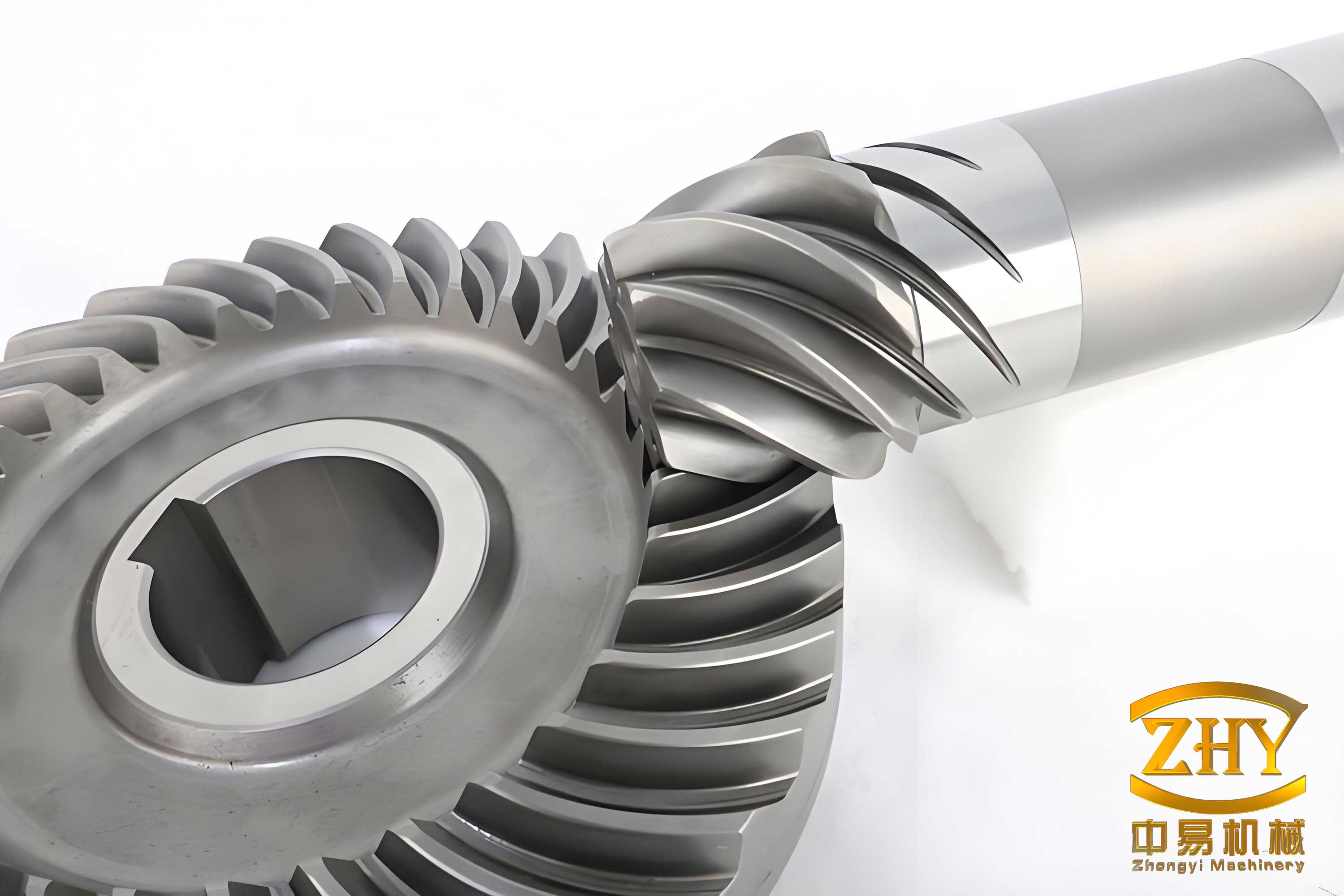
Spiral bevel gears are essential components in power transmission systems requiring non-parallel, intersecting shafts, such as those found in automotive differentials, aerospace applications, and heavy machinery. Their curved teeth allow for smoother engagement, higher load capacity, and reduced noise compared to straight bevel gears. The manufacturing process, often using methods like face-milling (e.g., Gleason) or face-hobbing, involves complex machine tool settings and cutter geometry. The final tooth form is not a simple surface but a composite consisting of the active flank surface, a root fillet transition surface, and the bottom land. Neglecting the cutter tip radius leads to an idealized sharp root, which does not reflect the physical gear and can cause significant errors in stress concentration predictions. Furthermore, under certain design conditions, the generating process can cause undercutting, where part of the active flank near the root is removed, altering the intended contact pattern and potentially weakening the tooth. Therefore, a robust modeling algorithm must automatically detect and correctly represent these geometric features.
Mathematical Model of the Tooth Surfaces
The foundation of any precise modeling technique is a rigorous mathematical description of the tooth surfaces. For a spiral bevel gear, these surfaces are defined by the conjugate action between the cutting tool (cutter head) and the rotating gear blank. We establish coordinate systems for both the cutter and the gear blank, and use vector algebra and the theory of gearing to derive the equations.
Coordinate Systems and Tool Geometry
Two primary coordinate systems are defined: a tool coordinate system \( S_t(X_t, Y_t, Z_t) \) attached to the cutter head, and a gear coordinate system \( S_g(X_g, Y_g, Z_g) \) attached to the gear blank. The gear coordinate system is typically defined with its origin \( O_g \) at the intersection of the gear axis and the perpendicular to the mating gear’s axis. The \( Z_g \)-axis coincides with the gear axis, pointing from the toe to the heel. The \( X_g \)-axis lies in the plane defined by the \( Z_g \)-axis and the machine tool setting point, and the \( Y_g \)-axis completes the right-handed system.
The cutting blade profile for machining the gear (e.g., for the gear member in a pair) generally consists of three distinct segments:
- Straight Cutting Edge (Flank): A straight line segment responsible for generating the active, conjugate tooth flank.
- Tip Fillet Arc: A circular arc of radius \( \rho_f \) that generates the trochoidal root fillet transition surface.
- Top Land: A straight or flat segment that generates the bottom land of the tooth space.
The geometry of a typical blade is characterized by parameters such as pressure angle \( \alpha \), blade edge radius \( \rho_f \), and point widths.
Equation of the Meshing Flank Surface
The surface generated by the straight edge of the cutter blade is the meshing flank. Let \( \mathbf{r}_t^{(1)}(u, \theta) \) be the position vector of a point on the straight blade in the tool coordinate system \( S_t \), where \( u \) is a parameter along the blade edge and \( \theta \) is the rotational angle of the cutter head. Through the kinematic relationship between the rotating cutter and the indexing gear blank, we can transform this vector to the gear coordinate system \( S_g \).
The necessary condition for the point to be on the generated tooth surface is the equation of meshing, which states that the common normal vector at the contact point must be perpendicular to the relative velocity vector between the tool and the workpiece. This condition can be expressed as:
$$ \mathbf{n} \cdot \mathbf{v}^{(12)} = 0 $$
where \( \mathbf{n} \) is the unit normal vector to the tool surface at the contact point, and \( \mathbf{v}^{(12)} \) is the relative velocity. This equation allows us to solve for one parameter (e.g., \( u \)) as a function of \( \theta \) and another independent parameter, say \( q \), representing the rolling motion (or cradle angle).
Thus, the meshing flank surface \( \Sigma_1 \) in \( S_g \) is defined by a vector function and the meshing condition:
$$ \mathbf{r}_g^{(1)} = \mathbf{r}_g^{(1)}(q, \theta, u(q, \theta)) = \begin{bmatrix} x_1(q, \theta) \\ y_1(q, \theta) \\ z_1(q, \theta) \end{bmatrix} $$
where:
$$ x_1 = f_{x1}(q, \theta),\quad y_1 = f_{y1}(q, \theta),\quad z_1 = f_{z1}(q, \theta) $$
Equation of the Root Fillet Transition Surface
The surface generated by the circular tip fillet of the cutter is the root fillet. Let \( \mathbf{r}_t^{(2)}(s, \phi) \) be the position vector of a point on the fillet arc in \( S_t \), where \( s \) is the arc length parameter from the start of the fillet and \( \phi \) is the cutter rotation angle (which may be related to \( \theta \) but is treated as an independent motion parameter for derivation). Applying the same coordinate transformation and meshing condition yields the equation for the fillet surface \( \Sigma_2 \):
$$ \mathbf{r}_g^{(2)} = \mathbf{r}_g^{(2)}(\phi, \psi, s(\phi, \psi)) = \begin{bmatrix} x_2(\phi, \psi) \\ y_2(\phi, \psi) \\ z_2(\phi, \psi) \end{bmatrix} $$
where \( \psi \) is a parameter related to the gear blank’s rotational position during the fillet generation phase. In practice, for face-milled gears, this surface is a trochoid.
Discrete Point Solution Strategy for Robust Modeling
Directly using the parametric equations for solid modeling in CAD software can be challenging due to their implicit nature and complex boundaries. A more robust and universally applicable approach is to calculate a dense cloud of discrete points that lie precisely on the mathematical surfaces and then use these points to construct B-spline curves and surfaces within the CAD environment.
Axis Section Planning and Point Cloud Generation
The core idea is to plan the discrete points systematically in an axial cross-section of the gear and then “project” them onto the 3D tooth surface via the mathematical model. An axis section is a plane containing the gear axis. A point in this section is defined by its radial distance \( R’ \) and axial distance \( Z’ \).
We define the boundaries of the tooth space in this axial section using the gear blank design parameters: the face cone (outside), the root cone, and the toe and heel boundaries (often extended slightly for trimming). Along the face cone and root cone lines, we distribute \( N_c \) equally spaced points, creating \( N_c \) radial “axis-section lines” connecting corresponding points on the face and root cones.
Any point on the \( i \)-th axis-section line can be represented by a proportional variable \( \lambda \in [0, 1] \):
$$ R’_i(\lambda) = R’_{a,i} + (R’_{f,i} – R’_{a,i}) \cdot \lambda $$
$$ Z’_i(\lambda) = Z’_{a,i} + (Z’_{f,i} – Z’_{a,i}) \cdot \lambda $$
where subscripts \( a \) and \( f \) denote points on the face cone and root cone boundaries, respectively.
Numerical Algorithm for Point Calculation and Undercut Detection
For a given target point \( (R’_i, Z’_i) \) on the axis-section line, finding the corresponding 3D point \( (x, y, z) \) on the actual tooth surface (either flank or fillet) becomes a constrained optimization problem. The goal is to find the tool and motion parameters \( (q, \theta) \) or \( (\phi, \psi) \) such that the projected radial distance and axial coordinate of the calculated surface point match the target values.
For the meshing flank surface \( \Sigma_1 \):
$$ \text{Minimize: } F_1 = | \sqrt{x_1^2 + y_1^2} – R’ | + | z_1 – Z’ | $$
$$ \text{Subject to: } 0 < u(q, \theta) < u_{\text{max}} $$
For the root fillet surface \( \Sigma_2 \):
$$ \text{Minimize: } F_2 = | \sqrt{x_2^2 + y_2^2} – R’ | + | z_2 – Z’ | $$
$$ \text{Subject to: } 0 < s(\phi, \psi) < s_{\text{max}} $$
Algorithms like the Particle Swarm Optimization (PSO) method are effective for solving these problems, providing the 3D coordinates \( (x, y, z) \) and the corresponding tool parameter \( u \) or \( s \).
The critical step is determining where on each axis-section line the flank surface ends and the fillet surface begins. This boundary point is where the straight blade edge meets the tip fillet arc on the cutter. Its location determines if undercutting occurs. We introduce an algorithm to find the proportional parameter \( \lambda_b \) for this boundary point on each line \( i \).
- Find Flank Lower Boundary \( \lambda_{f1,i} \): Find the maximum \( \lambda \) for which a valid point on the flank surface \( \Sigma_1 \) exists. This corresponds to the farthest point from the face cone that can be generated by the straight edge. Record the corresponding tool parameter \( u_{f1,i} \).
- Find Fillet Upper Boundary \( \lambda_{a2,i} \): Find the maximum \( \lambda \) for which a valid point on the fillet surface \( \Sigma_2 \) exists. This corresponds to the start of the fillet surface from the root side.
- Determine Undercut and True Boundary \( \lambda_{b,i} \):
- In the ideal, non-undercut case, the flank and fillet surfaces meet at a single point, so \( \lambda_{f1,i} \approx \lambda_{a2,i} \). We set \( \lambda_{b,i} = \lambda_{f1,i} \).
- If \( \lambda_{a2,i} > \lambda_{f1,i} + \epsilon \) (where \( \epsilon \) is a small tolerance, e.g., 0.001), undercutting has occurred. The fillet surface has “cut into” the flank. The true boundary is now the point where the fillet surface intersects the flank surface, which lies between \( \lambda_{f1,i} \) and \( \lambda_{a2,i} \). This point \( \lambda_{b,i} \) is found by solving:
$$ \text{Maximize: } G = | x_1 – x_2 | + | y_1 – y_2 | + | z_1 – z_2 | $$
$$ \text{Subject to: } \lambda_{f1,i} < \lambda < \lambda_{a2,i} \text{ and } u(q, \theta) > u_{f1,i} $$
The constraint \( u > u_{f1,i} \) ensures we find the intersection point (B) and not the end of the remaining flank (D). A golden-section search is suitable for this 1D optimization.
This algorithm robustly distinguishes the two topological scenarios for a spiral bevel gear tooth, as summarized below:
| Condition | Topology on Axis-Section Line | Boundary Determination |
|---|---|---|
| No Undercut | Flank surface (C-D) connects directly to Fillet surface (B-C). Point C is the natural boundary. | \( \lambda_{b,i} = \lambda_{f1,i} \) (≈ \( \lambda_{a2,i} \)) |
| Undercut Present | Fillet surface (A-B-C) cuts away part of the flank (B-D). Remaining flank is D-E. Point B is the new boundary. | \( \lambda_{b,i} \) found via intersection search between \( \lambda_{f1,i} \) and \( \lambda_{a2,i} \). |
Complete Point Cloud Generation Process
With the boundary \( \lambda_{b,i} \) determined for all \( N_c \) axis-section lines, the process for generating the complete point cloud is as follows:
- For each line \( i \), divide the interval \( [0, \lambda_{b,i}] \) and distribute \( N_{g1} \) discrete values of \( \lambda \). For each \( \lambda \), calculate \( (R’, Z’) \) and solve the optimization problem for the meshing flank surface \( \Sigma_1 \), adding the constraint \( u > u_{f1,i} \) if undercutting was detected on this line.
- For each line \( i \), divide the interval \( [\lambda_{b,i}, 1] \) and distribute \( N_{g2} \) discrete values of \( \lambda \). For each \( \lambda \), calculate \( (R’, Z’) \) and solve the optimization problem for the root fillet surface \( \Sigma_2 \).
- Collect all calculated 3D points \( (x, y, z) \). This results in two organized sets of points: one for the flank and one for the fillet.
The parameters \( N_c \), \( N_{g1} \), and \( N_{g2} \) control the density and accuracy of the final model.
Solid Model Construction and Validation Example
Modeling Workflow
The calculated discrete points serve as the foundation for building the solid model in a CAD system:
- Curve Fitting: For each axis-section line \( i \), fit a B-spline curve through the series of points belonging to the flank surface. Repeat for the points belonging to the fillet surface. This creates \( N_c \) flank curves and \( N_c \) fillet curves.
- Surface Generation: Use the “loft” or “blended surface” function to create a smooth B-spline surface through the set of flank curves. Repeat to create a separate surface through the fillet curves.
- Bottom Land: The bottom land is a simple conical surface (the root cone) and can be created directly from the gear blank dimensions.
- Solid Creation: Trim the gear blank solid (a conical frustum) using the combined tooth space surfaces (flank, fillet, and bottom land) to create one tooth gap. Pattern this tooth gap around the axis to complete the gear body.
Application to a Spiral Bevel Gear Pair
To demonstrate the methodology, we consider a spiral bevel gear pair designed for a right-angle drive. The basic design parameters are:
| Parameter | Value |
|---|---|
| Gear Ratio (Pinion/Gear) | 11 / 25 |
| Shaft Angle | 90° |
| Gear Pitch Diameter (Outer) | 225 mm |
| Offset | 40 mm |
| Face Width | 40 mm |
Using a dedicated calculation program that implements the proposed algorithms (e.g., in Python or MATLAB), the machine settings (root angles, cutter radius, machine center to back, sliding base, etc.) and tool geometry are computed. The key parameters for the gear member are summarized below:
| Machine Setting / Tool Parameter | Value |
|---|---|
| Cutter Radius | 114.3 mm |
| Blade Edge Radius (Fillet) | 1.8375 mm |
| Pressure Angle (Inner/Outer) | 18° / -24.5° |
| Radial Distance | 99.1452 mm |
| Cradle Angle | 59.5759° |
The algorithm was executed with \( N_c = 40 \), \( N_{g1} = 50 \), \( N_{g2} = 50 \). The computation confirmed that undercutting occurred on the concave side of the gear tooth near the toe region, while other flanks were free of undercut. The discrete points were calculated, and B-spline curves were successfully fitted.
Finite Element Analysis for Validation
To validate the geometric accuracy of the generated solid model of the spiral bevel gear, a static finite element analysis was performed. A sector of the gear pair (one gear tooth and one-and-a-half pinion teeth) was imported into FEA software (e.g., ABAQUS). A torque of 500 Nm was applied to the pinion while constraining the gear. The mesh was refined in the potential contact region.
The resulting stress contour plot on the tooth flanks showed a distinct elliptical area of high contact stress. The location, size, and orientation of this “contact ellipse” were in excellent agreement with the results predicted by traditional tooth contact analysis (TCA) software for the same nominal design position. This correlation confirms that the geometric model generated by the discrete-point method, which accounts for the cutter fillet and correctly handles undercutting, is sufficiently accurate for advanced engineering simulations. The precise shape of the root fillet also allows for realistic evaluation of bending stress concentrations.
Conclusion
This paper has presented a comprehensive and generalized methodology for the precise solid modeling of spiral bevel gears. The key contributions are:
- The formulation of a complete mathematical model for both the active meshing flank and the root fillet transition surfaces, explicitly incorporating the cutter tip geometry.
- The development of a robust numerical algorithm based on axis-section planning and discrete point calculation. This algorithm introduces a proportional variable \( \lambda \) and an optimization-based procedure to automatically detect and correctly model the boundary between the flank and fillet surfaces, including the topological change caused by undercutting.
- The demonstration of a complete workflow, from gear design parameters to a validated solid model, using finite element analysis to verify geometric fidelity through contact pattern correlation.
The proposed method is not dependent on any specific CAD kernel’s internal surface representations, making it highly portable and reliable. It provides a foundational digital twin of the spiral bevel gear that is essential for accurate loaded tooth contact analysis, stress calculation, and ultimately, the optimization of gear design and manufacturing processes.