
In modern mechanical transmission systems, particularly in high-speed and heavy-duty applications such as CRH5 electric multiple unit traction systems, the performance and reliability of gears are paramount. Among these, spiral bevel gears play a critical role due to their ability to transmit motion between intersecting shafts with high efficiency and smooth operation. However, the complex spatial geometry of spiral bevel gear tooth surfaces poses significant challenges in design and manufacturing. Traditional modeling approaches often yield approximations that do not accurately reflect the actual tooth surface, leading to potential issues in stress analysis, contact patterns, and overall gear performance. This article presents a detailed methodology for creating precise solid models of spiral bevel gears using Pro/ENGINEER (Pro/E), based on advanced design and computation techniques. The process involves calculating gear blank parameters via tooth root tilt modification, determining machine tool settings through local synthesis, generating tooth surface points using MATLAB, and ultimately constructing the 3D model in Pro/E. This approach ensures an accurate representation of the spiral bevel gear geometry, facilitating subsequent analyses such as finite element analysis (FEA) and dynamic simulation. Throughout this discussion, the term ‘spiral bevel gear’ will be emphasized to underscore its centrality in this work.
The foundation of accurate spiral bevel gear modeling lies in the proper design of the gear blank parameters. Unlike standard tapered designs, which can lead to disproportionate tooth contraction when processed via the duplex method, the tooth root tilt modification method is employed to correct angular errors and ensure optimal tooth geometry. This method adjusts the root angles to compensate for the reduction in the angle between tangents at the midpoints of the two tooth sides. The key steps involve determining the sum of the root angles and distributing them between the pinion and gear.
First, the theoretical sum of root angles to eliminate angular errors from duplex cutting is calculated as:
$$ \Delta \theta_D = \frac{\pi}{z_0 \tan \alpha_n \cos \beta} \left(1 – \frac{R \sin \beta}{r_0}\right) $$
where \( z_0 \) is the virtual number of teeth, \( \alpha_n \) is the normal pressure angle, \( \beta \) is the spiral angle at the midpoint, \( R \) is the cone distance at the midpoint, and \( r_0 \) is the cutter radius. However, practical constraints from Gleason guidelines limit the maximum root angle sum to:
$$ \Delta \theta_m = \begin{cases}
1.3 \Delta \theta_s, & \text{if } z_1 \geq 12 \\
(1.06 + 0.02 z_1) \Delta \theta_s, & \text{if } z_1 < 12
\end{cases} $$
with \( \Delta \theta_s \) being the sum under standard tapered design and \( z_1 \) the pinion tooth count. Thus, the actual sum used is:
$$ \Delta \theta_t = \min(\Delta \theta_D, \Delta \theta_m) $$
Next, the root angles are allocated between the pinion and gear based on the tooth depth proportion at the tilt point. The addendum heights are computed as:
$$ h_{a1} = h_{ae1} – \frac{b \tan \theta_{a1}}{2} $$
$$ h_{a2} = h_{ae2} – \frac{b \tan \theta_{a2}}{2} $$
where \( h_{ae1} \) and \( h_{ae2} \) are the addendum heights at the outer end, \( b \) is the face width, and \( \theta_{a1} \) and \( \theta_{a2} \) are the addendum angles. The root angles for the pinion (\( \theta’_{f1} \)) and gear (\( \theta’_{f2} \)) are then:
$$ \theta’_{f1} = \frac{h_{a2} \Delta \theta_t}{h_{a1} + h_{a2}} $$
$$ \theta’_{f2} = \frac{h_{a1} \Delta \theta_t}{h_{a1} + h_{a2}} $$
Using these formulas, the corrected gear blank parameters for a sample spiral bevel gear set are derived and summarized in Table 1 below. This table provides a comprehensive overview of the geometric dimensions essential for modeling the spiral bevel gear.
| Parameter | Symbol | Pinion (Active Gear) | Gear (Driven Gear) |
|---|---|---|---|
| Number of Teeth | \( z \) | 22 | 55 |
| Face Width | \( b \) (mm) | 82 | 82 |
| Transverse Module | \( m_t \) (mm) | 9.2 | 9.2 |
| Normal Pressure Angle | \( \alpha_n \) (°) | 20.0 | 20.0 |
| Midpoint Spiral Angle | \( \beta \) (°) | 30 | 30 |
| Pitch Diameter | \( d \) (mm) | 202.4 | 506.0 |
| Pitch Cone Angle | \( \delta \) (°) | 21.801 | 68.199 |
| Face Cone Angle | \( \delta_a \) (°) | 23.426 | 68.893 |
| Root Cone Angle | \( \delta_f \) (°) | 21.107 | 66.574 |
| Outer Cone Distance | \( R_e \) (mm) | 272.49 | 272.49 |
| Root Angle | \( \theta_f \) (°) | 0.694 | 1.624 |
| Addendum Angle | \( \theta_a \) (°) | 1.624 | 0.694 |
| Addendum Height | \( h_{ae} \) (mm) | 10.107 | 4.320 |
| Dedendum Height | \( h_{fe} \) (mm) | 6.049 | 11.836 |
| Whole Depth | \( h \) (mm) | 16.155 | 16.155 |
| Outer Tip Diameter | \( d_e \) (mm) | 221.167 | 509.208 |
| Cross Point to Crown | \( X_e \) (mm) | 249.247 | 97.189 |
| Midpoint Arc Thickness (Transverse) | \( s” \) (mm) | 15.058 | 9.207 |
With the gear blank parameters established, the next step involves calculating the machine tool settings required to cut the spiral bevel gear teeth accurately. This is achieved through the local synthesis method, which optimizes the contact pattern and transmission errors by controlling the tooth surface geometry. Local synthesis focuses on defining the machine settings at a specific point on the tooth surface, typically the midpoint, and then extrapolating to the entire surface. The flowchart in Figure 1 illustrates this iterative process, which balances gear geometry, cutter parameters, and machine kinematics to achieve desired performance characteristics.
The machine settings for both the pinion and gear are computed based on the local synthesis algorithm. For the gear (driven member), which is typically cut using a duplex method with a fixed setup, the cutter and machine adjustments are summarized in Table 2. These parameters include the cutter blade angles, cutter radius, and various machine axes positions that dictate the tool path relative to the gear blank.
| Parameter | Symbol | Gear (Concave Side) | Gear (Convex Side) |
|---|---|---|---|
| Cutter Point Width | \( W_2 \) (mm) | 6.35 | 6.35 |
| Cutter Blade Angle | \( \alpha_2 \) (°) | 22 | 18 |
| Cutter Tip Radius | \( r_0 \) (mm) | 152.4 | 152.4 |
| Machine Center to Back (Bed) | \( X_{B2} \) (mm) | 2.9458 | 2.9458 |
| Blank Installation Angle | \( \gamma_2 \) (°) | 66.5742 | 66.5742 |
| Vertical Work Offset | \( E_2 \) (mm) | 0.0000 | 0.0000 |
| Axial Work Offset | \( X_2 \) (mm) | 0.0000 | 0.0000 |
| Radial Cutter Position | \( S_2 \) (mm) | 203.7982 | 203.7982 |
| Angular Cutter Position | \( q_2 \) (mm) | 40.3593 | 40.3593 |
| Cutting Ratio (Roll) | \( i_c \) | 1.0766 | 1.0766 |
The pinion, being the active spiral bevel gear, is typically cut using a generating process with continuous indexing, and its machine settings are derived similarly but with adjustments for differential roll and modified kinematics to account for its smaller size and different tooth geometry. The local synthesis method ensures that the conjugate action between the pinion and gear is optimized, minimizing transmission errors and improving load distribution across the tooth surface of the spiral bevel gear.
Once the machine settings are determined, the mathematical model of the tooth surface can be established. The tooth surface of a spiral bevel gear is a complex spatial surface derived from the envelope of the cutter surface relative to the gear blank during the cutting process. The general equation for the tooth surface in the gear coordinate system can be expressed through a series of coordinate transformations involving the cutter geometry and machine motions. For a given cutter with blade profile defined by parameters \( u \) and \( \theta \), the position vector in the cutter coordinate system is \( \mathbf{r}_c(u, \theta) \). Through transformation matrices accounting for radial setting \( S \), angular setting \( q \), machine root angle \( \gamma \), and roll angle \( \phi \), the position vector in the gear coordinate system becomes:
$$ \mathbf{r}_g(u, \theta, \phi) = \mathbf{M}_{gc}(\phi) \cdot \mathbf{r}_c(u, \theta) $$
where \( \mathbf{M}_{gc}(\phi) \) is the homogeneous transformation matrix from cutter to gear. The equation of meshing between the cutter and gear blank is given by:
$$ f(u, \theta, \phi) = \mathbf{n}_c \cdot \mathbf{v}_c^{(gc)} = 0 $$
with \( \mathbf{n}_c \) being the normal vector to the cutter surface and \( \mathbf{v}_c^{(gc)} \) the relative velocity. Solving these equations simultaneously yields the tooth surface coordinates as functions of parameters \( u \) and \( \phi \).
To discretize the tooth surface, MATLAB is employed to solve these equations numerically. A program is written to iterate over a grid of points defined by the boundaries of the projected rotating plane. For each point, the parameters are solved, and if they fall outside the tooth boundaries, the loop breaks. The core MATLAB code structure involves nested loops and surface plotting functions. For instance, to compute and plot the convex side of the gear tooth, the code may include:
% Initialize arrays for point coordinates
pt3 = zeros(a1, b1, 3);
for i = 1:a1
    % Solve for surface points using tooth surface equations
    pt3q = computeToothSurface(params, i); % Custom function
    pt3(i, :, 1) = pt3q(:, 1, i)';
    pt3(i, :, 2) = pt3q(:, 2, i)';
    pt3(i, :, 3) = pt3q(:, 3, i)';
end
% Plot the surface mesh
surf(pt3(:, :, 1), pt3(:, :, 2), pt3(:, :, 3));
xlabel('X'); ylabel('Y'); zlabel('Z');
title('Mesh Grid of Spiral Bevel Gear Tooth Surface (Convex Side)');
The computeToothSurface function implements the tooth surface equations based on the local synthesis parameters. The resulting point cloud represents the precise geometry of the spiral bevel gear tooth. This mesh grid, as visualized in MATLAB, provides a preliminary check on the surface integrity before transferring to CAD software. The accuracy of this step is crucial for ensuring the fidelity of the final spiral bevel gear model.
With the discrete point coordinates generated, the next phase involves importing them into Pro/E to construct the solid model. The points are saved in a specific format recognizable by Pro/E, typically as an IBL (IBL file) format. This file contains sections and curves defined by point coordinates. An example snippet of the IBL file for the spiral bevel gear tooth surface is:
open
arclength
begin section ! 1
begin curve
1 67.5924 -5.6895 -178.0361
2 73.4988 1.1164 -193.4246
3 79.4052 10.3871 -208.4700
4 85.3115 22.3366 -222.9131
...
begin section ! 2
begin curve
1 75.5414 -12.1377 -174.5259
...
In Pro/E, this file is imported via the ‘Curve from File’ command under the ‘Datums’ menu. This action creates a network of curves that approximate the tooth surface. Then, using the ‘Boundary Blend’ feature, these curves are used as boundaries to generate a smooth surface patch. Repeating this process for both concave and convex sides yields the complete tooth surface. Additional features such as the back cone, front cone, face cone, and root cone surfaces are created using Pro/E’s sketching and extrusion tools to form the gear blank body. The tooth surfaces are then merged with this body to produce a solid spiral bevel gear model.
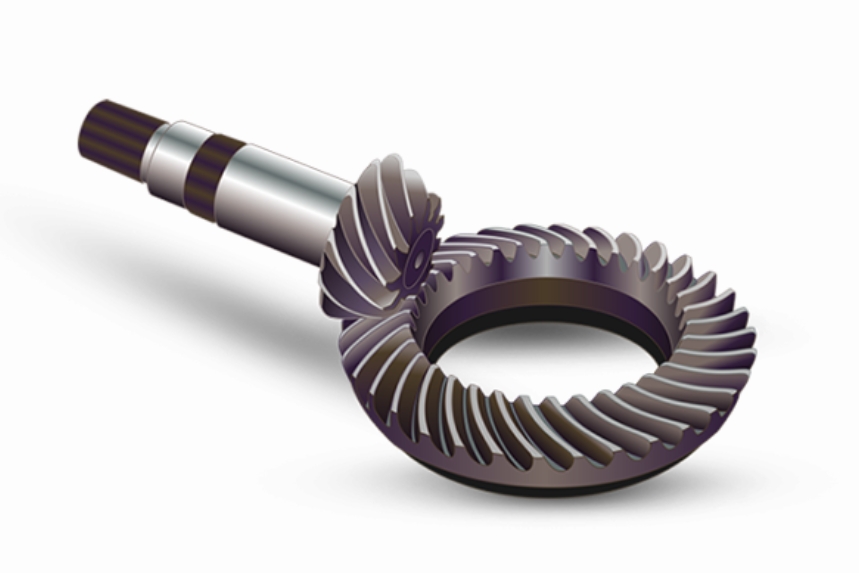
The modeling process for the pinion spiral bevel gear follows a similar trajectory but accounts for its left-hand spiral orientation and different tooth geometry derived from the generating process. Once both gear and pinion models are created, they can be assembled in Pro/E to check for proper meshing and interference. The assembly module allows for defining gear pairs with appropriate constraints, such as aligning axes and setting gear ratios. A motion analysis can be performed to simulate rotation and verify contact patterns, ensuring the design meets functional requirements. This virtual prototyping step is invaluable for identifying potential issues before physical manufacturing, saving time and costs in the development of spiral bevel gear systems.
To further elaborate on the mathematical underpinnings, the tooth surface equation can be detailed using differential geometry. The curvature and torsion of the spiral bevel gear tooth surface influence contact stresses and lubrication. The principal curvatures \( \kappa_1 \) and \( \kappa_2 \) at a point on the surface can be derived from the first and second fundamental forms. For a surface parametrized by \( \mathbf{r}(u, v) \), the Gaussian curvature \( K \) and mean curvature \( H \) are:
$$ K = \frac{LN – M^2}{EG – F^2} $$
$$ H = \frac{EN – 2FM + GL}{2(EG – F^2)} $$
where \( E, F, G \) are coefficients of the first fundamental form, and \( L, M, N \) are coefficients of the second fundamental form. These curvatures are critical in contact mechanics analysis for the spiral bevel gear, as they affect the Hertzian contact stress and fatigue life.
Additionally, the transmission error (TE) of the spiral bevel gear pair, defined as the deviation from ideal motion transfer, can be approximated using the tooth surface geometry. TE is a key indicator of noise and vibration performance. It can be computed as:
$$ TE(\phi) = \phi_{\text{output}} – \frac{z_1}{z_2} \phi_{\text{input}} $$
where \( \phi_{\text{input}} \) and \( \phi_{\text{output}} \) are the rotational angles of the pinion and gear, respectively. Minimizing TE through optimal tooth surface modification is a goal of the local synthesis method, highlighting the importance of precise modeling for high-performance spiral bevel gears.
In terms of manufacturing implications, the machine settings derived from local synthesis directly impact the cutting process. For instance, the ratio of roll \( i_c \) controls the speed of the generating motion, influencing tooth flank topography. The radial cutter position \( S \) and angular cutter position \( q \) determine the tool orientation relative to the gear blank, affecting tooth depth and spiral angle. These parameters must be meticulously calculated to ensure the produced spiral bevel gear matches the designed geometry. Advanced manufacturing techniques like CNC gear cutting machines utilize these settings to achieve high accuracy, underscoring the synergy between design and production in spiral bevel gear technology.
Moreover, the use of MATLAB for point generation allows for flexibility in modeling different tooth modifications, such as tip relief or crowning, which are often applied to spiral bevel gears to enhance performance under load. By adjusting the tooth surface equations, these modifications can be incorporated into the point cloud before importing to Pro/E. This capability enables designers to explore various optimization strategies for the spiral bevel gear without physical prototyping.
In conclusion, the methodology presented herein provides a robust framework for creating accurate solid models of spiral bevel gears using Pro/E. By integrating tooth root tilt modification for gear blank design, local synthesis for machine setting calculation, MATLAB for tooth surface point generation, and Pro/E for 3D modeling, this approach ensures a high-fidelity representation of the complex spiral bevel gear geometry. Such models are indispensable for subsequent engineering analyses, including finite element analysis for stress evaluation, dynamic simulation for vibration assessment, and manufacturing planning for toolpath generation. The emphasis on the term ‘spiral bevel gear’ throughout this discussion highlights its significance in modern mechanical systems, where precision and reliability are paramount. As industries continue to demand higher performance from gear transmissions, advanced modeling techniques like these will play a crucial role in the development of next-generation spiral bevel gear systems.
To summarize the key formulas and parameters in a consolidated manner, Table 3 presents the essential mathematical expressions used in the spiral bevel gear modeling process. This table serves as a quick reference for engineers and researchers working on similar projects.
| Description | Formula | Variables Explanation |
|---|---|---|
| Root Angle Sum (Theoretical) | \( \Delta \theta_D = \frac{\pi}{z_0 \tan \alpha_n \cos \beta} \left(1 – \frac{R \sin \beta}{r_0}\right) \) | \( z_0 \): virtual teeth, \( \alpha_n \): normal pressure angle, \( \beta \): spiral angle, \( R \): cone distance, \( r_0 \): cutter radius |
| Root Angle Sum (Practical Limit) | \( \Delta \theta_m = \begin{cases} 1.3 \Delta \theta_s, & z_1 \geq 12 \\ (1.06 + 0.02 z_1) \Delta \theta_s, & z_1 < 12 \end{cases} \) | \( \Delta \theta_s \): standard sum, \( z_1 \): pinion teeth |
| Addendum Height | \( h_{a1} = h_{ae1} – \frac{b \tan \theta_{a1}}{2} \) | \( h_{ae1} \): outer addendum, \( b \): face width, \( \theta_{a1} \): addendum angle |
| Root Angle Distribution | \( \theta’_{f1} = \frac{h_{a2} \Delta \theta_t}{h_{a1} + h_{a2}} \) | \( h_{a1}, h_{a2} \): addendum heights, \( \Delta \theta_t \): actual root angle sum |
| Tooth Surface Transformation | \( \mathbf{r}_g(u, \theta, \phi) = \mathbf{M}_{gc}(\phi) \cdot \mathbf{r}_c(u, \theta) \) | \( \mathbf{M}_{gc} \): transformation matrix, \( \phi \): roll angle, \( u, \theta \): cutter parameters |
| Equation of Meshing | \( f(u, \theta, \phi) = \mathbf{n}_c \cdot \mathbf{v}_c^{(gc)} = 0 \) | \( \mathbf{n}_c \): cutter normal, \( \mathbf{v}_c^{(gc)} \): relative velocity |
| Gaussian Curvature | \( K = \frac{LN – M^2}{EG – F^2} \) | \( E, F, G \): first fundamental form coefficients, \( L, M, N \): second fundamental form coefficients |
| Transmission Error | \( TE(\phi) = \phi_{\text{output}} – \frac{z_1}{z_2} \phi_{\text{input}} \) | \( \phi_{\text{input}}, \phi_{\text{output}} \): rotation angles, \( z_1, z_2 \): tooth numbers |
This comprehensive approach to spiral bevel gear modeling not only aids in design but also facilitates innovation in gear technology. As computational power increases, integrating these methods with optimization algorithms and artificial intelligence could lead to automated design systems for spiral bevel gears, further pushing the boundaries of efficiency and durability in mechanical transmissions.