
Gear transmission systems, particularly miter gears where the shafts intersect typically at a 90-degree angle, are fundamental components in countless mechanical power transmission applications, from automotive differentials to industrial machinery. The dynamic behavior of these systems is inherently nonlinear, primarily due to two unavoidable factors: the backlash or clearance between mating teeth and the time-varying meshing stiffness resulting from the changing number of tooth pairs in contact. These nonlinearities can induce complex phenomena such as amplitude jumps, coexisting multiple solution branches, and tooth surface impacts, which are critical from the perspectives of noise, vibration, harshness (NVH), and long-term reliability. Predicting and controlling these dynamic characteristics is therefore essential for optimal miter gear design.
This article delves into the nonlinear dynamic response of a straight bevel miter gear pair system, employing the Harmonic Balance Method (HBM) to derive steady-state solutions. The primary objective is to systematically explore the parameter solution domain boundary structure, which maps the regions where different dynamic states—such as single-valued stable responses, amplitude jumps, and various tooth impact regimes—exist. By constructing these maps in two-parameter planes (e.g., frequency vs. backlash, frequency vs. load), we can visually identify parameter sensitivities and safe operating zones, providing crucial data-driven support for the design and parameter selection of miter gear transmissions to avoid undesirable dynamic regimes.
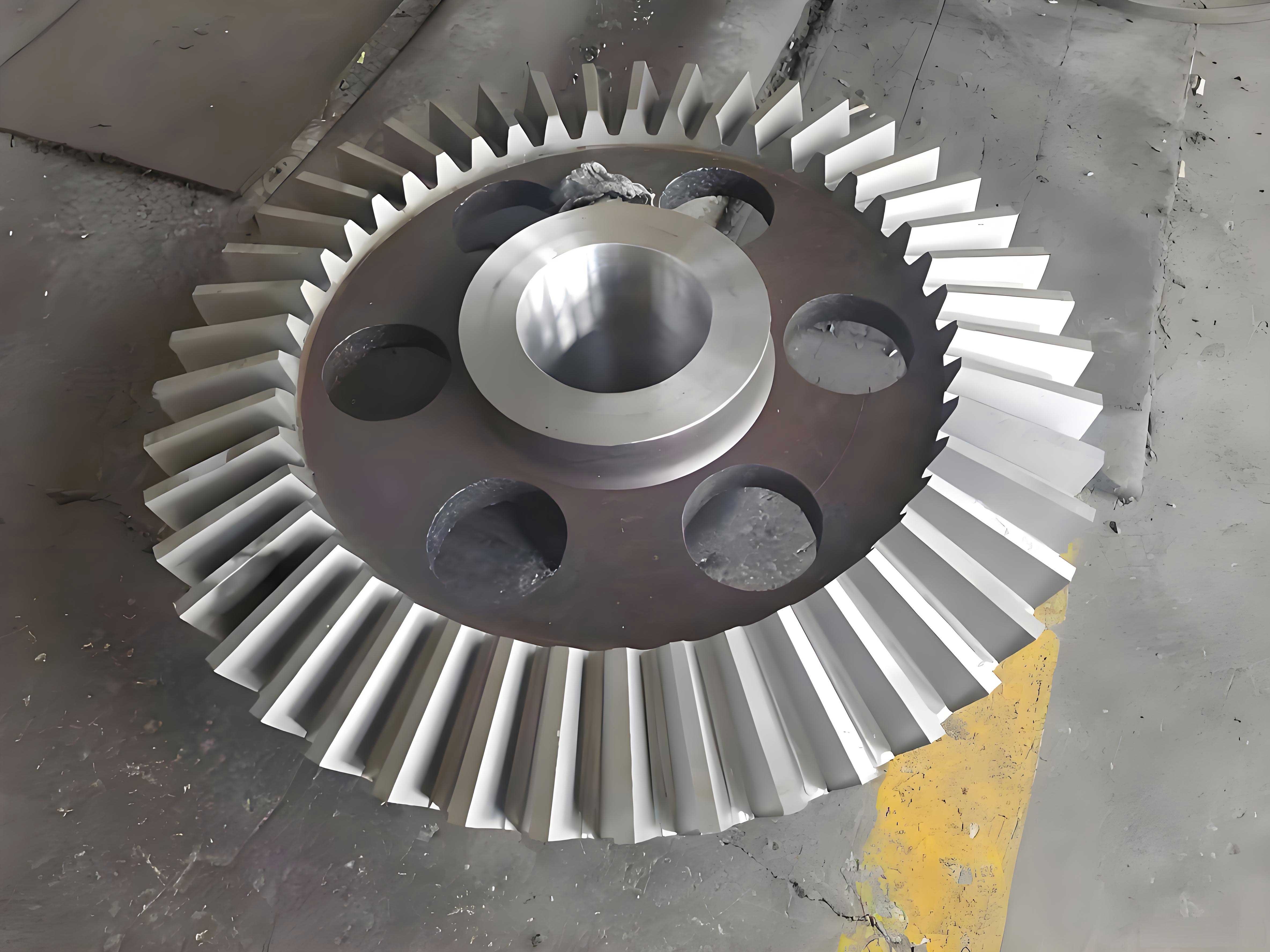
1. Nonlinear Dynamic Modeling of Miter Gear Systems
The dynamic model considered is a 7-degree-of-freedom (7-DOF) system representing a single-stage straight bevel miter gear pair with elastic bearing supports. The coordinate system is defined at the intersection point O of the two gear axes. Each gear (subscripts 1 for pinion, 2 for gear) is allowed to vibrate with three translational motions (X, Y, Z) at the bearing center and one torsional motion (θ) about its axis. The bearing supports are modeled by equivalent stiffness and damping in three orthogonal directions (\(k_{ij}, c_{ij}\) where \(i=x,y,z\) and \(j=1,2\)).
The relative dynamic displacement along the line of action (LOA), considering vibrations and transmission error, is the key coordinate. For a miter gear pair with shaft angle Σ=90°, the pinion pitch cone angle \(\delta_1\) is 45°. The relative displacement \(\Lambda_n\) is given by:
$$ \Lambda_n = (X_1 – X_2)a_1 – (Y_1 – Y_2)a_2 – (Z_1 – Z_2 + r_1\theta_1 – r_2\theta_2)a_3 – e_n(t) $$
where \(a_1 = \cos\delta_1 \sin\alpha_n\), \(a_2 = \cos\delta_1 \cos\alpha_n\), \(a_3 = \cos\alpha_n\), \(\alpha_n\) is the normal pressure angle, \(r_1, r_2\) are base circle radii at the mid-face, and \(e_n(t)\) is the static transmission error (STE) excitation, often expressed as a Fourier series:
$$ e_n(t) = \sum_{l=1}^{N} A_l \cos(l \Omega_h t + \Phi_l) $$
Here, \(\Omega_h\) is the gear meshing frequency. The meshing force \(F_n\) along the LOA and its components in the coordinate directions are:
$$ \begin{cases} F_n = k_h(t) f(\Lambda_n) + c_h \dot{\Lambda}_n \\[6pt]
F_x = -F_n(\sin\alpha_n \cos\delta_1 + \cos\alpha_n \sin\delta_1) = -a_4 F_n \\[6pt]
F_y = F_n(\sin\alpha_n \sin\delta_1 – \cos\alpha_n \cos\delta_1) = a_5 F_n \\[6pt]
F_z = F_n \cos\alpha_n = a_3 F_n
\end{cases} $$
The heart of the nonlinearity lies in two terms: the time-varying meshing stiffness \(k_h(t)\) and the backlash function \(f(\Lambda_n)\). The stiffness is periodic and can be expanded as:
$$ k_h(t) = k_m + \sum_{l=1}^{N} A_{kl} \cos(l \Omega_h t + \Phi_{kl}) $$
where \(k_m\) is the mean meshing stiffness. The piecewise-linear backlash function \(f(\Lambda_n)\), with a total backlash of \(2b_h\), is defined as:
$$ f(\Lambda_n) = \begin{cases}
\Lambda_n – b_h, & \Lambda_n > b_h \\
0, & |\Lambda_n| \le b_h \\
\Lambda_n + b_h, & \Lambda_n < -b_h
\end{cases} $$
Applying Newton’s second law, the system of equations for the miter gear pair can be written. After non-dimensionalization using characteristic frequency \(\Omega_n = \sqrt{k_m / m_e}\) (where \(m_e\) is the equivalent mass) and characteristic displacement \(b_h\), the final non-dimensional equations governing the miter gear dynamics are obtained. The key non-dimensional relative displacement is \(\lambda = \Lambda_n / b_h\), and the governing equation for the meshing direction is:
$$ -a_1 \ddot{x}_1 + a_2 \ddot{y}_1 + a_3 \ddot{z}_1 + a_1 \ddot{x}_2 – a_2 \ddot{y}_2 – a_3 \ddot{z}_2 + \ddot{\lambda} + 2a_3\xi_h\dot{\lambda} + a_3 k_h(\tau) f(\lambda) = f_{pm} + f_{pv} + f_e(\tau) $$
where dots denote derivatives with respect to non-dimensional time \(\tau = \Omega_n t\), \(\xi_h\) is non-dimensional damping, \(f_{pm}\) and \(f_{pv}\) are the constant and variable parts of the non-dimensional load, and \(f_e\) is the non-dimensional STE excitation. The non-dimensional stiffness is \(k_h(\tau) = 1 + \alpha \cos(\Omega \tau)\) for fundamental harmonic, where \(\Omega = \Omega_h/\Omega_n\) is the frequency ratio and \(\alpha\) is the stiffness variation coefficient. The non-dimensional backlash function becomes:
$$ f(\lambda) = \begin{cases}
\lambda – 1, & \lambda > 1 \\
0, & |\lambda| \le 1 \\
\lambda + 1, & \lambda < -1
\end{cases} $$
2. Solving for Steady-State Response using Harmonic Balance
The Harmonic Balance Method (HBM) is a powerful frequency-domain technique for obtaining periodic solutions of nonlinear systems. For the miter gear system, we assume the steady-state response, particularly the dominant fundamental harmonic component, for each degree of freedom \(x_i\):
$$ x_i(\tau) = x_{mi} + x_{ci} \cos(\Omega \tau) + x_{si} \sin(\Omega \tau) $$
$$ \text{Amplitude: } x_{ai} = \sqrt{x_{ci}^2 + x_{si}^2} $$
The nonlinear backlash function \(f(\lambda)\) is handled using Describing Function (DF) approximation, which replaces the nonlinearity with its quasi-linear equivalent gain for the fundamental harmonic. The DF coefficients for the average term (\(N_m\)) and the alternating term (\(N_a\)) are functions of the response’s mean \(x_m\) and amplitude \(x_a\):
$$ \begin{aligned}
N_m(x_m, x_a, b) &= \frac{1}{2x_m} \left[ x_a (G(\mu_+) – G(\mu_-)) \right] + 1 \\
N_a(x_m, x_a, b) &= 1 – \frac{1}{2} \left[ H(\mu_+) – H(\mu_-) \right]
\end{aligned} $$
where \(\mu_{\pm} = (\pm b – x_m)/x_a\). The functions \(G(\mu)\) and \(H(\mu)\) are defined as:
$$ G(\mu) = \begin{cases}
\frac{2}{\pi} \left( \mu \arcsin \mu + \sqrt{1-\mu^2} \right), & |\mu| \le 1 \\
|\mu|, & |\mu| > 1
\end{cases} $$
$$ H(\mu) = \begin{cases}
\frac{2}{\pi} \left( \arcsin \mu + \mu\sqrt{1-\mu^2} \right), & |\mu| \le 1 \\
\text{sgn}(\mu), & |\mu| > 1
\end{cases} $$
Substituting the harmonic trial solutions and the DF approximations for the backlash nonlinearity into the non-dimensional equations of motion, and balancing the constant, \(\cos(\Omega\tau)\), and \(\sin(\Omega\tau)\) terms separately, yields a set of nonlinear algebraic equations:
$$ \begin{cases}
\mathbf{K}_m \mathbf{G}_m – \mathbf{F}_m = 0 \\
-\Omega^2 \mathbf{M} \mathbf{X}_c + \Omega \mathbf{C} \mathbf{X}_s + \mathbf{K}_m \mathbf{G}_c + \mathbf{K}_c \mathbf{G}_m – \mathbf{F}_c = 0 \\
-\Omega^2 \mathbf{M} \mathbf{X}_s – \Omega \mathbf{C} \mathbf{X}_c + \mathbf{K}_m \mathbf{G}_s + \mathbf{K}_s \mathbf{G}_m – \mathbf{F}_s = 0
\end{cases} $$
Here, \(\mathbf{X}_{c,s}\) are vectors of cosine/sine coefficients, \(\mathbf{G}_{m,c,s}\) contain the DF coefficients (\(N_m x_{mi}, N_a x_{ci}, N_a x_{si}\)), and \(\mathbf{M}, \mathbf{C}, \mathbf{K}_m\) are the mass, damping, and mean stiffness matrices, respectively, specific to the miter gear system geometry.
This system is solved numerically. To trace solution branches completely, including unstable ones and navigate past turning points where amplitude jumps occur, the Broyden quasi-Newton method (for solving at a fixed parameter) is combined with a pseudo-arclength continuation algorithm (for tracing the branch as a parameter like frequency \(\Omega\) changes). This combination is crucial for constructing the full parameter solution domain structure for the miter gear system.
3. Dynamic Characteristics: Amplitude Jumps and Tooth Impact
The frequency response of the non-dimensional mesh displacement amplitude \(\lambda_a\) reveals the core nonlinear phenomena. Figure X (conceptual) typically shows a resonant peak near the normalized meshing frequency \(\Omega \approx 1\) and another near the shaft rotational frequency. The response is not a single curve but can have multiple solution branches for the same frequency parameter.
- Amplitude Jump & Multi-valued Solutions: In certain frequency ranges, three solutions coexist: two stable and one unstable (saddle point). As frequency is swept slowly up or down, the amplitude can discontinuously “jump” from one stable branch to another, a hallmark of nonlinear stiffness. For miter gears, this is influenced by backlash and time-varying stiffness.
- Tooth Surface Impact: The backlash nonlinearity can cause the gears to lose contact (separation) or impact on the opposite flank of the tooth. The impact state \(I\) can be classified based on the maximum (\(\lambda_{max} = \lambda_m + \lambda_a\)) and minimum (\(\lambda_{min} = \lambda_m – \lambda_a\)) relative displacement:
$$ I = \begin{cases}
0 \text{ (No Impact)}, & \text{if } \lambda_{min} > b \text{ and } \lambda_{max} > b \quad \text{(Loaded side contact)} \\
1 \text{ (Single-sided Impact)}, & \text{if } \lambda_{min} \le b \text{ and } \lambda_{max} > b \\
2 \text{ (Double-sided Impact)}, & \text{if } \lambda_{min} < -b \text{ and } \lambda_{max} > b
\end{cases} $$
We define a combined state descriptor “n/I”, where \(n\) is the number of stable solutions (1 or 2) and \(I\) is the impact state (0, 1, 2). For example, “2/1-0” indicates two stable solutions coexist, one with single-sided impact and one with no impact. Analyzing the evolution of these “n/I” states across parameter spaces is the goal of the solution domain boundary analysis.
4. Parameter Solution Domain Boundary Structure
The sensitivity of the miter gear system’s dynamic state to key parameters is best visualized in two-parameter planes. We analyze the planes formed by the excitation frequency ratio \(\Omega\) and each of the following: backlash \(b\), stiffness variation \(\alpha\), static error excitation amplitude \(f_e\), and load \(f_{pm}\). In each plane, a fine grid of parameter combinations is evaluated using the HBM-continuation solver to determine the prevailing “n/I” state.
4.1. Frequency-Backlash (\(\Omega \times b\)) Plane
This plane reveals how the dynamic regime changes with gear clearance. For very small backlash (\(b < 0.2\)), the system behavior near the primary resonance is highly nonlinear with regions of double-sided impact (2/2) and complex multi-state coexistence (e.g., 2/1-2). As backlash increases, the severe double-sided impact regions shrink and shift towards lower frequencies, indicating a softening effect. A critical finding for miter gear design is that for \(b > 0.98\), the complex jump and impact phenomena stabilize significantly. The system primarily exhibits single-valued (1/0, 1/1) or simpler two-state responses, suggesting that a carefully selected, sufficiently large backlash can suppress the most undesirable chaotic multi-impact states.
4.2. Frequency-Stiffness Variation (\(\Omega \times \alpha\)) Plane
This plane assesses the influence of the time-varying meshing stiffness amplitude. Interestingly, the dynamic characteristics of the miter gear system show relative insensitivity to changes in \(\alpha\). The primary resonance region’s structure remains largely consistent. However, some subtle transitions occur: as \(\alpha\) increases beyond 0.4, the regions associated with double-sided impact (state 2) in the shaft-frequency resonance disappear. This implies that while the mean stiffness dictates the resonance frequency, the dynamic jump and impact behavior is more strongly governed by the backlash nonlinearity than by the stiffness fluctuation in this model.
4.3. Frequency-Error Excitation (\(\Omega \times f_e\)) Plane
Static transmission error is a major internal excitation source. The solution domain structure shows high sensitivity to \(f_e\). As \(f_e\) increases:
- Both main resonance regions widen and shift to lower frequencies, indicating increased effective nonlinear softening.
- The extent of multi-valued solution regions (amplitude jump zones) expands dramatically.
- High-impact states (like 2/2 and 2/1-2) appear and grow, particularly in the meshing frequency resonance zone.
- Even at high frequencies (off-resonance), the system transitions from no-impact (1/0) to single-sided impact (1/1) states. This underscores the critical importance of high manufacturing accuracy and assembly quality for miter gears to minimize \(f_e\) and thus avoid excitable, high-impact dynamic regimes.
4.4. Frequency-Load (\(\Omega \times f_{pm}\)) Plane
The mean load level has a stabilizing effect. As the non-dimensional load \(f_{pm}\) increases:
- The resonance peaks shift to higher frequencies, indicating a stiffening effect, and the jump regions (multi-valued solutions) shrink.
- High-impact states (e.g., 2/1-2, 1/2) disappear. The system transitions towards simpler, predominantly no-impact (1/0) or single-impact (1/1) responses.
- The most complex dynamics occur under “high-speed, light-load” conditions (\(f_{pm}\) low, \(\Omega\) high), which is a critical operational regime to analyze for miter gear applications like high-speed drivetrains.
The following table summarizes the parametric influence on the dynamic characteristics of the miter gear system:
| Parameter | Trend (Increasing) | Effect on Amplitude Jumps | Effect on Tooth Impact | Resonance Shift | Design Implication for Miter Gears |
|---|---|---|---|---|---|
| Backlash (\(b\)) | Increase | Regions shrink & shift; Stabilizes for b>0.98 | Double-sided impact reduces; Single-sided impact may persist | Towards lower frequency (Softening) | Avoid very small clearance; Optimal moderate backlash can stabilize dynamics. |
| Stiffness Variation (\(\alpha\)) | Increase | Minor reduction in jump complexity | Reduces double-sided impact regions | Minor change | Dynamic behavior is relatively insensitive; focus on mean stiffness. |
| Error Excitation (\(f_e\)) | Increase | Significant expansion of jump regions | Marked increase in severe (double-sided) impact | Towards lower frequency (Increased Softening) | Critical to minimize via high-precision manufacturing and assembly. |
| Mean Load (\(f_{pm}\)) | Increase | Significant reduction/elimination of jumps | Eliminates severe impact; promotes no-impact contact | Towards higher frequency (Stiffening) | Light-load, high-speed conditions are most critical for noise/vibration; ensure sufficient preload. |
5. Conclusions and Design Guidance for Miter Gears
This analysis of the parameter solution domain boundary structure for a nonlinear miter gear system provides profound insights for engineers. The Harmonic Balance Method, combined with advanced numerical continuation, successfully maps the complex interplay between parameters and dynamic states.
Key conclusions for the design and operation of miter gear systems are:
- Backlash is a Double-Edged Sword: While necessary to prevent binding, very small backlash induces severe nonlinear jumps and double-sided tooth impacts. An optimally selected, moderately larger backlash (\(b > 0.98\) in the studied model) can lead to a more stable and predictable dynamic response.
- Manufacturing Accuracy is Paramount: The static transmission error (\(f_e\)) is the most sensitive parameter exacerbating nonlinear jumps and severe impact regimes. Tight control over gear tooth profile accuracy and assembly alignment is non-negotiable for high-performance, low-noise miter gear applications.
- Load has a Stabilizing Effect: Higher mean loads suppress nonlinear jumps and drive the system towards benign, continuous contact operation. The most challenging dynamic conditions for a miter gear pair occur under high-speed, light-load scenarios, which should be a focal point for dynamic analysis.
- Time-Varying Stiffness is Secondary: For the dynamic phenomena studied, the effect of the fluctuating meshing stiffness (\(\alpha\)) is less pronounced than that of backlash and error. The mean stiffness remains the primary factor setting resonance frequencies.
- The Solution Domain as a Design Tool: The constructed “n/I” state maps in various parameter planes serve as direct design charts. They allow designers to select operational parameters (speed, load) and design parameters (backlash, precision grade) that avoid regions associated with complex multi-impact and jump phenomena, ensuring the miter gear transmission operates in a stable, low-impact dynamic regime.
Future work could extend this methodology to include more degrees of freedom, such as detailed bearing nonlinearities or shaft flexibility, and to investigate the effects of lubrication and friction on the solution domain boundaries of miter gear systems.