
In high-precision gear manufacturing, gear grinding is a critical finishing process widely used to achieve tight tolerances and superior surface quality. However, one common issue that plagues this process is uneven wear, often referred to as gear grinding deviation, where the left and right tooth surfaces experience unequal material removal. This problem not only compromises gear grinding efficiency but also leads to defects such as grinding cracks and reduced product lifespan. As an engineer specializing in gear profile grinding, I have extensively analyzed this phenomenon in form gear grinding machines, particularly those with automatic centering functions like the NILES type. This article delves into the root causes of uneven wear, explores its implications, and presents comprehensive solutions, incorporating mathematical models, tables, and practical adjustments to mitigate its effects. The goal is to provide a detailed reference for optimizing gear grinding processes and minimizing production losses.
Uneven wear in gear grinding occurs when the minimum grinding allowance on the left and right tooth surfaces is not evenly distributed, resulting in one side being over-ground while the other remains under-ground. This deviation can be quantified as the offset of the gear slot center. Specifically, if the center offset exceeds 0.025 mm, it indicates significant uneven wear, as the difference in minimum grinding allowance between the two surfaces reaches 0.05 mm. Such imbalance often manifests as single-sided blackening, protrusions on one tooth flank, or inconsistent hardening layer depths, all of which can precipitate grinding cracks and premature gear failure. In gear profile grinding, this issue is exacerbated by factors like heat treatment distortions and residual stresses, making early detection and correction essential. For instance, during rough grinding stages, uneven wear may go unnoticed until minimal allowance remains, leading to irreversible damage and increased scrap rates.
The automatic centering system in form gear grinding machines, such as the NILES model, is designed to align the grinding wheel with the gear slot center by measuring multiple points along the circumference, tooth width, and height. The logical sequence of the centering and grinding programs is crucial for understanding uneven wear. The centering program typically involves probing predefined positions—such as specific gear slots, layers along the tooth width, and diameters along the tooth height—to calculate the optimal center position that equalizes the grinding allowance on both tooth surfaces. This process can be summarized in a step-by-step logic flow, as shown in Table 1, which outlines the key stages from initial probing to final output for grinding.
| Step | Action | Description |
|---|---|---|
| 1 | Initial Probing | The probe moves to a predefined measurement position, typically at the middle layer and diameter of a gear slot, to perform a preliminary centering. |
| 2 | Center Calculation | Based on equalizing the minimum grinding allowance on both tooth surfaces, the current gear slot center position is computed. |
| 3 | Multi-Point Probing | Using the initial center as a reference, additional set points (e.g., other slots, layers, diameters) are probed, and their grinding allowances are displayed. |
| 4 | Data Analysis | All probed points, including the initial slot, are analyzed to identify variations in grinding allowances. |
| 5 | Optimal Center Output | The A-axis coordinate for the gear slot center is calculated and output, ensuring equal distribution of the minimum grinding allowance. |
| 6 | Grinding Program Initiation | The grinding program uses this center position, adjusted for any manual offsets, to begin the grinding process. |
Following centering, the grinding program translates the probe center to the grinding wheel center along the Z-axis and incorporates any manual offset values from the “manual correction” parameters before commencing the grinding cycle. The relationship between centering and grinding can be mathematically expressed to highlight the importance of precise alignment. For example, the ideal center position \( C_{\text{ideal}} \) is derived from the measured allowances on the left and right surfaces, \( A_L \) and \( A_R \), such that the deviation \( \Delta C \) is minimized:
$$ \Delta C = \left| \frac{A_L – A_R}{2} \right| $$
If \( \Delta C > 0.025 \, \text{mm} \), uneven wear is likely to occur. This equation underscores the need for accurate centering to prevent issues like grinding cracks in gear profile grinding.
Several factors contribute to uneven wear in gear grinding, and understanding these causes is vital for effective mitigation. First, failure to probe the lowest points on the gear tooth surfaces—due to excessive gear deformation or improper centering position selection—can lead to inaccurate center calculations. This often happens when too few gear slots or layers are probed, resulting in a theoretical center that does not account for actual variations. For instance, if the maximum and minimum grinding allowances from centering show small deviations, the computed center may suggest adequate alignment, but in reality, the first grinding pass might remove excessive material, inducing grinding cracks. Conversely, large deviations in probed allowances can cause the grinding program to avoid contact initially, wasting time and increasing the risk of uneven wear. To address this, increasing the number of probed slots and layers along the tooth width is recommended, as it captures a more comprehensive data set for center calculation.
Second, gross errors in centering values, often caused by surface contaminants like oxide scales or residual shot peening particles, can skew the probe readings. When the probe contacts such异物, the measured grinding allowance appears artificially high, leading to a miscalculated center and subsequent uneven wear. This is particularly problematic in gear grinding processes where surface preparation is inadequate. Regular cleaning of gear surfaces before centering is essential to eliminate these errors. Third, cumulative system errors in the machine tool itself can cause consistent directional uneven wear—for example, always over-grinding the left tooth surface. This is often due to misalignment between the probe and grinding wheel centers, which can be corrected by adjusting machine parameters. In NILES machines, the Z_OFFSET parameter in the user data settings is key to resolving this. Additionally, if the “manual correction” module has pre-set A-axis values, it can exacerbate uneven wear; thus, these should be zeroed before any adjustments.
Other factors include gears with large modification coefficients, where the pitch circle nears the root circle, causing probed points to fall on the root arc and resulting in small, uneven allowances. Adjusting the probed diameter to avoid the root arc region can mitigate this. Similarly, gears with significant tooth flank modifications may experience amplified uneven wear effects due to reduced grinding allowances in highly modified areas. In such cases, reducing the number of probed layers along the tooth width and focusing on multiple slots at a single layer can improve centering accuracy. The interplay of these factors highlights the complexity of gear profile grinding and the need for tailored strategies to prevent grinding cracks.
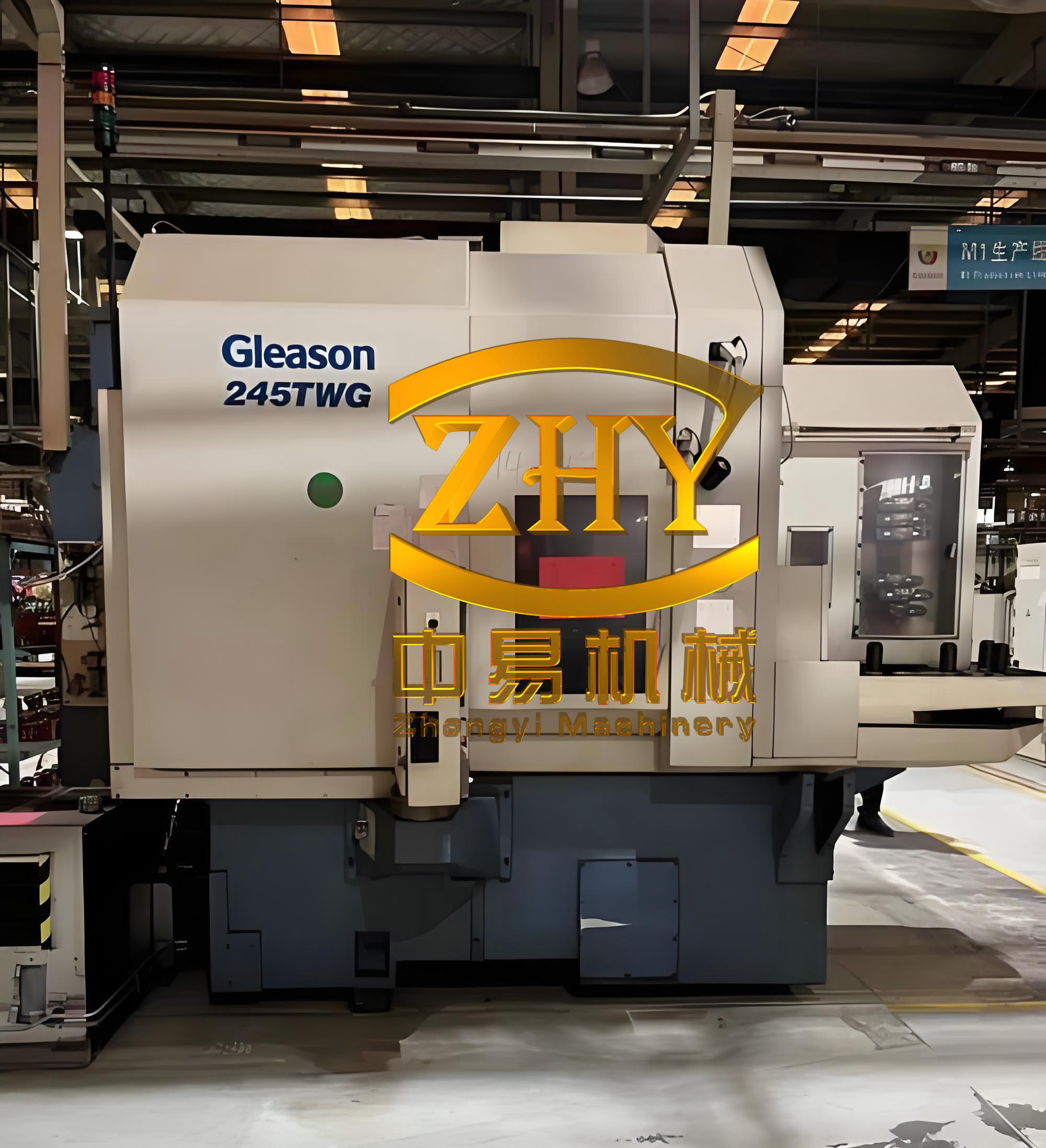
To correct system errors causing uneven wear, two primary methods are employed in NILES form gear grinding machines: A-axis correction and Z-axis correction. The A-axis correction method involves using the “manual correction” module to offset the workpiece table in the opposite direction of the observed uneven wear. This approach is straightforward and commonly used in production environments due to its ease of application. However, it relies heavily on operator experience and does not provide precise quantification of the deviation, making it less suitable for high-mix, low-volume production where consistency is critical. The adjustment is typically done by inputting an empirical value into the A-axis offset parameter, which then shifts the grinding path accordingly. While this can temporarily alleviate uneven wear, it does not address underlying machine inaccuracies and may lead to cumulative errors over time.
In contrast, the Z-axis correction method targets the fundamental misalignment between the probe and grinding wheel centers by modifying the Z_OFFSET parameter in the machine’s user data. This method, though less frequently used due to its complexity, offers a permanent solution with high precision. The step-by-step procedure for Z-axis correction is as follows: First, locate the “Z_OFFSET_ABRICHTETER” parameter in the user data and note its current value. Then, install a test workpiece—preferably a straight gear without modifications and with clean surfaces—and run the centering program followed by the “stop before grinding” routine. Using the handwheel, move the Y-axis to position the grinding wheel near the gear slot, stopping at the programmed start position plus 1 mm. Switch to the Z-axis and record its position, denoted as \( Z \). Then, slowly move the Z-axis negatively until the grinding wheel contacts one tooth surface, recording the position \( Z_1 \), and positively until it contacts the opposite surface, recording \( Z_2 \). The ideal center position \( Z_{\text{ideal}} \) is given by:
$$ Z_{\text{ideal}} = \frac{Z_1 + Z_2}{2} $$
The required adjustment \( \Delta Z \) is then calculated as:
$$ \Delta Z = Z – Z_{\text{ideal}} $$
The new Z_OFFSET value is set to the original value minus \( \Delta Z \). For example, if the original Z_OFFSET is 49.86 and \( \Delta Z = -0.03 \), the updated parameter becomes 49.89. After adjustment, the Z-axis must be returned to its reference point to ensure the changes are applied. To verify the correction, repeat the test with a qualified straight gear; if \( | \Delta Z | < 0.025 \, \text{mm} \), the uneven wear is within acceptable limits. This method effectively eliminates system-induced deviations, reducing the risk of grinding cracks and enhancing the reliability of gear profile grinding operations.
The implications of uneven wear extend beyond immediate quality issues to long-term productivity losses. In gear grinding, especially in high-volume production, even minor deviations can accumulate, leading to increased cycle times and higher rejection rates. For instance, if uneven wear causes one tooth surface to be under-ground, subsequent finishing passes may not fully correct it, resulting in gears that fail metrology checks. Moreover, the excessive heat generated from uneven material removal can initiate grinding cracks, which propagate under load and lead to catastrophic failures. To quantify the economic impact, consider the relationship between uneven wear and production efficiency. Let \( T_{\text{total}} \) represent the total grinding time, \( T_{\text{ideal}} \) the ideal time without deviations, and \( \Delta T \) the additional time due to corrections for uneven wear. Then:
$$ \Delta T = k \cdot \Delta C $$
where \( k \) is a proportionality constant dependent on the gear geometry and grinding parameters. This linear relationship highlights how reducing \( \Delta C \) through proper centering and correction methods can significantly improve throughput. Additionally, the probability of grinding cracks \( P_{\text{crack}} \) can be modeled as a function of the uneven wear deviation and material properties:
$$ P_{\text{crack}} = \alpha \cdot e^{\beta \cdot \Delta C} $$
where \( \alpha \) and \( \beta \) are material-specific constants. This exponential growth underscores the critical need to maintain \( \Delta C \) below 0.025 mm to prevent defects. In practice, implementing statistical process control (SPC) charts for centering data can help monitor trends and initiate corrective actions before uneven wear becomes severe.
In conclusion, addressing uneven wear in form gear grinding machines requires a multifaceted approach that combines robust centering strategies, meticulous machine maintenance, and precise error corrections. For deviations where the gear slot center offset \( \Delta Z \) is less than 0.025 mm, no immediate adjustment is necessary, but continuous monitoring is advised. When \( \Delta Z \) exceeds this threshold, the Z-axis correction method is recommended for its accuracy and long-term stability, particularly in diverse production environments. In high-volume scenarios, A-axis correction can serve as a quick fix, but it should be complemented with periodic Z-offset calibrations to prevent systemic issues. Emphasizing preventive measures—such as optimizing centering parameters, ensuring clean gear surfaces, and regularly validating machine geometry—can minimize the occurrence of uneven wear and its associated defects like grinding cracks. As gear profile grinding continues to evolve toward higher precision and efficiency, these solutions will play a pivotal role in achieving consistent quality and extending gear service life. Through diligent application of these principles, manufacturers can transform challenging grinding processes into reliable, high-yield operations.