
The spiral bevel gear is a fundamental component widely used in aerospace and other high-performance mechanical systems for transmitting motion and power between intersecting or offset shafts. The quality of the tooth contact pattern—its shape, size, and location—is a critical indicator of the gear pair’s performance, directly influencing load capacity, noise, vibration, and longevity. A persistent challenge in the manufacturing of traditional Gleason-coniflex spiral bevel gears is the tendency for the contact pattern to exhibit undesirable “diagonal contact,” particularly “outward diagonal contact.” This phenomenon results in inadequate contact coverage across the tooth flank under load, leading to stress concentration, reduced transmission efficiency, and accelerated wear. This article introduces and details a novel machining methodology, the Spread-Out Helix Modified Roll method, developed to fundamentally eliminate this diagonal contact issue, thereby enhancing gear performance and manufacturing efficiency.
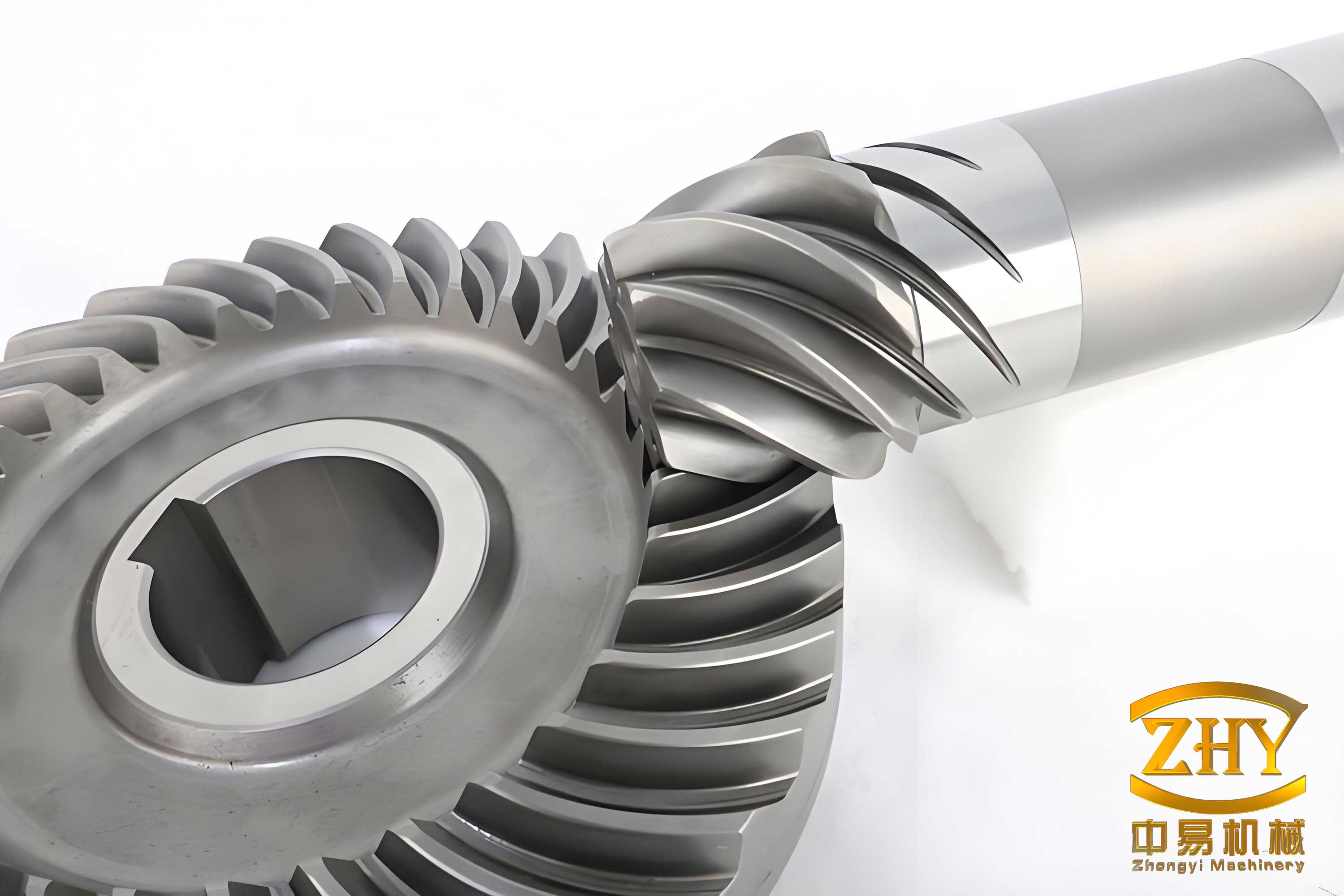
The root cause of diagonal contact in conventional generated spiral bevel gears lies in the standard machine tool setup. In the traditional method, the cutter axis for both the gear (typically the larger member) and the pinion (the smaller member) is oriented perpendicular to their respective root cones to simultaneously generate the tooth flank and the fillet. This configuration, however, causes the cutter axes for the gear and pinion to be non-parallel. Consequently, the pressure angles of the mating tooth surfaces are equal only at a designated “calculation point” (usually the mid-point of the tooth face). At other points along the tooth, varying spiral angles introduce pressure angle errors, preventing perfect conjugate action and manifesting as a diagonal contact band. The farther a point is from the calculation point, the greater the error, leading to the characteristic diagonal orientation of the contact pattern.
The proposed Spread-Out Helix Modified Roll method presents a paradigm shift in the cutter orientation philosophy. The core principle is to establish parallelism between the gear and pinion cutter axes during their respective cutting processes. For the gear, the cutter axis remains installed perpendicular to its root cone, following conventional practice. For the pinion, however, the cutter axis is installed perpendicular not to its own root cone, but to an offset surface related to the gear’s root cone—specifically, a surface equidistant to the pinion’s face cone. This critical adjustment ensures that the cutting surfaces (hyperboloids) generated by the gear and pinion cutters are mating surfaces. This parallelism, established from the outset, ensures conjugate action along the entire length of the tooth, theoretically eliminating the inherent cause of diagonal contact in the traditional method.
Within this framework, the gear is machined using a standard generating roll motion. The pinion, however, is cut using a modified roll technique with an added helical feed motion—the “spread-out helix.” This helical motion, where the cutter translates along its own axis as it rotates and generates, is essential for producing the desired tapered tooth form (coniflex) on the pinion while maintaining the parallel-axis cutting condition. Furthermore, this method provides explicit control over the contact pattern. The localized curvature of the pinion tooth surface can be independently modified in two principal directions: the lengthwise direction (via adjustment of the cutter point radius) and the profile direction (via modification of the roll ratio, i.e., the modified roll coefficient). This allows for the tailoring of the contact ellipse’s dimensions. Additionally, the direction of the contact path can be influenced by controlling the geodesic torsion, provided no curvature interference occurs.
Mathematical Modeling and Machine-Tool Setting Calculation
The successful application of the Spread-Out Helix Modified Roll method hinges on the precise calculation of machine-tool settings. The mathematical model is built upon the principles of differential geometry and gear meshing theory, utilizing vector analysis to describe the spatial relationships and relative motions between the machine tool, cutter, and workpiece.
1. Coordinate Systems and Gear (Wheel) Generation
The machining process is modeled within a series of coordinate systems. The machine coordinate system $\Sigma_0 (O; x, y, z)$ is fixed, with its origin at the machine center. The gear coordinate system $\Sigma_2 (O_2; x_2, y_2, z_2)$ is attached to the gear blank. The cutter coordinate system is defined relative to the machine. For the gear, generated using the conventional method, the primary settings are: radial setting $S_2$, angular setting $q_2$, machine root angle $\delta_{f2}$, sliding base setting $X_{B2}$, and machine gear ratio $i_{02}$. The initial calculation point $M_2$ is chosen on the gear pitch cone. The basic radial distance $S_2$ and a preliminary angular setting $q’_2$ are determined from the cutter radius $r_{02}$, mean cone distance $R_m$, spiral angle $\beta$, and gear root angle $\theta_{f2}$:
$$
\tan q’_2 = \frac{r_{02} \cos \beta}{R_m \cos \theta_{f2} – r_{02} \sin \beta}, \quad S_2 = \frac{r_{02} \cos \beta}{\sin q’_2}
$$
This point $M_2$ is then shifted to the actual point of contact $P_2$ on the tooth flank, defining the final angular setting $q_2$:
$$
q_2 = \arcsin\left( \frac{R_{P2} \cos \theta_2}{S_2} \right)
$$
where $R_{P2} = r_{02} – W_2 – l_2 \sin \alpha_{02}$ is the forming radius at $P_2$, $W$ is the cutter point width, $l_2$ is the cutter surface parameter, and $\alpha_{02}$ is the cutter pressure angle. The machine gear ratio for pure rolling is given by $i_{02} = \cos \theta_{f2} / \sin \delta_2$, where $\delta_2$ is the gear pitch angle.
2. Determination of Pinion Tooth Surface Parameters
Instead of deriving the pinion surface from the generated gear surface, the indirect generation concept is employed. The gear cutter surface (considering its inner blade) is treated as an imaginary generating surface that can simultaneously produce the convex gear flank and the concave pinion flank. At the calculated meshing point, the pinion tooth surface normal vector $\mathbf{n}_1$ and its curvature parameters can be derived directly from the gear cutter geometry and the spatial relationship between the members.
Given the gear cutter pressure angle $\alpha_{02}$, the pinion pitch angle $\delta_1$, and the shaft angle $\Sigma$, the components of the unit normal vector $\mathbf{n}_1$ at the pinion calculation point $P_1$ in the machine coordinate system are:
$$
\begin{aligned}
n_{1x} &= \cos \alpha_{02} \cos \delta_{a1} \sin \theta_2 + \sin \alpha_{02} \sin \delta_{a1} \\
n_{1y} &= \cos \alpha_{02} \cos \theta_2 \\
n_{1z} &= -\cos \alpha_{02} \sin \delta_{a1} \sin \theta_2 + \sin \alpha_{02} \cos \delta_{a1}
\end{aligned}
$$
Here, $\delta_{a1}$ is the pinion machine root angle (equal to its face angle in this method), and $\theta_2$ is a parameter related to the gear point position.
The principal curvatures and torsion of the theoretical pinion surface, $A’_1$ (lengthwise), $B’_1$ (profile), and $C’_1$ (geodesic torsion), are derived from the induced normal curvature relationship:
$$
A’_1 = -\Delta B’_1 \tan^2 \gamma’ – \frac{\cos \alpha_{02}}{R_{P2}}, \quad B’_1 = -\Delta B’_1, \quad C’_1 = \Delta B’_1 \tan \gamma’
$$
where $\tan \gamma’ = \frac{\cos \alpha_{02} (\tan \alpha_{02} \sin \theta_2 – \tan \theta_{f2})}{\cos \theta_2}$ and $\Delta B’_1$ is a derived term based on geometry. To achieve a favorable contact pattern, these theoretical values are intentionally modified by small amounts $\Delta A$, $\Delta B$, and $\Delta C$:
$$
A_1 = A’_1 \pm \Delta A, \quad B_1 = B’_1 \pm \Delta B, \quad C_1 = C’_1 \pm \Delta C
$$
The modifications $\Delta A$ and $\Delta B$ control the size of the contact ellipse, while $\Delta C$ influences its direction to avoid pronounced diagonal contact.
3. Calculation of Pinion Machine-Tool Settings for Spread-Out Helix Modified Roll
The pinion is generated using the Spread-Out Helix Modified Roll method. The generating surface is an Archimedean helicoid due to the added axial feed motion of the cutter. Its vector equation is:
$$
\mathbf{r}_{01}(l_1, \theta_1) = \begin{bmatrix}
S_1 \cos q_1 + R_{P1} \sin \theta_1 \\
-S_1 \sin q_1 + R_{P1} \cos \theta_1 \\
-l_1 \cos \alpha_{01} + p \theta_1
\end{bmatrix}
$$
where $S_1$ and $q_1$ are the pinion’s radial and angular settings, $R_{P1}=r_{01}+l_1 \sin \alpha_{01}$ is the forming radius, $r_{01}$ is the pinion cutter point radius, $l_1$ and $\theta_1$ are surface parameters, $\alpha_{01}$ is the pinion cutter pressure angle, and $p$ is the helical feed parameter (axial displacement per radian of cutter rotation).
The normal vector to this helicoid, $\mathbf{n}_{01}$, is derived from the partial derivatives of $\mathbf{r}_{01}$.
The pinion tooth surface is the envelope of this generating surface relative to the pinion blank motion. The relationship is governed by the equation of meshing: $\mathbf{v}_{01}^{(01)} \cdot \mathbf{n}_{01} = 0$, where $\mathbf{v}_{01}^{(01)}$ is the relative velocity at the contact point. Furthermore, the curvature parameters of the generated pinion surface must match the designed values $A_1, B_1, C_1$. This leads to a system of equations involving the unknown machine settings:
$$
\begin{aligned}
\mathbf{r}_{01} &= \mathbf{M}_{01} \mathbf{r}_{P1} + \mathbf{r}_{O1} \\
\mathbf{n}_{01} &= \mathbf{M}_{01} \mathbf{n}_{1} \\
\mathbf{v}_{01}^{(01)} \cdot \mathbf{n}_{01} &= 0 \\
\kappa_1 &= \frac{A_1 B_1 – C_1^2}{B_1} \\
\frac{1}{B_1} &= -\frac{(2c) (\mathbf{v}_0 \cdot \mathbf{n}_{01}) + (\boldsymbol{\omega}_{01}, \mathbf{v}_0, \mathbf{n}_{01})}{(\boldsymbol{\omega}_{01} \cdot \mathbf{e}_1)^2}
\end{aligned}
$$
Here, $\mathbf{M}_{01}$ is the transformation matrix from pinion to machine coordinates, $\mathbf{r}_{P1}$ is the position of the calculation point, $\mathbf{r}_{O1}$ contains the axial setting $X_1$ and the blank offset $X_{B1}$, $\kappa_1$ is the generating surface curvature, $2c$ is the second-order modified roll coefficient, $\boldsymbol{\omega}_{01}$ is the relative angular velocity, $\mathbf{v}_0$ is the cutter velocity, and $\mathbf{e}_1$ is the lengthwise direction vector. This system of nine nonlinear equations is solved numerically (e.g., using MATLAB’s `fsolve`) for the nine primary unknowns: $S_1, q_1, r_{01}, \theta_1, l_1, X_1, X_{B1}, i_{01}, 2c$.
Virtual Simulation and Contact Analysis
To validate the theoretical foundation of the Spread-Out Helix Modified Roll method for spiral bevel gears, a comprehensive virtual simulation and analysis workflow was executed. A sample spiral bevel gear pair was designed, and its parameters are summarized below.
| Parameter | Pinion | Gear (Wheel) |
|---|---|---|
| Number of Teeth | 9 | 37 |
| Module (mm) | 4.112 | 4.000 |
| Pressure Angle (deg) | 20 | 20 |
| Mean Spiral Angle (deg) | 35 | 35 |
| Hand of Spiral | Left | Right |
| Shaft Angle (deg) | 90 | 90 |
| Pitch Angle (deg) | 13.6713 | 76.3287 |
| Face Angle (deg) | 17.7987 | 78.2542 |
| Root Angle (deg) | 11.7458 | 72.2013 |
Based on the mathematical model, the machine-tool settings for both the gear and the pinion were calculated. The key results for the gear convex side and the pinion concave side are presented in the following table.
| Machine Setting | Pinion (Concave) | Gear (Convex) |
|---|---|---|
| Cutter Diameter (mm) | 157.1152 | 150.7729 |
| Radial Setting, S (mm) | 67.9110 | 66.3235 |
| Angular Setting, q (deg) | 71.5114 | 67.4435 |
| Machine Root Angle, δ (deg) | 17.7987 | 72.2013 |
| Sliding Base, X_B (mm) | -7.6148 | 0.0000 |
| Axial Setting, X (mm) | 1.9726 | 0.0000 |
| Machine Gear Ratio, i | 4.3399 | 1.0265 |
| Helical Feed Parameter, p (mm/rad) | 7.8975 | 0.0000 |
| Modified Roll Coefficient, 2c | 0.0126 | 0.0000 |
Using these parameters, a three-dimensional virtual machining model was developed in CREO Parametric. Parametric models of the gear blanks and the cutting tool (as a solid representing the swept volume of the cutter blades) were created. The relative motions—rotation, roll, and the helical feed for the pinion—were simulated by performing Boolean subtraction operations between the blank and a series of tool positions discretized along the machining path. This process resulted in a high-fidelity digital twin of the physical spiral bevel gears manufactured via the Spread-Out Helix Modified Roll method.
The generated mesh models were then refined, and NURBS surfaces were fitted to the tooth flanks to obtain geometrically accurate and smooth surfaces suitable for high-precision analysis. The assembled gear pair was subjected to Tooth Contact Analysis (TCA). The TCA algorithm solves for the points of contact between the theoretical pinion and gear surfaces under slight load, simulating their meshing through incremental rotation. For comparison, an identical gear pair designed with the traditional Gleason SGM (Spread Gear Motion) method was also modeled and analyzed.
The results were decisive. The traditional SGM method showed a clear diagonal orientation of the contact path across the tooth flank. In contrast, the contact pattern from the Spread-Out Helix Modified Roll method was substantially elongated and aligned almost perpendicular to the root line, demonstrating a near-lengthwise bearing pattern. This virtual proof confirmed the fundamental capability of the new method to eliminate the undesirable diagonal contact inherent to the traditional generation of spiral bevel gears.
Experimental Verification and Rolling Test
Following the successful simulation, physical cutting trials were conducted on a CNC spiral bevel gear milling machine. The calculated settings from Table 2 were input into the machine’s control system. The gear and pinion were machined from standard gear steel blanks. After cutting, the spiral bevel gear pair was mounted on a gear rolling tester, set to their designated mounting distances and axis orientations. A light coating of marking compound was applied to the gear teeth. The pinion was then slowly rotated against the gear under a very light load to transfer the compound and reveal the static contact pattern.
The observed contact pattern on the gear convex side corroborated the TCA predictions. The pattern was a well-defined ellipse, centrally located on the tooth flank, with its long axis oriented favorably along the lengthwise direction of the tooth. There was no evidence of the pronounced outward diagonal contact typically seen in gears cut by the conventional method. Minor deviations in the pattern’s exact position and shape relative to the simulation were attributable to real-world factors such as machine tool alignment, cutter edge condition, and slight material deflection, all of which are expected in physical manufacturing. The core objective—the elimination of the problematic diagonal contact—was conclusively achieved.
Conclusion
This work has presented a comprehensive investigation into the Spread-Out Helix Modified Roll method for machining high-performance spiral bevel gears. The method addresses a long-standing deficiency in traditional generation by re-engineering the cutter installation philosophy. By enforcing parallelism between the gear and pinion cutter axes, it ensures the generating surfaces are intrinsically conjugate, thereby removing the root cause of diagonal contact at the conceptual level.
The detailed mathematical modeling, based on vector analysis and gear meshing theory, provides a rigorous framework for calculating all necessary machine-tool settings, including the critical helical feed and modified roll parameters for the pinion. The virtual simulation and TCA results provided clear theoretical validation, showing a transformation from a diagonal contact path to a favorable lengthwise-oriented pattern. Finally, the physical manufacturing and rolling tests on an actual spiral bevel gear pair confirmed the practical viability and effectiveness of the method.
The Spread-Out Helix Modified Roll method thus represents a significant advancement. It not only enhances the intrinsic quality and load distribution of spiral bevel gears by eliminating diagonal contact but also has the potential to improve manufacturing efficiency. It reduces or eliminates the time-consuming and skill-intensive trial-and-error process of “contact pattern chasing” often required in traditional spiral bevel gear production, leading to more predictable and optimal gear performance directly from the first-cut article.