
In my extensive experience in gear manufacturing, the production of spiral bevel gears represents one of the most sophisticated and precision-demanding tasks in mechanical engineering. These gears are critical for transmitting power between intersecting shafts, typically at a 90-degree angle, and are widely used in automotive differentials, aerospace applications, and heavy machinery. Their complex geometry, characterized by curved teeth and a spiral angle, ensures smooth, quiet, and efficient operation under high loads. However, achieving the required accuracy and performance necessitates rigorous adherence to detailed milling and grinding processes. This article delves into the comprehensive procedures, adjustments, and theoretical underpinnings essential for manufacturing high-quality spiral bevel gears, emphasizing practical insights and technical depth. I will explore everything from initial setup and tooling to final inspection and contact pattern optimization, incorporating formulas and tables to elucidate key concepts. Throughout, the focus remains on spiral bevel gears, as their unique design poses distinct challenges in machining and finishing.
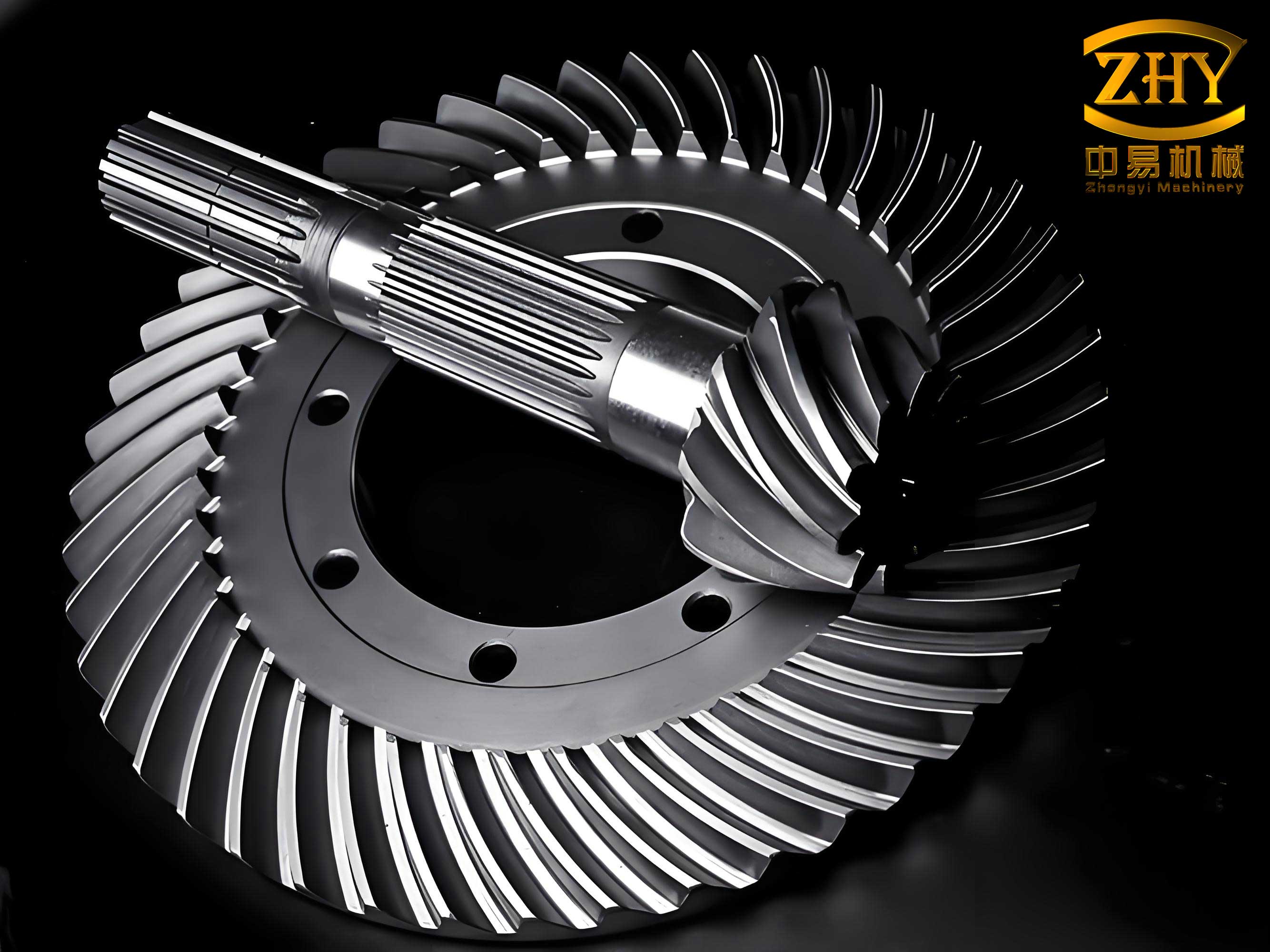
The manufacturing of spiral bevel gears typically involves two primary stages: rough milling (or cutting) and finish grinding, especially for hardened gears. Each stage requires precise machine adjustments, careful tool selection, and meticulous operation. I will first discuss the milling process, which forms the gear teeth to near-net shape, followed by the grinding process that refines the tooth surfaces to achieve superior accuracy and surface finish. The geometry of spiral bevel gears is governed by complex relationships, which I will express using mathematical formulas. For instance, the basic geometric parameters include the pitch cone angle (δ), spiral angle (β), module (m), and number of teeth (z). The relationship between these can be described as: $$ \tan \delta = \frac{z_1}{z_2} $$ for a pair of gears with teeth numbers z1 and z2, assuming shaft angle Σ = 90°. The spiral angle β influences the tooth curvature and contact pattern, often ranging from 25° to 40° for optimal performance. Another critical formula is for the pitch diameter (d): $$ d = m \times z $$. These parameters directly affect the machine settings, such as the roll ratio and cutter head positioning, which are vital for generating the correct tooth profile.
Let me begin with the milling process for spiral bevel gears. Upon receiving the process documentation and adjustment cards, the first step is to select the appropriate cutter head and tools as specified. The cutter head, often a face mill type with multiple inserted blades, must match the gear design in terms of diameter, blade profile, and material. For spiral bevel gears, the cutter head generates the tooth slot through a generating motion that simulates the mating gear. The machine adjustments are multifaceted, involving five key parameters: cutter position (radial and angular), workpiece position (horizontal and vertical), machine table tilt, indexing, and roll ratio. These are set according to the adjustment card, and I always verify each setting meticulously. A table summarizing typical adjustment parameters for a spiral bevel gear milling machine might look like this:
| Adjustment Parameter | Symbol | Typical Range | Purpose |
|---|---|---|---|
| Cutter Radial Position | Rc | 50-200 mm | Controls tooth depth and profile |
| Workpiece Horizontal Position | Xw | ±10 mm | Sets installation distance |
| Machine Table Tilt Angle | θt | 0-30° | Adjusts root cone angle |
| Roll Ratio | ir | Calculated per gear pair | Governs generating motion for tooth curvature |
| Indexing | N | Equal to number of teeth | Divides gear blank for each tooth slot |
The roll ratio is particularly crucial for spiral bevel gears, as it determines the relative motion between the cutter head and workpiece to generate the spiral tooth form. It is calculated based on the gear geometry: $$ i_r = \frac{z_{\text{cutter}}}{z_{\text{gear}}} \times K $$ where zcutter is a machine constant, zgear is the gear tooth count, and K is a factor accounting for spiral angle. In practice, this is set via change gears on the machine. When mounting these gears, I ensure the power is off, and the gear teeth are clean and properly meshed with a backlash of 0.05-0.1 mm. After tightening all screws, I double-check the gear teeth numbers and their active/passive orientation to avoid errors. Once adjustments are complete, I initiate the machine by first activating the hydraulic system and checking pressure gauges for normal readings (typically 2-3 MPa). A point test run confirms correct motions before starting the full cutting cycle. It is vital never to disengage hydraulics under load, as this can damage the machine or workpiece.
Tool setup is another critical aspect. The cutter head must be mounted on a clean spindle, and I use a dial indicator to align the blade tips to within a common plane, with a tolerance of ≤ 0.005 mm. For spiral bevel gears, the radial runout of同名 blades should be ≤ 0.01 mm to ensure uniform tooth thickness. A blade setting gauge helps adjust the cutter blade plane relative to the machine saddle, allocating the depth of cut. The root cone angle, derived from the gear drawing, is set by rotating the machine’s swivel plate. The installation distance, a key dimension for spiral bevel gears, is controlled by adjusting the horizontal workpiece position, factoring in the fixture’s offset. When replacing the workpiece spindle taper sleeve, I clean all surfaces, apply a thin oil film, and hand-press it into place, ensuring a slight initial gap of 0.02-0.03 mm that vanishes upon tightening, indicating good taper contact. Forceful hammering is strictly avoided to prevent damage.
In spiral bevel gear pairs, the gear with more teeth is designated the “gear” (larger member), and if teeth are equal, the adjustment card specifies which is the gear. I always mill the gear first, then the pinion (smaller member) to match. During rough milling, I mark reference points on the back cone: two adjacent teeth on the gear and one tooth on the pinion, using center punches for later pairing. This ensures proper meshing alignment. For finish milling, the pinion is matched to the gear using these marks, and the contact pattern is checked on a rolling tester with marking compound. I record the installation distances and backlash for subsequent operations. Throughout cutting, I adjust coolant nozzles to direct ample flow at the cutting zone, which is essential for tool life and surface finish. When blade wear at the top edge reaches 0.1-0.2 mm, I replace or regrind the blades promptly to avoid excessive wear and maintain low surface roughness. The cutting parameters depend on material and tool type; for high-speed steel blades, cutting speed (vc) is typically 30-50 m/min, and feed rate (f) is selected via change gears. The relationship can be expressed as: $$ v_c = \frac{\pi \times D \times n}{1000} $$ where D is cutter diameter in mm, and n is spindle speed in rpm. Feed per tooth (fz) is given by: $$ f_z = \frac{v_f}{n \times z_t} $$ with vf as feed speed and zt as number of teeth in cutter.
Transitioning to the grinding process for spiral bevel gears, this stage is employed for hardened gears to achieve precise tooth geometry and superior surface integrity. Grinding demands even finer adjustments and controls. The setup begins with change gears for generating motion, indexing, and feed. I inspect all gears for nicks or burrs, clean them, and install them without skewing. The meshing backlash should be 0.03-0.08 mm, verified with a dial indicator. The indexing change gears or plates are selected based on tooth count and machine constant, with zero error allowed. The roll change gears for grinding are critical for tooth profile accuracy; I calculate them to at least five decimal places to ensure the exact velocity ratio between the cradle and workpiece. This ratio, ig, for spiral bevel gears is derived from the basic gear geometry: $$ i_g = \frac{\sin \delta_1}{\sin \delta_2} \times \frac{\cos \beta_2}{\cos \beta_1} $$ where δ1 and δ2 are pitch cone angles, and β1 and β2 are spiral angles of pinion and gear, respectively. The drum mechanism, which controls the grinding stroke, must be set correctly for rough and finish rollers.
The cradle angle determines the starting point of the generating motion, and its swing angle must cover the entire tooth flank. Adjustments for cutter position, workpiece position, and machine table position are made to guarantee accurate grinding. Grinding wheel selection is based on workpiece material, grinding mode, desired roughness, and productivity. For spiral bevel gears, I often use cup or dish-shaped wheels. Before mounting, I check the wheel for cracks by sound test, balance it dynamically and statically, and after dressing, rebalance it to ensure stability at high speeds. The wheel is mounted with flanges and secured, then I verify its position relative to the workpiece. Upon starting, I run the wheel at its recommended speed, typically 30-35 m/s, while standing clear of its rotation plane. The wheel speed (vs) is calculated as: $$ v_s = \frac{\pi \times D_s \times n_s}{60 \times 1000} \text{ m/s} $$ where Ds is wheel diameter in mm, and ns is wheel speed in rpm. The workpiece fixture is cleaned and fitted to the spindle, with runout checked to be within 0.005-0.01 mm. Installation distance is set as in milling, incorporating fixture offsets.
Before grinding, I perform a dry run with the wheel approaching the gear, rolling through several cycles to confirm accuracy. For paired spiral bevel gears, the gear is ground first, then the pinion is matched. When tooth counts have common divisors, I identify the best meshing position after finish milling by measuring tooth accuracy and marking the gear with hard stamps or electric engraving. The pinion is similarly marked to ensure paired assembly. During finish grinding of the pinion, I pair it with the gear on a rolling tester, adjusting for installation distance and backlash while checking the contact pattern with marking compound. Coolant flow must be abundant to flood the grinding zone, preventing thermal damage. On some grinding machines, I regularly check the accumulator gas pressure and recharge it if low to maintain consistent hydraulic performance.
To achieve uniform tooth slots, grinding must cover both tooth flanks, the slot bottom, and root fillets. The grinding allowance should be evenly distributed; from milling, the unilateral flank allowance typically does not exceed 0.1-0.15 mm. Excessive grinding can cause burns, so I monitor parameters closely. The grinding speed is usually 25-30 m/s, but for gears with pitch cone angles over 70°, I reduce it to 20-25 m/s to avoid annealing and cracks. The specific material removal rate (Q’w) can be estimated as: $$ Q’_w = a_p \times v_w \times b $$ where ap is depth of cut, vw is workpiece speed, and b is grinding width. Proper cooling is vital; I use water-based coolants with additives to enhance lubrication and heat dissipation.
Contact pattern analysis is paramount for spiral bevel gears, as it directly affects noise, load distribution, and longevity. The ideal contact under light load is approximately elliptical, centered on the tooth flank with clearances at edges to prevent edge loading. This elliptical pattern is achieved by modifying the theoretical conjugate tooth surfaces through adjustments in the finishing process. The modification amounts, ΔL for lengthwise and ΔH for heightwise, are often derived empirically but can be approximated as: $$ \Delta_L = C_L \times m \times \sin \beta $$ $$ \Delta_H = C_H \times m \times \cos \beta $$ where CL and CH are coefficients based on gear design. Poor contact patterns, such as toe-or heel-biased contact or excessive edge contact, indicate issues that require troubleshooting. I systematically check: the accuracy of the cutting theory approximations, possible errors in machine adjustments, appropriateness of tool parameters, and the geometric precision of machine, tools, arbors, and blanks. When defects arise, I prioritize adjusting the pinion finishing parameters based on the gear, as the gear is often considered the master. A table of common contact defects and corrective actions for spiral bevel gears is useful:
| Contact Defect | Possible Cause | Corrective Adjustment |
|---|---|---|
| Contact too close to toe | Excessive spiral angle or incorrect cradle angle | Decrease pinion spiral angle or modify cradle start position |
| Contact too close to heel | Insufficient spiral angle or wheel position error | Increase pinion spiral angle or adjust wheel radial setting |
| High edge contact | Insufficient lengthwise crowning | Increase modification ΔL via machine settings |
| Low contact area | Excessive pressure angle error | Adjust cutter blade angle or grinding wheel profile |
For hardened spiral bevel gears, I employ negative-rake hard metal hobbing tools for finish hobbing, which can boost productivity by 2-3 times and yield significant cost savings. The negative rake angle, typically -5° to -10°, enhances edge strength when machining materials with hardness above 45 HRC. The cutting forces are higher, so machine rigidity is crucial. The optimal cutting speed for such tools is around 80-120 m/min for hardened steels, with feed rates reduced to 0.05-0.15 mm/tooth. The tool life equation, based on Taylor’s tool life model, can be expressed as: $$ v_c \times T^n = C $$ where T is tool life in minutes, n is an exponent (≈0.1 for hard metal), and C is a constant. This approach ensures economical production of high-precision spiral bevel gears.
In summary, the manufacturing of spiral bevel gears is a nuanced process that blends meticulous machine adjustments, sophisticated tooling, and deep understanding of gear geometry. From milling to grinding, each step demands precision and attention to detail to achieve the desired tooth profile, surface finish, and contact pattern. The use of formulas for parameter calculations and tables for operational guidelines helps standardize and optimize production. Spiral bevel gears, with their complex curvature, require continuous refinement in processes to meet evolving industry demands for efficiency and reliability. By adhering to these practices and leveraging advanced tooling, manufacturers can produce spiral bevel gears that excel in performance across diverse applications, from automotive transmissions to industrial machinery. The journey from blank to finished gear is a testament to precision engineering, and I hope this detailed exposition provides valuable insights for practitioners in the field.