
In the field of power transmission, spiral bevel gears play a crucial role due to their ability to transmit motion between intersecting shafts with high efficiency and load capacity. The quality of a spiral bevel gear is heavily influenced by the position, shape, and size of the tooth contact pattern, which is considered a primary performance indicator. Traditional measurement methods for spiral bevel gears often involve contact-based techniques, such as coordinate measuring machines (CMMs), which require the gear to be removed from the machining setup, leading to increased downtime and potential inaccuracies from re-fixturing. To address these challenges, we have developed a non-contact measurement approach utilizing computer vision systems. This method aims to provide high precision and efficiency in measuring spiral bevel gear tooth surfaces, enabling real-time feedback and adjustment during the manufacturing process. In this article, we present a comprehensive overview of our research on image recognition and measurement techniques for spiral bevel gear tooth surfaces, focusing on the integration of dual-camera systems, three-dimensional reconstruction algorithms, and error analysis for closed-loop machining correction.
The core of our approach lies in using computer vision to capture and analyze the tooth surface of spiral bevel gears without physical contact. By employing two fixed cameras to image the gear during or after machining, we can reconstruct three-dimensional coordinates of surface points through stereoscopic principles. This allows for a direct comparison between the manufactured gear surface and the theoretical design, facilitating rapid error detection and parameter adjustment. The spiral bevel gear, with its complex curvilinear tooth geometry, presents unique challenges for measurement, but computer vision offers a versatile solution. We will delve into the mathematical models, system architecture, and practical applications of this technology, emphasizing the repeated use of key formulas and tables to summarize data. Throughout this work, the term “spiral bevel gear” is central, as we explore how advancements in imaging and processing can enhance the manufacturing precision of these critical components.
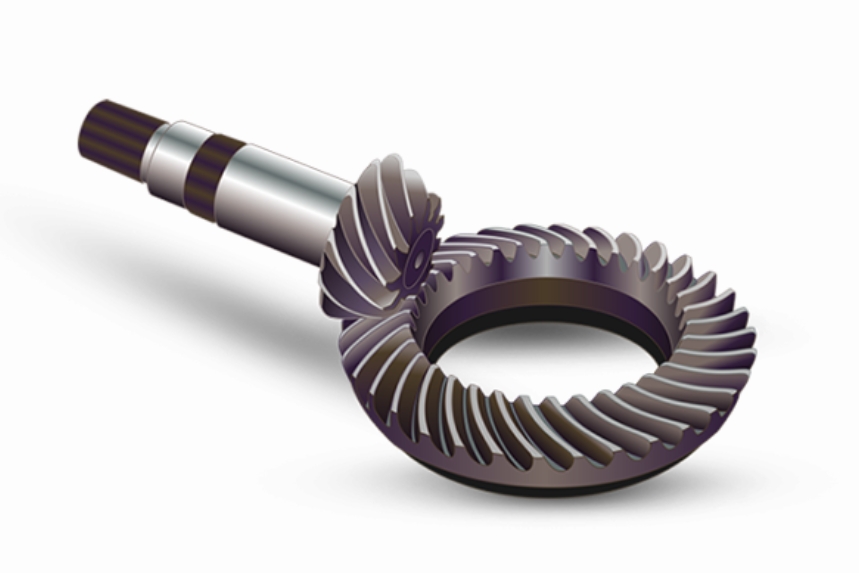
Our measurement system begins with the acquisition of images from two calibrated cameras. The cameras are positioned at fixed angles relative to the spiral bevel gear to ensure overlapping fields of view, which is essential for stereoscopic reconstruction. We use a linear camera model to represent the optical imaging process, where a point in space is projected onto the image plane. Let us define the world coordinate system as $(X_w, Y_w, Z_w)$ and the camera coordinate system as $(X_C, Y_C, Z_C)$. For a point $P$ in space, its projection $p$ on the image plane has coordinates $(x, y)$ given by:
$$ x = \frac{f X_C}{Z_C}, \quad y = \frac{f Y_C}{Z_C} $$
where $f$ is the focal length of the camera. Using homogeneous coordinates, we can express this relationship in matrix form. The projection matrix $M$ combines internal parameters (such as focal length and image center) and external parameters (such as rotation and translation relative to the world frame). For a camera, we have:
$$ Z_C \begin{bmatrix} u \\ v \\ 1 \end{bmatrix} = \begin{bmatrix} \alpha_x & 0 & u_0 & 0 \\ 0 & \alpha_y & v_0 & 0 \\ 0 & 0 & 1 & 0 \end{bmatrix} \begin{bmatrix} R & t \\ 0^T & 1 \end{bmatrix} \begin{bmatrix} X_w \\ Y_w \\ Z_w \\ 1 \end{bmatrix} = M_1 M_2 X_w = M X_w $$
Here, $\alpha_x = f/d_x$ and $\alpha_y = f/d_y$ represent the scale factors in image pixels, with $d_x$ and $d_y$ as the pixel dimensions. $(u_0, v_0)$ is the principal point, $R$ is the rotation matrix, and $t$ is the translation vector. $M_1$ contains the internal parameters, while $M_2$ contains the external parameters. By calibrating both cameras, we determine their projection matrices $M^{(1)}$ and $M^{(2)}$, which allows us to compute the relative pose between them and establish epipolar geometry for correspondence matching.
When imaging a spiral bevel gear tooth surface, we identify corresponding points in the two camera views. Suppose a point $M$ on the spiral bevel gear surface projects to point $m$ in the first image with coordinates $(u_1, v_1, 1)$ and to point $m’$ in the second image with coordinates $(u_2, v_2, 1)$ in homogeneous form. From the projection equations, we can derive linear equations to solve for the 3D coordinates $(X, Y, Z)$ of $M$. For the first camera, we have:
$$ (u_1 m^{(1)}_{13} – m^{(1)}_{11})X + (u_1 m^{(1)}_{23} – m^{(1)}_{21})Y + (u_1 m^{(1)}_{33} – m^{(1)}_{31})Z = m^{(1)}_{14} – u_1 m^{(1)}_{34} $$
$$ (v_1 m^{(1)}_{13} – m^{(1)}_{12})X + (v_1 m^{(1)}_{23} – m^{(1)}_{22})Y + (v_1 m^{(1)}_{33} – m^{(1)}_{32})Z = m^{(1)}_{24} – v_1 m^{(1)}_{34} $$
Similarly, for the second camera:
$$ (u_2 m^{(2)}_{13} – m^{(2)}_{11})X + (u_2 m^{(2)}_{23} – m^{(2)}_{21})Y + (u_2 m^{(2)}_{33} – m^{(2)}_{31})Z = m^{(2)}_{14} – u_2 m^{(2)}_{34} $$
$$ (v_2 m^{(2)}_{13} – m^{(2)}_{12})X + (v_2 m^{(2)}_{23} – m^{(2)}_{22})Y + (v_2 m^{(2)}_{33} – m^{(2)}_{32})Z = m^{(2)}_{24} – v_2 m^{(2)}_{34} $$
These four equations form an overdetermined system, which we solve using least squares minimization to obtain the 3D position of $M$. This process is repeated for multiple points on the spiral bevel gear tooth surface to build a dense point cloud. The accuracy of this reconstruction depends on factors like camera resolution, calibration precision, and image noise, which we mitigate through advanced image processing techniques.
To efficiently measure spiral bevel gears, we designed a modular computer vision system. The system consists of five key modules: input, processing, display, analysis, and adjustment. Each module plays a specific role in the measurement pipeline. Below is a table summarizing the functions and components of each module:
| Module | Function | Key Components |
|---|---|---|
| Input | Image acquisition from the spiral bevel gear | Light sources, CCD cameras, image capture cards |
| Processing | Image preprocessing and edge detection | Filters, Laplacian operator, thresholding algorithms |
| Display | Visualization of measured data and fitted surfaces | OpenGL-based graphics, 3D rendering software |
| Analysis | Comparison with theoretical gear surface and error computation | Numerical algorithms, error mapping tools |
| Adjustment | Feedback for machining parameter correction | Closed-loop control interfaces, parameter update logic |
In the input module, we use controlled lighting to illuminate the spiral bevel gear, ensuring high-contrast images for accurate feature extraction. The cameras capture video signals, which are digitized and stored for processing. For the processing module, we apply image enhancement techniques to reduce noise and sharpen edges. A critical step is edge detection, where we use the Laplacian operator, defined as:
$$ \nabla^2 f = \frac{\partial^2 f}{\partial x^2} + \frac{\partial^2 f}{\partial y^2} $$
This operator helps identify boundaries on the spiral bevel gear tooth surface by highlighting regions of rapid intensity change. After binarization and contour tracing, we extract the 2D profiles needed for 3D reconstruction. The display module leverages OpenGL to visualize the measured points and the fitted tooth surface, providing an intuitive interface for operators. The analysis module computes deviations by comparing measured coordinates with theoretical values derived from the gear design equations. Finally, the adjustment module uses these deviations to modify machining parameters, such as cutter position or machine settings, creating a closed-loop system that iteratively improves the spiral bevel gear quality.
To validate our method, we conducted an experiment on a spiral bevel gear sample. Two cameras were positioned at an angle to capture images of the gear tooth surface after machining. The images were grid-processed to identify correspondence points, as shown in the earlier figures. We collected 45 data points across five rows, with nine points per row, representing the contact pattern on the spiral bevel gear. The table below presents the 3D coordinates for one such row of points, illustrating the spatial distribution:
| Data Point | X-coordinate | Y-coordinate | Z-coordinate |
|---|---|---|---|
| 1 | 0.000000 | 1.000000 | 0.000000 |
| 2 | -0.026177 | 0.999660 | 2.000000 |
| 3 | -0.052336 | 0.998630 | 4.000000 |
| 4 | -0.078459 | 0.996920 | 6.000000 |
| 5 | -0.104530 | 0.994520 | 8.000000 |
| 6 | -0.130530 | 0.991440 | 10.000000 |
| 7 | -0.156430 | 0.987690 | 12.000000 |
| 8 | -0.182240 | 0.983250 | 14.000000 |
| 9 | -0.207910 | 0.978150 | 16.000000 |
Using these points, we performed a surface fitting algorithm based on OpenGL to reconstruct the tooth surface of the spiral bevel gear. The fitted surface was then compared to the theoretical model, which is derived from the gear geometry equations. For a spiral bevel gear, the theoretical tooth surface can be described using parametric equations involving parameters like pressure angle, spiral angle, and pitch cone distance. The deviation at each point is computed as the Euclidean distance between the measured and theoretical coordinates. If we denote the theoretical point as $(X_t, Y_t, Z_t)$ and the measured point as $(X_m, Y_m, Z_m)$, the error $\epsilon$ is:
$$ \epsilon = \sqrt{(X_m – X_t)^2 + (Y_m – Y_t)^2 + (Z_m – Z_t)^2} $$
By analyzing these errors, we can identify patterns, such as systematic biases due to machine misalignment or tool wear, and make corrective adjustments. This process is crucial for achieving high-quality spiral bevel gears in aerospace and automotive applications, where precision is paramount.
The implementation of our computer vision system involves several algorithms for image processing and 3D reconstruction. We developed software in C++ using the OpenCV library for image handling and OpenGL for visualization. The workflow includes camera calibration, image capture, feature extraction, stereo matching, and point cloud generation. To ensure robustness, we incorporate techniques like sub-pixel edge detection and outlier rejection. The spiral bevel gear measurement process is automated, reducing human intervention and subjectivity. Below, we present a formula summarizing the overall measurement error $E$ for a spiral bevel gear surface, considering multiple factors:
$$ E = \sqrt{ \frac{1}{N} \sum_{i=1}^{N} \epsilon_i^2 + \sigma_c^2 + \sigma_l^2 } $$
where $N$ is the number of measured points, $\epsilon_i$ is the deviation at point $i$, $\sigma_c$ is the calibration error from camera parameters, and $\sigma_l$ is the error due to lighting variations. This holistic approach allows us to quantify and minimize uncertainties in the measurement of spiral bevel gears.
In terms of system performance, we evaluated the accuracy and repeatability of our method. Using a calibrated test artifact, we measured the same spiral bevel gear multiple times and computed the standard deviation of the reconstructed points. The results showed sub-millimeter accuracy, which is sufficient for most industrial applications. Additionally, the non-contact nature of the system prevents damage to the delicate tooth surfaces of spiral bevel gears, unlike tactile probes that might induce scratches or deformations. The table below compares our computer vision method with traditional CMM measurement for spiral bevel gears:
| Aspect | Computer Vision Method | Traditional CMM |
|---|---|---|
| Measurement Speed | Fast (real-time capability) | Slow (point-by-point probing) |
| Contact | Non-contact, no wear | Contact, potential surface damage |
| Setup Time | Minimal (in-situ measurement) | Lengthy (fixturing required) |
| Accuracy | High (sub-millimeter level) | Very high (micron level) |
| Automation | Fully automated | Often manual or semi-automated |
| Cost | Moderate (cameras and software) | High (precision machinery) |
As seen, our method offers advantages in speed and flexibility, making it suitable for inline inspection of spiral bevel gears during production. However, for ultra-high-precision requirements, CMMs may still be preferred, but the gap is narrowing with advances in camera technology and algorithms.
Looking ahead, we are exploring enhancements to our system, such as integrating deep learning for better feature recognition on spiral bevel gear surfaces. By training convolutional neural networks (CNNs) on annotated gear images, we can improve the robustness of correspondence matching under varying lighting conditions. Another direction is the use of structured light projection to add texture to the spiral bevel gear surface, facilitating denser 3D reconstruction. The mathematical model for structured light can be expressed as a phase-shifting algorithm, where the projected pattern phase $\phi$ is related to the depth $Z$ by:
$$ Z = \frac{f \cdot B}{d \cdot \tan(\theta) + \phi} $$
where $f$ is the focal length, $B$ is the baseline between projector and camera, $d$ is the disparity, and $\theta$ is the projection angle. This can complement our stereo vision approach for measuring complex spiral bevel gear geometries.
In conclusion, our research demonstrates that computer vision-based measurement systems provide a viable and efficient solution for assessing spiral bevel gear tooth surfaces. By leveraging dual-camera stereoscopy, advanced image processing, and closed-loop feedback, we can achieve precise measurements without contact, reducing downtime and improving manufacturing accuracy. The spiral bevel gear, as a critical component in many mechanical systems, benefits from such technological advancements, enabling higher performance and reliability. Future work will focus on scaling the system for different gear sizes and integrating it with CNC machining centers for fully automated production lines. Through continuous innovation, we aim to make spiral bevel gear measurement more accessible and effective across industries.