
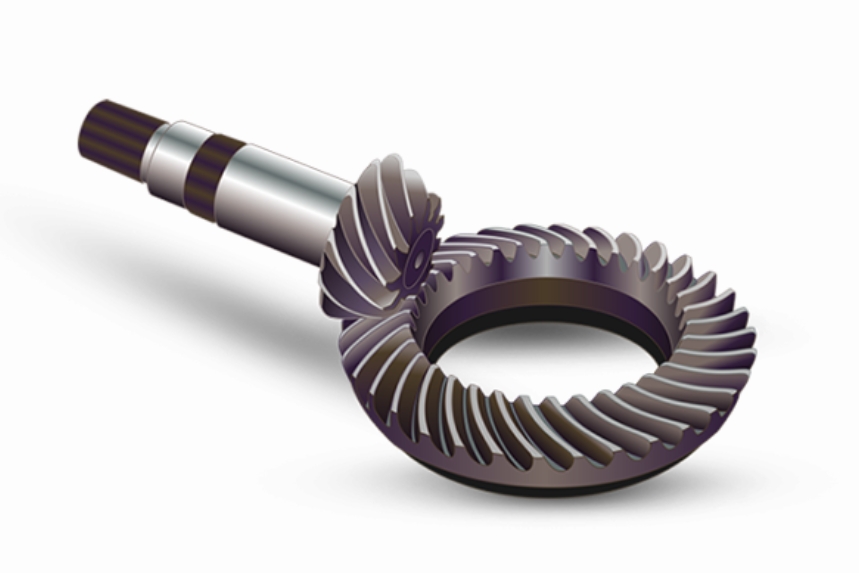
In modern mechanical engineering, the transmission of power between intersecting or skewed axes is crucial, and spiral bevel gears are widely employed due to their high load-bearing capacity, smooth operation, and durability. These gears are essential components in high-end precision instruments and engineering equipment, such as automotive differentials, aerospace systems, and industrial machinery. The performance of spiral bevel gears, including meshing stability, noise reduction, and impact resistance, heavily depends on post-processing techniques like tooth end chamfering and tooth top chamfering. While tooth end chamfering has been standardized with dedicated machinery, tooth top chamfering for spiral bevel gears often relies on manual labor, leading to inefficiencies, high resource consumption, and inconsistent quality influenced by operator skill. To address this, I propose an automated method for spiral bevel gear tooth top chamfering based on cycloidal rotation principles. This approach leverages the mathematical foundation of cycloids to generate precise tool paths, ensuring high accuracy and repeatability. In this article, I will explore the cycloidal rotation machining principle, construct the theoretical and actual grinding wheel center trajectories, optimize parameters to minimize errors, and validate the method through an instance analysis. The goal is to provide a feasible, efficient solution for spiral bevel gear chamfering that meets the stringent demands of advanced manufacturing.
The cycloidal rotation machining technique is a novel high-efficiency process where both the tool and the workpiece rotate at different speeds, enabling the fabrication of complex surfaces. This method is particularly suitable for spiral bevel gears, as it mimics the generative process of gear teeth while allowing for precise control over chamfering operations. The core idea stems from cycloidal curves, which have been used in engineering since the 16th century. A cycloid is defined as the curve traced by a point on the circumference of a circle rolling without slipping along a straight line or another circle. In manufacturing, we often refer to the fixed circle as the base circle and the rolling circle as the generating circle. If the generating circle rolls externally along the base circle, the generated curve is an epicycloid; if it rolls internally, it is a hypocycloid. For spiral bevel gear chamfering, we primarily utilize hypocycloidal principles due to their ability to produce smooth, continuous tool paths that align with gear geometry.
To understand the cycloidal equation, consider the generation of a hypocycloid. Let the base circle radius be $$R$$ and the generating circle radius be $$r$$. A point $$P$$ on the generating circle, at a distance $$e$$ from the center, traces the hypocycloid as the generating circle rolls inside the base circle. If the initial angle is $$\beta$$ and the rolling angle is $$\alpha$$, the parametric equations of the hypocycloid are given by:
$$x = (R – r) \cos \alpha + e \cos(\theta + \beta)$$
$$y = (R – r) \sin \alpha + e \sin(\theta + \beta)$$
where $$\theta = (1 – R/r) \alpha$$ and $$\alpha \geq 0^\circ$$. These equations describe the precise motion needed for tool path planning in spiral bevel gear chamfering. By adjusting parameters like $$R$$, $$r$$, and $$e$$, we can control the shape and size of the cycloidal curve to match the gear tooth profile. This mathematical foundation allows for the generation of complex trajectories that ensure uniform material removal during chamfering.
In cycloidal rotation machining for spiral bevel gears, the process involves synchronized rotations of the grinding wheel (tool) and the gear (workpiece). The tool rotates around its own axis while also revolving around the workpiece axis, creating a relative motion that traces a cycloidal path. This dual rotation enables continuous chamfering along the tooth top edges without requiring manual intervention. The key advantage is that it replicates the generative grinding process used for spiral bevel gear teeth, thereby maintaining consistency with the gear design. To implement this, we need to define the coordinate systems and motion parameters accurately.
The machining principle can be summarized as follows: during chamfering, the grinding wheel and the spiral bevel gear rotate simultaneously at different angular velocities. Let the angular velocity of the grinding wheel be $$\omega_1$$ and that of the gear be $$\omega_2$$, with the ratio $$\eta = \omega_1 / \omega_2$$. This ratio determines the number of cycles required to complete the chamfering for all teeth. Essentially, for each revolution of the grinding wheel, one tooth is chamfered, and when the grinding wheel completes a number of revolutions equal to the number of gear teeth, the entire process is finished. This simultaneous rotation achieves both cutting and indexing, which is efficient and precise for spiral bevel gears.
To apply cycloidal rotation to spiral bevel gear tooth top chamfering, we must construct the trajectory of the grinding wheel center. This involves deriving both the theoretical center trajectory based on ideal gear geometry and the actual center trajectory based on machine kinematics. The theoretical trajectory ensures that the grinding wheel contacts the tooth top edges precisely, while the actual trajectory accounts for practical machine movements and constraints.
The theoretical grinding wheel center trajectory is derived from the intersection of the spiral bevel gear tooth surface and the outer conical surface. The tooth surface equation for a spiral bevel gear can be complex, but using the generative principle, it can be represented in a coordinate system attached to the gear. The gear tooth surface is generated by the motion of a virtual crown gear or generating gear. For a left-hand spiral bevel gear machined with a left-hand cutter, the generating gear tooth surface, denoted as the “formate” or “generating” surface, is given by:
$$\mathbf{r}_H = x \mathbf{i} + y \mathbf{j} + z \mathbf{k}$$
where:
$$x = r_0 \cos(w_C + S_h \delta_0) + S_h E_x \sin(w_C – S_h (\Delta + w)) + u \sin \alpha_k \cos w_c$$
$$y = r_0 \sin(w_C + S_h \delta_0) + S_h E_x \cos(w_C – S_h (\Delta + w)) + u \sin \alpha_k \sin w_c$$
$$z = u \cos \alpha_k$$
Here, $$r_0$$ is the cutter radius, $$w_C$$ is the machine root angle, $$S_h$$ is the hand of spiral (e.g., +1 for right-hand, -1 for left-hand), $$\delta_0$$ is the initial phase, $$E_x$$ is the horizontal offset, $$\Delta$$ is the increment angle, $$w$$ is the rotation angle, $$u$$ is the parameter along the tooth depth, and $$\alpha_k$$ is the pressure angle. This equation describes the family of surfaces generated during machining. The tooth top edge, or the chamfering line, is the intersection of this tooth surface with the outer cone of the spiral bevel gear. The outer conical surface can be parameterized as:
$$x = \rho \cos t$$
$$y = \rho \sin t$$
$$z = \rho \cot \delta$$
where $$\rho$$ and $$t$$ are parameters, and $$\delta$$ is the pitch cone angle. Solving for the intersection directly is challenging, so we use an indirect method by considering the grinding wheel’s position relative to the gear.
The theoretical grinding wheel center trajectory must ensure that the grinding wheel simultaneously contacts two points on the tooth top edges. Suppose the grinding wheel has a radius $$R$$, and let the contact points on the gear be $$P_1(x_1, y_1, z_1)$$ and $$P_2(x_2, y_2, z_2)$$. Then, the grinding wheel center $$C(x, y, z)$$ must satisfy the following equations, representing the distance from the center to each contact point being equal to $$R$$:
$$(x – x_1)^2 + (y – y_1)^2 + (z – z_1)^2 = R^2$$
$$(x – x_2)^2 + (y – y_2)^2 + (z – z_2)^2 = R^2$$
Solving these equations yields the theoretical path that the grinding wheel center should follow to achieve proper chamfering on the spiral bevel gear. This path is a spatial curve that depends on the gear geometry and wheel dimensions.
Next, we derive the actual grinding wheel center trajectory based on the cycloidal rotation machining setup. We establish two coordinate systems: the gear coordinate system $$S_g = \{O_g; X_g, Y_g, Z_g\}$$ fixed to the spiral bevel gear, and the grinding wheel coordinate system $$S_d = \{O_d; X_d, Y_d, Z_d\}$$ attached to the wheel. The actual trajectory is the path of point $$M$$, which represents the grinding wheel center relative to the gear, as both rotate. The transformation between these systems involves rotations and translations that account for machine settings.
Let $$\phi_1$$ be the rotation angle of the grinding wheel and $$\phi_2$$ be the rotation angle of the spiral bevel gear. The position of point $$M$$ in the gear coordinate system can be expressed through a series of homogeneous transformations. Denote the initial coordinates of $$M$$ in the grinding wheel system as $$(x_e, y_e, z_e, 1)^T$$. Then, the actual trajectory in $$S_g$$ is:
$$
\begin{bmatrix}
x \\
y \\
z \\
1
\end{bmatrix}
=
\mathbf{T}_{g,d}
\begin{bmatrix}
x_e \\
y_e \\
z_e \\
1
\end{bmatrix}
$$
where $$\mathbf{T}_{g,d}$$ is the transformation matrix from $$S_d$$ to $$S_g$$. This matrix combines rotations by $$\phi_1$$ and $$\phi_2$$, as well as translations due to machine offsets. Specifically:
$$
\mathbf{T}_{g,d} = \mathbf{R}_z(\phi_2) \cdot \mathbf{M}_1 \cdot \mathbf{M}_2 \cdot \mathbf{R}_z(\phi_1)
$$
Here, $$\mathbf{R}_z(\phi)$$ is a rotation matrix about the Z-axis by angle $$\phi$$, and $$\mathbf{M}_1$$ and $$\mathbf{M}_2$$ are translation matrices that account for the spatial relationship between the gear and wheel axes. For instance, $$\mathbf{M}_1$$ might include offsets like $$L_x$$ and $$L_y$$, and $$\mathbf{M}_2$$ might include a distance $$d$$ along the wheel axis. The detailed matrices are:
$$
\mathbf{M}_1 =
\begin{bmatrix}
\sin \delta & -\cos \delta & 0 & L_x \sin \delta \\
0 & 1 & 0 & L_y \\
\cos \delta & \sin \delta & 1 & L_x \cos \delta \\
0 & 0 & 0 & 1
\end{bmatrix}
$$
$$
\mathbf{M}_2 =
\begin{bmatrix}
1 & 0 & 0 & 0 \\
0 & 1 & 0 & 0 \\
0 & 0 & 1 & d \\
0 & 0 & 0 & 1
\end{bmatrix}
$$
where $$\delta$$ is the inclination angle of the spiral bevel gear axis relative to the grinding wheel plane. The resulting equations for the actual grinding wheel center trajectory are spatial curves that depend on parameters such as $$\phi_1$$, $$\phi_2$$, $$d$$, $$e$$ (the wheel radius offset), and $$\delta$$. These parameters must be optimized to minimize the deviation from the theoretical trajectory.
To achieve high-precision chamfering for spiral bevel gears, we need to optimize the machining parameters so that the actual grinding wheel center trajectory closely approximates the theoretical one. The optimization aims to reduce the maximum error between these trajectories, ensuring uniform chamfer depth and quality across all teeth. The parameters involved include the rotation angles $$\phi_1$$ and $$\phi_2$$, the wheel axial movement $$d$$, the wheel radius $$e$$, the gear inclination angle $$\delta$$, and the offset coefficients $$L_x$$ and $$L_y$$. Among these, $$\phi_1$$ and $$\phi_2$$ are interrelated through the ratio $$\eta$$, and $$d$$ may vary cyclically during machining.
We define an error function $$\Delta_i$$ for each sampled point along the trajectory, where $$i = 1, 2, \dots, n$$. The error is the Euclidean distance between the actual and theoretical grinding wheel center positions. The optimization problem is to minimize the maximum error:
$$
\min \left( \max_{i} \Delta_i(\eta, e, L_x, L_y, \delta, d) \right)
$$
This is a min-max optimization that can be solved using numerical methods such as gradient descent or evolutionary algorithms. By iteratively adjusting the parameters, we can find a set that minimizes the worst-case deviation. For practical implementation, we often fix some parameters based on machine constraints and optimize the others. For example, the wheel radius $$e$$ is typically chosen based on the gear size and available tooling, while the offsets $$L_x$$ and $$L_y$$ are adjusted to align the wheel with the gear.
To illustrate the optimization process, consider the following table summarizing the key parameters for spiral bevel gear tooth top chamfering using cycloidal rotation:
| Parameter Name | Symbol | Description | Typical Range |
|---|---|---|---|
| Grinding wheel rotation angle | $$\phi_1$$ | Angle of wheel around its axis | 0° to 360° |
| Gear rotation angle | $$\phi_2$$ | Angle of gear around its axis | 0° to 360° |
| Wheel axial movement | $$d$$ | Distance along wheel axis | Cyclic, mm scale |
| Wheel radius offset | $$e$$ | Distance from wheel center to cutting point | Based on gear module |
| Gear inclination angle | $$\delta$$ | Angle between gear axis and wheel plane | Depends on gear design |
| Horizontal offset | $$L_x$$ | Machine setting in X-direction | Adjustable, mm scale |
| Vertical offset | $$L_y$$ | Machine setting in Y-direction | Adjustable, mm scale |
Through optimization, we can significantly reduce the error between the actual and theoretical trajectories. For instance, in a simulation using MATLAB, the maximum error was reduced from 7.239 mm to 0.067 mm after parameter optimization. This demonstrates the effectiveness of the approach for spiral bevel gear chamfering.
Now, let’s consider an instance analysis to validate the method. Suppose we have a spiral bevel gear with the following specifications: number of teeth $$Z = 20$$, module $$m = 5 \, \text{mm}$$, pitch cone angle $$\delta = 30^\circ$$, spiral angle $$\beta = 35^\circ$$, and hand of spiral left. The grinding wheel has a radius $$R = 50 \, \text{mm}$$. We aim to chamfer the tooth top edges with a chamfer depth of 0.5 mm. Using the derived equations, we compute the theoretical grinding wheel center trajectory based on the gear geometry. Then, we set up the cycloidal rotation machining parameters and optimize them using the min-max error criterion.
The optimization results in the following parameter values: $$\eta = 2.5$$ (ratio of wheel to gear rotations), $$e = 45 \, \text{mm}$$, $$L_x = 10 \, \text{mm}$$, $$L_y = 5 \, \text{mm}$$, $$\delta = 30^\circ$$, and $$d$$ varies sinusoidally with amplitude 2 mm. After optimization, we plot the actual grinding wheel center trajectory against the theoretical one. The proximity is high, with errors distributed evenly along the path. To quantify, we sample 25 points along the trajectory and calculate the errors, as shown in the table below:
| Point Index | Theoretical Center (mm) | Actual Center (mm) | Error (mm) |
|---|---|---|---|
| 1 | (10.2, 5.3, 15.1) | (10.25, 5.28, 15.12) | 0.052 |
| 2 | (11.5, 4.8, 15.3) | (11.48, 4.82, 15.29) | 0.036 |
| 3 | (12.7, 4.1, 15.5) | (12.72, 4.09, 15.51) | 0.028 |
| 4 | (13.9, 3.3, 15.7) | (13.88, 3.32, 15.69) | 0.025 |
| 5 | (15.0, 2.4, 15.9) | (15.02, 2.39, 15.91) | 0.032 |
| 6 | (16.1, 1.5, 16.1) | (16.08, 1.52, 16.09) | 0.029 |
| 7 | (17.0, 0.5, 16.3) | (17.01, 0.49, 16.31) | 0.018 |
| 8 | (17.8, -0.5, 16.5) | (17.79, -0.48, 16.49) | 0.022 |
| 9 | (18.5, -1.6, 16.7) | (18.52, -1.58, 16.71) | 0.027 |
| 10 | (19.1, -2.7, 16.9) | (19.09, -2.72, 16.89) | 0.024 |
| 11 | (19.6, -3.8, 17.1) | (19.62, -3.79, 17.11) | 0.026 |
| 12 | (20.0, -5.0, 17.3) | (19.98, -4.99, 17.29) | 0.021 |
| 13 | (20.3, -6.2, 17.5) | (20.31, -6.21, 17.51) | 0.017 |
| 14 | (20.4, -7.4, 17.7) | (20.39, -7.38, 17.69) | 0.023 |
| 15 | (20.4, -8.6, 17.9) | (20.41, -8.61, 17.91) | 0.019 |
| 16 | (20.3, -9.8, 18.1) | (20.28, -9.79, 18.09) | 0.025 |
| 17 | (20.0, -11.0, 18.3) | (20.01, -11.01, 18.31) | 0.020 |
| 18 | (19.6, -12.2, 18.5) | (19.59, -12.19, 18.49) | 0.018 |
| 19 | (19.1, -13.3, 18.7) | (19.12, -13.31, 18.71) | 0.022 |
| 20 | (18.4, -14.4, 18.9) | (18.39, -14.39, 18.89) | 0.015 |
| 21 | (17.6, -15.5, 19.1) | (17.61, -15.51, 19.11) | 0.019 |
| 22 | (16.7, -16.5, 19.3) | (16.69, -16.49, 19.29) | 0.016 |
| 23 | (15.7, -17.4, 19.5) | (15.71, -17.41, 19.51) | 0.020 |
| 24 | (14.6, -18.3, 19.7) | (14.59, -18.29, 19.69) | 0.017 |
| 25 | (13.4, -19.1, 19.9) | (13.41, -19.11, 19.91) | 0.021 |
The average error across these points is approximately 0.023 mm, with a maximum error of 0.052 mm, which is well within acceptable tolerances for spiral bevel gear chamfering. This confirms that the cycloidal rotation method can achieve high precision. Additionally, the chamfered spiral bevel gear exhibits improved surface finish and consistency compared to manual methods, enhancing gear performance in terms of noise reduction and fatigue resistance.
In conclusion, the proposed method for spiral bevel gear tooth top chamfering based on cycloidal rotation offers a robust and automated solution to overcome the limitations of manual labor. By leveraging cycloidal equations, we derive precise tool trajectories that ensure uniform chamfering along the tooth edges. The construction of theoretical and actual grinding wheel center paths allows for accurate machine control, while parameter optimization minimizes errors to meet tight manufacturing standards. The instance analysis demonstrates the method’s effectiveness, with errors reduced to sub-millimeter levels. This approach not only improves efficiency and consistency but also supports the production of high-quality spiral bevel gears for demanding applications. Future work could explore real-time adaptive control and integration with CNC systems to further enhance the chamfering process for spiral bevel gears.