
In the realm of power transmission, spiral bevel gears stand out as a pinnacle of engineering, renowned for their superior performance and high load-carrying capacity. As a primary direction in bevel gear technology development, spiral bevel gears, predominantly represented by the Klingelnberg and Gleason systems, offer significant advantages including smooth transmission, reduced noise, increased contact ratio, uniform wear, capability for high transmission ratios, and the potential for precision finishing processes like grinding and hard skiving. Throughout my extensive involvement in the manufacturing and design of spiral bevel gears, I have come to recognize that the contact pattern on the tooth flank is not merely a parameter but a comprehensive indicator. It reflects not only the individual gear’s accuracy but also the precision of the gearbox housing, the quality of assembly adjustments, the overall stiffness of the gear set, and the installation conditions, thereby serving as a holistic measure of the gear drive’s quality in service.
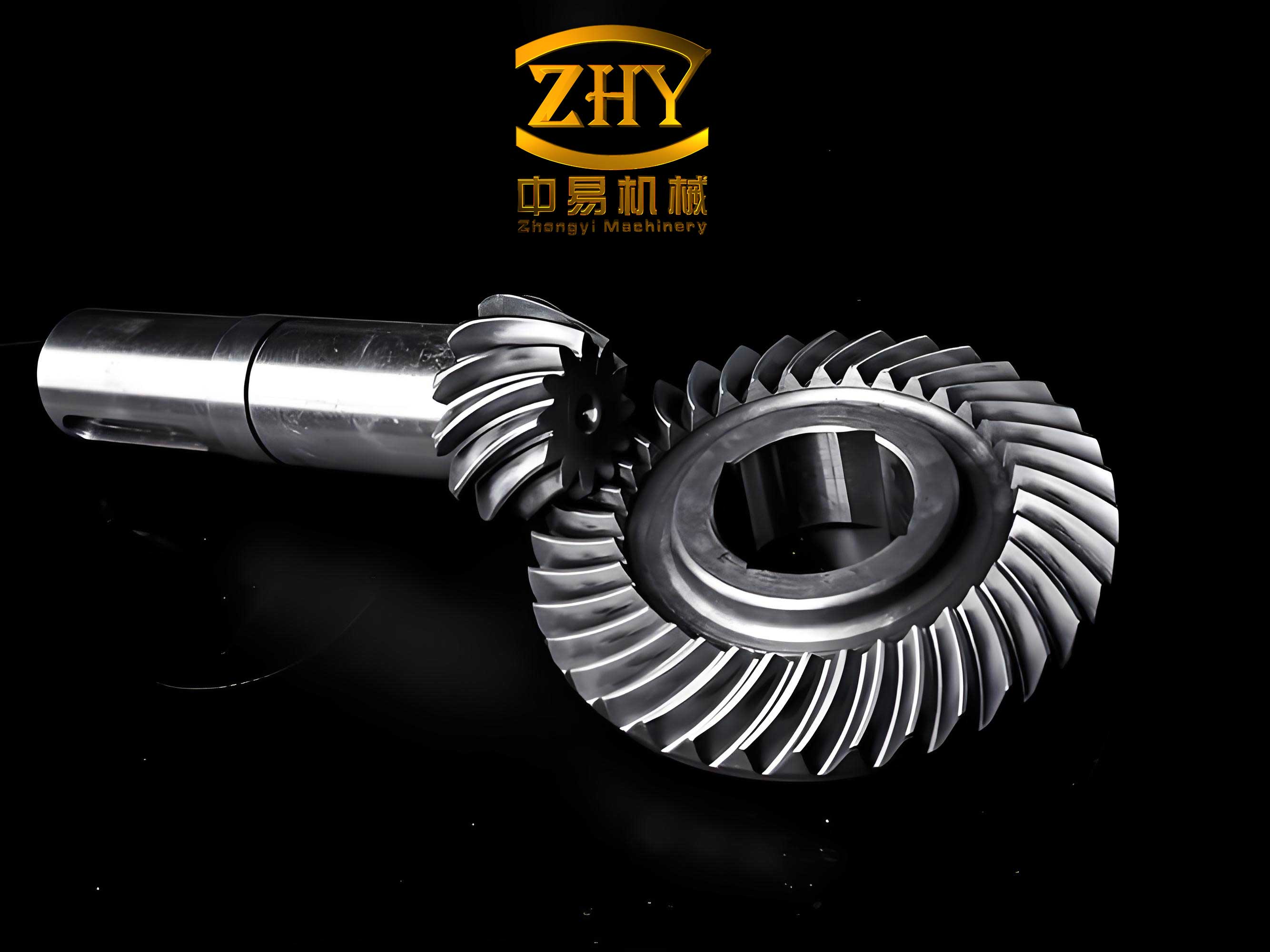
To ensure optimal performance, controlling the contact pattern is paramount. In practical production, we employ a method known as reverse correction: anticipating that under load, the working surface (convex side of the ring gear) contact pattern will shift toward the tooth center and tip, the finished gear’s contact pattern should be positioned toward the toe and root initially. The non-working face should be biased toward the heel and tip. The initial contact pattern during cutting is determined based on the workpiece’s heat treatment deformation规律. By testing on a rolling tester and observing the pattern’s behavioral规律, we adjust machining parameters accordingly to achieve a final合格 product. This article delves deeply into the inspection methodologies and corrective measures for spiral bevel gears contact patterns, drawing from hands-on experience to provide a detailed guide.
The inspection of contact patterns for spiral bevel gears is primarily conducted on a rolling检查机. By altering the relative positions of the two spindles, we can observe how the contact pattern changes in terms of location, size, and shape. In our practice, we first set the检查机 to the theoretical mounting distance using gauge blocks, install the gear pair, and position the两轴箱 according to scales. Since observing the ring gear’s tooth flank is more straightforward, we typically apply a thin layer of marking compound (e.g., red lead) to the pinion and run the gears in both directions for about 30 seconds each to transfer the pattern onto the ring gear. This allows for clear visualization. Based on numerous adjustments and observations, we have summarized the规律 of how the contact pattern shifts for a left-hand pinion when changing the spindle positions, as encapsulated in Table 1.
| Adjustment Parameter | Effect on Pinion Tooth Flank Contact Pattern Along Height Direction | Effect on Concave Flank Contact Pattern Along Length Direction | Effect on Convex Flank Contact Pattern Along Length Direction |
|---|---|---|---|
| Increase Mounting Distance (+ΔH) | Shifts significantly from tip toward root | Shifts slightly toward toe | Shifts slightly toward heel |
| Decrease Mounting Distance (-ΔH) | Shifts significantly from root toward tip | Shifts slightly toward heel | Shifts slightly toward toe |
| Positive Offset (+ΔV) | Shifts slightly from tip toward root | Shifts significantly from heel toward toe | Shifts significantly from toe toward heel |
| Negative Offset (-ΔV) | Shifts slightly from root toward tip | Shifts significantly from toe toward heel | Shifts significantly from heel toward toe |
Note: For a right-hand ring gear, the规律 is consistent but the signs of ΔH and ΔV are opposite. For a right-hand pinion, the length-direction规律 for the left-hand pinion is reversed, while the height-direction规律 remains the same. These规律 are fundamental for diagnosing and correcting contact patterns in spiral bevel gears.
The position of the contact pattern along the tooth length is intrinsically linked to the spiral angle of the spiral bevel gears. The slope along the tooth length is governed by the spiral angle. Therefore, any deviation in the contact pattern toward the toe or heel is attributed to errors in the spiral angle. Correction typically involves altering the radial cutter position to adjust the spiral angle. The relationship can be expressed through the basic formula for spiral angle approximation in spiral bevel gears: $$ \beta = \arcsin\left(\frac{m_n \cdot z}{d}\right) $$ where $\beta$ is the spiral angle, $m_n$ is the normal module, $z$ is the number of teeth, and $d$ is the pitch diameter. Adjusting the radial刀位 changes the effective cutting diameter, thereby modifying $\beta$. In practice, if the spiral angle needs to be increased, the radial cutter position is decreased, and vice versa. The magnitude of adjustment depends on experience and gear geometry; for等高齿, changes通常在0.1 to 0.6 mm. For larger adjustments, the ΔV value from the rolling tester can be used in calculations. Table 2 summarizes the effects of changing various factors on the contact pattern for spiral bevel gears.
| Changed Parameter | Effect on Contact Pattern (Left-Hand Concave Flank) | Effect on Contact Pattern (Left-Hand Convex Flank) |
|---|---|---|
| Decrease Radial Cutter Position or Eccentric Angle | Shifts from toe toward heel | Shifts from heel toward toe |
| Increase Radial Cutter Position or Eccentric Angle | Shifts from heel toward toe | Shifts from toe toward heel |
Additionally, changes in horizontal and vertical wheel positions, as well as cutter blade diameter, should be checked to ensure comprehensive correction for spiral bevel gears.
The contact pattern position along the tooth height direction is determined by the slope in the profile direction, which is influenced by the pressure angle. Deviations toward the root or tip indicate pressure angle errors. Correcting this involves modifying the pressure angle. Two primary methods are employed for spiral bevel gears. For minor corrections, adjusting the cradle center position and床位 is effective. If the contact pattern is偏于齿顶 (tip contact), decreasing the cradle center position and increasing the床位 can rectify it. Conversely, for齿根接触 (root contact), increasing the cradle center position and decreasing the床位 is applied. The relationship can be approximated by the pressure angle formula: $$ \alpha = \arccos\left(\frac{r_b}{r}\right) $$ where $\alpha$ is the pressure angle, $r_b$ is the base circle radius, and $r$ is the pitch circle radius. Adjustments alter the effective生成 geometry. For more significant pressure angle errors (up to 2°–3°), changing the machine’s ratio (滚比) is used. Increasing the ratio corrects tip contact on the pinion, while decreasing it corrects root contact. This directly affects the tooth profile generation in spiral bevel gears.
Diagonal contact in spiral bevel gears is a common issue arising from the use of the平顶齿轮加工原理, where the spiral angle and pressure angle vary along the tooth length. On the convex flank, the pressure angle is smaller at the heel and larger at the toe, leading to a tendency for the contact pattern to run from toe-root to heel-tip, termed “inner diagonal.” On the concave flank, the opposite occurs. Improper cutter diameter selection or紊乱调整 data can also cause diagonal contact. Mild diagonal contact may disappear after running-in, but when correction is needed, the “ratio–horizontal wheel position” method is applied, accompanied by changes in床位 to maintain cutting depth and radial刀位 to maintain proper length-wise position. Table 3 outlines the修正 strategies for diagonal contact in spiral bevel gears.
| Type of Diagonal Contact | Flank Type | Radial Cutter Position Adjustment | Axial Wheel Position Adjustment | 床位 Adjustment |
|---|---|---|---|---|
| Outer Diagonal | Convex | Increase | Decrease | Decrease |
| Concave | Decrease | Increase | Increase | |
| Inner Diagonal | Convex | Decrease | Increase | Increase |
| Concave | Increase | Decrease | Decrease |
Alternative methods include modifying the附加滚切方式 or vertical wheel position (hypoid offset) to correct diagonal contact in spiral bevel gears.
The width of the contact pattern on spiral bevel gears is crucial for load distribution and noise performance. Adjusting the vertical wheel position primarily influences the pattern width by altering the tooth flank curvature. The relationship can be described using curvature formulas: $$ \kappa = \frac{1}{R} $$ where $\kappa$ is the curvature and $R$ is the radius of curvature. Changing the vertical轮位 affects the relative positioning between the cutter and workpiece, thereby modifying the effective curvature. Table 4 summarizes how vertical wheel position adjustments impact the contact pattern width for different spiral bevel gears configurations.
| Gear Hand | Flank Type | Vertical Wheel Position Movement Direction | Effect on Contact Pattern Width |
|---|---|---|---|
| Left-Hand | Convex | Upward | Increases |
| Concave | Downward | Increases | |
| Right-Hand | Convex | Downward | Increases |
| Concave | Upward | Increases |
In practice, for spiral bevel gears, if the contact pattern is too narrow, moving the vertical轮位 as per Table 4 can widen it, ensuring better load distribution. Conversely, if too wide, the opposite adjustment is made. This fine-tuning is essential for optimizing the performance of spiral bevel gears.
Beyond these fundamental adjustments, the correction of contact patterns for spiral bevel gears often requires a综合调整 approach, where multiple parameters are adjusted simultaneously based on the specific deviation observed. For instance, a combination of radial刀位, cradle center, and ratio changes might be needed to correct both spiral angle and pressure angle errors. The interdependence of parameters can be modeled using equations from gear geometry. For example, the machine settings for generating spiral bevel gears can be represented as functions of design parameters: $$ X = f(\beta, \alpha, R, \ldots) $$ where $X$ represents machine settings like radial刀位, cradle angle, etc. In my experience, developing a systematic debugging procedure is key. We start by identifying the pattern deviation on the rolling tester, then参照 the规律 tables to hypothesize which parameters need adjustment, make incremental changes on the gear cutting machine, and re-check until the pattern is positioned correctly toward the toe and root for the convex flank, and toward the heel and tip for the concave flank, accounting for heat treatment shifts.
Furthermore, the importance of the contact pattern for spiral bevel gears extends to noise and vibration analysis. The contact pattern’s location and size directly influence meshing stiffness variations, which can be quantified using formulas like: $$ k_m = \frac{F}{\delta} $$ where $k_m$ is the meshing stiffness, $F$ is the load, and $\delta$ is the deflection. A poorly positioned pattern can lead to increased stiffness fluctuations, causing noise. Therefore, precise pattern control is integral to achieving quiet operation in spiral bevel gears applications.
In high-volume production of spiral bevel gears, we also implement statistical process control (SPC) for contact pattern parameters. By measuring pattern dimensions (length, width, centroid location) on a sample basis, we monitor trends and preempt deviations. This involves using coordinate measuring machines (CMMs) or dedicated pattern scanners. The data can be analyzed using control charts, with upper and lower specification limits derived from performance requirements. For example, the pattern centroid coordinates $(x_c, y_c)$ along length and height should fall within tolerance zones: $$ x_{c,\text{min}} \leq x_c \leq x_{c,\text{max}}, \quad y_{c,\text{min}} \leq y_c \leq y_{c,\text{max}} $$ This ensures consistency across batches of spiral bevel gears.
Another advanced aspect is the use of simulation software to predict contact patterns for spiral bevel gears under load. Finite element analysis (FEA) can model tooth deflections and contact pressures, allowing virtual debugging before physical cutting. The contact pattern can be simulated using elasticity theory: $$ \sigma_c = \sqrt{\frac{F E^*}{\pi R}} $$ where $\sigma_c$ is the contact stress, $E^*$ is the equivalent modulus, and $R$ is the relative curvature. By correlating simulation results with rolling tester observations, we refine our correction strategies for spiral bevel gears.
Moreover, the hardening process for spiral bevel gears induces distortions that affect the contact pattern. We conduct experiments to characterize the deformation规律, often expressed as shifts in pattern location: $$ \Delta L = a \cdot T + b \cdot C $$ where $\Delta L$ is the pattern shift, $T$ is the tempering temperature, $C$ is the carbon content, and $a, b$ are coefficients. This empirical model helps set pre-correction offsets during cutting, embodying the reverse correction method for spiral bevel gears.
In troubleshooting, when spiral bevel gears exhibit poor contact patterns post-assembly, we systematically check安装 errors, bearing preloads, and housing bores. The pattern on the rolling tester serves as a diagnostic tool. For instance, if the pattern is偏于齿顶 under load, we might increase the预调整 toward the root during cutting. This iterative learning process has been honed over years of manufacturing spiral bevel gears.
To encapsulate, the inspection and correction of contact patterns for spiral bevel gears are both an art and a science. The tables and formulas provided here offer a structured framework, but successful application requires hands-on experimentation and a deep understanding of gear geometry and machine dynamics. By meticulously adjusting parameters like radial刀位, cradle center, ratio, and vertical轮位, and by leveraging规律 from rolling tests, we can consistently produce spiral bevel gears with optimal contact patterns that ensure longevity, efficiency, and quiet operation. As technology evolves, integrating digital twins and AI for pattern prediction will further enhance our ability to master spiral bevel gears manufacturing, pushing the boundaries of what these remarkable components can achieve in advanced mechanical systems.