
In the field of mechanical engineering, spiral bevel gears play a crucial role due to their constant transmission ratio, high precision, and load-bearing capacity. They are widely used in aerospace, automotive, and industrial machinery. My research focuses on developing an accurate and efficient modeling method for spiral bevel gears using spherical involute theory, followed by inspection via 3D printing and coordinate measuring machines. This article details the theoretical foundations, modeling steps, simulation, and experimental validation, emphasizing the keyword ‘spiral bevel gears’ throughout.
The core of this approach lies in the spherical involute theory, which describes the tooth surface formation of spiral bevel gears. Unlike planar involutes, spherical involutes are curves on a sphere, ensuring that all points on the tooth surface maintain a constant distance from the pitch cone apex. This property is essential for the proper meshing of spiral bevel gears. The mathematical derivation starts with the generation of a spherical involute curve. Consider a rolling plane tangent to the root cone along a generatrix, performing pure rolling on the cone. A fixed point on this plane traces the spherical involute. In a dynamic coordinate system O-X’Y’Z’, the vector OB is given by:
$$ \begin{cases} x’ = l \sin\psi \\ y’ = 0 \\ z’ = l \cos\psi \end{cases} $$
Here, $l$ represents the length from the cone apex to point B, and $\psi = \beta \sin\delta_f$, where $\delta_f$ is the root cone angle. Through coordinate transformation between dynamic and static systems, the spherical involute equation in the static coordinate system O-XYZ is derived as:
$$ \begin{cases} x = l \left( \sin\beta \sin\psi + \cos\beta \cos\psi \sin\delta_f \right) \\ y = l \left( \sin\beta \cos\psi \sin\delta_f – \cos\beta \sin\psi \right) \\ z = l \cos\psi \cos\delta_f \end{cases} $$
To incorporate the helical characteristic of spiral bevel gears, a helix is introduced based on gear cutting principles. Imagine a cutter disk rotating with angular velocities $\omega_1$ (self-rotation) and $\omega$ (revolution), such that $\omega_1 = 2\omega$. This setup ensures that any point on the cutter moves linearly along the X-axis, imprinting a conical helix on the root cone. The trajectory equation for a point A on the cutter is:
$$ \begin{cases} x = -2r \sin(\omega t) \\ y = 0 \\ z = 0 \end{cases} $$
where $r$ is the cutter radius, typically $r = \frac{5}{6} R_x$, with $R_x$ as the outer cone distance. The workpiece rotates with angular velocity $\omega_2$, and due to pure rolling, $\omega / \omega_2 = \sin\delta_f$. This helix defines the starting points of the spherical involute, forming the tooth surface of spiral bevel gears.
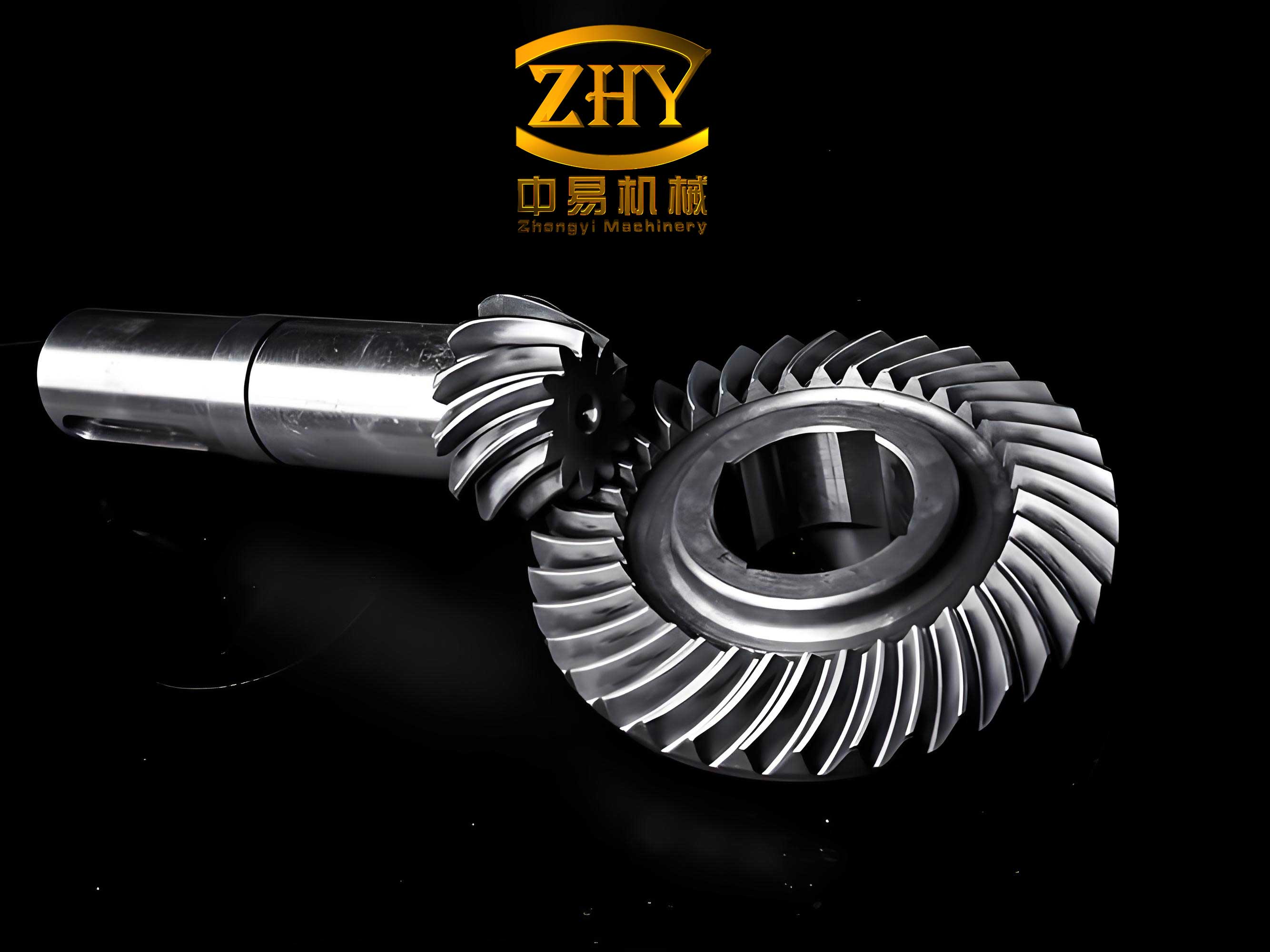
To apply this theory, I considered a pair of mating spiral bevel gears with specific parameters. The gear set includes a large gear and a small gear, designed for a 90° shaft angle. Key parameters are summarized in the table below, which are essential for generating discrete points and modeling.
| Parameter | Large Gear | Small Gear |
|---|---|---|
| Number of Teeth | 43 | 11 |
| Module at Large End (mm) | 4.65 | 4.65 |
| Pressure Angle (°) | 20 | 20 |
| Midpoint Spiral Angle (°) | 30 | 30 |
| Root Cone Angle (°) | 72.9727 | 13.4655 |
| Pitch Cone Angle (°) | 75.6507 | 14.3493 |
| Outer Cone Distance (mm) | 103.1945 | 103.1945 |
Using MATLAB software, I developed a program to compute discrete points for both concave and convex tooth surfaces of the spiral bevel gears. The program implements the spherical involute equations with helical parameters. For the small gear’s concave surface, the code iterates over parameters $\beta$ and $l$ to generate coordinates. The transformation matrices are applied as follows:
$$ A = \begin{bmatrix} \cos\omega_2 & \sin\omega_2 & 0 \\ -\sin\omega_2 & \cos\omega_2 & 0 \\ 0 & 0 & 1 \end{bmatrix}, \quad B = \begin{bmatrix} \sin\beta & -\cos\beta & 0 \\ \cos\delta_f \cos\beta & \cos\delta_f \sin\beta & -\sin\delta_f \\ \sin\delta_f \cos\beta & \sin\delta_f \sin\beta & \cos\delta_f \end{bmatrix} $$
Then, the coordinates are computed using $C = A \times \text{inv}(B) \times D$, where $D = [q \sin\psi; 0; q \cos\psi]$ and $q = 2r \sin(\omega j)$. This process yields thousands of points for each tooth surface, which are saved as text files. Similarly, points for the large gear and convex surfaces are generated by adjusting parameters like root cone angle and rotation direction. The discrete points form the basis for accurate modeling of spiral bevel gears.
Next, I imported these discrete points into UG NX12.0 software for surface fitting and solid modeling. The steps include creating fitted surfaces for concave and convex faces, sketching tooth profiles, and constructing gear blanks. For the large gear, I sketched the tooth profile on the X-Z plane, defining parameters such as cone distance, root cone angle, and tooth width. After rotating the sketch to form a sheet body, I trimmed it with the fitted surface to create a single tooth segment. The gear blank was modeled by sketching the root and addendum profiles and rotating around the axis. Key commands like ‘Sew’, ‘Mirror Geometry’, and ‘Pattern Geometry’ were used to replicate and assemble the teeth. The mirroring step ensures the correct hand of spiral for the large gear, while the small gear retains its original orientation. The final models of the spiral bevel gears are fully parametric and suitable for further analysis.
To validate the meshing performance, I assembled the spiral bevel gears in Creo Parametric 9.0. The assembly involves aligning the gear axes perpendicularly and constraining reference planes. For motion simulation, I used the mechanism module to define a gear pair with conical type. The motion axes were selected for both gears, and the transmission ratio was set as user-defined with pitch diameters of 199.95 mm and 51.15 mm. Dragging the small gear resulted in smooth rotation of both gears, confirming proper meshing. This simulation step is crucial for ensuring that the modeled spiral bevel gears function correctly before physical prototyping.
For physical validation, I exported the models as STL files and used a 3D printer with PLA material. The printing parameters were optimized for accuracy: layer height of 0.2 mm, wall thickness of 1.2 mm, and infill density of 10%. The printing process took approximately 18.5 hours for the large gear and 2.7 hours for the small gear, with material usage detailed in the table below. The printed spiral bevel gears showed good form and were able to mesh smoothly when manually tested.
| Component | Printing Time (hours) | Material Length (m) | Material Weight (g) |
|---|---|---|---|
| Large Spiral Bevel Gear | 18.5 | 63.89 | 191 |
| Small Spiral Bevel Gear | 2.7 | 8.51 | 25 |
| Large Gear Concave Tooth | 7.13 | 15.43 | 46 |
| Large Gear Convex Tooth | 15.24 | 33.29 | 99 |
| Small Gear Concave Tooth | 6.77 | 14.78 | 44 |
| Small Gear Convex Tooth | 7 | 15.55 | 46 |
To assess the accuracy of the 3D-printed spiral bevel gears, I performed inspection using a coordinate measuring machine (CMM). For efficient measurement, I planned the inspection points on the tooth surfaces. In UG NX, I created point sets on the concave and convex faces of both gears, with 12 points in the U-direction and 8 points in the V-direction, covering critical areas. The point coordinates were exported and optimized using an improved ant colony algorithm for path planning, reducing inspection time by about 26% as shown below.
| Tooth Surface | Unplanned Inspection Time (s) | Planned Inspection Time (s) | Time Reduction (%) |
|---|---|---|---|
| Large Gear Concave | 637 | 467 | 26.65 |
| Large Gear Convex | 646 | 476 | 26.35 |
| Small Gear Concave | 627 | 457 | 27.13 |
| Small Gear Convex | 630 | 466 | 26.03 |
The CMM, a Leitz Reference HP model, was used with a 5 mm probe ball. The measurement speed was set to 20 mm/s for movement and 2 mm/s for probing. After fitting the coordinate system, the probe followed the planned path automatically. The measured data were compared with the CAD model to compute errors. The error distributions for the spiral bevel gears are summarized in the table below, indicating that the 3D printing errors range from 0 to 0.16 mm, with average errors close to zero.
| Tooth Surface | Error Range (mm) | Mean Error (mm) | Standard Deviation (mm) |
|---|---|---|---|
| Large Gear Concave | 0 – 0.16 | 0.02 | 0.05 |
| Large Gear Convex | 0 – 0.06 | 0.01 | 0.03 |
| Small Gear Concave | 0 – 0.15 | 0.03 | 0.06 |
| Small Gear Convex | 0 – 0.15 | 0.02 | 0.04 |
The error analysis confirms the effectiveness of the modeling method. The spherical involute theory provides a robust foundation for generating accurate tooth surfaces for spiral bevel gears. The integration of MATLAB for discrete point generation, UG for modeling, Creo for simulation, and 3D printing for prototyping creates a comprehensive workflow. This approach is particularly useful for designing and testing spiral bevel gears in research and development, offering a balance between precision and efficiency.
In conclusion, my work demonstrates that spherical involute-based modeling of spiral bevel gears is viable and accurate. The use of discrete points and surface fitting enables detailed tooth geometry, while 3D printing and CMM inspection validate the physical counterparts. Future improvements could focus on optimizing printing parameters to reduce errors further or extending the method to other gear types. The keyword ‘spiral bevel gears’ has been central to this discussion, highlighting their importance in mechanical systems. This methodology paves the way for advanced manufacturing and inspection techniques for spiral bevel gears, contributing to the broader field of gear technology.