
In my years of experience in mechanical engineering and manufacturing, I have often encountered the intricate challenges associated with spiral gear systems. Spiral gears, particularly those with a shaft angle of 90 degrees, are crucial components in various applications, from automotive differentials to industrial machinery. Their unique geometry requires precise machining and deep understanding to ensure optimal performance. This article delves into advanced machining techniques and design principles for spiral gears, with a focus on practical insights gained through hands-on work. I will explore special toolpaths in CAM programming, detailed geometric calculations, and best practices for manufacturing these complex components. Throughout this discussion, the term ‘spiral gear’ will be emphasized to underscore its importance in power transmission systems.
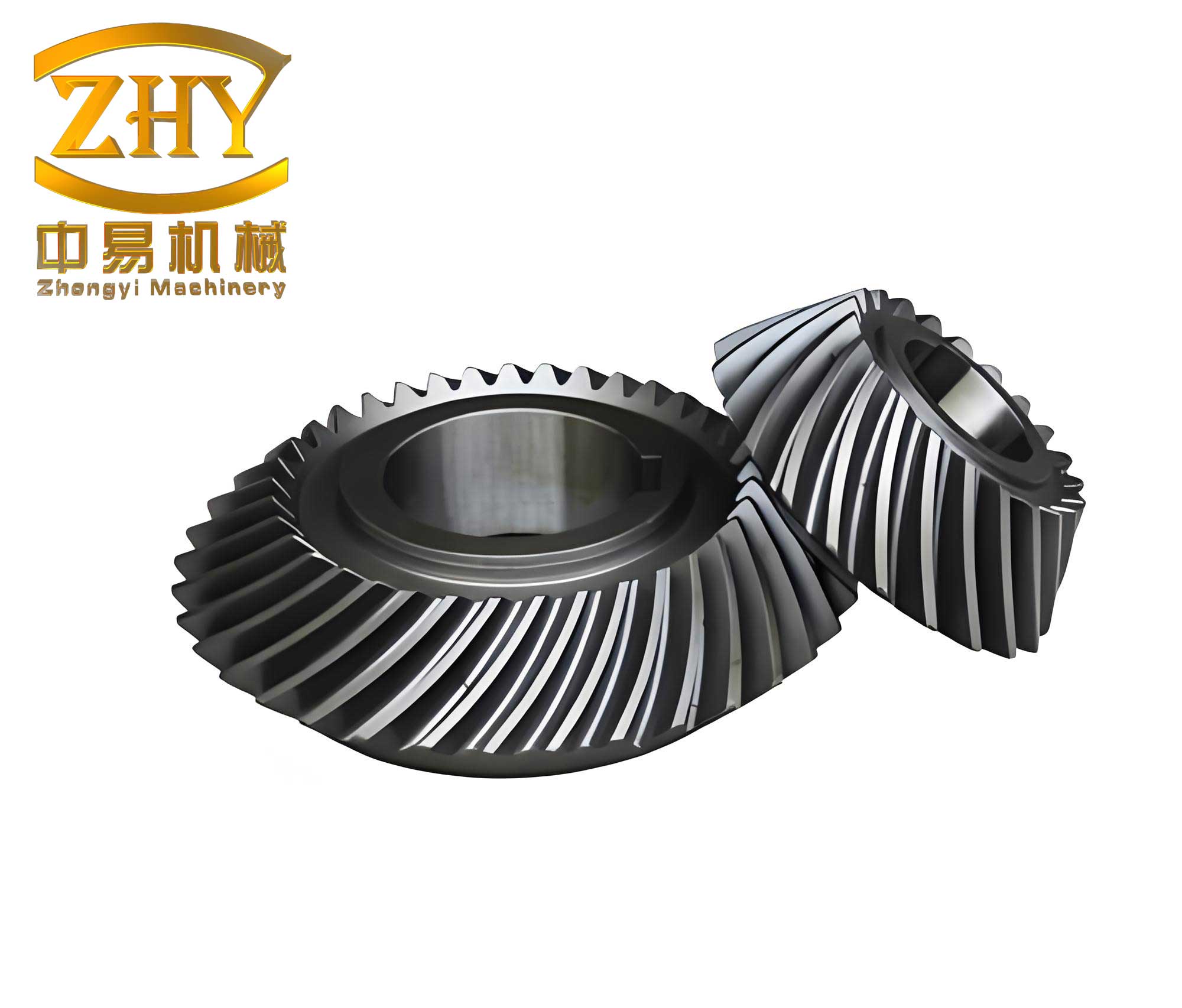
Spiral gears, often referred to as crossed helical gears, are characterized by their helical teeth that mesh at an angle. When the shaft angle is 90 degrees, the system involves a pinion and a gear with different helix angles and tooth counts. In my work, I have found that designing and machining such spiral gears demands a thorough grasp of their geometric relationships. The fundamental parameters include module, pressure angle, helix angle, and number of teeth. For a spiral gear pair with a 90-degree shaft angle, the helix angles ($\beta_1$ and $\beta_2$) satisfy the equation: $\beta_1 + \beta_2 = 90^\circ$. This relationship is pivotal in determining other dimensions. Below, I present a table summarizing key formulas for spiral gear design.
| Parameter | Formula | Description |
|---|---|---|
| Normal Module ($m_n$) | $m_n = m_t \cos \beta$ | Normal module derived from transverse module and helix angle. |
| Transverse Module ($m_t$) | $m_t = \frac{d}{z}$ | Transverse module based on pitch diameter and tooth count. |
| Helix Angle Relationship | $\beta_1 + \beta_2 = 90^\circ$ | Sum of helix angles equals shaft angle for spiral gears. |
| Center Distance ($a$) | $a = \frac{m_n (z_1 + z_2)}{2 \cos \beta_1 \cos \beta_2}$ | Center distance considering normal module and helix angles. |
| Axial Pitch ($p_a$) | $p_a = \frac{\pi m_n}{\sin \beta}$ | Axial pitch crucial for machining the spiral gear. |
| Pitch Diameter ($d$) | $d = \frac{m_n z}{\cos \beta}$ | Pitch diameter calculation for any spiral gear. |
When it comes to machining spiral gears, especially the pinion which often resembles a multi-start worm, CAM programming plays a vital role. I have extensively used software like UG/NX for generating toolpaths. One of the challenges is creating efficient roughing and finishing operations that accommodate the complex surfaces of spiral gears. Through experimentation, I have developed special toolpaths by modifying standard CAM operations. For instance, by adjusting the “surface region” machining operation, one can generate toolpaths that perform uniform depth cuts without retraction, ideal for machining channels or runners on mold surfaces. This technique involves selecting a drive geometry as an auxiliary surface, setting the tool position to “top,” and configuring cutting patterns. The formula for calculating stepover distance in such toolpaths can be expressed as: $$s = f \cdot \frac{d_t}{2}$$ where $s$ is stepover, $f$ is a factor based on surface finish, and $d_t$ is tool diameter. This ensures smooth material removal for spiral gear components.
Another valuable toolpath is the modified “area milling” operation, which produces spiral-like tool motion suitable for high-speed machining. By setting the cutting pattern to “parallel lines” with “Zig-Zag” type and enabling smooth transitions in non-cutting moves, this toolpath reduces tool wear and improves surface quality on spiral gear teeth. The cutting speed ($V_c$) for such operations can be optimized using: $$V_c = \frac{\pi \cdot d_t \cdot N}{1000}$$ where $N$ is spindle speed in RPM. Integrating these toolpaths requires careful parameter tuning, but they significantly enhance the machining of spiral gears.
Beyond machining, the tooth profile of the pinion in a 90-degree spiral gear pair is critical. In my analysis, I realized that in the plane through the pinion axis and perpendicular to the gear axis, the pinion acts like a rack, and the gear resembles an involute gear. This analogy simplifies profile determination. The pinion’s axial tooth profile corresponds to the gear’s transverse profile. Therefore, the pinion’s tooth dimensions, such as addendum ($h_a$) and dedendum ($h_f$), can be derived from the gear’s transverse parameters. For example, the addendum for the pinion is: $$h_a = m_t$$ and dedendum is: $$h_f = 1.25 m_t$$ assuming standard proportions. The complete tooth profile can be plotted using parametric equations for an involute curve, adjusted for helix angle. For a spiral gear, the transverse pressure angle ($\alpha_t$) relates to the normal pressure angle ($\alpha_n$) by: $$\tan \alpha_t = \frac{\tan \alpha_n}{\cos \beta}$$ This equation is essential for accurate tooth generation.
To further illustrate, consider a spiral gear pair with normal module $m_n = 2 \text{ mm}$, pinion teeth $z_1 = 20$, gear teeth $z_2 = 40$, and shaft angle $\Sigma = 90^\circ$. If we choose a helix angle $\beta_1 = 30^\circ$ for the pinion, then $\beta_2 = 60^\circ$ for the gear. Using the formulas, we can compute all dimensions. Below is a table with calculated values for this example.
| Component | Parameter | Value |
|---|---|---|
| Pinion (Spiral Gear) | Transverse Module ($m_t$) | $m_t = \frac{m_n}{\cos \beta_1} = \frac{2}{\cos 30^\circ} \approx 2.309 \text{ mm}$ |
| Pitch Diameter ($d_1$) | $d_1 = m_t \cdot z_1 = 2.309 \times 20 = 46.18 \text{ mm}$ | |
| Axial Pitch ($p_{a1}$) | $p_{a1} = \frac{\pi m_n}{\sin \beta_1} = \frac{\pi \times 2}{\sin 30^\circ} = 12.57 \text{ mm}$ | |
| Addendum ($h_{a1}$) | $h_{a1} = m_t = 2.309 \text{ mm}$ | |
| Gear (Spiral Gear) | Transverse Module ($m_t$) | $m_t = \frac{m_n}{\cos \beta_2} = \frac{2}{\cos 60^\circ} = 4 \text{ mm}$ |
| Pitch Diameter ($d_2$) | $d_2 = m_t \cdot z_2 = 4 \times 40 = 160 \text{ mm}$ | |
| Axial Pitch ($p_{a2}$) | $p_{a2} = \frac{\pi m_n}{\sin \beta_2} = \frac{\pi \times 2}{\sin 60^\circ} \approx 7.26 \text{ mm}$ | |
| Center Distance ($a$) | $a = \frac{d_1 + d_2}{2} = \frac{46.18 + 160}{2} = 103.09 \text{ mm}$ |
In CAM programming for spiral gears, I often utilize multi-axis machining strategies to handle the helical surfaces. The toolpath generation must account for continuous tool engagement to avoid marks on the tooth flanks. For spiral gears, the lead ($L$) of the helix is given by: $$L = \pi d \cot \beta$$ where $d$ is pitch diameter. This lead determines the toolpath length along the axis. By incorporating this into CAM operations, one can achieve precise tooth forms. Additionally, for roughing spiral gear blanks, I recommend adaptive clearing toolpaths that maintain constant chip load, defined by: $$Q = f_z \cdot z \cdot N$$ where $Q$ is material removal rate, $f_z$ is feed per tooth, and $z$ is number of tool teeth. This is particularly effective for spiral gear materials like steel or bronze.
The design of spiral gears also involves checking for interference and undercutting, especially when the pinion has a small number of teeth. The minimum tooth count to avoid undercutting in the transverse plane is: $$z_{\min} = \frac{2 h_a^*}{m_t \sin^2 \alpha_t}$$ where $h_a^*$ is addendum coefficient. For spiral gears with high helix angles, this limit is reduced, offering flexibility. However, backlash control is crucial for spiral gear pairs to ensure smooth operation. Backlash ($j$) can be adjusted by modifying center distance or tooth thickness, and it is calculated as: $$j = \Delta a \cdot \tan \alpha_t$$ where $\Delta a$ is the deviation from theoretical center distance. Proper backlash minimizes noise and wear in spiral gear transmissions.
In practice, machining spiral gears on CNC lathes or milling centers requires precise fixturing and tool alignment. For the pinion, which is essentially a worm, I use thread milling or whirling processes. The tool geometry must match the tooth profile of the spiral gear. For example, the tool’s pressure angle should equal the normal pressure angle of the spiral gear. The cutting depth for each pass can be derived from the tooth depth formula: $$h = h_a + h_f = 2.25 m_t$$ By dividing this into multiple steps, spiral gear teeth are machined accurately. Coolant and lubrication are vital during machining to dissipate heat, as spiral gears often operate in high-friction environments.
Moreover, surface finish on spiral gear teeth affects efficiency and lifespan. I employ finishing toolpaths with stepover distances less than 10% of tool diameter to achieve low roughness. The surface roughness ($R_a$) can be estimated from feed rate ($f$) and tool nose radius ($r_e$) using: $$R_a \approx \frac{f^2}{32 r_e}$$ This equation guides parameter selection for spiral gear finishing. Post-machining, heat treatment like carburizing or nitriding is applied to spiral gears to enhance hardness and durability.
To summarize the design process for spiral gears, I have created a flowchart of steps, but in textual form: start with application requirements, determine load and speed, select materials, calculate geometric parameters using the formulas above, perform strength checks (e.g., bending stress $\sigma_b = \frac{F_t}{b m_n Y}$ where $F_t$ is tangential force, $b$ is face width, $Y$ is form factor), and finally plan machining operations. Throughout, the unique aspects of spiral gears must be considered, such as the sliding action between teeth due to the helix angle. This sliding velocity ($v_s$) is given by: $$v_s = v \cdot \sin \beta$$ where $v$ is pitch line velocity. This sliding contributes to wear, so lubrication design is key for spiral gear systems.
In conclusion, mastering spiral gear design and machining requires a blend of theoretical knowledge and practical skills. From special CAM toolpaths to precise tooth profile calculations, every aspect demands attention. I have shared insights from my experience, emphasizing the term ‘spiral gear’ to highlight its significance. By leveraging advanced software and understanding geometric principles, engineers can produce high-performance spiral gears for diverse applications. Future trends may include additive manufacturing for spiral gears, but traditional machining will remain relevant for precision. I encourage continuous learning and experimentation to unlock the full potential of spiral gear technology.
For those interested in further exploration, I recommend studying the dynamics of spiral gear meshing, where vibration analysis can optimize noise reduction. The meshing frequency ($f_m$) for a spiral gear pair is: $$f_m = \frac{N \cdot z}{60}$$ where $N$ is rotational speed in RPM. Monitoring this frequency helps in diagnosing issues. Ultimately, the spiral gear is a testament to mechanical ingenuity, and its applications will continue to expand with advancements in manufacturing.