
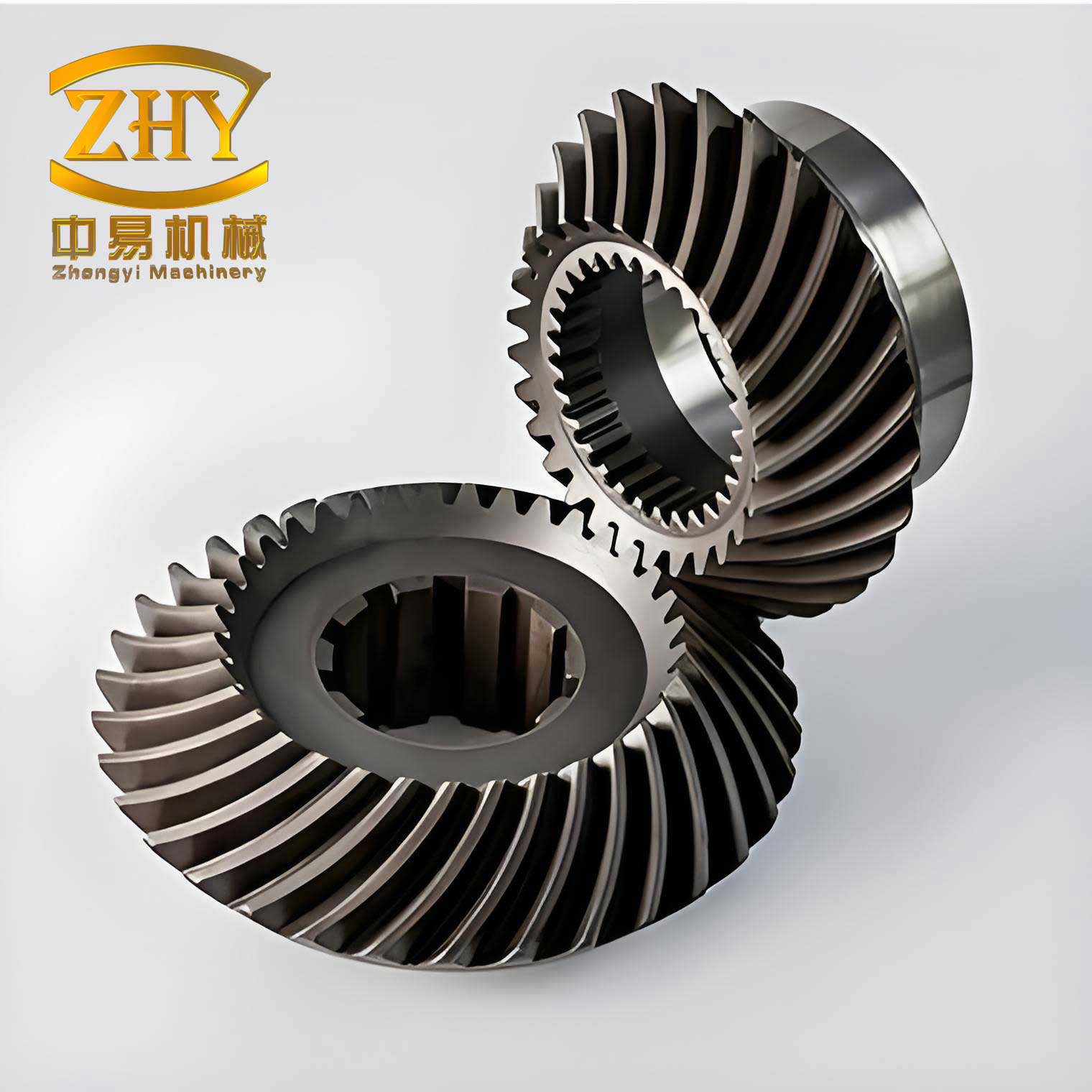
The application of **spiral gears**, also known as crossed helical gears, in modern industry is driven by their relative ease of manufacture and lower cost compared to other types of gear systems like hypoid or bevel gears. However, a significant barrier to their widespread adoption has been the lack of mature, universally accepted formulas for calculating their load-bearing capacity, particularly their resistance to pitting and surface wear—their contact fatigue strength. This analysis aims to bridge that gap by developing a practical engineering methodology for the contact fatigue strength calculation of **spiral gears**. By examining the unique geometric characteristics of the contact point and deriving a comprehensive formula, this work provides engineers with a reliable tool for design and analysis. Furthermore, a detailed investigation into the influencing factors and their effects offers critical insights for optimizing **spiral gears** performance in real-world applications, thereby enhancing their utility and reliability in mechanical power transmission systems.
### 1. Geometrical Characteristics of the Contact Point in Spiral Gears
Unlike parallel-axis gears where teeth make line contact, the mating of **spiral gears** results in point contact. This fundamental difference arises because the axes are non-parallel and non-intersecting. The contact ellipse’s size, shape, and orientation are crucial for stress calculation. The analysis begins at the pitch point, P, where the pitch cylinders of the two **spiral gears** are tangent. Let $\beta_1$ and $\beta_2$ represent the helix angles of gear 1 (driver) and gear 2 (driven), respectively. The shaft angle $\Sigma$ is given by $\Sigma = \beta_1 + \beta_2$ for gears of the same hand, and $\Sigma = |\beta_1| + |\beta_2|$ for gears of opposite hand, though in the standard notation for **spiral gears**, $\Sigma = \beta_1 \pm \beta_2$.
On an involute helicoidal surface, the straight-line generator (the tooth trace) is a principal direction where the normal curvature is zero. For gear $i$ (i=1,2), let $k_{Ii}$ be the normal curvature in this first principal direction. Therefore:
$$k_{I1} = 0, \quad k_{I2} = 0$$
The second principal direction is perpendicular to the generator. The normal curvatures in these directions, $k_{II1}$ and $k_{II2}$, are derived from the geometry of the involute helicoid:
$$k_{II1} = \frac{\cos^2 \alpha_t \cos \beta_{b1}}{d_1 \sin \alpha_t \cos \beta_1}, \quad k_{II2} = \frac{\cos^2 \alpha_t \cos \beta_{b2}}{d_2 \sin \alpha_t \cos \beta_2}$$
Where:
* $\alpha_t$ is the transverse pressure angle at the pitch cylinder.
* $\alpha_n$ is the normal pressure angle.
* $d_1$ and $d_2$ are the pitch diameters.
* $\beta_{b1}$ and $\beta_{b2}$ are the base cylinder helix angles, related by $\sin \beta_{bi} = \sin \beta_i \cos \alpha_n$.
* The gear ratio is $u = z_2 / z_1 = d_2 / d_1$.
The relationship between transverse and normal pressure angle is: $\tan \alpha_t = \tan \alpha_n / \cos \beta$.
The sum of the principal curvatures for the two gear surfaces at the pitch point, $\Sigma k$, is therefore:
$$\Sigma k = k_{II1} + k_{II2} = \frac{\cos^2 \alpha_t}{d_1 \sin \alpha_t} \left( \frac{\cos \beta_{b1}}{\cos \beta_1} + \frac{1}{u} \cdot \frac{\cos \beta_{b2}}{\cos \beta_2} \right)$$
In **spiral gears**, the principal directions of the two contacting surfaces are not aligned. The angle between the tooth generator and the contact line at the pitch point differs for each gear. Let $\psi_1$ and $\psi_2$ be these angles. They can be calculated as:
$$\tan \psi_1 = \frac{\sin \Sigma}{\frac{\cos \beta_2}{\sin \beta_1} + \cos \Sigma}, \quad \tan \psi_2 = \frac{\sin \Sigma}{\frac{\cos \beta_1}{\sin \beta_2} + \cos \Sigma}$$
The sign convention: $\psi_i$ is positive for a right-hand helix and negative for a left-hand helix. The angle between the principal directions of the two surfaces is then $\psi = \psi_1 – \psi_2$.
The geometry of the contact ellipse is defined by the relative curvature. A key parameter is the ratio $\theta$ of the induced principal curvatures along the major and minor axes of the contact ellipse. This ratio is derived from the principal curvatures and the angle $\psi$:
$$\theta = \frac{|k_{II1} – k_{II2}|}{\sqrt{(k_{II1} + k_{II2})^2 – 4 k_{II1} k_{II2} \sin^2 \psi}}$$
This ratio $\theta$ uniquely determines the eccentricity of the contact ellipse and is fundamental to calculating the contact stress. It depends solely on the helix angles $\beta_1$, $\beta_2$, and the gear ratio $u$.
### 2. Calculation Formulas for Contact Fatigue Strength
The contact stress at the center of the elliptical contact area between two elastic bodies, according to Hertzian theory, is given by:
$$\sigma_H = Z_E \sqrt{ \frac{F_n \Sigma k}{2 \pi (1 – \nu^2)} \cdot \frac{1}{\cos \theta} }$$
For **spiral gears**, we adapt this formula by incorporating the specific geometry. The normal load $F_n$ is the calculated load perpendicular to the tooth surface:
$$F_n = \frac{K F_t}{\cos \alpha_n \cos \beta} \approx \frac{K T_1}{d_1 \cos \alpha_n \cos \beta_1}$$
Where:
* $K$ is the load factor ($K = K_A K_V$), accounting for application and dynamic loads. For **spiral gears** with low contact ratios, $K_V$ can be significant.
* $F_t$ is the nominal tangential force at the pitch circle.
* $T_1$ is the driving pinion torque.
$Z_E$ is the elasticity coefficient:
$$Z_E = \sqrt{ \frac{2}{\pi \left( \frac{1-\nu_1^2}{E_1} + \frac{1-\nu_2^2}{E_2} \right) }}$$
Where $E_i$ and $\nu_i$ are the modulus of elasticity and Poisson’s ratio for gear $i$, respectively.
Substituting the expression for $\Sigma k$ and $F_n$ into the Hertz formula, we derive the fundamental contact stress formula for **spiral gears**:
$$\sigma_H = Z_E Z_\beta Z_u \sqrt{ \frac{K T_1}{d_1^3} \cdot \frac{u \pm 1}{u} }$$
Where:
* $Z_\beta$ is the helix angle factor, influencing the curvature. A simplified form is $Z_\beta \approx \sqrt{\cos \beta}$.
* $Z_u$ is a **critical new factor** introduced to account for the combined effect of helix angles and gear ratio on the effective curvature and the shape of the contact ellipse. It is defined as:
$$Z_u = \sqrt{ \frac{1}{\pi} \cdot \frac{\cos^2 \alpha_t}{\sin \alpha_t \cos \alpha_n} \cdot \frac{1}{\sqrt{\cos \theta}} \cdot \sqrt{ \frac{\cos \beta_{b1}}{\cos \beta_1} + \frac{1}{u} \cdot \frac{\cos \beta_{b2}}{\cos \beta_2} }}$$
The factor $\cos \theta$ in the denominator of $Z_u$ directly links the elliptical contact geometry (through $\theta$) to the contact stress. The relationship between the auxiliary parameter $\theta$ and the standard Hertzian elliptic integrals is well-tabulated. For convenience in engineering design, the value of $1/\sqrt{\cos \theta}$ can be pre-calculated or determined from charts based on $\beta_1$, $\beta_2$, and $u$.
Let $[\sigma_H]$ be the allowable contact stress, defined as $[\sigma_H] = \frac{\sigma_{H \lim} Z_N}{S_H}$, where $\sigma_{H \lim}$ is the endurance limit for contact stress, $Z_N$ is the life factor, and $S_H$ is the safety factor. The design formula to prevent contact fatigue failure in **spiral gears** is then:
$$d_1 \ge \sqrt[3]{ \frac{K T_1}{[\sigma_H]^2} \cdot \frac{u \pm 1}{u} \cdot (Z_E Z_\beta Z_u)^2 }$$
This formula highlights that the pinion pitch diameter $d_1$ is the primary design variable for contact strength, not the face width. The face width $b$ should be sufficient for lateral stability, typically $b \ge \pi m_n$, where $m_n$ is the normal module.
### 3. Analysis of Influencing Factors and Their Effects
A thorough analysis of the derived formula reveals how key parameters affect the contact fatigue strength of **spiral gears**.
**1. Pinion Pitch Diameter ($d_1$):** This is the most dominant factor. Contact stress $\sigma_H$ is inversely proportional to $d_1^{3/2}$. A small increase in $d_1$ significantly reduces stress and increases pitting resistance. This underscores a key design principle for **spiral gears**: increasing center distance/pitch diameter is highly effective for improving contact life.
**2. Helix Angles ($\beta_1, \beta_2$):** Helix angles have a dual, complex influence:
* *Effect on Curvature:* Generally, increasing the helix angles increases the equivalent radius of curvature at the contact point ($1/\Sigma k$ decreases), which tends to reduce contact stress.
* *Effect on Contact Ellipse Shape:* The angles $\beta_1$ and $\beta_2$, along with their relative hand, determine the parameter $\theta$ and thus the factor $1/\sqrt{\cos \theta}$ in $Z_u$. This factor modifies the basic Hertzian stress.
To illustrate the combined effect, the factor $1/\sqrt{\cos \theta}$ can be tabulated. The table below shows a sample for gears of opposite hand.
**Table 1: Values of $1/\sqrt{\cos \theta}$ for Gears of Opposite Hand ($\beta_1 = 10^\circ$)**
| $\beta_2$ (deg) | u=1 | u=2 | u=3 | u=5 | u=8 |
| :— | :—: | :—: | :—: | :—: | :—: |
| **10** | 1.000 | 0.985 | 0.978 | 0.971 | 0.967 |
| **20** | 0.985 | 0.970 | 0.962 | 0.955 | 0.951 |
| **30** | 0.978 | 0.962 | 0.954 | 0.946 | 0.942 |
| **45** | 0.971 | 0.955 | 0.946 | 0.938 | 0.934 |
**General Trends:**
* **Opposite Hand Gears:** The factor $1/\sqrt{\cos \theta}$ is always less than or equal to 1, meaning the elliptical contact condition slightly *reduces* stress compared to a simplified line contact assumption. The value is minimized (most favorable) when $|\beta_1| \approx |\beta_2|$.
* **Same Hand Gears:** The factor can be greater than 1, indicating a *less favorable* elliptical contact that increases stress. For a fixed $\beta_1$, there is often a specific $\beta_2$ that maximizes this factor, leading to a peak in contact stress for that configuration.
* **Summary:** For opposite-hand **spiral gears**, the curvature effect dominates, and larger, more equal helix angles are beneficial. For same-hand gears, the ellipse shape effect is significant and can create an unfavorable stress peak at certain angle combinations.
**3. Gear Ratio ($u$):** The gear ratio also has a dual beneficial effect:
* *Curvature Effect:* As $u$ increases, the equivalent curvature radius increases ($\Sigma k$ decreases), reducing stress.
* *Ellipse Shape Effect:* As shown in Table 1, for a given $\beta_1, \beta_2$, increasing $u$ generally decreases the factor $1/\sqrt{\cos \theta}$, further reducing stress.
Both effects work in unison to lower contact stress as the gear ratio increases, improving the contact fatigue strength of the slower-moving, larger **spiral gear**.
**4. Material Pairing:** The choice of materials directly affects the elasticity coefficient $Z_E$ and the allowable stress $[\sigma_H]$. Effective material pairing is crucial for maximizing the load capacity of **spiral gears**.
**Table 2: Common Material Pairings for Spiral Gears**
| Material Pairing | Approx. $Z_E$ [$\sqrt{\text{N/mm}^2}$] | $\sigma_{H \lim}$ Range [N/mm²] | Characteristics |
| :— | :—: | :—: | :— |
| Case-hardened Steel / Case-hardened Steel | 189.8 | 1200 – 1500 | Highest strength, requires high precision and smooth finish. |
| Hardened Steel / Bronze | 159.8 | 500 – 800 | Good for wear resistance, bronze accommodates misalignment. |
| Quenched & Tempered Steel / Cast Iron (Nodular) | 181.4 | 500 – 700 | Good balance of strength and cost. |
| Quenched & Tempered Steel / Grey Cast Iron | 165.4 | 350 – 500 | Economical for low-to-medium loads. |
| Grey Cast Iron / Grey Cast Iron | 146.0 | 250 – 400 | Used for very low loads and non-critical applications. |
**5. Lubrication and Running-in:** Proper lubrication is vital. During initial operation, a controlled running-in period under appropriate lubricant promotes mild wear that smoothens surface asperities and slightly increases the contact area (conforms the surfaces). This running-in process effectively increases the equivalent radius of curvature, leading to a lower steady-state contact stress and prolonged fatigue life for the **spiral gears**.
### 4. Design Example
To demonstrate the application of the proposed method, consider a drive with the following requirements:
* Power, $P = 10 \text{ kW}$
* Pinion speed, $n_1 = 1000 \text{ rpm}$
* Gear ratio, $u = 3$
* Shaft angle, $\Sigma = 90^\circ$
* Life: Long-term operation
* Prime mover: Electric motor, driven machine with moderate shock.
**Step 1: Initial Parameters and Material Selection**
* Select opposite-hand **spiral gears** for more favorable contact.
* Choose helix angles: $\beta_1 = 45^\circ$ (right-hand), $\beta_2 = 45^\circ$ (left-hand).
* Normal module, $m_n = 3 \text{ mm}$.
* Normal pressure angle, $\alpha_n = 20^\circ$.
* Material: Pinion and gear made from case-hardened steel (Grade 1). From Table 2, assume $\sigma_{H \lim} = 1300 \text{ N/mm}^2$, $Z_E = 189.8 \text{ N}^{0.5}\text{/mm}$.
* Life factor $Z_N \approx 1.0$, Safety factor $S_H = 1.1$. Thus, $[\sigma_H] = 1300 \cdot 1.0 / 1.1 \approx 1182 \text{ N/mm}^2$.
* Load factor estimate: $K = K_A K_V = 1.25 \times 1.1 = 1.375$.
**Step 2: Preliminary Pinion Diameter Calculation**
First, calculate the pinion torque: $T_1 = 9.55 \times 10^6 \times \frac{P}{n_1} = 9.55 \times 10^4 \text{ Nmm}$.
For $\beta_1=\beta_2=45^\circ$, $u=3$, and opposite hand, from a detailed chart (extrapolating from Table 1), we find $1/\sqrt{\cos \theta} \approx 0.94$.
Calculate $Z_u$ components:
* $\alpha_t = \arctan(\tan 20^\circ / \cos 45^\circ) \approx 27.24^\circ$
* $\cos \beta_b = \sqrt{1 – (\sin \beta \cos \alpha_n)^2} \approx \cos \beta$ for high $\beta$.
* $Z_u = \sqrt{ \frac{1}{\pi} \cdot \frac{\cos^2 27.24^\circ}{\sin 27.24^\circ \cos 20^\circ} \cdot \frac{1}{0.94} \cdot \sqrt{ \frac{\cos 45^\circ}{\cos 45^\circ} + \frac{1}{3} \cdot \frac{\cos 45^\circ}{\cos 45^\circ} }} \approx \sqrt{0.318 \times 1.576 \times 1.064 \times \sqrt{1.333}} \approx 0.83$
* $Z_\beta = \sqrt{\cos 45^\circ} \approx 0.84$
Now apply the design formula:
$$d_1 \ge \sqrt[3]{ \frac{1.375 \times 9.55 \times 10^4}{1182^2} \times \frac{3+1}{3} \times (189.8 \times 0.84 \times 0.83)^2 }$$
$$d_1 \ge \sqrt[3]{ \frac{1.31 \times 10^5}{1.397 \times 10^6} \times 1.333 \times (132.3)^2 } \approx \sqrt[3]{0.0938 \times 1.333 \times 17500} \approx \sqrt[3]{2188} \approx 13.0 \text{ mm}$$
This calculated $d_1$ is very small due to the high allowable stress. We proceed with the chosen $m_n=3$ mm.
**Step 3: Tooth Number and Geometry Finalization**
$d_1 = \frac{m_n z_1}{\cos \beta_1} \Rightarrow z_1 = \frac{d_1 \cos \beta_1}{m_n} = \frac{13.0 \times \cos 45^\circ}{3} \approx 3.06$. This is too low.
Choose $z_1 = 20$ teeth. Then $d_1 = (3 \times 20) / \cos 45^\circ \approx 84.85 \text{ mm}$.
$z_2 = u \times z_1 = 60$ teeth. $d_2 = (3 \times 60) / \cos 45^\circ \approx 254.56 \text{ mm}$.
Center distance $a = (d_1 + d_2)/2 = (84.85 + 254.56)/2 \approx 169.7 \text{ mm}$.
Face width: $b \ge \pi m_n = 9.42 \text{ mm}$. Select $b = 20 \text{ mm}$.
**Step 4: Verification Contact Stress**
Recalculate $Z_u$ precisely with the final numbers and verify $\sigma_H < [\sigma_H]$. This final check confirms the design’s adequacy against contact fatigue.
### 5. Conclusion
This analysis establishes a comprehensive engineering framework for evaluating the contact fatigue strength of **spiral gears**.
1. The contact in **spiral gears** is elliptical, with its eccentricity uniquely determined by the helix angles ($\beta_1, \beta_2$) and the gear ratio ($u$). The proposed formula incorporating the geometry factor $Z_u$ provides a practical and accurate method for design calculations.
2. The pinion pitch diameter ($d_1$) is the most influential design parameter for controlling contact stress, whereas face width primarily ensures stability.
3. Helix angles affect strength through two mechanisms: modifying the effective contact curvature and shaping the contact ellipse. For **spiral gears** of opposite hand, larger and nearly equal angles are generally beneficial. For same-hand gears, careful selection is needed to avoid unfavorable ellipse geometries that maximize stress.
4. Increasing the gear ratio ($u$) consistently improves contact fatigue resistance through both increased curvature radius and a more favorable contact ellipse shape.
5. Strategic material pairing, such as using a hard-steel pinion with a softer gear, can significantly enhance the load capacity of **spiral gear** sets.
6. A proper running-in process with suitable lubricant is recommended to optimize the initial contact conditions and extend the service life of **spiral gear** drives.