
The transition towards more powerful, efficient, and quieter railway vehicles has consistently driven innovation in traction transmission systems. Among the various gear types, the spiral gear, also known as the helical gear, has emerged as a critical component due to its inherent advantages of high load capacity, smooth and quiet meshing, and operational reliability. This article explores the application, design, and specific considerations of spiral gears in both electric and diesel-electric railway traction.
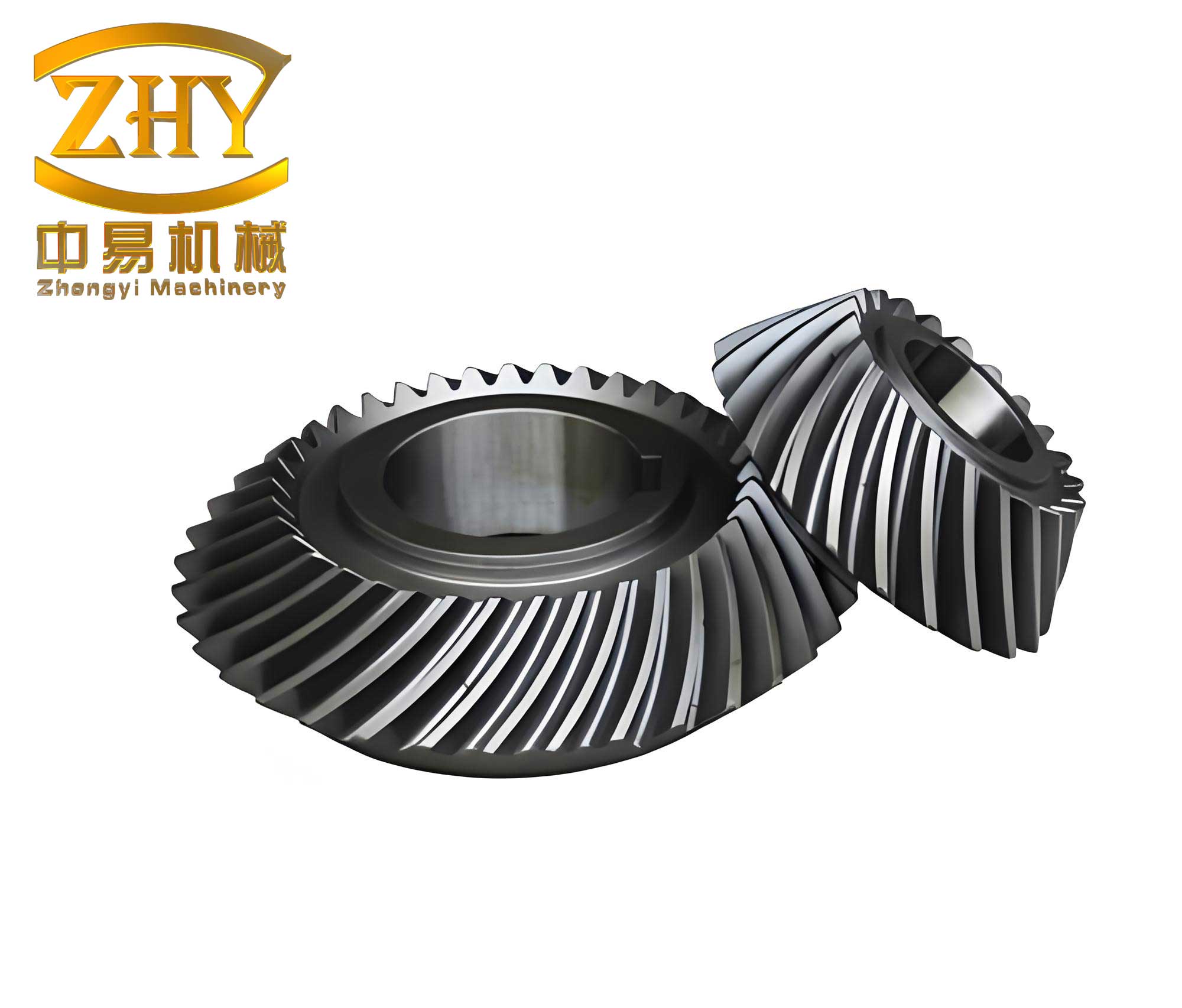
The fundamental advantage of a spiral gear lies in its angled teeth, which engage gradually. This results in multiple teeth sharing the load at any given moment compared to spur gears, leading to reduced stress per tooth, lower vibration, and significantly diminished noise generation. These characteristics are paramount for modern high-speed and high-performance traction systems where passenger comfort and component longevity are key design goals.
Traction Drive System Configurations
The choice of transmission architecture significantly influences the operating conditions and design requirements for the spiral gear sets used.
Electric Multiple Units (EMUs) and Locomotives
Traditional systems often employed the axle-hung or nose-suspended motor drive. Here, the motor is mounted partly on the bogie frame and partly on the axle via a bearing. While simple, this design subjects the gears to alignment issues and shock loads from track irregularities. Spur or low-helix-angle spiral gears were commonly used.
The modern standard for high-performance vehicles is the hollow-shaft parallel cardan drive. In this configuration, the motor is resiliently mounted on the bogie frame. Torque is transmitted via a flexible coupling, a cardan shaft, and finally through a robust spiral gear set housed in a rigid gearbox mounted on the axle. This design decouples the motor mass from the unsprung axle mass, allowing for higher speeds and providing a stable, precise environment for the spiral gears to operate. The gearbox ensures perfect alignment and lubrication, maximizing the performance benefits of the high-precision spiral gear.
Diesel-Electric Locomotives
For diesel-electric traction, the primary diesel engine drives a generator, which in turn powers axle-mounted traction motors. The final drive to the wheels often utilizes a system similar to modern EMUs, frequently employing a robust spiral gear set in an axle-mounted gearbox, driven via cardan shafts from a centrally mounted motor-generator set.
In diesel-hydraulic locomotives, the engine’s power is transmitted through a hydraulic torque converter or fluid coupling and a gear-type transmission. High-power hydraulic transmissions rely heavily on sophisticated, multi-stage spiral gear trains to manage the substantial torque and power levels, which can exceed several thousand horsepower per unit. The spiral gears in these applications must endure severe service conditions, including wide speed/torque ranges and frequent start-stop cycles.
Design Philosophy for Traction Spiral Gears
The design of spiral gears for railway traction diverges from general industrial practice due to unique operational demands. Key considerations include variable load spectra, high overloads, dynamic附加 loads, limited space, and the requirement for extreme reliability over long service lives (often exceeding 1 million kilometers).
Load Spectrum and Average Duty Cycle
The traction characteristic of a locomotive defines the available torque versus speed. Unlike constant-load industrial applications, a traction spiral gear operates across a vast spectrum—from high torque at low speed during starting to lower torque at maximum velocity. Furthermore, the duty cycle includes periods of full power, partial power, and coasting.
For strength calculations, defining an average operating point is practical. This involves segmenting the speed-torque envelope, assigning a time proportion to each segment based on typical service profiles, and calculating a weighted average. For instance, a shunting locomotive and a mainline locomotive will have vastly different average operating points. The formulas for average torque ($T_m$) and average speed ($N_m$) over a total operating time are:
$$T_m = \frac{\sum (T_i \cdot t_i)}{\sum t_i} = \frac{T_1 t_1 + T_2 t_2 + T_3 t_3 + …}{t_1 + t_2 + t_3 + …}$$
$$N_m = \frac{\sum (N_i \cdot t_i)}{\sum t_i} = \frac{N_1 t_1 + N_2 t_2 + N_3 t_3 + …}{t_1 + t_2 + t_3 + …}$$
Where $T_i$ and $N_i$ are the torque and speed in operating segment $i$, and $t_i$ is the time spent in that segment. This average duty point forms the basis for initial spiral gear sizing and life estimation.
Strength Calculation Standards
The design of a traction spiral gear must satisfy three primary criteria: resistance to bending failure at the tooth root, resistance to surface pitting (contact fatigue), and resistance to scoring (scuffing) at high speeds. While specialized railway standards exist, many designs are evaluated using established industrial formulas like those from AGMA (American Gear Manufacturers Association) or ISO, with railway-specific correction factors applied.
For example, the contact stress ($\sigma_H$) for a spiral gear pair can be estimated by a formula analogous to the Hertzian contact stress, modified with application factors:
$$\sigma_H = Z_E \cdot \sqrt{ \frac{F_t}{b \cdot d_1} \cdot \frac{u+1}{u} \cdot Z_\beta \cdot K_A \cdot K_V \cdot K_{H\beta} \cdot K_{H\alpha} }$$
Where:
$Z_E$ = Elastic coefficient
$F_t$ = Transmitted tangential load at the pitch circle
$b$ = Face width
$d_1$ = Pitch diameter of the pinion (smaller spiral gear)
$u$ = Gear ratio ($z_2/z_1$)
$Z_\beta$ = Helix angle factor
$K_A$, $K_V$, $K_{H\beta}$, $K_{H\alpha}$ = Application, dynamic, face load, and transverse load distribution factors, respectively.
The permissible stress is derived from material properties and required life, adjusted for the reliability demanded in railway service.
Dynamic Additional Loads
A critical aspect of traction drive design is accounting for dynamic附加 torques, especially in systems using long cardan shafts. These torques arise from:
1. Universal Joint Kinematics: Angular misalignment between shafts during bogie rotation on curves causes cyclic torque variations.
2. Wheel Diameter Differences: Without a differential, a difference in driven wheel diameters causes forced slippage and complex torque reactions, particularly at low speeds.
3. Stick-Slip Oscillations: During very low-speed adhesion or wheel slip conditions, self-excited torsional vibrations can occur, superimposing high peak torques on the nominal load.
These dynamic effects can significantly increase the stress on the spiral gear teeth. They are often addressed through empirical safety factors derived from field testing or by using torsional vibration analysis models during the design phase.
Key Design Parameters
The load capacity and performance of a spiral gear are often characterized by the non-dimensional parameter $\gamma$. A higher $\gamma$ generally indicates a more heavily loaded gear design.
$$\gamma = \frac{F_t}{b \cdot d_1} \cdot \frac{u+1}{u}$$
Traction spiral gears typically operate at higher $\gamma$ values compared to general industrial gears, pushing the boundaries of material and manufacturing technology. The helix angle ($\beta$) is a crucial parameter. While a larger $\beta$ increases the overlap ratio for smoother operation, it also increases axial thrust and sensitivity to alignment errors. Therefore, traction spiral gears commonly use moderate helix angles in the range of $12^\circ$ to $20^\circ$.
The standard tooth form often uses a normal pressure angle ($\alpha_n$) of $20^\circ$. For heavily loaded final drive gears, both pinion and wheel are often given positive profile shift (addendum modification) to equalize bending strength at the root and to increase the effective contact ratio. There is a growing trend toward using higher pressure angles (e.g., $25^\circ$) for increased bending strength and reduced risk of pitting in the demanding service of a traction spiral gear.
To counteract deflections and manufacturing deviations, both profile modification (tip and root relief) and lead crowning (barreling of the tooth face) are essential. This prevents edge loading and reduces meshing impact noise, which is critical for high-speed operation where mesh frequencies can enter the audible range.
Material and Heat Treatment
Reliability under overload conditions is non-negotiable for traction components. Case-hardened steels, such as grades equivalent to AISI 4320, 9310, or 18CrNiMo7-6, are the predominant choice for high-power spiral gears. The deep, hard case provides excellent resistance to pitting and bending fatigue, while the tough core handles shock loads. The case depth must be carefully controlled to exceed the depth of the maximum shear stress induced by the contact pressure. Induction hardening is also used, provided it achieves sufficient depth and includes the tooth root fillet to induce beneficial compressive residual stresses. The table below summarizes typical design parameters for spiral gears in different applications.
| Application | Module (mm) | Normal Pressure Angle | Helix Angle | Face Width (mm) | Material & Heat Treatment | Typical Accuracy Grade (ISO) |
|---|---|---|---|---|---|---|
| EMU Final Drive | 8 – 12 | 20° | 14° – 18° | 100 – 150 | Case-Hardened Steel | 4 – 5 |
| Diesel-Hydraulic Transmission | 5 – 8 | 20° – 25° | 15° – 20° | 60 – 100 | Case-Hardened Steel | 3 – 4 |
| Axle-Hung Drive (Legacy) | 10 – 14 | 20° | 8° – 12° | 120 – 180 | Case-Hardened or Through-Hardened | 6 – 7 |
Application in Electric Traction: A Closer Look
In modern EMUs with parallel cardan drives, the spiral gear set is the heart of a compact and efficient final drive. The large spiral gear is often an “elastic gear,” where the gear rim is connected to the hub through a ring of rubber or steel springs. This design dampens high-frequency torque fluctuations and shock loads from the track, protecting both the gear teeth and the motor.
The operating environment is challenging. The gearbox is exposed to heat radiated from the brakes and rails. During summer, oil temperatures can rise significantly above ambient, potentially reducing the lubricant’s film strength and the effective load capacity of the spiral gear. Effective cooling fins and optimized oil circulation are essential. Furthermore, at very high circumferential speeds (exceeding 40 m/s in some high-speed trains), lubrication and cooling become critical design challenges, influencing oil type selection, splash patterns, and gearbox aerodynamics.
The pursuit of lower noise has led to meticulous attention to the finishing of these spiral gears. After case hardening, they are precision ground to ISO quality level 4 or better. The profile and lead modifications mentioned earlier are meticulously applied and verified. This high level of precision ensures the spiral gear operates with minimal excitation, contributing to the low noise signature of modern trainsets.
Application in Diesel-Hydraulic Transmissions
The spiral gear in a high-power hydraulic transmission represents the pinnacle of power density and reliability requirements. These gears operate inside the transmission casing, bathed in oil, but are subject to the full torque spectrum of the diesel engine, filtered through the characteristics of the torque converter.
A single transmission may contain multiple spiral gear stages for range changing and reversing. For instance, a typical design might include input spiral gears, intermediate spiral gears, and output spiral gears, all designed for specific speed and torque ratios. The design of such a spiral gear train must consider not only the static loads but also the torsional dynamics of the entire driveline, from engine to final drive. Resonance conditions must be avoided.
Endurance testing is paramount. Advanced test rigs that simulate the actual load spectrum over accelerated timelines are used to validate the design life of these critical spiral gear sets before they are approved for series production. The target for mean distance between failures for such transmission spiral gears is often set in the hundreds of thousands of operating hours.
Performance Summary for Representative Designs
The table below provides a condensed overview of calculated and operational parameters for spiral gears in specific traction roles, illustrating the application of the design principles discussed.
| Parameter / Vehicle Type | Shunting Diesel Locomotive (Final Drive) | Mainline Diesel Locomotive (Final Drive) | High-Speed EMU (Final Drive) |
|---|---|---|---|
| Pinion Avg. Torque, $T_m$ | ~12,000 Nm | ~8,500 Nm | ~4,000 Nm |
| Pinion Avg. Speed, $N_m$ | ~500 rpm | ~1,200 rpm | ~3,000 rpm |
| Load Intensity Factor, $\gamma$ | High (0.8 – 1.0 N/mm²) | Medium-High (0.6 – 0.8 N/mm²) | Medium (0.4 – 0.6 N/mm²) |
| Primary Design Driver | Bending Strength & Shock Loads | Pitting Resistance & Durability | Surface Durability & Noise |
| Safety Factor (Bending) | > 2.5 | > 2.0 | > 1.8 |
| Safety Factor (Contact) | > 1.4 | > 1.3 | > 1.2 |
In conclusion, the spiral gear is a fundamental enabling technology for modern railway traction. Its successful application hinges on a holistic design approach that synthesizes mechanical design, metallurgy, lubrication science, and a deep understanding of the unique and demanding operational environment of rail vehicles. From the compact final drive of a high-speed EMU to the multi-stage power train of a heavy-haul diesel locomotive, the evolution of traction performance is inextricably linked to the continuous advancement in the design, manufacturing, and application of the high-performance spiral gear.