
In the realm of mechanical transmission systems, spiral gears hold a pivotal role due to their unique geometry and performance characteristics. As an engineer specializing in gear manufacturing, I have extensively studied and implemented various processing methods for spiral gears. These gears, often referred to as helical cylindrical gears, feature tooth lines that follow cylindrical helices and curved tooth surfaces, enabling them to transmit motion between non-parallel and non-intersecting shafts with a constant ratio. The advantages of spiral gears are manifold, including a high overlap coefficient, compact design, smooth operation, enhanced load capacity, reduced energy consumption, and minimal noise generation. Consequently, spiral gears are indispensable in high-demand industries such as aerospace, automotive, and heavy machinery. This article delves into the intricate processing techniques,工艺流程, and precision machining methods for spiral gears, incorporating tables and formulas to provide a comprehensive overview.
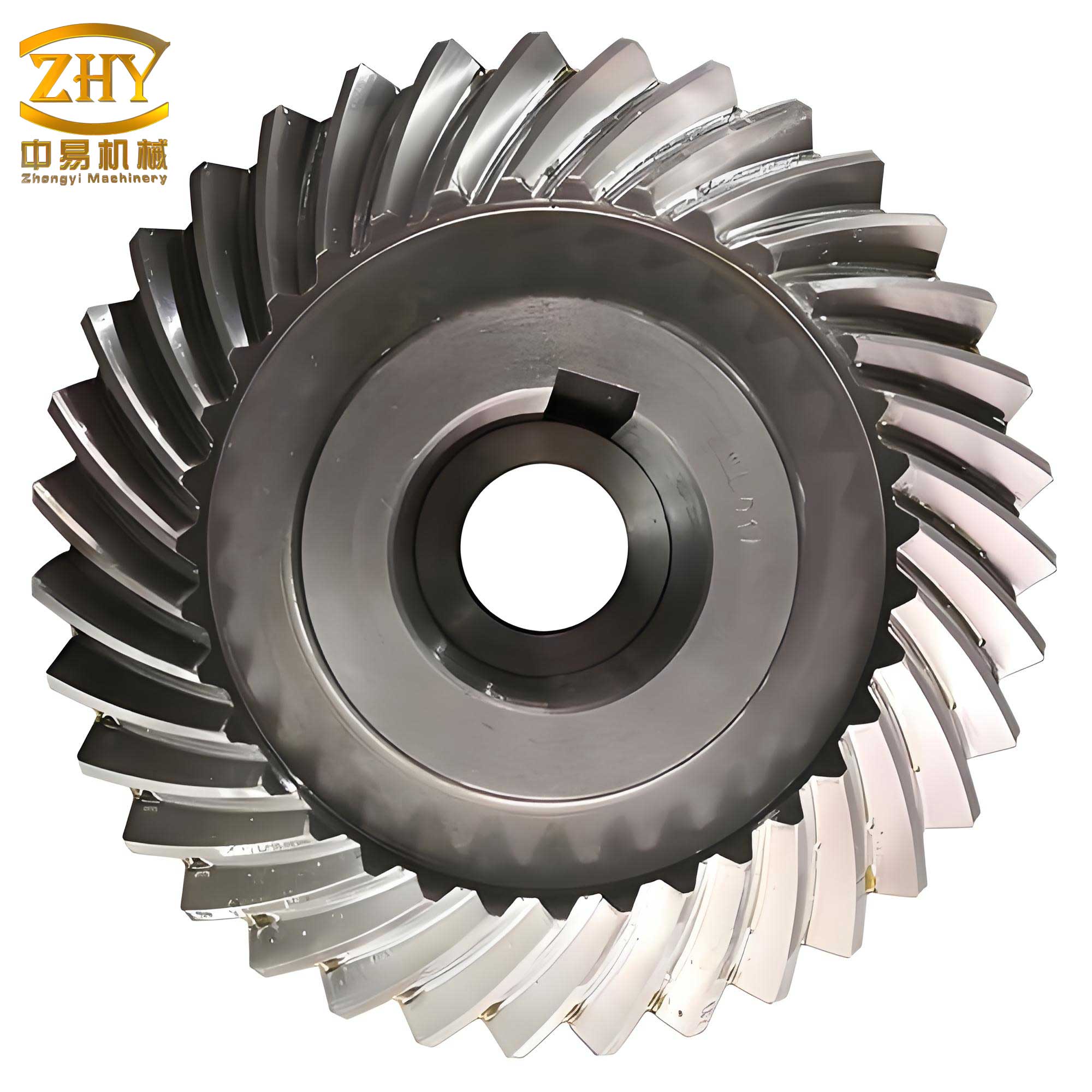
The manufacturing of spiral gears requires meticulous attention to detail, as even minor deviations can impact performance. From my experience, the processing of spiral gears involves several stages, each critical to achieving the desired precision and durability. I will begin by exploring the common加工方法 for spiral gears, followed by a detailed breakdown of the加工工艺流程, and conclude with advanced精密加工工艺. Throughout this discussion, I will emphasize the importance of optimizing parameters to ensure efficiency and quality in producing spiral gears.
Processing Methods for Spiral Gears
Several methods have been developed for加工 spiral gears, each with its own merits and limitations. Based on my实践, I categorize these into three primary approaches: the unified cutter method, hard tooth surface honing, and hard tooth surface grinding. The unified cutter method is designed for adaptability in universal machines, making it suitable for small-batch production. It involves tilting the cutter while maintaining its center, which simplifies operations but lacks the precision needed for mass production of high-accuracy spiral gears. Hard tooth surface honing is a traditional technique that reduces surface roughness and corrects tooth form and direction errors. However, it struggles to control distortions from heat treatment, such as radial runout and pitch errors, often leading to non-uniform rolling across the tooth surface. In contrast, hard tooth surface grinding, which can be基于 on generating or forming principles, offers superior precision. The generating method involves relative motion between the tool and gear to create an enveloping surface, while the forming method leverages CAD and CNC technologies for integrated manufacturing. For spiral gears, especially those with varying tooth槽 structures, the generating method is preferred due to its ability to handle complex geometries. To summarize these methods, I have compiled a table below that highlights their key aspects.
| Method | Principle | Advantages | Disadvantages | Typical Applications |
|---|---|---|---|---|
| Unified Cutter Method | Cutter tilting with fixed center | Simple operation, adaptable for small batches | Low precision, not suitable for mass production | Small batches of spiral bevel gears and hypoid gears |
| Hard Tooth Surface Honing | Free fitting with abrasive action | Reduces roughness, corrects errors, high efficiency | Poor control of heat treatment distortions, non-uniform rolling | Pre-finishing of spiral gears |
| Hard Tooth Surface Grinding (Generating) | Tool-gear展成运动 for enveloping surface | High precision, handles complex齿面 | Complex setup, requires advanced machinery | Precision finishing of spiral gears with varying structures |
| Hard Tooth Surface Grinding (Forming) | CAD/CNC integration for direct forming | Automated, consistent for批量生产 | Limited to simpler geometries, high initial investment | Mass production of standard spiral gears |
In selecting a method for加工 spiral gears, factors such as production volume, accuracy requirements, and cost must be considered. For instance, in aerospace applications where spiral gears must withstand extreme loads, hard tooth surface grinding via the generating method is often employed to achieve the necessary precision. The mathematical basis for these methods can be expressed through formulas related to gear geometry. For example, the tooth profile of a spiral gear is based on an involute curve, which can be represented parametrically. Let $$ r_b $$ denote the base circle radius, and $$ \theta $$ the involute angle. Then, the coordinates of the involute curve are given by:
$$ x = r_b (\cos \theta + \theta \sin \theta) $$
$$ y = r_b (\sin \theta – \theta \cos \theta) $$
For spiral gears, this profile is swept along a helical path. The helix of a spiral gear can be described by the parametric equations:
$$ x = R \cos(\phi) $$
$$ y = R \sin(\phi) $$
$$ z = p \phi $$
where $$ R $$ is the radius, $$ \phi $$ is the angular parameter, and $$ p $$ is the pitch parameter related to the螺旋角 $$ \beta $$ by $$ p = R \tan \beta $$. Thus, the tooth surface of a spiral gear is a combination of these equations, making its manufacturing mathematically intensive.
Processing Workflow for Spiral Gears
The加工工艺流程 for spiral gears is a multi-stage process that ensures each gear meets stringent specifications. From my involvement in production lines, I have refined this workflow to include rough processing, heat treatment, semi-finishing, and finishing. Each stage plays a crucial role in shaping the final spiral gears, and I will elaborate on them with supporting tables and formulas.
Rough Processing of Spiral Gears
Rough processing aims to remove excess material from the blank, preparing it for subsequent stages. Common techniques include layer cutting, which confines tool motion to a two-dimensional plane for optimized trajectories. For spiral gears,滚齿 is typically used to define the tooth thickness at the pitch circle. It is essential to control the grinding allowance to within 0.2 mm per side and limit runout to prevent uneven渗层 during heat treatment. The material removal rate can be approximated by:
$$ Q = f \times d \times v $$
where $$ Q $$ is the removal rate, $$ f $$ is the feed rate, $$ d $$ is the depth of cut, and $$ v $$ is the cutting speed. This formula helps in planning efficient rough processing for spiral gears.
Heat Treatment of Spiral Gears
Heat treatment enhances the mechanical properties of spiral gears, but it often introduces distortions due to thermal and structural stresses. Processes like carburizing, quenching, and nitriding are employed based on the gear’s requirements. To minimize变形, I recommend controlled heating rates of 150–200 °C/h and adequate tempering. The carburizing depth should be maintained at 1.0–1.2% carbon content to avoid peeling during semi-finishing. The distortion $$ \delta $$ can be modeled as a function of temperature gradient $$ \Delta T $$ and material properties:
$$ \delta = \alpha \cdot \Delta T \cdot L $$
where $$ \alpha $$ is the thermal expansion coefficient and $$ L $$ is the characteristic length. For spiral gears, this necessitates预留加工余量 to accommodate changes. The table below summarizes key heat treatment parameters for spiral gears.
| Process | Temperature Range | Cooling Method | Target Carburizing Depth | Distortion Control Measures |
|---|---|---|---|---|
| Carburizing | 900–950 °C | Air cooling with forced风冷 | 1.0–1.2% C | Uniform heating, slow cooling rates |
| Quenching | 800–850 °C | Oil or polymer quenching | N/A | 分段加热, stress relief tempering |
| Nitriding | 500–600 °C | Furnace cooling | 0.3–0.5 mm case depth | Low temperature processing |
Semi-Finishing of Spiral Gears
Semi-finishing removes residual stresses and excess material from heat treatment, setting the stage for precision machining. For spiral gears, ball-end tools are often used to machine the complex tooth surfaces. To avoid interference, tool orientation and size must be adjusted, with smaller diameters preferred to reduce cutting forces. In mass production, gears are classified based on size, backlash, and contact patterns using coordinate measuring machines. This allows for tailored adjustments in the honing process. The contact area $$ A_c $$ between mating螺旋齿轮 can be approximated by:
$$ A_c = \frac{F_n}{E’} \sqrt{\frac{R_1 R_2}{R_1 + R_2}} $$
where $$ F_n $$ is the normal load, $$ E’ $$ is the effective modulus, and $$ R_1, R_2 $$ are the radii of curvature. This formula aids in optimizing semi-finishing for spiral gears.
Finishing of Spiral Gears
Finishing achieves the final accuracy and surface smoothness of spiral gears, often through honing or precision grinding. Honing eliminates residual stresses and heat treatment distortions, ensuring contact areas meet design specs. The backlash variation during honing must be less than in semi-finishing to prevent jamming. If one gear in a pair is scrapped, the remaining gear can be honed with a new mate, but this requires careful matching. The surface finish $$ R_a $$ can be related to honing parameters by:
$$ R_a = k \cdot v_h^{-0.5} \cdot p_h^{0.3} $$
where $$ v_h $$ is the honing speed, $$ p_h $$ is the pressure, and $$ k $$ is a constant. This emphasizes the need for controlled conditions in finishing spiral gears.
Precision Machining Techniques for Spiral Gears
Precision machining is vital for high-performance spiral gears, especially in applications demanding tight tolerances. I have focused on two advanced methods: the generating-based precision machining and CNC-based precision machining. Both rely on synchronized motions between tool and workpiece, with formulas governing their execution.
Generating-Based Precision Machining
In this method, the tool installation angle varies periodically with the spiral angle of the gear, ensuring accurate envelope generation. The tool and gear undergo relative generating motion,模拟 a planar gear rolling纯滚动. For spiral gears with variable螺旋角, the tool must swing according to the angle变化规律. The relationship between tool angle $$ \gamma $$ and螺旋角 $$ \beta $$ is linear:
$$ \gamma(t) = \gamma_0 + c \cdot \beta(t) $$
where $$ \gamma_0 $$ is the initial angle, $$ c $$ is a constant, and $$ \beta(t) $$ changes with tooth position. The generating motion can be described by the equation of meshing:
$$ \vec{v}_t \cdot \vec{n} = \vec{v}_g \cdot \vec{n} $$
where $$ \vec{v}_t $$ and $$ \vec{v}_g $$ are the velocities of tool and gear, and $$ \vec{n} $$ is the normal vector at the contact point. This ensures precise tooth profiles for spiral gears.
CNC-Based Precision Machining
CNC machining enables multi-axis联动 for complex spiral gear geometries. Typically, three or more axes are controlled simultaneously, with the tool fixed on the Z-axis and the workpiece on moving X and Y axes. The tool path must follow the螺旋角变化规律, governed by CNC programs. The coordinates $$ (x, y, z) $$ during machining can be expressed as:
$$ x = R \cos(\theta + \Delta \theta) $$
$$ y = R \sin(\theta + \Delta \theta) $$
$$ z = f(\beta) $$
where $$ \Delta \theta $$ is the angular offset and $$ f(\beta) $$ is a function of the螺旋角. For higher accuracy, five-axis CNC machines are used, allowing tool orientation adjustments. The table below compares these precision methods for spiral gears.
| Method | Axes of Motion | Control System | Accuracy Level | Suitable for Variable螺旋角 |
|---|---|---|---|---|
| Generating-Based | 2–3 axes (rotary and linear) | Mechanical or hybrid CNC | High (micron range) | Yes, via tool swing |
| CNC-Based (3-axis) | 3 linear axes | Full CNC programming | Medium to High | Limited, requires complex paths |
| CNC-Based (5-axis) | 5 axes (linear and rotary) | Advanced CNC with interpolation | Very High (sub-micron) | Yes, flexible tool orientation |
The effectiveness of these methods can be quantified using error metrics. For instance, the tooth profile error $$ \epsilon_p $$ for螺旋齿轮 can be minimized by optimizing CNC parameters:
$$ \epsilon_p = \sqrt{ \sum_{i=1}^{n} (x_{i,actual} – x_{i,ideal})^2 } $$
where $$ x_{i,actual} $$ and $$ x_{i,ideal} $$ are measured and ideal coordinates. This highlights the importance of precise control in machining spiral gears.
Conclusion
In summary, the processing and precision machining of spiral gears involve a sophisticated blend of traditional techniques and advanced technologies. From my perspective, the key to success lies in understanding the geometric complexities of spiral gears and applying appropriate methods at each stage. The generating-based and CNC-based precision machining methods offer robust solutions for achieving high accuracy, especially when coupled with rigorous process control. As industries continue to demand更高性能 spiral gears, further research into innovative加工工艺 will be essential. I hope this detailed exposition, enriched with tables and formulas, provides valuable insights for engineers and manufacturers working with螺旋齿轮. By adhering to these principles, we can ensure the reliable production of spiral gears that meet the evolving needs of modern machinery.