
In modern high-speed train systems, the bevel gearbox plays a critical role in transmitting power from the motor to the wheels. As a key component, the bevel gearbox must operate efficiently under demanding conditions, and splash lubrication is commonly employed to ensure proper gear and bearing lubrication. However, the complex fluid dynamics within the bevel gearbox, especially during high-speed operation, can lead to issues such as inadequate oil coverage, excessive churning losses, and poor heat dissipation. In this study, I focus on analyzing the splash lubrication mechanism of a spiral bevel gear transmission system used in electric multiple units (EMUs). By employing advanced numerical methods and structural optimizations, I aim to enhance the lubrication performance and reduce power losses in bevel gearboxes.
The lubrication of bevel gearboxes is particularly challenging due to the spatial intersection of axes, which complicates oil splash patterns. Traditional computational fluid dynamics (CFD) methods often struggle with the complex geometries and free surface flows inherent in bevel gear systems. To address this, I utilize the Moving Particle Semi-implicit (MPS) method, a mesh-free Lagrangian approach that excels in handling large deformations and free surface flows. I further enhance the MPS method by incorporating a thin film flow model, which improves the no-slip wall boundary conditions and enables accurate prediction of oil film distribution on surfaces. This allows me to investigate how factors like input gear speed and initial oil volume affect lubrication characteristics and power losses in bevel gearboxes.
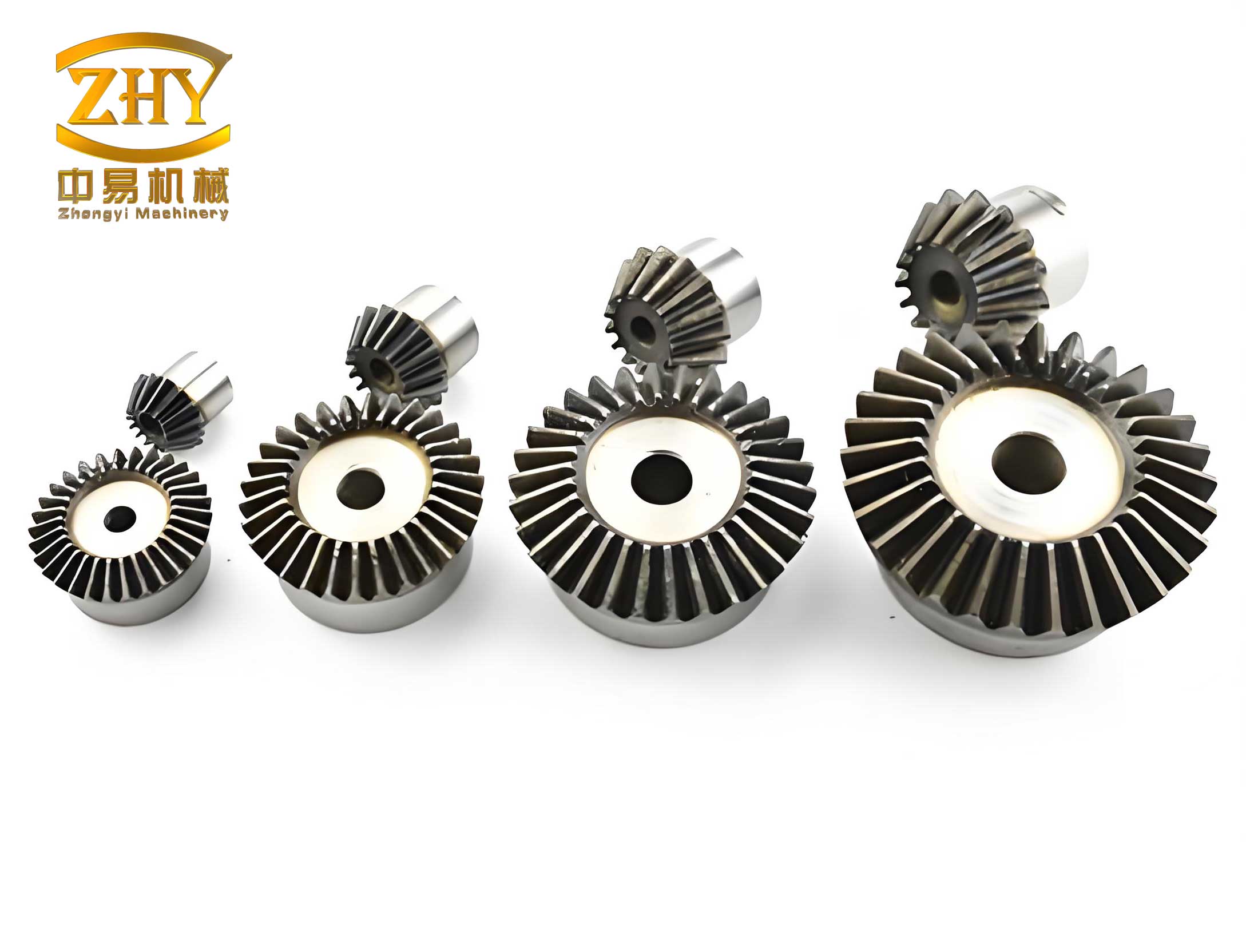
My research begins with establishing a high-fidelity flow field simulation model for a spiral bevel gearbox. The bevel gear system consists of an input bevel gear and an output bevel gear with a 90-degree shaft angle. The geometric parameters of the bevel gears are summarized in Table 1. I simplify the gearbox housing to retain essential features while ensuring computational efficiency, and I use particles to discretize the lubricating oil domain. The physical properties of the oil, such as density and viscosity, are modeled as functions of temperature using empirical relationships. For instance, the viscosity-temperature relationship is given by:
$$ \lg\left[\lg(\nu + 0.7)\right] = A – B \lg(\theta + 273.15) $$
where $\nu$ is the kinematic viscosity in mm²/s, $\theta$ is the oil temperature in °C, and $A$ and $B$ are constants derived from reference viscosities at 40°C and 100°C. The density is approximated as:
$$ \rho = 876 – 0.6\theta $$
with $\rho$ in kg/m³. These equations allow me to simulate oil behavior under different thermal conditions, which is crucial for accurate lubrication analysis in bevel gear systems.
| Parameter | Input Bevel Gear | Output Bevel Gear |
|---|---|---|
| Number of Teeth | 22 | 55 |
| Module (mm) | 9.2 | 9.2 |
| Face Width (mm) | 82 | 82 |
| Pressure Angle (°) | 20 | 20 |
| Spiral Angle (°) | 30 | 30 |
The MPS method solves the incompressible Navier-Stokes equations using a particle-based approach. The governing equations include the continuity equation and momentum equation:
$$ \frac{d\rho}{dt} = 0 $$
$$ \frac{d\mathbf{u}}{dt} = -\frac{1}{\rho}\nabla p + \nu\nabla^2\mathbf{u} + \mathbf{g} $$
where $\mathbf{u}$ is velocity, $p$ is pressure, $\nu$ is kinematic viscosity, and $\mathbf{g}$ is gravity. The particle interactions are modeled using a kernel function $w(r_{ij})$, defined as:
$$ w(r_{ij}) = \begin{cases} \frac{r_e}{r_{ij}} – 1, & \text{if } r_{ij} < r_e \\ 0, & \text{if } r_{ij} \geq r_e \end{cases} $$
with $r_{ij}$ being the distance between particles $i$ and $j$, and $r_e$ the effective radius. The particle number density $n_i$ is computed as:
$$ n_i = \sum_{j \neq i} w(r_{ij}) $$
Gradient and Laplacian operators are approximated using these particle interactions, enabling the simulation of fluid flow around the bevel gears. To model oil film formation on walls, I integrate the thin film flow equations into the MPS framework. The thin film momentum equation, after integration over the film thickness $h$, becomes:
$$ \rho \frac{\partial}{\partial t}(h\bar{\mathbf{u}}) + \rho \nabla \cdot \left( \int_0^h \mathbf{u}\mathbf{u}^T dz \right) = -h\nabla(p + \sigma\kappa) – \boldsymbol{\tau}_{\text{disk}} + \mathbf{F} $$
where $\bar{\mathbf{u}}$ is the average velocity, $\sigma$ is surface tension, $\kappa$ is curvature, $\boldsymbol{\tau}_{\text{disk}}$ is wall shear stress, and $\mathbf{F}$ is external force. This model allows me to predict oil film thickness and distribution on the gearbox housing and bevel gear surfaces, which is essential for evaluating lubrication performance.
I conduct simulations under various operating conditions to analyze the splash lubrication characteristics of the bevel gearbox. The input bevel gear speed and initial oil volume are varied as shown in Table 2. Each simulation runs for 3 seconds, with a ramp-up period to avoid transient shocks. I monitor oil coverage rate $\eta$ and average oil film thickness $\delta$ on the housing inner walls and bevel gear surfaces. The churning power loss $P_{\text{loss}}$ is calculated from the torque experienced by the bevel gears due to oil agitation:
$$ P_{\text{loss}} = \sum_{i=1}^{n} \frac{T_i N_i}{9550} $$
where $T_i$ is the churning torque on gear $i$, $N_i$ is its rotational speed in rpm, and $n$ is the number of gears (here, two bevel gears). This formula helps quantify the energy dissipation associated with splash lubrication in the bevel gear system.
| Case | Input Bevel Gear Speed (rpm) | Initial Oil Volume (L) | Housing Structure |
|---|---|---|---|
| 1 | 600 | 15 | Original |
| 2 | 1200 | 15 | Original |
| 3 | 1800 | 15 | Original |
| 4 | 2400 | 15 | Original |
| 5 | 3000 | 15 | Original |
| 6 | 1200 | 12 | Original |
| 7 | 1200 | 18 | Original |
| 8 | 1200 | 21 | Original |
| 9 | 1200 | 24 | Original |
| 10 | 600 | 15 | Improved |
| 11 | 3000 | 15 | Improved |
The results reveal that splash lubrication in the bevel gearbox is highly dependent on the motion of the output bevel gear. As the output bevel gear rotates, it agitates the oil, causing splashing that coats the housing walls and the bevel gear surfaces. At lower speeds, oil coverage is limited, but as speed increases, the splash effect intensifies, leading to better lubrication. For instance, at an input bevel gear speed of 600 rpm, the housing oil coverage is around 48.22%, while at 3000 rpm, it reaches 90.80%. The average oil film thickness on the housing also increases from 0.25 mm to 0.51 mm. However, on the bevel gear surfaces, the oil film thickness decreases with speed due to higher shear forces, dropping from 59 µm to 7.2 µm. This highlights the dual influence of splash and gear motion on lubrication in bevel gear systems.
To quantify the impact of speed on power loss, I compute the churning torque and power loss for each case. The data in Table 3 shows that power loss rises significantly with input bevel gear speed, especially at higher ranges. This is because the output bevel gear, being immersed in oil, experiences greater drag forces at elevated speeds. The relationship between power loss and speed is nonlinear, indicating that high-speed operation of bevel gearboxes can lead to substantial efficiency reductions.
| Input Speed (rpm) | Input Bevel Gear Torque (N·m) | Output Bevel Gear Torque (N·m) | Total Power Loss (W) |
|---|---|---|---|
| 600 | 0.056 | 0.889 | 25.86 |
| 1200 | 0.193 | 1.229 | 86.07 |
| 1800 | 0.347 | 1.556 | 182.64 |
| 2400 | 0.404 | 11.566 | 1264.25 |
| 3000 | 0.811 | 47.782 | 6258.77 |
Similarly, initial oil volume affects lubrication and power loss in the bevel gearbox. As oil volume increases from 12 L to 24 L, more oil is available for splashing, which enhances oil coverage on housing walls. The average oil film thickness on the housing rises from 0.17 mm to 0.59 mm, and on the bevel gear surfaces, it increases from 6.4 µm to 82.7 µm. This improvement in lubrication comes at the cost of higher churning losses, as shown in Table 4. The power loss grows from 39.57 W to 257.08 W, with the input bevel gear contributing a larger share at higher oil volumes. This suggests that while more oil benefits lubrication, it also increases energy dissipation in bevel gear systems.
| Oil Volume (L) | Input Bevel Gear Torque (N·m) | Output Bevel Gear Torque (N·m) | Total Power Loss (W) |
|---|---|---|---|
| 12 | 0.058 | 0.642 | 39.57 |
| 15 | 0.193 | 1.229 | 86.07 |
| 18 | 0.323 | 1.761 | 129.10 |
| 21 | 0.453 | 2.499 | 182.48 |
| 24 | 0.672 | 3.434 | 257.08 |
Based on these findings, I identify a structural issue in the original bevel gearbox housing: a boss near the output bevel gear creates a narrow gap that hinders oil splash and leads to discontinuous oil films. To address this, I propose an improved housing design where the boss is removed, increasing the clearance around the output bevel gear. Simulations of the improved bevel gearbox show enhanced lubrication performance. For example, at 600 rpm input speed, the housing oil coverage improves from 48.22% to 53.49%, and the average oil film thickness increases from 0.246 mm to 0.287 mm. At 3000 rpm, coverage rises from 90.80% to 92.79%, and thickness from 0.507 mm to 0.717 mm. Moreover, the churning power loss decreases, as seen in Table 5. This reduction is due to better oil flow and reduced drag on the bevel gears, demonstrating the effectiveness of structural optimization in bevel gearboxes.
| Case | Input Speed (rpm) | Total Power Loss (W) – Original | Total Power Loss (W) – Improved | Reduction |
|---|---|---|---|---|
| Low Speed | 600 | 25.86 | 19.33 | 25.25% |
| High Speed | 3000 | 6258.77 | 5476.91 | 12.49% |
The thin film flow model integrated into the MPS method proves valuable for predicting oil film behavior. The film thickness $h$ is governed by the continuity equation:
$$ \frac{\partial h}{\partial t} + \nabla \cdot (h\bar{\mathbf{u}}) = Q_m $$
where $Q_m$ is a mass source term. Combined with the momentum equation, this allows me to simulate how oil films develop and migrate on surfaces. For instance, on the housing walls, films are primarily driven by splash from the output bevel gear, while on the bevel gears themselves, films are influenced by both splash and centrifugal forces. The film thickness distribution can be analyzed using the equation:
$$ \delta(\mathbf{x}, t) = \frac{1}{A} \int_A h(\mathbf{x}, t) \, dA $$
where $\delta$ is the average film thickness over area $A$. This helps quantify lubrication uniformity in the bevel gearbox.
I also explore the sensitivity of power loss to operational parameters. The churning torque $T$ on a bevel gear can be expressed as a function of oil properties and gear geometry:
$$ T = C_d \cdot \rho \cdot \omega^2 \cdot D^5 $$
where $C_d$ is a drag coefficient, $\omega$ is angular velocity, and $D$ is gear diameter. This empirical relation explains why power loss escalates rapidly at high speeds in bevel gear systems. For my bevel gearbox, the output bevel gear, with its larger diameter, dominates the churning loss, especially when immersed in oil.
To further validate the MPS approach for bevel gear applications, I compare my results with established literature on spiral bevel gear lubrication. The agreement in oil distribution patterns and power loss trends confirms the reliability of my method. The MPS method, with its mesh-free nature, handles the complex bevel gear geometry effectively, avoiding the meshing challenges of traditional CFD. This makes it suitable for analyzing splash lubrication in various bevel gear configurations, including those with intersecting axes.
In conclusion, my study demonstrates that splash lubrication in bevel gearboxes is a complex interplay of fluid dynamics and structural design. The input bevel gear speed and initial oil volume significantly affect oil coverage, film thickness, and power loss. Higher speeds improve housing lubrication but reduce gear surface films and increase churning losses. Larger oil volumes enhance lubrication at the cost of higher losses. The improved housing design, by eliminating obstructions near the output bevel gear, boosts oil splash and film continuity while reducing power loss. These insights can guide the optimization of bevel gearboxes for high-speed trains, balancing lubrication performance and energy efficiency. Future work could extend this analysis to multi-stage bevel gear systems or incorporate thermal effects for a comprehensive understanding of bevel gearbox operation.
The use of advanced numerical methods like MPS, coupled with thin film modeling, provides a powerful tool for simulating splash lubrication in bevel gearboxes. By repeatedly focusing on bevel gear dynamics, I underscore the importance of tailored approaches for these complex transmission systems. The findings highlight that bevel gear lubrication is not just about oil quantity but also about flow paths and structural clearances. As bevel gears continue to be integral in high-speed train drivetrains, such studies contribute to more efficient and reliable designs, ensuring that bevel gearboxes meet the demands of modern rail transportation.