
In modern tobacco production, the SQ34X cutting machine plays a critical role in processing tobacco leaves and stems into fine strands. A key component of this machine is the gear shaft, which drives the copper chain conveyor. However, the traditional one-piece gear shaft design often leads to excessive wear or tooth breakage, requiring lengthy and labor-intensive replacement procedures. This article presents a novel split gear shaft design that significantly improves maintenance efficiency. By dividing the gear shaft into two interconnected parts, we have reduced disassembly time and labor requirements, ensuring minimal disruption to production continuity. Throughout this research, the term “gear shaft” is emphasized to highlight its centrality in the system’s performance and maintenance challenges.
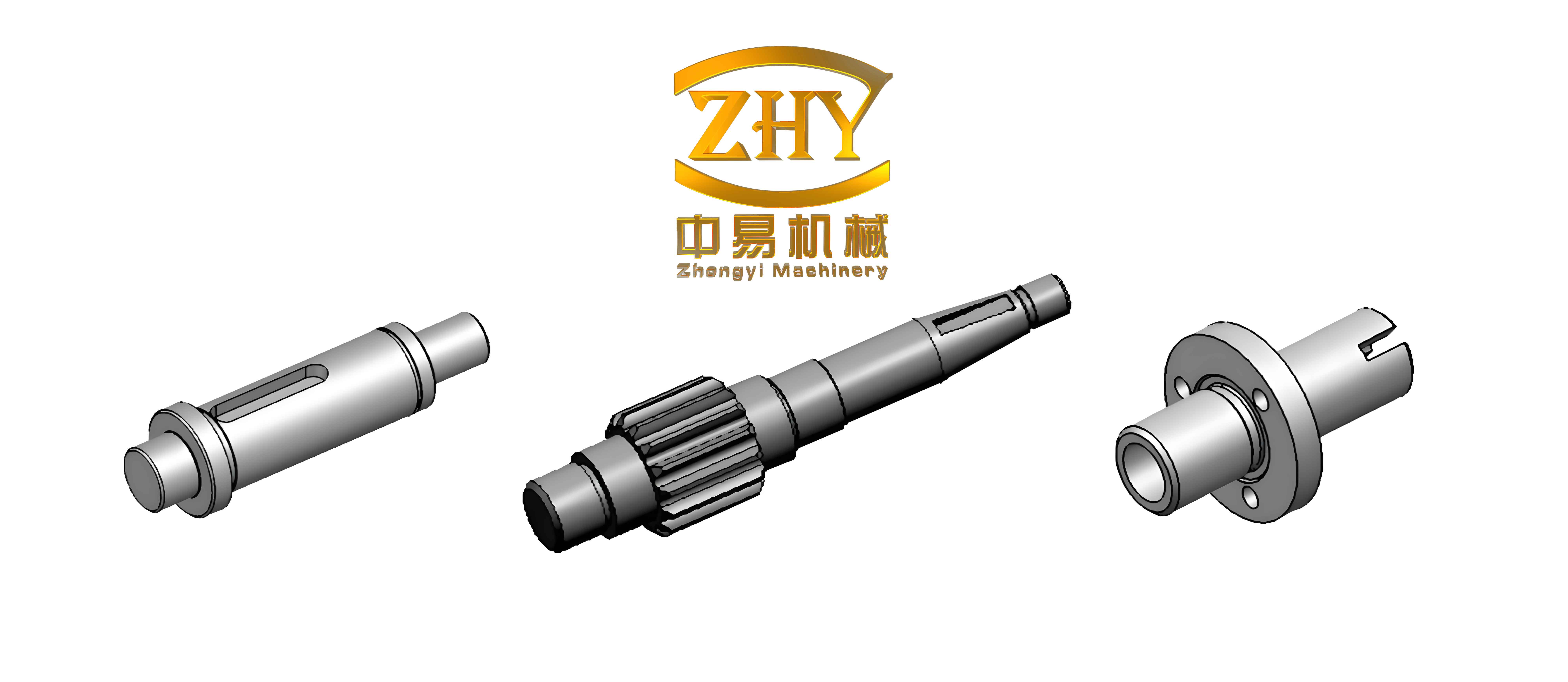
The conventional gear shaft in the SQ34X cutting machine is an integral component where the gears and shaft are forged as a single unit. This design, while robust, poses significant challenges during maintenance. When wear or failure occurs, the entire gear shaft must be replaced, necessitating the removal of numerous adjacent parts such as the upper knife gate lifting cylinder, transmission side chains, sprockets, supports, spacers, bearings, and end caps. This process typically requires five technicians working for approximately 32 hours, leading to prolonged downtime and increased labor costs. The high loads exerted during material compaction and conveyance exacerbate wear on the gear teeth, particularly the drive gear integrated into the gear shaft. This issue underscores the need for a more efficient design that facilitates quicker replacement without compromising strength or reliability.
To address these challenges, we developed a split gear shaft configuration. The design separates the gear shaft into left and right sections, connected axially via a long hex socket screw and spring washer inserted through a central bore. This approach allows for the replacement of only the worn section without disassembling the entire assembly. For radial connection, we evaluated two primary schemes: splined coupling and double keyway coupling. After thorough analysis, the splined coupling was selected due to its superior load-bearing capacity, ability to handle high torque, and self-centering properties, which ensure even load distribution and extended service life. The split gear shaft design not only simplifies maintenance but also enhances the overall durability of the transmission system.
The selection of the splined coupling was based on a comparative assessment of its advantages over keyed connections. Splined couplings are ideal for applications involving high torque transmission and frequent load variations, as they provide multiple contact points that distribute stress more evenly. In contrast, keyed connections, while simpler, are less suited for the high radial forces and impact loads encountered in the SQ34X cutting machine during stem processing. The splined design incorporates an involute profile on both the external and internal components, ensuring precise alignment and efficient power transmission. The parameters for the involute gear and spline were carefully calculated to meet the operational demands, as summarized in the following tables.
| Parameter | Symbol | Value |
|---|---|---|
| Module | M | 8 |
| Number of Teeth | Z | 14 |
| Pressure Angle (°) | α | 20 |
| Addendum Coefficient | ha* | 1 |
| Radial Modification Coefficient | X | -0.04 |
| Accuracy Grade | — | 8f |
| Radial Runout | Fr | 0.042 |
| Base Tangent Length and Deviation | WEbnsKbni | 36.719-0.008-0.016 |
| Span Teeth Number | K | 2 |
| Working Tooth Height Coefficient | hw | 1.92 |
| Full Tooth Height Coefficient | h | 2.8 |
The material chosen for the split gear shaft is 4Cr13 martensitic stainless steel, known for its excellent machinability, high toughness, and superior corrosion resistance. After heat treatment, the material achieves a Brinell hardness of HB 240–260, with the gear teeth surface hardened to HRC 50–55 through high-frequency quenching. This ensures the gear shaft can withstand the high stresses encountered during operation. The involute spline parameters for the internal and external components are detailed below, ensuring compatibility and optimal performance.
| Parameter | Symbol | Internal Spline Value | External Spline Value |
|---|---|---|---|
| Module | M | 2 | 2 |
| Number of Teeth | Z | 28 | 28 |
| Pressure Angle (°) | α | 30 | 30 |
| Fit Tolerance Grade | — | 7H | 7f |
| Pitch Diameter (mm) | D | 56 | 56 |
| Min. Internal Spline Involute End Diameter (mm) | Df min | 58.4 | 53.76095 |
| Basic Space Width | S | 3.1415926 | 3.1415926 |
| Max. Effective Space Width | Ev max | 3.2555926 | 3.1415926 |
| Min. Effective Space Width | Ev min | 3.1415926 | 3.0725926 |
| Min. Actual Space Width | Emin | 3.2045926 | 2.9645926 |
| Radial Runout Tolerance | Fr | 23 | 14 |
| Surface Roughness | Ra or Rz | 0.8 | 0.8 |
The承载能力 of the split gear shaft was rigorously evaluated through calculations for tooth surface contact strength, tooth root bending strength, tooth root shear strength, and wear resistance. The input torque (T) is calculated based on the motor power (p = 3 kW) and speed (n = 60 rpm):
$$
T = 9549 \times \frac{p}{n} = 9549 \times \frac{3}{60} = 477.45 \, \text{N·m}
$$
The nominal tangential force (F_t) acting on the gear shaft is derived from the torque and pitch diameter (D = 56 mm for the spline):
$$
F_t = \frac{2000 \times T}{D} = \frac{2000 \times 477.45}{56} = 17051.785 \, \text{N}
$$
For the splined connection, the unit load (W) is determined by the number of teeth (Z = 28), engagement length (l = 50 mm), and pressure angle (α = 30°):
$$
W = \frac{F_t}{Z \times l \times \cos \alpha} = \frac{17051.785}{28 \times 50 \times \cos 30^\circ} = \frac{17051.785}{28 \times 50 \times 0.866} \approx 14.07 \, \text{N/mm}
$$
The tooth surface contact stress (σ_H) is calculated using the unit load and working tooth height (h_w = 1.92 mm):
$$
\sigma_H = \frac{W}{h_w} = \frac{14.07}{1.92} \approx 7.33 \, \text{MPa}
$$
The allowable contact stress [σ_H] is derived from the material’s yield strength (σ_0.2 = 1050 MPa) and safety factors (S_H = 1.40, K_1 = 1.75, K_2 = 1.3, K_3 = 1.1, K_4 = 1.5):
$$
[\sigma_H] = \frac{\sigma_{0.2}}{S_H \times K_1 \times K_2 \times K_3 \times K_4} = \frac{1050}{1.40 \times 1.75 \times 1.3 \times 1.1 \times 1.5} \approx 199.8 \, \text{MPa}
$$
Since σ_H ≤ [σ_H], the design is safe for contact strength. Similarly, the tooth root bending stress (σ_F) is evaluated based on the full tooth height (h = 2.8 mm) and chordal tooth thickness (S_Fn ≈ π):
$$
\sigma_F = \frac{6 \times h \times W \times \cos \alpha}{S_{Fn}^2} = \frac{6 \times 2.8 \times 14.07 \times \cos 30^\circ}{\pi^2} \approx \frac{6 \times 2.8 \times 14.07 \times 0.866}{9.8696} \approx 20.74 \, \text{MPa}
$$
The allowable bending stress [σ_F] uses the material’s tensile strength (σ_b = 1035 MPa) and factors (S_F = 1.0, K_1 = 1.75, K_2 = 1.3, K_3 = 1.1, K_4 = 1.5):
$$
[\sigma_F] = \frac{\sigma_b}{S_F \times K_1 \times K_2 \times K_3 \times K_4} = \frac{1035}{1.0 \times 1.75 \times 1.3 \times 1.1 \times 1.5} \approx 275.72 \, \text{MPa}
$$
With σ_F ≤ [σ_F], the bending strength is adequate. The tooth root shear stress (τ_Fmax) considers the stress concentration factor (a_tn = 0.675) and is computed as:
$$
\tau_{tn} = \frac{1600 \times T}{\pi \times d_h^3} = \frac{1600 \times 477.45}{\pi \times 53.159^3} \approx 1.62 \, \text{MPa}
$$
$$
\tau_{Fmax} = \tau_{tn} \times a_{tn} = 1.62 \times 0.675 \approx 1.09 \, \text{MPa}
$$
The allowable shear stress [τ_F] is half of [σ_F]:
$$
[\tau_F] = \frac{[\sigma_F]}{2} = \frac{275.72}{2} \approx 137.86 \, \text{MPa}
$$
As τ_Fmax ≤ [τ_F], shear strength is sufficient. For wear resistance, the surface pressure under 10^8 cycles (σ_H1) and long-term operation (σ_H2) were checked against allowable values, confirming durability. The results of these calculations are summarized in the table below, validating the split gear shaft design.
| Item | Calculated Value (MPa) | Allowable Value (MPa) | Verification Result |
|---|---|---|---|
| Tooth Surface Contact Stress | σ_H = 7.33 | [σ_H] = 199.8 | Safe |
| Tooth Root Bending Stress | σ_F = 20.74 | [σ_F] = 275.72 | Safe |
| Tooth Root Shear Stress | τ_F = 1.09 | [τ_F] = 137.86 | Safe |
| Wear Resistance (10^8 cycles) | σ_H1 = 7.33 | [σ_H1] = 185.0 | Safe |
| Long-Term Wear Resistance | σ_H2 = 7.33 | [σ_H2] = 55.5 | Safe |
To validate the practical benefits of the split gear shaft, we conducted comparative tests simulating wear scenarios. Two groups of skilled technicians performed replacements on SQ34X cutting machines: one using the traditional one-piece gear shaft and the other using the new split design. The time and personnel required were recorded, as shown in the following tables. The results demonstrate a dramatic reduction in maintenance time from approximately 32 hours to about 3.5 hours, representing an 89% improvement in efficiency. Additionally, the number of technicians needed decreased from five to two, reducing labor costs and physical strain.
| Time (hours) | Group A (One-Piece) | Group A (Split) | Group B (One-Piece) | Group B (Split) |
|---|---|---|---|---|
| First Attempt | 31.8 | 3.25 | 32.2 | 3.5 |
| Second Attempt | 32.1 | 3.75 | 32.0 | 3.6 |
| Average | 31.95 | 3.5 | 32.1 | 3.55 |
| Number of Personnel | Group A (One-Piece) | Group A (Split) | Group B (One-Piece) | Group B (Split) |
|---|---|---|---|---|
| First Attempt | 5 | 2 | 5 | 2 |
| Second Attempt | 5 | 2 | 5 | 2 |
| Average | 5 | 2 | 5 | 2 |
The implementation of the split gear shaft eliminates the need to disassemble components like the knife gate lifting cylinder, bearings, and end caps during replacement. By simply loosening the central hex screw, the worn section can be swapped out quickly. This innovation not only enhances maintenance efficiency but also ensures the gear shaft’s reliability under high-load conditions. The use of splined connections provides excellent torque transmission and alignment, critical for the continuous operation of SQ34X cutting machines in tobacco production lines.
In conclusion, the split gear shaft design represents a significant advancement in the maintenance of SQ34X cutting machines. Through detailed engineering analysis and practical testing, we have demonstrated that this approach reduces downtime, labor, and costs while maintaining structural integrity. The repeated focus on the gear shaft throughout this study underscores its importance in industrial applications. Future work could explore material enhancements or automated monitoring systems to further optimize the performance and lifespan of the gear shaft in demanding environments.